Marc Vipsanius Agrippa [1] ( Latin Marcus Vipsanius Agrippa ; 63 BC - 12 BC ) - Roman statesman and commander, friend, associate and son-in-law of Emperor Octavian Augustus .
| Mark Vipsanius Agrippa | |
|---|---|
| MARCUS VIPSANIUS AGRIPPA | |
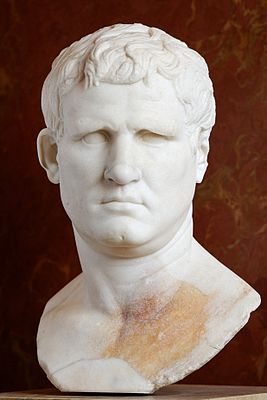 | |
| Date of Birth | 63 BC e. |
| Place of Birth | |
| Date of death | 12 BC e. |
| A place of death | Campaign |
| A country | |
| Occupation | Roman statesman and commander |
| Father | Lucius Vipsaniy |
| Spouse | 1. Cecilia Attica ( 37 B.C. - 28 B.C. ) 2. Claudia Marcellus ( 37 B.C. - 21 B.C. ) 3. Julia Elder ( 21 BC - 12 BC ) |
| Children | 1. Vipsania Agrippina (from first marriage) 2. Vipsania Marcellus (from the second marriage) 3. Guy Julius Caesar Vipsanian 4. Vipsania Julia Agrippina 5. Lucius Julius Caesar Vipsanian 6. Vipsania Agrippina (Agrippina the Elder) 7. Mark Vipsaniy Agrippa Postum (from the third marriage) |
Agrippa played a significant role in the military successes of Octavian Augustus, who did not have military capabilities: in 36 BC. e. he defeated Sextus Pompey at the naval battle, in 31 BC. e. victory over Anthony and Cleopatra in the battle of Promontory approved the autocracy of Octavian. Patron of the arts, built the Pantheon .
Content
- 1 Biography
- 1.1 Times of the Second Triumvirate
- 1.2 Fighting Mark Anthony
- 1.3 Agrippa and Augustus
- 2 Children of Agrippa
- 3 Architectural and scientific heritage
- 4 References
Biography
Agrippa was born into a wealthy provincial family and belonged to the horseman class. He spent his childhood in Dalmatia , back in the days of the Illyrian kingdom, famous for its pirates , whence it brought its ability to naval commander. He was brought up in Rome . Agrippa was the same age as Octavian Augustus, and since childhood they were close friends. When the struggle broke out between the factions in the Roman Senate , Caesar sent Octavian, Agrippa and the son of one of his friends - Guy Maecenas - to study in Apollonia , in the location of the Macedonian legions , preparing to march on the Parthians .
Octavian, Agrippa, and Patron became close friends far from Rome. Agrippa quickly gained popularity in the Macedonian legions, his outstanding commander abilities were noticed by commanders. There he studied architecture - science, which he later found useful. In Apollonia, Agrippa learned of the assassination of Caesar in 44 BC. e. On the advice of Agrippa and the Maecenas, Octavian immediately went to Rome.
Times of the Second Triumvirate
Returning to Rome, Octavian and his friends realized the need to support the legions. Agrippa returned to Greece, where he took command of the Macedonian legions (and, most importantly, the IV legion ), and sent them to Rome, who did not want to appoint Octavian as consul . Enlisting the support of the legions and occupying Rome, Octavian concluded an agreement with Mark Antony and Lepidus in order to take revenge on Caesar's killers and share power. So the Second Triumvirate was founded. During two battles at Philippi (42 BC), when the troops of Octavian and Anthony managed to defeat Brutus and Cassius , Agrippa was the main legate in the army of Octavian.
In 41 BC e. Mark Anthony's wife Fulvia and his brother Lucius rebelled and temporarily seized power in Rome. Agrippa managed to suppress the rebellion, besieged the fortress of Perusia ( Perugia ), where Fulvia and Lucius took refuge, and forced them to surrender a year later. Octavian released the captives to his wife and brother Anthony and managed to agree with him on the division of the provinces. In 38 BC e. Agrippa crushed the uprisings in Aquitaine and Gaul , and also crossed the Rhine in order to punish German tribes for raids. Returning to Rome, he refused the promised triumph , but agreed to his first consulate in 37 BC. e.
At the same time, a war was brewing with Sextus Pompey , who, after the assassination of Caesar, was appointed commander of the Roman fleet, and after the fall of the republic in 42 BC. e. led the fleet to Sicily , where he founded a pirate state, annexing Corsica, Sardinia and the Peloponnese . Soon, the fleet of Pompey began to threaten Rome, blocking the route of food supplies to Italy. The Triumvirates failed to agree with Pompey, Octavian twice tried to independently liberate Sicily from Pompey, but failed: his fleet was defeated in 37 BC. e. during the battle of Messan, and again a year later. Then Octavian instructed Agrippa to create a fleet and destroy the pirates.
First of all, Agrippa made sure to create a safe harbor for the ships of the new fleet. For this, he ordered to connect Lake Lukrinsky with the sea, and also to build a canal between Lukrinsky and Avernian lakes. So the inner and outer harbor was created and the active construction of the fleet began. At the same time, Agrippa married Cecilia Attica - the daughter of Titus Pomponius Attica , who was a friend of Cicero .
Agrippa managed to build a large fleet, consisting of a quinquire - ships with five rows of oars, well protected by high sides and armed with throwing machines. It was this type of ship that could effectively withstand the light ships that made up Pompey's fleet. Having prepared the ship's crews, Agrippa decided to go to sea and defeated the pirates of Sextus Pompey at Mila and Navloch ( Rometta Marea ) in 36 BC. e. A total of 180 Pompey ships fought against 420 Roman ones, of which only 17 were able to escape. Pompey himself managed to escape at the base of his fleet - Messane. Thanks to this victory, Octavian in alliance with Lepidus was able to land in Sicily and defeat the army of Pompey. Pompey himself fled to Asia Minor, where he was killed by one of Anthony's legates. For victory over the fleet of Pompey, Agrippa was awarded the sea crown ( lat. Corona navalis ), in which he is usually depicted on coins.
Fighting Mark Anthony
In 33 BC e. Agrippa was elected aedile , and was engaged in active construction activities in Rome. However, the outbreak of war with Anthony forced Agrippa to return to military activities. Anthony and Cleopatra gathered an army of 100 thousand infantry soldiers, 12 thousand cavalry and 370 ships and went with her to Italy, but were forced to stay for a long time in Greece . Agrippa assembled the fleet, captured the island of Lefkada , as well as the cities of Patras and Corinth , thereby depriving the army of Anthony and Cleopatra of supply and blocking it. After the land army of Octavian arrived in Greece, Anthony's position worsened even more, and he was first forced to retreat with the army to Cape of Shares in Epirus , and then, on the advice of Cleopatra, he began to prepare a retreat to Hellenistic Egypt , where large forces were waiting for him the form of eleven legions.
September 2, 31 BC e. Anthony and Cleopatra equipped 170 vessels, placed 22 thousand of the best soldiers on them and decided to break through the blockade organized by Agrippa. Anthony's fleet consisted of heavy and clumsy triremes , while Agrippa decided to organize his fleet in a completely different way than during the struggle with Sextus Pompey: it consisted mainly of light and high-speed ships - liburns , which were usually used by pirates. Agrippa equipped the ships with additional belt armor against rams , as well as throwing weapons and a harpoon - his own invention - a special sickle - bearing beam that could destroy the rig of the ship or, even when hooked overboard, even turn it over.
The hulking ships of Anthony could not resist Agrippa's fleet of ships. Most of Anthony's fleet was sunk or surrendered, and Anthony and Cleopatra in light ships managed to break through to Egypt. Upon learning of their flight, the commanders of Anthony decided to lay down their arms. Octavian's troops captured Greece, then Syria and Egypt. In besieged Alexandria, Anthony committed suicide, and the road to autocracy opened before Octavian.
Agrippa and Augustus
In 29 BC e. Octavian returned to Italy after defeating the Parthians , in Rome he was given a three-day triumph. Agrippa received a blue vexillum for his victory at Cape Stock - a sign of exceptional distinction. In 28 BC e. Agrippa for the second time becomes consul and, together with Octavian, conducts a census . In 27 BC e. Agrippa receives a third consular term. In the same year, the Senate appropriated Octavian the title of Augustus , which Octavian accepted, contrary to Agrippa’s advice. The commander recommended to his friend not to destroy the republican order and said that “ Equality sounds good in words and is extremely fair in practice ” ( Dion Cassius . 52, 3). However, Agrippa, along with Guy Patron, played an important role in establishing the principate system that lasted in the Roman Empire until the Third Century Crisis and the birth of the dominate system.
Having become the sovereign emperor, Octavian Augustus married Agrippa to his niece Claudia Marcellus (the fate of his first wife is unknown) and makes him his heir. Once, during an attack of illness, Augustus even handed Agrippa his ring with a seal . Agrippa spends several years after the end of his consular term in Gaul , where he is reforming the provincial system of administration and taxation , as well as building roads and aqueducts (e.g. Pont du Gard ).
However, due to the intrigues of the third wife of Octavian Augustus - Libya , who was afraid of Agrippa's influence on the emperor, a dispute began between friends. Augustus named the successor of his nephew Marcellus, and Agrippa exiled to an honorable exile - the governor in Syria. Agrippa left Rome for the island of Lesbos , from where he ruled the province through the legate .
At 21 BC e. Marcellus dies, and Augustus, feeling that he cannot cope alone with state affairs, calls Agrippa first to Sicily and then to Rome. It is believed that it was precisely on the advice of the Patron that Octavian Augustus decided to adopt Agrippa, and also made him divorce Claudius and marry Augustus' daughter, Marcellus's widow, Julia , known for her beauty, abilities, and profligacy. In 19 BC e. Agrippa suppresses the rebellion of the tribes in Spain ( Cantabrian war ) and restores order in Gaul. In 18 BC e. Augustus appoints him a tribune , as well as his colleague and co-ruler, next year they will organize the feast of the revival of Rome together.
In 17 BC. e. Agrippa was appointed Governor of Syria for the second time. For two years, his thrifty and judicious rule gained popularity among the provincials, especially among the Jewish population. Agrippa also managed to regain Roman control over Tauric Chersonesos (modern Crimea )
In the year 14 BC e. Agrippa returned to Rome, received an extension of the power of the tribune for another five years, and also received from Augustus the supreme authority in all provinces of the state. In 13, Agrippa went to conquer lands in the Danube region (the future province of Pannonia ), but he fell seriously ill there, returned to Italy, and died in Campania in early March 12 at the age of 51. Octavian Augustus appointed a magnificent funeral in his honor, and he himself mourned for a month. The ashes of Agrippa were buried in the pavilion of Augustus.
Children of Agrippa
- From the first wife, Cecilia Attica : daughter of Agrippina (Wipsania) - the first wife of the emperor Tiberius .
- From the second wife, Claudia Marcella : the daughter of Vipsanius Marcellus Agrippina - the wife of Publius Vara .
- From the third wife, Julia the Elder : sons Gaius Caesar , Lucius Caesar and Agrippa Postum , as well as daughters: Agrippina the Elder (wife of Germanicus ) and Vipsania Julia .
After the death of Agrippa, Augustus Octavian took care of his children and himself monitored their upbringing. Augustus adopted his two oldest sons: Lucius and Gaius. It is believed that he did not adopt Agrippa Postum (born after the death of his father), because he wanted the younger son of his late friend to continue the family tree of Agrippa.
Architectural and Scientific Heritage
Agrippa is responsible not only for the military victories of Augustus Octavian, but also for the fact that in his reign Rome was decorated with many architectural structures. In 33 B.C. e., occupying the position of Edil, Agrippa was engaged in the restoration and construction of aqueducts , the expansion and cleaning of urban sewers ( Big Cloak ), the construction of baths and porticoes , as well as the arrangement of gardens. Agrippa also patronized public art exhibitions.
In memory of the battle at Cape of Shares, Agrippa built the building of the Roman Pantheon , which burned down in 80 AD. e. Initially, the Pantheon had the usual quadrangular shape for Roman temples and was oriented in a different direction than today. On the site of the burnt temple, the new Pantheon, still existing, was erected by the emperor Hadrian . By tradition, the donation inscription of Agrippa was restored on the facade of the new building, although the Pantheon of Agrippa was not like a new building. Largely due to the construction activities of Mark Agrippa, Octavian Augustus could boast: “I accepted Rome as brick, but I leave it as marble . ”
Agrippa is also known as a geographer . He embodied Caesar's dream of holding a general census in the possessions of Rome. According to Greek sources and based on the work of Roman land surveyors, he compiled a general map of the Roman state, which was carved in marble on the orders of Augustus. A copy of this map was displayed on a portico named after Agrippa in Rome, built by his sister Polla. This map, with its accompanying descriptions, formed the basis of the "History of Nature" by Pliny the Elder and, possibly, the work of Strabo . There are also references to the autobiography of Agrippa, now lost.
Links
- ↑ Ageenko F.L. Agrippa // Dictionary of proper names of the Russian language. Stress Pronunciation. Inflection . - M .: World and Education; Onyx, 2010 .-- S. 59 .-- 880 p. - ISBN 5-94666-588-X , 978-5-94666-588-9.