Aleksandr Ivanovich Kazarsky ( June 16, 1797 , Dubrovno [1] , Orsha Uyezd , Belorussian province - June 16 (28), 1833 [2] , Nikolaev ) - Russian military sailor, hero of the Russian-Turkish war of 1828 - 1829 , captain of the 1st rank (1831) [3] , knight of the Order of St. George . The rank of the adjutant wing was in the retinue of Emperor Nicholas I. He became widely known after the 18-gun brig " Mercury " under his command won the battle with two Turkish battleships .
| Alexander Ivanovich Kazarsky | |||
|---|---|---|---|
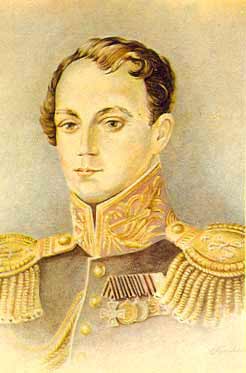 Alexander Ivanovich Kazarsky | |||
| Date of Birth | June 16, 1797 | ||
| Place of Birth | Dubrovno | ||
| Date of death | June 16 (28), 1833 (36 years old) | ||
| Place of death | Nikolaev (Nikolaev region) | ||
| Affiliation |  Russian empire Russian empire | ||
| Type of army |  fleet fleet | ||
| Years of service | 1811-1833 | ||
| Rank | 1st rank captain adjutant wing | ||
| Commanded | Bombardier ship " Rival " brig " Mercury " frigate " Hasty " frigate Tenedos | ||
| Battles / wars | The Russo-Turkish War of 1828-1829 | ||
| Awards and prizes |
| ||


Origin
Kazarsky was born into the family of a retired provincial secretary who manages the estate of Prince Lyubomirsky . Alexander was the fourth child in the family of Ivan Kuzmich and Tatyana Gavrilovna Kazarsky. He had a younger brother Nikolai and three older sisters: Praskovya, Ekaterina, Matryona [4] .
Early years
As a child, Alexander studied at a parish school, where a priest of the Dubrovno Orthodox parish taught him letters, and the young priests taught mathematics, Latin and French. Reading books was not encouraged in the Kazarsky house, but his father instilled confidence in Alexander in the firmness of the foundations of the empire [5] , and gave a clear concept of honor and fidelity to the Fatherland.
In 1808, the godfather of Alexander came to the Kazarsky - Vasily Semenovich, cousin of Ivan Kuzmich. Shortly before that, he received a position in the chief commander of the Black Sea Fleet and proposed to appoint Alexander to the Black Sea Navigation School in Nikolaev. The father agreed and, according to the testimony of Captain-Lieutenant Ivan Nikolaevich Suschev, the first biographer of Kazarsky, said goodbye: “Honest name, Sasha, is the only thing that I will leave as your inheritance” [6] .
Career
Alexander Kazarsky volunteered for the fleet in 1811 , becoming a cadet of the Nikolaev Navigation School. Classes at the school were accompanied by stories about the military glory of the Russian fleet. Among the teachers of Kazarsky was L.A. Latyshev , who sailed with Ushakov and took part in the capture of Corfu . Since studying at the school, Admiral Senyavin became the idol of Kazarsky for life [5] . Being modest and shy, Alexander was hard on people and had no real friends. Nevertheless, he agreed with some fellow students in the cadet corps, from which one can distinguish Nikolai Chizhov, the son of a military adviser and nephew of the honored professor of St. Petersburg University Dmitry Semyonovich Chizhov . Kazarsky and Chizhov became friends. Nicholas was well-read and instilled in Alexander a love of literature [5] .
On August 30, 1813, Kazarsky was recorded as a midshipman in the Black Sea Fleet, and in 1814 he was promoted to warrant officer [7] . At the beginning of his naval career, he went on the Desna and Cleopatra brigantines [5] , transporting goods between the Black Sea ports [8] , and later, according to his own report, was sent to the Danube Flotilla , where he was appointed commander of a detachment of small rowing ships in Izmail [ 4] . Before leaving for Izmail, Alexander visited Dubrovno and found his home in desolation: his father died, the sisters Praskovya and Ekaterina got married, mother Tatyana Gavrilovna left for their homeland in Little Russia , and Matryona died, rushing to the Dnieper , when she escaped from French soldiers chasing her, who occupied the city in 1812 [5] .
In 1819, Kazarsky was promoted to lieutenant and appointed to the frigate Eustathius , who went to Sevastopol . In the Black Sea Fleet, Kazarsky served under the leadership of Ivan Semenovich Skalovsky , whom he considered his idol from his youth [4] . Under the leadership of Skalovsky, Kazarsky passed a good commanding school, learned the basic principles that an officer should follow: act independently and decisively, be able to establish mutual understanding with the crew, unravel plans and get ahead of the enemy [5] .
After serving at Eustache, Kazarsky went on a practical voyage [9] on the schooner Sevastopol, served on the Ingul and Opponent transport [10] , on the Sokol boat [11] , the Mercury brig, whose commander became a few years later, and on a battleship [5] .
The capture of Anapa and Varna
In 1828, Kazarsky commanded the transport ship " Rival " [12] . The ship participated in the landing of troops of the third brigade and the delivery of weapons. A.S. Greig ordered that the transport be equipped with a “ unicorn ”, which transferred the transport vessel to the rank of bombardier ships . While the main fleet could not approach the fortress in shallow water, the "Contender" under the command of Kazarsky for three weeks, maneuvering, fired at its fortifications [5] . During the siege of Anapa, the "Contender" received six holes in the hull and two damage to the mast [12] , but until the last day of the siege continued to attack the fortress. For participation in the capture of Anapa, Alexander Kazarsky was promoted to lieutenant commander [5] [13] .
In September of the same year, Varna was taken according to a similar scenario, and Kazarsky was awarded a golden saber for the courage shown at the same time [4] .
At Mercury
In 1829, Greig appointed Kazarsky as the commander of the 18-gun brig Mercury . Alexander Ivanovich served on the "Mercury" several years earlier, so the ship was well known to him [5] .
Under the command of Captain Lieutenant Kazarsky, Mercury completed one of the most outstanding feats in the history of naval battles. On May 14, 1829, the 18-gun brig was overtaken by two Turkish ships “Selimiye” and “Real-Bey,” having a total of ten times superiority in the number of guns. Having accepted an unequal battle, the brig crew under the command of Kazarsky won a brilliant victory, inflicting damage to the enemy, forcing him to leave the battle [14] . A Turkish officer from Real Bay wrote later [15] :
In the course of the battle, the commander of the Russian frigate [16] told me that the captain of this brig would never surrender, and if he lost all hope, then he would blow his brig into the air. If in the great deeds of ancient and modern times there are feats of courage, then this action should be darkened all of them, and the name of this hero should be inscribed with gold letters at the Temple of Glory: he is called the captain-lieutenant Kazarsky, and the brig - "Mercury".
For his feat, Kazarsky was promoted to captain of the second rank , awarded the Order of St. George IV class [17] and appointed an adjutant wing [18] . Also in the coat of arms of Kazarsky, as a symbol of willingness to sacrifice themselves [19] , an image of the Tula pistol was introduced, which Alexander Ivanovich put before a battle on a spire at the entrance to the kruyt-camera so that the last surviving officer would blow up gunpowder with a shot [20] .
The shield is divided into three parts, of which the first in the blue field shows a golden pistol and under it there is a silver moon, with its horns facing down. In the second, in a golden field between the laurel and oil-bearing branches of a black-colored rafter. In the lower voluminous part In a silver field is a military ship with loose sails. In the middle, in a small shield, the coat of arms used in the Kozarskago clan is depicted, that is: in a red field it wriggles already, crowned with a noble crown, and holding an apple in its mouth. The shield is crowned with a noble helmet and a crown with five stony feathers on it. The bastard on the shield is blue and gold, lined with silver and red.
- The coat of arms of Kazarsky is included in Part 10 of the General Tombstone of the noble families of the All-Russian Empire , p. 122 [21]
Further Service
In 1829 , from May 26 to July 17, Kazarsky commanded the 44-gun frigate " Hasty " [22] and took part in the capture of Messemvria [5] . From July 17, 1829 to 1830 he was captain of the 60-gun frigate " Tenedos " [23] . This frigate belonged to the largest frigates of the Russian fleet, which were sometimes called 60-gun battleships . Until October 1829, the Tenedos under the command of Kazarsky went out three times to the Bosphorus .
In 1830, Kazarsky was sent to England with Prince Trubetskoy to congratulate King William IV [24] . In 1831, for excellent service, Alexander Ivanovich was promoted to captain of the 1st rank [13] , after which he was dismissed from command of the ship and entered the retinue of Nicholas I [4] . Consisting of a retinue, he was sent to Kazan to determine the feasibility of the continued existence of the Kazan Admiralty . After the trip, he went along rivers and lakes from the White Sea to Onega in search of a new waterway [24] .
Death
In 1833, Kazarsky was sent to conduct an audit and inspection of rear offices and warehouses in the Black Sea ports, but shortly after arriving in Nikolaev he suddenly died of poisoning. Arsenic coffee was allegedly used for the poisoning .
Kazarsky’s uncle Motskepich (according to other sources, Alexey Ilyich Matskevich [25] ) left him a legacy of 70 thousand rubles, the casket of which was looted with the participation of Grigory Avtomonov , Nikolaev police chief . According to the testimony of Count A. H. Benckendorf [26] , Kazarsky was going to certainly find the culprit. Benckendorff claimed that Avtomonov had a relationship with the wife of captain-commander Mikhailova, whose friend, Roza Ivanovna, had a close acquaintance with a certain pharmacist [27] .
Kazarsky, having dined with Mikhailova, drank a cup of coffee and felt unwell [27] . A close acquaintance of Kazarsky, Elizaveta Farennikova, claimed that in recent days, Kazarsky, going to someone, did not eat or drink anything, as he was warned of a possible attempt. Even a certain German woman with whom he was staying in Nikolaev, he asked to try each dish before proceeding to the meal himself. However, Kazarsky could not refuse the beautiful daughter of the owner of the house, who brought him a cup of poisoned coffee. During the conversation, Alexander Ivanovich drank the entire cup [28] . According to the headquarters doctor Petrushevsky, whom Kazarsky addressed, he constantly spat, which caused black spots to form on the floor that could not be washed off [27] . Farennikova claims that the doctor was conspiring against Kazarsky, because instead of giving him an antidote, he put him in a hot bath despite the fact that Kazarsky himself told him that he had been poisoned [28] . After death, Kazarsky’s body turned black, his head and chest swelled, his face fell off, his hair fell out, his eyeballs burst, and his legs fell off his feet in a coffin [27] . These changes occurred in less than two days, and some authors claim that their cause was not poisoning, but the summer heat, and the cause of death was ordinary flu [29] . In his note, Benckendorf says that Greig’s investigation into the death of Kazarsky didn’t reveal anything and that another investigation is unlikely to be successful, since Avtomonov, whom the count suspected was conspiracy against Kazarsky, is a close relative of Adjutant General Lazarev [27] .
According to fleet historian Vladimir Shigin, the version presented in Benkendorf’s note on inheritance poisoning was fabricated. The actual cause of the poisoning was the activity of Kazarsky as an inspector of the Black Sea Fleet and the Black Sea ports and the disclosure by him of the facts of abuse and corruption of the highest naval commanders under the leadership of Admiral A.S. Greig . [thirty]
The external changes of Kazarsky after death were also confirmed by Elizaveta Farennikova, who was a witness to this: “the head and face were swollen to impossibility, blackened like coal; hands were swollen, axelbants, epaulettes turned black, everything turned black ... when they began to put in the coffin, then the hair fell on the pillow ” [18] [29] . The death of Kazarsky Farennikov is associated with his auditing activities and the unrest and abuses that prevailed in the Navy at that time [28] .
During the funeral, a lot of people walked behind the coffin, among whom were widows and orphans, whom Kazarsky helped a lot. Sobbing, they shouted: “They killed, they destroyed our benefactor! Poisoned our father! ” [28] .
Six months later, a commission of inquiry arrived from St. Petersburg to exhume the corpse and remove the internal organs to be sent to the capital, but, as Farennikova recalls, this was the end of the matter [31] .
Kazarsky was personally acquainted with A. S. Pushkin , P. A. Vyazemsky and K. I. Dahl . Pushkin’s “prophetic” drawing is known, in which he depicted portraits of Kazarsky, Silvo, Fournier, Dahl and Zaitsevsky (the figure is capitalized with the capital letters of the names of the people depicted: Q, S, F, D, Z) and an ax touching Dahl and Kazarsky, which after were poisoned in Nikolaev [32] .
Perpetuation of memory
Monument to Kazarsky in Sevastopol
The commander of the Black Sea Squadron, Admiral M.P. Lazarev, was the first to immortalize the brig’s feat. On his own initiative, fundraising for the construction of the monument was carried out [33] , a total of 12 thousand rubles were collected [5] . The monument was laid for the fifth anniversary of the feat of the Mercury brig - in 1834 and opened in 1839 on the Michmansky Boulevard of Sevastopol. It was designed by academician of architecture A.P. Bryulov . Construction work was performed by the master O. G. Nyuman. The construction was carried out with funds raised by sailors of the Black Sea and Baltic Fleets.
The monument was built in the style of classicism . An antique trireme is set on a truncated pyramid of Crimean limestone. On the podium in small niches are high-relief images of A. I. Kazarsky and the ancient gods - Nicky (goddess of victory), Neptune and Mercury . On the pedestal are two mascarons and military attributes symbolizing glory and valor. In one of the documents of the Central State Archive in Moscow it is indicated that the inscription "Kazarsky. For posterity, as an example, ” Nicholas I ordered to write [34] .
The monument to Alexander Kazarsky was the first monument erected in Sevastopol [35] .
In the homeland of A. S. Kazarsky in the central part of the city of Dubrovno, a stone with a memorial plaque with an inscription in the Belarusian language was installed: “ Gonar’s fellow Slavutag, hero of Ruska-Turetskay Vayna 1828-1829 gadoў, captain of the first rank of kamanzіra bryga“ Merkury ”Kazarskaga Alyavsandcha " [36] .
Objects Named After Kazarsky
The name of Kazarsky was given to the brig of the Baltic Fleet [37] , a series of six mine cruisers of the Black Sea Fleet, as well as the first of the ships of this type [38] . In Soviet times, the name "Kazarsky" was carried by a sea minesweeper [5] .
On June 8, 1954, a street was named after Kazarsky in the Nakhimovsky district of Sevastopol, previously bearing the name of the Fourth Parallel [39] and a street in the hometown of Dubrovno, and in Leninsky district of Nikolaev (Vodopoy microdistrict) a lane was named after Kazarsky [40]
Notes
- ↑ Kulakov F.S., Kholodova I.P. Dubrovno: Historical and Economic Essay.// Cities of Belarus - Mn. : Belarus, 1983. - S.7. - 95 p., Ill. - 25,000 copies.
- ↑ Alexander Ivanovich Kazarsky, the most important dates of life and activity // General Marine List. - SPb. : Type of. Marine Min., In Ch. Admiralty. Archived on March 5, 2012.
- ↑ Kazarsky Alexander Ivanovich // Big Soviet Encyclopedia : [in 30 vol.] / Ch. ed. A.M. Prokhorov . - 3rd ed. - M .: Soviet Encyclopedia, 1969-1978.
- ↑ 1 2 3 4 5 Kazarsky, Alexander Ivanovich . Runivers . Date of treatment October 18, 2010. Archived January 25, 2012.
- ↑ 1 2 3 4 5 6 7 8 9 10 11 12 13 Alexander Ivanovich Kazarsky, biography // General Marine List. - SPb. : Type of. Marine Min., In Ch. Admiralty. Archived on March 5, 2012.
- ↑ Belko, Victor Alexander Kazarsky - the thorny path to achievement. Part 2 . Date of treatment February 3, 2011. Archived January 29, 2012.
- ↑ Kazarsky, Alexander Ivanovich // Russian Biographical Dictionary : in 25 volumes. - SPb. - M. , 1896-1918.
- ↑ Chernyshev A. A. Russian sailing fleet. Directory. - M .: Military Publishing House, 2002. - T. 2. - S. 238—239. - 480 p. - (Ships and ships of the Russian fleet). - 5,000 copies. - ISBN 5-203-01789-1 .
- ↑ Chernyshev A. A. Russian sailing fleet. Directory. - M .: Military Publishing House, 2002. - T. 2. - S. 138. - 480 p. - (Ships and ships of the Russian fleet). - 5,000 copies. - ISBN 5-203-01789-1 .
- ↑ Переоборудованный впоследствии в бомбардирский корабль.
- ↑ По данным «Общего морского списка», Александр Иванович командовал этим кораблём, однако в справочнике А. А. Чернышёва его фамилия среди командиров катера отсутствует.
- ↑ 1 2 Чернышёв А. А. Российский парусный флот. Справочник. — М. : Воениздат, 2002. — Т. 2. — С. 29. — 480 с. — (Корабли и суда Российского флота). - 5,000 copies. — ISBN 5-203-01789-1 .
- ↑ 1 2 Тарас А. Е. Сражения и кампании русского парусного флота (1696—1863 гг.). — Мн. : Харвест, 2007. — С. 504. — 672 с. — (Неизвестные войны). - 3000 copies. — ISBN 978-985-16-1774-2 .
- ↑ «Меркурий» // Военная энциклопедия : [в 18 т.] / под ред. В. Ф. Новицкого [и др.]. - SPb. ; [ М. ] : Тип. т-ва И. Д. Сытина , 1911—1915.
- ↑ История российского флота / Научный редактор — Сергей Потрашков. — М. : Эксмо, 2006. — С. 349. — 672 с. — 9000 экз. — ISBN 5-699-18717-0 , 5-699-18718-9, 5-699-19360-X.
- ↑ Имеется в виду пленённый Семён Михайлович Стройников, незадолго до этого сдавший туркам без боя фрегат «Рафаил».
- ↑ Русский 18-пушечный бриг «Меркурий» принял бой с двумя турецкими линейными кораблями . Победа.ru . Синодальный Отдел Московского Патриархата по взаимодействию с Вооруженными Силами и правоохранительными учреждениями . Дата обращения 13 апреля 2010. Архивировано 25 января 2012 года.
- ↑ 1 2 Иванов В. Б. Тайны властные . — Севастополь: ЧП «Иванова», 2008. — (Тайны Севастополя). - 1000 copies. — ISBN 978-966-96974-3-1 .
- ↑ Тарас А. Е. Сражения и кампании русского парусного флота (1696—1863 гг.). — Мн. : Харвест, 2007. — С. 505. — 672 с. — (Неизвестные войны). - 3000 copies. — ISBN 978-985-16-1774-2 .
- ↑ Рапорт командира брига «Меркурий» капитан-лейтенанта Казарского адмиралу А. С. Грейгу, 14 мая 1829 года.
- ↑ Герб Козарского (Казарского) . Общий гербовник дворянских родов Российской империи . Геральдика.ру. Дата обращения 4 декабря 2011. Архивировано 29 января 2012 года.
- ↑ Чернышёв А. А. Российский парусный флот. Справочник. — М. : Воениздат, 1997. — Т. 1. — С. 241. — 312 с. — (Корабли и суда Российского флота). - 10,000 copies. — ISBN 5-203-01788-3 .
- ↑ Чернышёв А. А. Российский парусный флот. Справочник. — М. : Воениздат, 1997. — Т. 1. — С. 251. — 312 с. — (Корабли и суда Российского флота). - 10,000 copies. — ISBN 5-203-01788-3 .
- ↑ 1 2 Морской энциклопедический словарь. В трёх томах / Под. ed. В. В. Дмитриева. - SPb. : Судостроение, 1993. — Т. 2. — С. 16. — ISBN 5-7355-0281-6 .
- ↑ Валентина Фролова - Ветры Босфора (отрывок) . www.litparus.ru. Дата обращения 24 сентября 2016.
- ↑ Форум Фьорда - Про Позор и про Славу российского военфлота (недоступная ссылка) . nurman.ru. Дата обращения 24 сентября 2016. Архивировано 27 сентября 2016 года.
- ↑ 1 2 3 4 5 Записка графа Бенкендорфа от 8 сентября 1833 года . Морской сборник № 12-1907 год. Неофициальный отдел, «Собственноручные резолюции Императора Николая I. — Из дел и бумаг кн. Меншикова. Дата обращения 17 марта 2011. Архивировано 23 июля 2014 года.
- ↑ 1 2 3 4 Воспоминания Фаренниковой Елизаветы // Русская старина : журнал. — 1886. — Вып. июль . Архивировано 5 марта 2012 года.
- ↑ 1 2 Горбачёв, Сергей Потомству в пример (27 мая 2009). Дата обращения 18 января 2011. Архивировано 1 февраля 2012 года.
- ↑ Владимир Шигин, «Герои забытых побед», Москва, Вече, 2010, с.111-24
- ↑ Фаренникова Е. Александр Иванович Казарский. † 16-го июня 1833 г. // Русская старина : журнал. — 1886. — Вып. Июль . — С. 207 .
- ↑ Золотухин А. Пушкин и Кнорре . Дата обращения 29 января 2010. Архивировано 29 января 2012 года.
- ↑ Памятник бригу «Меркурий» . Sevastopol.info. Дата обращения 13 апреля 2010. Архивировано 25 января 2012 года.
- ↑ Лев Гришин. Памятник командиру брига Меркурий. «Казарскому. Потомству в пример» . Профессионалы.ru (7 октября 2009). Дата обращения 25 марта 2011. Архивировано 29 января 2012 года.
- ↑ Макареев М. В. Список командиров брига «Меркурий» с момента постройки до исключения из списков флота . Музей Черноморского флота . Дата обращения 13 апреля 2010. Архивировано 25 января 2012 года.
- ↑ Мышьяк для командира «Меркурия»
- ↑ Чернышёв А. А. Российский парусный флот. Справочник. — М. : Воениздат, 2002. — Т. 2. — С. 95. — 480 с. — (Корабли и суда Российского флота). - 5,000 copies. — ISBN 5-203-01789-1 .
- ↑ Минный крейсер «Казарский» . Sevastopol.info. Дата обращения 18 января 2011. Архивировано 25 января 2012 года.
- ↑ Улица Казарского . Sevastopol.info. Дата обращения 18 января 2011. Архивировано 25 января 2012 года.
- ↑ Пер. Казарского . Города Украины в улицах и лицах. Дата обращения 1 декабря 2011. Архивировано 25 января 2012 года.
Literature
- Алтабаева Е., Коваленко В. Потомству в пример. Учебное пособие. — Симферополь: Таврида, 1999.
- Горбунов И. Ф. Александр Иванович Казарский. Последние дни его жизни, июнь 1833 г. // Русская старина. 1886. Декабрь. С. 591—603.
- Доронина Э., Яковлева Т. Памятники Севастополя. — Симферополь: Таврида, 1987.
- Мамышев В. Флигель-адъютант его Императорского величества, капитан 1 ранга Александр Иванович Казарский. - SPb. , 1904.
- Стволинский Ю. М. Герои брига «Меркурий». — М. , 1963.
- Фаренникова Е. Александр Иванович Казарский. † 16-го июня 1833 г. // Русская старина : журнал. — 1886. — Вып. Июль . — С. 203—208 .
- Шавшин В. Севастополь в истории Крымской войны. — Севастополь, Киев: «Телескоп», «Арт-политика», 2004.
- Шигин В. В. Герои забытых побед. — М. : Вече, 2010. — 448 с. — (Морская летопись). — 4000 экз. — ISBN 978-5-9533-3007-7 .
Links
- Макареев, Михаил Александр Иванович КАЗАРСКИЙ, капитан 1 ранга, БИОГРАФИЯ . Музей Черноморского флота . Дата обращения 13 апреля 2010. Архивировано 25 января 2012 года.
- Иванов, Валерий Загадочная смерть кап. 1 ранга А. Казарского . Официальный сайт Севастопольского писателя Иванова Валерия Борисовича (19 сентября 2008). Дата обращения 29 января 2010. Архивировано 29 января 2012 года.
- Казарский, Александр Иванович . Руниверс . Дата обращения 18 октября 2010. Архивировано 25 января 2012 года.