| Cyrillic alphabets |
|---|
 |
| Slavic : |
| Belorussian |
| Bulgarian |
| Serbian |
| Macedonian |
| Russian |
| Ukrainian |
| Non-Slavic : |
| Kazakh |
| Kyrgyz |
| Mongolian |
| Tajik |
| Historical: |
| Old Slavic alphabet |
| Romanian Cyrillic |
| * Only official alphabets of UN member states . More details here . |

Ukrainian alphabet ( Ukrainian Ukrainian abetka ) - in the current composition has existed since the end of the XIX century ; includes 33 letters: in comparison with Russian - they do not use Yёyo, b, s, Uh, but there are Ґґ , Єє , II and Її . (In 1932-1990, the letter Ґ was absent, and the soft sign was the last letter [1] ). There are also many words using the apostrophe (denoted by ') [comm. 1] , the Ukrainian apostrophe is applied in the same way as Russian dividing b (compare: Russian to present / Ukrainian pre-present ) or dividing b without mitigating the previous consonant ( Russian nightingales / Ukrainian nightingales ).
| A a | B b | In in | G r | Ґ ґ | D d | Her |
| Her | F | S s | And and | І і | Ї ї | Th |
| K to | L l | M m | N n | Oh oh | N p | R p |
| C s | T t | At | F f | X x | C c | |
| H h | W sh | Y | B b | Yoo | I am i |
Content
- 1 Alphabet
- 1.1 Reading
- 2 Presentation on computers
- 3 History
- 4 See also
- 5 notes
Alphabet
|
|
Reading
- And in all cases it transmits sound [a], but in pre-stressed syllables a slight rudeness may appear - [a °] ([ ɒ ]);
- G transmits a loud laryngeal or rear-lingual fricative sound [ɦ];
- Ґ corresponds to Russian G ;
- E corresponds to Russian E ;
- Є corresponds to Russian E ;
- F corresponds to Russian, but before I (as well as Yu , Z ) - softened [ʑ], approximately as in the Russian word “dock”;
- And close to Russian Y , but somewhat softer;
- I corresponds to Russian And (as a rule, a little softer);
- Ї read as YI ;
- Y before “o” means consonant [j]; in other positions, a non-syllable vowel [i̯];
- O in all positions reads as [o]; in pre-stressed syllables, a resemblance to Y may appear, especially if the word has several ruined vowels (y, y) [8] ;
- Ts corresponds to Russian, but before b and softening vowels ( I , Є , Yu , Z ) - soft [t͡sʲ];
- Ch is pronounced firmly [t͡ʃ] = [t͡sh], as in Belarusian , Serbian (or as Polish CZ ), or as Czech Č (less firmly); but before I , Yu , I - it softens, as in Russian;
- Ш corresponds to Russian, but before softening vowels - softened, similar to Russian Щ ;
- Щ in the literary Ukrainian pronunciation is read as solid [ʃt͡ʃ] = [pcs.] (Like Polish SZCZ ), before I - as soft [ɕt͡ɕ] = [щ͡ч] (Polish ŚĆ ).
Presentation on computers
The standard Ukrainian keyboard looks like:
History
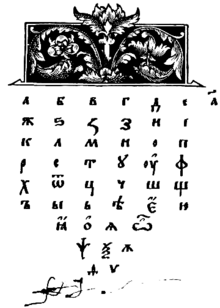
The formation of the Ukrainian alphabet occurred on the basis of the Cyrillic alphabet, the alphabet inherited all its letters. In connection with the development of the phonetic system of the language, a mismatch between traditional letters and new sounds gradually increased. In the letter, this led to a mixture of letters: and ~ i ~ s, b ~ b, ѣ ~ e ~ u. Spelling spontaneously changed from the 13th to the 18th centuries. and only in 1708-1710 were the norms settled by the Russian reform of the letter . In the XIX century, the phonetic principle of spelling was laid down, and new letters appeared that are used in the alphabet to this day: і in all softening positions, and not just before vowels, as in the then Russian spelling - A.P. Pavlovsky , є (Church Slavonic “anchor e” ") - Spelling of Rusalka Dniester , ї (restoration for iotated sound of two points according to Church Slavonic tradition, instead of one according to Peter's" citizen ") - Kiev spelling of 1873," Notes of the South-West Department of the Geographical Society " [9] .
See also
- For more information about the pronunciation and use of Ukrainian letters, see the article " Ukrainian language ", and about their history - articles on individual letters (see table). Also see articles on other historical variants of Ukrainian spelling:
- Yarzhka
- Maksimovichevka
- Spelling of the "Mermaid Dniester"
- Kulishovka
- Drahomanovka
- Zhelehovka
Notes
- Comments
- ↑ Typically, the following three Unicode character variants are used: 1) apostrophe from the main Latin code block: U + 0027 ' apostrophe 2) closing single quote: U + 2019 ' right single quotation mark 3) apostrophe - letter modifier: U + 02BC ʼ modifier letter apostrophe .
- Sources
- ↑ Officially, the current composition and order of the alphabet was approved in 1993: Ukrainian Spelling / Academy of Sciences of Ukraine, Institute of Knowledge of the Russian Federation. O. O. Potebnі; Institute of Ukrainian movi - 4 types., Vypr. th add. - K .: Naukova Dumka , 1993 .-- 240 p.
- ↑ In the place of the pre-Slavic one after all consonants, and also in the place of the pre-Slavic one всех after all consonants, except d , t , s , s , c , l , n , p : * night > nich / nit͡ʃ /, * vѣra > wira / wirɑ /.
- ↑ In place of the Pre -Slavic ѣ after d , t , s , s , c , l , n , p : * sѣno > sіno / sʲinɔ /.
- ↑ Usually at the beginning of a word: інший / ɪnʃɪj /, as well as in the word hiba / xɪbɑ /.
- ↑ At the junction of the two parts of the word, where the first ends with / ʲ /, and the second begins with / ɪ /: sinіy / sɪnʲɪj / = blue-i .
- ↑ At the junction of the two parts of the word, where the first ends with / j /, and the second begins with / ɪ /: country / krɑjɪnɑ / = edge-in-a .
- ↑ Some native speakers of the Ukrainian language replace this sound with the sound combination / xw / (occasionally / kw /), which is simplified to / x / in front of the lip vowels / ɔ / and / u /. The reason for this phenomenon is the absence in the root Ukrainian words and long-standing borrowings of both the sound / f / and its sonorous analogue / v /. In some cases, this pronunciation is fixed spelling: hvіrtka <gender. forta <him. Pforte ; kvasola <floor fasola <sr.-v.-n. fasôl <lat. phaseolus <Greek φάσηλος , hura <gender fura < dumb Fuhre . However, for many, such a sound replacement has come across and comes across a disapproving attitude that has social roots, since for a long time the languages of the elite in different parts of Ukraine were Polish and Russian . In these languages, the sound [f] developed on a natural basis, as a result of stunning the sound [v] in the final position or as a result of phonetic assimilation : editing [prafka], lion [lʲef], twój [tfuj], wstrząs [fstʂɔ̃s].
- ↑ A. E. Suprun, Introduction to Slavic Philology; Minsk, Higher School, 1989
- ↑ xviii. ІSTORIYA UKRAINSKOGO LAW. Ivan Ogіnko. History of Ukrainian literary movi. . litopys.org.ua. Date of treatment December 2, 2018.