Tasmanian devil (also known as Tasmanian devil , marsupial devil and marsupial devil [1] ; lat. Sarcophilus harrisii ) - a mammal of the family of predatory marsupials ; the only species of the genus Sarcophilus . Its black coloring, a huge mouth with sharp teeth, ominous night cries and a fierce disposition gave the first European settlers the reason to call this stocky predator " devil ." The name of the genus " Sarcophilus " is derived from the words dr. Greek. σάρξ - meat and other Greek φιλέω - I love ("lover of the flesh").
| Tasmanian devil | |||||||||||||||||||||||||||||||||||||
|---|---|---|---|---|---|---|---|---|---|---|---|---|---|---|---|---|---|---|---|---|---|---|---|---|---|---|---|---|---|---|---|---|---|---|---|---|---|
 | |||||||||||||||||||||||||||||||||||||
| Scientific classification | |||||||||||||||||||||||||||||||||||||
| |||||||||||||||||||||||||||||||||||||
| International scientific name | |||||||||||||||||||||||||||||||||||||
Sarcophilus harrisii ( , 1841 ) | |||||||||||||||||||||||||||||||||||||
| Synonyms | |||||||||||||||||||||||||||||||||||||
| |||||||||||||||||||||||||||||||||||||
| Area | |||||||||||||||||||||||||||||||||||||
| |||||||||||||||||||||||||||||||||||||
| Security status | |||||||||||||||||||||||||||||||||||||
| Geochronology appeared 2,588 million years
◄ Nowadays◄ Cretaceous-Paleogene extinction | |||||||||||||||||||||||||||||||||||||

Phylogenetic analysis showed a close relationship between the Tasmanian devil and the quolls, and more distant - with the extinct marsupial wolf tilacin ( Thylacine cynocephalus ).
Content
- 1 Appearance
- 2 Distribution
- 3 Lifestyle and diet
- 4 Reproduction
- 5 Population Status
- 5.1 Diseases
- 5.2 Export
- 5.3 Animal welfare
- 6 Tasmanian devil in culture
- 7 Notes
- 8 Literature
- 9 References
Appearance
The Tasmanian devil is the largest of the modern marsupial predators. This is a dense and squat animal the size of a small dog , however, with a heavy physique and dark color, it is more reminiscent of a miniature bear. The length of his body is from 50 to 80 cm, the size of the tail is from 23 to 30 cm. The dimensions of his body depend on age, habitat and nutrition. Males are larger than females. Large males weigh up to 12 kg at a height at the withers of up to 30 cm.
The Tasmanian devil's body is awkward and massive. The limbs are strong, shortened; the forelegs are slightly longer than the hind legs, which is uncharacteristic for marsupials . The head is disproportionately large, with a blunt muzzle. The ears are small, pink. The coat is short, black; white lunar spots are usual on the chest and sacrum, small round spots are also on the sides. The tail is short and thick; in it, the Tasmanian devil stores fat , and in a sick or starving animal, the tail becomes thin. His hair is covered with long hair, which is often wiped, and then the tail remains almost naked. The first finger on the hind limbs is absent; claws are large.
The skull is massive with strong jaws and sharp, massive teeth; molars like hyenas are adapted for biting and crushing bones. With one bite, the marsupial devil is able to bite his spine or skull through his prey. The strength of a marsupial devil bite, related to body weight, is the highest among mammals [2] . The bag in females looks like a horseshoe-shaped fold of skin that opens back; nipples - 4.
Distribution
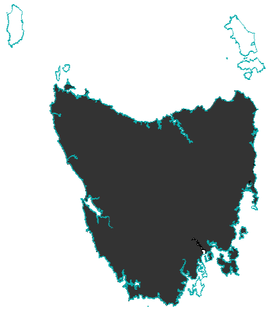
Currently, the marsupial devil is found only on the island of Tasmania , although it used to inhabit mainland Australia . He disappeared from the mainland about 600 years ago (400 years before the first Europeans appeared in Australia), presumably crowded out and exterminated by dingo dogs brought in by natives . In Tasmania, European settlers also ruthlessly exterminated marsupial devils as they ravaged the chicken coops. As a result, as the island was developed, the marsupial devil retreated farther into the undeveloped forest and mountain regions of Tasmania, and its numbers steadily declined until, in 1941, hunting for it was officially prohibited. Now Tasmanian devils are common in the central, northern and western parts of the island in territories designated for sheep pastures, as well as in Tasmanian national parks .
Lifestyle & Diet
Marsupials devils are found in almost any landscape, with the exception of densely populated and deforested areas. They are most numerous in the coastal savannahs and near cattle pastures, which "supply" them with the main food - carrion, as well as in dry sclerophyll and mixed sclerophyll-rain forests. This animal is actively hiding in the dense shrubs at night, in the afternoon, in crevices among stones, in empty burrows, under the trunks of fallen trees, where it arranges a nest of bark, leaves and grass.
Very voracious (his daily food norm is 15% of body weight), the marsupial devil eats small and medium mammals and birds, as well as insects, snakes , amphibians , edible roots and tubers of plants. Often wanders along the shores of reservoirs, finding and eating frogs and crayfish, and on the coast - small inhabitants of the sea, washed ashore. However, the marsupial devil receives most of the booty in the form of carrion; Using his developed sense of smell, he finds and devours any corpses - from fish to dead sheep and cows , and prefers already decomposed, rotten and wormy meat. His constant prey is made up of dead wombats , wallabies , kangaroo rats , rabbits , etc. Perhaps the Tasmanian devil used to eat carrion left over from tilacin meals; now he often discourages prey from marsupial martens . He eats the whole prey, along with the skin and bones (except for the largest). Like scavengers and large predators, marsupial devils play an important role in the Tasmanian ecosystem. In particular, they reduce the risk of infection of sheep with meat flies , as they remove carrion, in which larvae develop. In addition to gluttony, this beast is also indiscriminate in food - echidna needles, pieces of rubber, silver foil, pieces of leather shoes and harnesses, dish towels and undigested carrots and ears of corn were found in its excrement .
Devils are not territorial, but they have certain possessions that go around at night in search of prey. Their area is from 8 to 20 km 2 , and the possessions of different animals intersect. Tasmanian devils lead a strictly solitary lifestyle; the only situation when several devils get together is the joint devouring of large prey. The meal is accompanied by hierarchical skirmishes and loud noise, sometimes audible for several kilometers.
The marsupial devil makes a large number of frightening sounds: from a monotonous growl and a dull "cough" to terrible piercing screams that created him a bad reputation. It was the nightly frightening cries of a still unknown animal and led to the fact that the first Europeans gave him the "devilish" name.
Marsupial devils are very aggressive, but the habit of widely opening their mouths, as if in a yawn, is not a way of intimidation and aggression with them, but rather a sign of uncertainty. Alarmed, Tasmanian devils, like skunks , emit a strong unpleasant odor. Despite the ferocity, even adult marsupial devils are tame, and can be kept as pets.
In a calm state, the marsupial devil is rather slow and clumsy, but in emergency situations it switches to a gallop, developing a speed of up to 13 km / h. Young animals are agile and mobile, climb trees well. Adults climb worse, but they are able to climb inclined trunks and climb perches in chicken coops. Marsupial devils swim well.
Due to the aggressive disposition and nightlife, an adult marsupial devil has few natural enemies. They used to be hunted by marsupial wolves (tilacins) and dingoes . Young marsupial devils sometimes fall prey to birds of prey and tiger marsupials marten ( Dasyurus maculatus ). The new enemy and food rival of the Tasmanian devil was an ordinary fox illegally brought to Tasmania in 2001.
Reproduction
Marsupial devils mate in March-April. Even their mating is a demonstration of aggression. After 3 days, the female chases the male with unchallenged aggression. Pregnancy lasts an average of 21 days; in April-May, the female brings 20-30 cubs [3] , of which no more than four survive, having managed to attach to the four nipples in the bag. The female eats the remaining cubs [4] . On average, more females than males survive. Like other marsupials, the cubs are born very small: their weight is 0.18-0.29 g. [3] Young marsupial devils develop quite quickly: by the 90th day they are completely covered with wool, and between 87 and 93 days they open eyes. At the 4th month, the grown cubs (weighing about 200 g) leave the bag, but the lactation in the female continues even up to 5-6 months. In late December, the cubs finally leave their mother and live independently. By the end of the second year of life, young females enter breeding. The maximum lifespan of marsupial devils is 8 years.
Population Status
Tasmanian devils caused a lot of trouble to European settlers, ruining chicken coops, eating animals caught in traps, and supposedly attacking lambs and sheep, which is why these animals were actively pursued. In addition, the marsupial devil meat turned out to be edible and, according to the colonists, tasted like veal in taste. By June 1941, when the law on the protection of the Tasmanian devil was passed, he was on the verge of complete extinction. However, unlike the marsupial wolf , which died out in 1936, the population of marsupial devils was restored, and now they are quite numerous. Their population, like that of the quolls , is subject to strong seasonal fluctuations, since annually in the summer (December-January) young marsupial devils leave their mothers and scatter around the territory in search of food. However, 60% of them die within the first few months, unable to withstand food competition.
The penultimate sharp decline in the number of marsupial devils took place in 1950; before the DFTD epidemic, their numbers were estimated at 100,000–150,000 individuals, with a density of 20 individuals per 10–20 km 2 .
Diseases
For the first time, a deadly disease called devil facial tumor disease (DVD), or DFTD, was reported in 1999. Over the past period, from it, according to various estimates, 20 to 50% of the marsupial devil population died, mainly in the eastern part of the island.
DFTD begins with small tumors around the mouth, which degenerate into malignant and gradually spread from the head of the animal to the entire body. Overgrown tumors block the animal’s vision, hearing and mouth, depriving it of the ability to obtain food and leading to starvation. Mortality in this disease is 100% (within 12-18 months). One hypothesis suggests that DFTD is caused by a virus , it is also possible that the tumor cells themselves are a source of infection [5] ( transmissible malignant tumor ); presumably, the disease is transmitted through bites when animals fight over territory and females. Judging by historical data, the disease is endemic to Tasmanian devils, and its epizootics are repeated at intervals of 77-146 years. Ongoing anti-epidemic measures include trapping and isolation of infected individuals, as well as the creation of isolated "insurance" populations in the event of the extinction of marsupial devils in nature.
According to Nature News , scientists were able to detect a genetic predisposition to the resistance of some individuals to DFTD (since 1995, this disease has killed more than 80% of the population) [6] . In a recent study, scientists were able to find out that initially the disease occurs in cells that protect the nerves of animals. This discovery led to the development of a test that will help diagnose a tumor in the early stages of development. [7]
In 2006, researchers were able to find that in the tumors of various individuals of the devils, chromosomes undergo the same rearrangements. In addition, scientists caught a sick individual with a rare genetic defect, which was absent in the tumor cells. All this indicated that the tumor cells are “external”, that is, they are transmitted from a sick organism to a healthy one. [8]
Currently, there is no cure for DFTD, so the devils have to look for natural mechanisms to combat the disease. As it turned out, these animals have them. First, the devils have accelerated sexual adulthood. In July 2008, scientists from the University of Tasmania were able to establish that the number of pregnant females under the age of one year increased significantly (in some control populations, growth was more than 80%). Typically, females do not begin sexual activity until two years of age, but further analysis has shown that they now mature 6-12 months earlier. Given that the average life span of the devil is six years, this is a significant “shift." Secondly, the devils began to breed all year round, while before the mating season lasted only a couple of months. According to researchers, changing the breeding strategy is designed to compensate for the damage caused by the disease.
To date, the tumor has destroyed more than seventy percent of the devil population. [9]
Export
Export of the Tasmanian devil for export is prohibited; The last Tasmanian devil outside of Australia died in California in 2004. The issue of assigning this marsupial predator the status of “Vulnerable” in the IUCN Red List is currently being considered. However, in 2005, the Tasmanian government made an exception and presented two Tasmanian devils to Frederick , the Crown Prince of Denmark, and his wife Mary (born in Tasmania) after the birth of their first son. Now these gifts live in the Copenhagen Zoo.
Animal Protection
In 2009, the Linux OS developer community decided to draw public attention to the issue of endangered species . In Linux version 2.6.29, it received a new logo: the Tux penguin was temporarily taken by the Tasmanian devil Tuz [10] .
Tasmanian Devil in Culture
The Tasmanian devil is a symbolic Australian animal, in particular its image is on the emblem of the Tasmanian National Parks and Wildlife Service and the former Australian football team, “Tasmanian Devils”. The former NBL Hobart Devils basketball team has also been named after this animal. The Tasmanian Devil is one of six endemic Australian animals depicted on commemorative coins issued from 1989 to 1994.
Tasmanian devils are very popular among both Australian and foreign tourists. Due to its characteristic behavior and appearance, this animal is a character in numerous documentaries and children's books [11] [12] [13] [14] . The latest documentary, Terrors of Tasmania, was filmed in 2005. It tells about the fate of the female devil during the mating season and the period of care of the offspring. The film also talks about DFTD and measures taken to preserve the appearance. This film was shown both on Australian television and on the American channel National Geographic .
The Tasmanian devil is also widely known outside of Australia thanks to the Looney Tunes cartoon character named Taz . Genetics also called the Tasmanian devil a mutant mouse, characterized by impaired development of sensitive cells of the inner ear . This leads to violations of the mutant's behavior, in particular, tossing the head and running in circles [15] , which is more reminiscent of a cartoon character than a real Tasmanian devil.
Notes
- ↑ Sokolov V.E. Mammals Latin, Russian, English, German, French. / edited by Acad. V. E. Sokolova. - M .: Rus. lang., 1984. - S. 16. - 10,000 copies.
- ↑ Wroe, S .; McHenry, C .; Thomason, J. Bite club: comparative bite force in big biting mammals and the prediction of predatory behavior in fossil taxa (English) // Proceedings of the Royal Society B-Biological Sciences: journal. - 2005. - Vol. 272 , no. 1563 . - P. 619-625 . - DOI : 10.1098 / rspb.2004.2986 . - PMID 15817436 .
- ↑ 1 2 Guiler, ER Observations on the Tasmanian devil, Sarcophilus harrisii II. Reproduction, Breeding and Growth of Pouch Young (English) // Australian Journal of Zoology: journal. - 1970. - Vol. 18 . - P. 63-70 . - DOI : 10.1071 / ZO9700063 .
- ↑ Tasmanian marsupial devil (Sarcophilus harrisii) . Encyclopedia of the animal world "AnimalBox". Date of treatment January 18, 2015.
- ↑ Tasmanian Devil Cancer Culprit Revealed | Wired science | Wired.com
- ↑ Tasmanian devils found a genetic predisposition to the resistance of some individuals to DFTD
- ↑ For the Tasmanian devils the light of hope dawned
- ↑ Bad news for the devils
- ↑ Lenta.ru: Strategy for saving Tasmanian devils recognized as unsuccessful
- ↑ Updated Linux kernel received a new logo
- ↑ Reilly, Pauline; Rolland, Will. The Tasmanian devil. - Kenthurst, New South Wales: Kangaroo Press, 1988 .-- ISBN 0-86417-207-9 .
- ↑ Owen, Pemberton, 2005 , pp. 145-165.
- ↑ Williams, Jasper; Suzuki, John; De Zoete, Claire. Tasmanian devils. - South Yarra, Victoria: Macmillan Education Australia, 2007 .-- ISBN 978-1-4202-1924-1 .
- ↑ Currey, Kylie; Parrish, Steve. Growing up as a devil. - Archerfield, Queensland: Steve Parish Publishing, 2006 .-- ISBN 1-74021-794-2 .
- ↑ Erven, A. et al. A novel stereocilia defect in sensory hair cells of the deaf mouse mutant Tasmanian Devil (English) // European Journal of Neuroscience: journal. - 2002. - Vol. 16 . - P. 1433-1441 . - DOI : 10.1046 / j.1460-9568.2002.02213.x . - PMID 12405956 .
Literature
- Owen D., Pemberton D. Tasmanian Devil: A unique and threatened animal . - Allen & Unwin, 2005 .-- 225 p. - ISBN 978-1-74114-368-3 .
Links
- Tasmanian devils are destroyed by vampire inclinations // Internet-journal "Elements", 02/03/06.
- Tasmanian devils did not have immunity against viral cancer // Tape. Ru, 12/23/2008
- Decrypted by the Tasmanian devil genome // Tape. Ru, 06/28/2011
- Mating games of the Tasmanian devil (video)