Clever Geek Handbook
📜 ⬆️ ⬇️

List of integrals of elementary functions

Integration is one of two basic operations in mathematical analysis . Unlike the differentiation operation, the integral of an elementary function may not be an elementary function. For example, it follows from the Liouville theorem that the integral ofex2 {\ displaystyle e ^ {x ^ {2}}} e ^ {x ^ 2} not an elementary function. Tables of the famous antiderivatives are often very useful, although now they are losing their relevance with the advent of computer algebra systems. This page provides a list of the most common antiderivatives.

C{\ displaystyle C} C used as an arbitrary integration constant, which can be determined if the value of the integral at any point is known. Each function has an infinite number of antiderivatives.

Content

  • 1 Function Integration Rules
  • 2 Integrals of elementary functions
    • 2.1 rational functions
    • 2.2 Logarithms
    • 2.3 Exponential Functions
    • 2.4 Irrational functions
    • 2.5 Trigonometric Functions
    • 2.6 Hyperbolic Functions
  • 3 Special functions
  • 4 notes
  • 5 Bibliography

Function Integration Rules
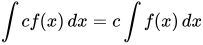
∫cf(x)dx=c∫f(x)dx{\ displaystyle \ int cf (x) \, dx = c \ int f (x) \, dx} \int cf(x)\,dx = c\int f(x)\,dx
∫[f(x)+g(x)]dx=∫f(x)dx+∫g(x)dx{\ displaystyle \ int [f (x) + g (x)] \, dx = \ int f (x) \, dx + \ int g (x) \, dx} \int [f(x) + g(x)]\,dx = \int f(x)\,dx + \int g(x)\,dx
∫[f(x)-g(x)]dx=∫f(x)dx-∫g(x)dx{\ displaystyle \ int [f (x) -g (x)] \, dx = \ int f (x) \, dx- \ int g (x) \, dx} \int [f(x) - g(x)]\,dx = \int f(x)\,dx - \int g(x)\,dx
∫f(x)g(x)dx=f(x)∫g(x)dx-∫(∫g(x)dx)df(x){\ displaystyle \ int f (x) g (x) \, dx = f (x) \ int g (x) \, dx- \ int \ left (\ int g (x) \, dx \ right) \, df (x)} {\displaystyle \int f(x)g(x)\,dx=f(x)\int g(x)\,dx-\int \left(\int g(x)\,dx\right)\,df(x)}
∫f(ax+b)dx=oneaF(ax+b)+C{\ displaystyle \ int f (ax + b) \, dx = {1 \ over a} F (ax + b) \, + C} \int f(ax+b)\,dx = {1 \over a} F(ax+b)\,+C

Integrals of elementary functions

Rational Functions

∫0dx=C{\ displaystyle \ int \! 0 \, dx = C} {\displaystyle \int \!0\,dx=C} (the antiderivative of zero is a constant; within any integration limits, the integral of zero is zero)
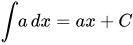
∫adx=ax+C{\ displaystyle \ int \! a \, dx = ax + C} {\displaystyle \int \!a\,dx=ax+C}
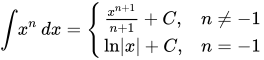
∫xndx={xn+onen+one+C,n≠-oneln⁡|x|+C,n=-one{\ displaystyle \ int \! x ^ {n} \, dx = {\ begin {cases} {\ frac {x ^ {n + 1}} {n + 1}} + C, & n \ neq -1 \\ \ ln \ left | x \ right | + C, & n = -1 \ end {cases}}} {\displaystyle \int \!x^{n}\,dx={\begin{cases}{\frac {x^{n+1}}{n+1}}+C,&n\neq -1\\\ln \left|x\right|+C,&n=-1\end{cases}}}
∫dxa2+x2=oneaarctgxa+C=-oneaarcctgxa+C{\ displaystyle \ int \! {dx \ over {a ^ {2} + x ^ {2}}} = {1 \ over a} \, \ operatorname {arctg} \, {\ frac {x} {a} } + C = - {1 \ over a} \, \ operatorname {arcctg} \, {\ frac {x} {a}} + C} \int\!{dx \over {a^2+x^2}} = {1 \over a}\,\operatorname{arctg}\,\frac{x}{a} + C = - {1 \over a}\,\operatorname{arcctg}\,\frac{x}{a} + C
Evidence

Make a replacementx=atg⁡t {\ displaystyle x = a \ operatorname {tg} t}   we get

∫dxa2+x2=∫d(atg⁡t)a2+(atg⁡t)2=onea∫cos2⁡tcos2⁡tdt=ta+C=oneaarctg⁡xa+C.{\ displaystyle \ int \! {dx \ over {a ^ {2} + x ^ {2}}} = \ int \! {d (a \ operatorname {tg} t) \ over a ^ {2} + ( a \ operatorname {tg} t) ^ {2}} = {1 \ over a} \ int \! {\ cos ^ {2} t \ over \ cos ^ {2} t} dt = {t \ over a} + C = {1 \ over a} \ operatorname {arctg} {x \ over a} + C.}  

∫dxx2-a2=one2aln⁡|x-ax+a|+C{\ displaystyle \ int \! {dx \ over {x ^ {2} -a ^ {2}}} = {1 \ over 2a} \ ln \ left | {xa \ over {x + a}} \ right | + C}   ("High logarithm")

Logarithms

∫ln⁡xdx=xln⁡x-x+C{\ displaystyle \ int \! \ ln {x} \, dx = x \ ln {x} -x + C}  
∫dxxln⁡x=ln⁡|ln⁡x|+C{\ displaystyle \ int {\ frac {dx} {x \ ln x}} = \ ln | \ ln x | + C}  
∫logb⁡xdx=xlogb⁡x-xlogb⁡e+C=xln⁡x-oneln⁡b+C{\ displaystyle \ int \! \ log _ {b} {x} \, dx = x \ log _ {b} {x} -x \ log _ {b} {e} + C = x {\ frac {\ ln {x} -1} {\ ln b}} + C}  

Exponential Functions

∫exdx=ex+C{\ displaystyle \ int \! e ^ {x} \, dx = e ^ {x} + C}  
∫axdx=axln⁡a+C{\ displaystyle \ int \! a ^ {x} \, dx = {\ frac {a ^ {x}} {\ ln {a}}} + C}  

Irrational Functions

∫dxa2-x2=arcsin⁡xa+C{\ displaystyle \ int \! {dx \ over {\ sqrt {a ^ {2} -x ^ {2}}}} = \ arcsin {x \ over a} + C}  
∫-dxa2-x2=arccos⁡xa+C{\ displaystyle \ int \! {- dx \ over {\ sqrt {a ^ {2} -x ^ {2}}}} = \ arccos {x \ over a} + C}  
∫dxxx2-a2=oneaarcsec|x|a+C{\ displaystyle \ int \! {dx \ over x {\ sqrt {x ^ {2} -a ^ {2}}}} = {1 \ over a} \, \ operatorname {arcsec} \, {| x | \ over a} + C}  
∫dxx2+a=ln⁡|x+x2+a|+C{\ displaystyle \ int \! {dx \ over {\ sqrt {x ^ {2} + a}}} = \ ln \ left | {x + {\ sqrt {x ^ {2} + a}}} \ right | + C}   ("Long logarithm")
∫x2+adx=one2(xx2+a+aln⁡|x+x2+a|)+C{\ displaystyle \ int \! {\ sqrt {x ^ {2} + a}} \, dx = {1 \ over 2} ({x} {\ sqrt {x ^ {2} + a}} + {a } \ ln | x + {\ sqrt {x ^ {2} + a}} |) + C}  
Evidence

Let bea<0 {\ displaystyle a <0}   , suppose also thatx≥0 {\ displaystyle x \ geq 0}   . We use hyperbolic functions , make a replacementx=-ach⁡t,t≥0 {\ displaystyle x = {\ sqrt {-a}} \ operatorname {ch} t, t \ geq 0}  

∫x2+adx=∫(-ach⁡t)2+ad(-ach⁡t)=-a∫ch2⁡t-onesh⁡tdt=-a∫sh2⁡tdt=-a∫ch⁡2t-one2dt=-a2(sh⁡2t2-t)+Cone=-a2(sh⁡tch⁡t-t)+Cone{\ displaystyle {\ begin {aligned} \ int \! {\ sqrt {x ^ {2} + a}} dx & = \ int {\ sqrt {({\ sqrt {-a}} \ operatorname {ch} t) ^ {2} + a}} d ({\ sqrt {-a}} \ operatorname {ch} t) = - a \ int {\ sqrt {\ operatorname {ch} ^ {2} t-1}} \ operatorname {sh} tdt \\ & = - a \ int \ operatorname {sh} ^ {2} tdt = -a \ int {\ operatorname {ch} 2t-1 \ over 2} dt = {- a \ over 2} \ left ({\ operatorname {sh} 2t \ over 2} -t \ right) + C_ {1} \\ & = {- a \ over 2} (\ operatorname {sh} t \ operatorname {ch} tt) + C_ {1} \ end {aligned}}}  

But

sh⁡t=ch2-one=x2-a-one=x2+a-a,{\ displaystyle \ operatorname {sh} t = {\ sqrt {\ operatorname {ch} ^ {2} -1}} = {\ sqrt {{x ^ {2} \ over -a} -1}} = {{ \ sqrt {x ^ {2} + a}} \ over {\ sqrt {-a}}},}  sh⁡tch⁡t=xx2+a-a, {\ displaystyle \ operatorname {sh} t \ operatorname {ch} t = x {{\ sqrt {x ^ {2} + a}} \ over -a},}  et=sh⁡t+ch⁡t=x+x2+a-a. {\ displaystyle e ^ {t} = \ operatorname {sh} t + \ operatorname {ch} t = {x + {\ sqrt {x ^ {2} + a}} \ over {\ sqrt {-a}}}.}  

therefore

t=ln⁡x+x2+a-a.{\ displaystyle t = \ ln {x + {\ sqrt {x ^ {2} + a}} \ over {\ sqrt {-a}}}.}  

Hence, including the logarithm of the denominator of the last fraction in the constant C, we obtain

∫x2+adx=x2x2+a+a2ln⁡|x+x2+a|+C{\ displaystyle \ int \! {\ sqrt {x ^ {2} + a}} \, dx = {x \ over 2} {\ sqrt {x ^ {2} + a}} + {a \ over 2} \ ln | x + {\ sqrt {x ^ {2} + a}} | + C}  

Ifx<0 {\ displaystyle x <0}   then by replacingx=-t,t>0 {\ displaystyle x = -t, t> 0}   we reduce the integral to the case already considered. Ifa>0 {\ displaystyle a> 0}   then make a replacementx=ash⁡t {\ displaystyle x = {\ sqrt {a}} \ operatorname {sh} t}   and we carry out arguments similar to the case considered [1] .

Trigonometric Functions

∫sin⁡xdx=-cos⁡x+C{\ displaystyle \ int \! \ sin {x} \, dx = - \ cos {x} + C}  
∫cos⁡xdx=sin⁡x+C{\ displaystyle \ int \! \ cos {x} \, dx = \ sin {x} + C}  
∫tgxdx=-ln⁡|cos⁡x|+C{\ displaystyle \ int \! \ operatorname {tg} \, {x} \, dx = - \ ln {\ left | \ cos {x} \ right |} + C}  
Evidence

∫tgxdx=∫sin⁡xcos⁡xdx=-∫d(cos⁡x)cos⁡x=-ln⁡|cos⁡x|+C{\ displaystyle \ int \! \ operatorname {tg} \, {x} \, dx = \ int {\ frac {\ sin x} {\ cos x}} dx = - \ int {\ frac {d (\ cos x)} {\ cos x}} = - \ ln | \ cos x | + C}  

∫ctgxdx=ln⁡|sin⁡x|+C{\ displaystyle \ int \! \ operatorname {ctg} \, {x} \, dx = \ ln {\ left | \ sin {x} \ right |} + C}  
Evidence

∫ctgxdx=∫cos⁡xsin⁡xdx=∫d(sin⁡x)sin⁡x=ln⁡|sin⁡x|+C{\ displaystyle \ int \! \ operatorname {ctg} \, {x} \, dx = \ int {\ frac {\ cos x} {\ sin x}} dx = \ int {\ frac {d (\ sin x )} {\ sin x}} = \ ln | \ sin x | + C}  

∫sec⁡xdx=ln⁡|sec⁡x+tgx|+C{\ displaystyle \ int \! \ sec {x} \, dx = \ ln {\ left | \ sec {x} + \ operatorname {tg} \, {x} \ right |} + C}  
∫cosec⁡xdx=-ln⁡|cosec⁡x+ctgx|+C{\ displaystyle \ int \! \ operatorname {cosec} {x} \, dx = - \ ln {\ left | \ operatorname {cosec} {x} + \ operatorname {ctg} \, {x} \ right |} + C}  
∫sec2⁡xdx=∫dxcos2⁡x=tgx+C{\ displaystyle \ int \! \ sec ^ {2} x \, dx = \ int \! {dx \ over \ cos ^ {2} x} = \ operatorname {tg} \, x + C}  
∫cosec2⁡xdx=∫dxsin2⁡x=-ctgx+C{\ displaystyle \ int \! \ operatorname {cosec} ^ {2} x \, dx = \ int \! {dx \ over \ sin ^ {2} x} = - \ operatorname {ctg} \, x + C}  
∫sec⁡xtgxdx=sec⁡x+C{\ displaystyle \ int \! \ sec {x} \, \ operatorname {tg} \, {x} \, dx = \ sec {x} + C}  
∫cosec⁡xctgxdx=-cosec⁡x+C{\ displaystyle \ int \! \ operatorname {cosec} {x} \, \ operatorname {ctg} \, {x} \, dx = - \ operatorname {cosec} {x} + C}  
∫sin2⁡xdx=one2(x-sin⁡xcos⁡x)+C{\ displaystyle \ int \! \ sin ^ {2} x \, dx = {\ frac {1} {2}} (x- \ sin x \ cos x) + C}  
∫cos2⁡xdx=one2(x+sin⁡xcos⁡x)+C{\ displaystyle \ int \! \ cos ^ {2} x \, dx = {\ frac {1} {2}} (x + \ sin x \ cos x) + C}  
∫sinn⁡xdx=-sinn-one⁡xcos⁡xn+n-onen∫sinn-2⁡xdx,n∈N,n⩾2{\ displaystyle \ int \! \ sin ^ {n} x \, dx = - {\ frac {\ sin ^ {n-1} {x} \ cos {x}} {n}} + {\ frac {n -1} {n}} \ int \! \ Sin ^ {n-2} {x} \, dx, n \ in \ mathbb {N}, n \ geqslant 2}  
∫cosn⁡xdx=cosn-one⁡xsin⁡xn+n-onen∫cosn-2⁡xdx,n∈N,n⩾2{\ displaystyle \ int \! \ cos ^ {n} x \, dx = {\ frac {\ cos ^ {n-1} {x} \ sin {x}} {n}} + {\ frac {n- 1} {n}} \ int \! \ Cos ^ {n-2} {x} \, dx, n \ in \ mathbb {N}, n \ geqslant 2}  
∫arctgxdx=xarctgx-one2ln⁡(one+x2)+C{\ displaystyle \ int \! \ operatorname {arctg} \, {x} \, dx = x \, \ operatorname {arctg} \, {x} - {\ frac {1} {2}} \ ln {\ left (1 + x ^ {2} \ right)} + C}  

Hyperbolic Functions

∫shxdx=chx+C{\ displaystyle \ int \ operatorname {sh} \, x \, dx = \ operatorname {ch} \, x + C}  
∫chxdx=shx+C{\ displaystyle \ int \ operatorname {ch} \, x \, dx = \ operatorname {sh} \, x + C}  
∫dxch2x=thx+C{\ displaystyle \ int {\ frac {dx} {\ operatorname {ch} ^ {2} \, x}} = \ operatorname {th} \, x + C}  
∫dxsh2x=-cthx+C{\ displaystyle \ int {\ frac {dx} {\ operatorname {sh} ^ {2} \, x}} = - \ operatorname {cth} \, x + C}  
∫thxdx=ln⁡|chx|+C{\ displaystyle \ int \ operatorname {th} \, x \, dx = \ ln | \ operatorname {ch} \, x | + C}  
∫cschxdx=ln⁡|thx2|+C{\ displaystyle \ int \ operatorname {csch} \, x \, dx = \ ln \ left | \ operatorname {th} \, {x \ over 2} \ right | + C}  
∫sechxdx=arctgshx+C{\ displaystyle \ int \ operatorname {sech} \, x \, dx = \ operatorname {arctg} \, \ operatorname {sh} \, x + C}  
also∫sechxdx=2arctg(ex)+C {\ displaystyle \ int \ operatorname {sech} \, x \, dx = 2 \, \ operatorname {arctg} \, (e ^ {x}) + C}  
also∫sechxdx=2arctg(thx2)+C {\ displaystyle \ int \ operatorname {sech} \, x \, dx = 2 \, \ operatorname {arctg} \, \ left (\ operatorname {th} \, {\ frac {x} {2}} \ right) + C}  
∫cthxdx=ln⁡|shx|+C{\ displaystyle \ int \ operatorname {cth} \, x \, dx = \ ln | \ operatorname {sh} \, x | + C}  
Proof of

Proof of the formula∫sechxdx=arctg⁡shx+C {\ displaystyle \ int \ operatorname {sech} \, x \, dx = \ operatorname {arctg} \ operatorname {sh} \, x + C}   :

∫sechxdx=∫dxch⁡x=∫ch⁡xch2⁡xdx=∫d(sh⁡x)one+sh2⁡x=arctg⁡sh⁡x+C{\ displaystyle \ int \ operatorname {sech} \, x \, dx = \ int {dx \ over \ operatorname {ch} x} = \ int {\ operatorname {ch} x \ over \ operatorname {ch} ^ {2 } x} dx = \ int {d (\ operatorname {sh} x) \ over 1+ \ operatorname {sh} ^ {2} x} = \ operatorname {arctg} \ operatorname {sh} x + C}  

Proof of the formula∫sechxdx=2arctg⁡(ex)+C {\ displaystyle \ int \ operatorname {sech} \, x \, dx = 2 \ operatorname {arctg} (e ^ {x}) + C}   :∫sechxdx=∫dxch⁡x=2∫dxex+e-x=2∫dexone+e2x=2arctg⁡(ex)+C {\ displaystyle \ int \ operatorname {sech} \, x \, dx = \ int {dx \ over \ operatorname {ch} x} = 2 \ int {dx \ over e ^ {x} + e ^ {- x} } = 2 \ int {d {e ^ {x}} \ over 1 + e ^ {2x}} = 2 \ operatorname {arctg} (e ^ {x}) + C}   .

Proof of the formula∫sechxdx=2arctg(thx2)+C {\ displaystyle \ int \ operatorname {sech} \, x \, dx = 2 \, \ operatorname {arctg} \, \ left (\ operatorname {th} \, {\ frac {x} {2}} \ right) + C}   :

∫sechxdx=∫onech⁡xdx=∫dxsh2⁡x2+ch2⁡x2=2∫d(x2)ch2⁡x2(one+th2⁡x2)=2∫d(th⁡x2)one+th2⁡x2=2arctg(thx2)+C{\ displaystyle {\ begin {aligned} \ int \ operatorname {sech} \, x \, dx & = \ int {1 \ over \ operatorname {ch} x} dx = \ int {dx \ over \ operatorname {sh} ^ {2} {x \ over 2} + \ operatorname {ch} ^ {2} {x \ over 2}} = 2 \ int {d ({x \ over 2}) \ over \ operatorname {ch} ^ {2 } {x \ over 2} (1+ \ operatorname {th} ^ {2} {x \ over 2})} \\ & = 2 \ int {d (\ operatorname {th} {x \ over 2}) \ over 1+ \ operatorname {th} ^ {2} {x \ over 2}} = 2 \, \ operatorname {arctg} \, \ left (\ operatorname {th} \, {\ frac {x} {2}} \ right) + C \ end {aligned}}}  

Special Functions

∫Ci⁡(x)dx=xCi⁡(x)-sin⁡x{\ displaystyle \ int \ operatorname {Ci} (x) \, dx = x \ operatorname {Ci} (x) - \ sin x}  
∫Si⁡(x)dx=xSi⁡(x)+cos⁡x{\ displaystyle \ int \ operatorname {Si} (x) \, dx = x \ operatorname {Si} (x) + \ cos x}  
∫Ei⁡(x)dx=xEi⁡(x)-ex{\ displaystyle \ int \ operatorname {Ei} (x) \, dx = x \ operatorname {Ei} (x) -e ^ {x}}  
∫li⁡(x)dx=xli⁡(x)-Ei⁡(2ln⁡x){\ displaystyle \ int \ operatorname {li} (x) \, dx = x \ operatorname {li} (x) - \ operatorname {Ei} (2 \ ln x)}  
∫li⁡(x)xdx=ln⁡xli⁡(x)-x{\ displaystyle \ int {\ frac {\ operatorname {li} (x)} {x}} \, dx = \ ln x \, \ operatorname {li} (x) -x}  
∫erf⁡(x)dx=e-x2π+xerf⁡(x){\ displaystyle \ int \ operatorname {erf} (x) \, dx = {\ frac {e ^ {- x ^ {2}}} {\ sqrt {\ pi}}} + x \ operatorname {erf} (x )}  

Notes

  1. ↑ Vinogradova I.A., Olehnik S.N., Sadovnichy V.A. Tasks and exercises in mathematical analysis. In 2 book Prince 1 / Ed. V.A. Gardener. - 2nd ed. - M .: Higher school , 2000. - S. 187. - ISBN 5-06-003768-1 .


Bibliography

Books
  • Gradshtein I. S. Ryzhik I. M. Tables of integrals, sums, series and products. - 4th ed. - M .: Nauka, 1963. - ISBN 0-12-294757-6 // EqWorld
  • Dvayt G. B. Tables of Integrals of St. Petersburg: Publishing House and Printing House of VNIIG im. B.V. Vedeneeva, 1995 .-- 176 p. - ISBN 5-85529-029-8 .
  • D. Zwillinger. CRC Standard Mathematical Tables and Formulae , 31st ed., 2002. ISBN 1-58488-291-3 .
  • M. Abramowitz and IA Stegun, eds. Handbook of Mathematical Functions with Formulas, Graphs, and Mathematical Tables , 1964. ISBN 0-486-61272-4
  • Korn G.A., Korn T.M. Math reference book for scientists and engineers . - M .: " Science ", 1974.
Integral Tables
  • Integrals at EqWorld
  • SOS Mathematics: Tables and Formulas
Calculation of Integrals
  • The Integrator (at Wolfram Research )
  • Empire of Numbers


Source - https://ru.wikipedia.org/w/index.php?title=List of_integral_elementary_functions&oldid = 99431217


More articles:

  • Half Plane
  • Archdiocese
  • Acre
  • Syngonia
  • Janissaries
  • List of integrals of irrational functions
  • Muhali
  • Teplice
  • Rowzing Symptom
  • List of integrals of hyperbolic functions

All articles

Clever Geek | 2019