
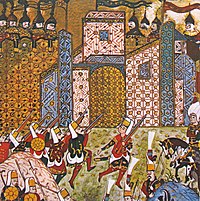
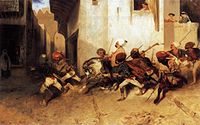

Janissaries ( tur . Yeniçeri [enicherii] “new army ” [1] ) - regular infantry of the armed forces of the Ottoman Empire in 1365-1826.
The Janissaries, together with the Sipahs ( heavy cavalry ) and akyndzhi ( irregular light cavalry ) formed the basis of the army in the Ottoman Empire. They were part of the regiments of Kapykulu (the personal guard of the Sultan , consisting of professional soldiers who were officially considered Sultan slaves). In the Ottoman state, the Janissary regiments also performed police , security, fire and, if necessary, punitive functions.
Content
History
As the Ottoman Empire expanded, it became necessary to reorganize its troops and create disciplined regular infantry units as its main striking force. The Janissary Infantry was created by the Turkish Sultan Murad I in 1365. A new army of young Christian youths of 8–16 years old was completed. Thus, the majority of the Janissaries were ethnic Albanians , Armenians , Bosnians , Bulgarians , Greeks , Georgians , Serbs , who were subsequently brought up in strict Islamic traditions. Children recruited in Rumelia ( Balkans ) were given up to be raised in Turkish families in Anatolia and vice versa.
The recruitment of children in the Janissaries ( devshirme - blood tax ) was one of the duties of the Christian population of the empire. The Ottoman authorities, recruiting an army of slaves , at the same time solved the domestic political problem, creating a powerful counterweight to the influence of the local army ( sipahi ).
The Janissaries initially recruited exclusively Christian children according to the order; the Jews were freed from devshirme . Later Bosnians and Albanian Muslims who converted to Islam also obtained the right from the Sultan to send their children to the Janissaries: military service in the ranks of Kapikulu allowed many to achieve a high position in society. The inhabitants of Istanbul , speaking the Turkish language , physically and mentally disabled, and also married, were also exempted from the devshirme. Perhaps the last circumstance partly explains the early marriages of that time.
The Janissaries were officially considered slaves of the Sultan and constantly lived in monasteries - barracks . They were forbidden to marry and acquire their own household until 1566. The property of a deceased or dead Janissary became the property of the regiment. In addition to military art , the Janissaries studied calligraphy, law, theology, literature and languages. Wounded or old Janissaries received a pension. Many of them made a successful civil career. In 1683, the children of Muslims began to be taken to the Janissaries.
From the end of the XVI - beginning of the XVII centuries, the process of decomposition of the Janissaries corps gradually began. They began to acquire families, engage in trade and craft. Gradually, the Janissaries became a powerful conservative political force, a thunderstorm and eternal and indispensable participants in the palace coups (Janissaries riots led to the overthrow and death of the Sultans, for example, in 1622, 1623 and 1807).
Janissaries were divided into several categories: combatant (eschinji), veterans (koruji), retirees (mutecaids, or oturaks) and supernumerary (tasslacji), who were waiting for the opportunity to take a vacant place. The last two categories did not serve and did not receive a salary, but enjoyed the rights and privileges of the Janissaries. Many Turks of all classes (city dwellers, barbers, artisans, small traders, etc.) were formally registered in supernumerary tasslacjs or immediately received the status of retired oturas. As a result, by the middle of the XVIII century, almost half of the Muslim population of the Ottoman Empire was recorded in the Janissaries [2] .
Disbandment
Finally, in 1826, the Janissaries corps was officially abolished by decree of Sultan Mahmud II , and the rebellion of the indignant Janissaries by decree was severely suppressed. During the operation on June 14, 1826, 15 artillery volleys were fired at the capital's Janissary barracks.
Picking and Training
After the devshirme, serviceable boys went to Istanbul. Here, the most capable of them were sent to Enderun , where they prepared for the court service. The rest were sent to the Janissary corps. They were trained in military affairs , as well as educated in them obedience and humility. First, the boys were brought up in Turkish families, where they studied the Turkish language , Islam and the fundamentals of military affairs. Then the young men were sent to educational buildings, where they had been trained for at least 6 years under the supervision of eunuchs . They were trained in many weapons . The recruitment system has changed over time: for example, in 1568 the sons of some retired Janissaries were allowed to enter the corps. And in 1594, the corps opened for Muslim volunteers.
Functions
- conquest campaigns;
- garrison service ;
- protection of the sultan ;
- city police .
Structure
The main combat unit of the Janissaries corps was a regiment ( Ojak "ocak") of about 1,000 troops. During their heyday, the number of regiments (the orta "orta") reached 196. The regiments differed in origin and function. The supreme commander was considered the sultan, but the tactical leadership was carried out by the aga . His assistants were the top officers of the corps - sekbanbashi and kul kahyasy . The Janissaries were closely associated with the Dervish Order of Bektash , whose adherents played the role of a kind of regimental priests . The Order also had a significant impact on the formation of the hierarchy of the Janissary corps. In general, researchers note a certain similarity between the Janissaries and the European spiritual and chivalric orders.
The training units of the corps, as well as the Janissary garrison of Istanbul, were commanded by Istanbul Agassa . The chief clergyman was the Ojak of the Imam . The main treasurer was beitulmaldzhi . Talimkhanedibibashi was responsible for the preparation of the Janissaries. The senior officers in charge of recruiting the boys in the corps on a certain territory of the empire and their training were Rumeli agassy (he was responsible for conducting the devshirme in Europe ), Anadolu agasy ( Asia ), Gelibolu agasy ( Gallipoli ). Later, a post appeared kuloglu bashchavushu , responsible for the education and training adopted in the corps of the Janissary sons.
Ojak consisted of three parts:
- Djemaat (ordinary warriors) - 101 aorta (in the first aorta a sultan was recorded as a soldier )
- Belyuk (personal guard of the Sultan ) - 61 aorta
- Sekban - 34 Ort
Within the regiment, the following ranks existed: sakabashi (“chief of water supply”), bash karakulluccu (lit. - “senior assistant cook ”; junior officer ), ashchi usta (“senior cook”), imam , bayraktar ( standard bearer ), vekilharch ( quartermaster ), бdabashi ("chief of the barracks") and, finally, chorbadzhi (lit. - "supovar"; resp. colonel ). Ordinary soldiers also had their own ranks, depending on their qualities and service life. The highest rank of the jerk exempted from participation in campaigns and gave the right to engage in trade.
The Yanicharsky Orts did not have any clear internal structure, in them for several hundred people (800-1000 according to the state, and actually often only 200-300) there were only 5 officers: Yaya-Bashi , or Chorvadzhi-Bashi - the commander of the Oort, Oda -bashi - assistant commander, vekil-harge , or killer-harge - quartermaster, bayrakdar - ensign or standard-bearer; bash-eski - chief of veterans and deputy standard bearer. Only in some Ort there was one more non-commissioned officer ( zembildji ) [3] .
Dress code and weapons
A distinctive feature of the Janissaries was a mustache and a shaved beard , which was uncharacteristic of the traditional Muslim population. They were distinguished from the rest of the military by a white felt cap ( burke , or yuskyuf ) with a piece of cloth hanging from behind, reminiscent of the shape of a sleeve of a sultan’s dressing gown or ceremonial cap of a Zaporozhye Cossack . Janissaries clothes were tailored from wool . The uniform of senior officers was trimmed with fur. The status of the owner was emphasized by belts and sashes .
Initially, the Janissaries were skilled archers , and then armed with firearms. At first, some Janissaries wore full armor , but eventually abandoned it. Armor continued to be worn only by heartbreakers . At first, the most common janissary weapons were bows and short spears. Later, with the transition to firearms, the bow did not lose popularity and remained a prestigious ceremonial weapon. Crossbows also enjoyed popularity among the Janissaries. Janissaries were also armed with swords (which at the beginning of the existence of the corps were a rarity), sabers , daggers , scimitars . Various maces , battle axes and various types of pole arms ( glaive , berdysh , halberds , guizarma ), as well as pistols (from the 17th century) were popular. The role of a kind of regimental banner was performed by a large soup cauldron ( cauldron and sheriff ).
By the 18th century, the Janissaries were armed with rifles with a flintlock , but without bayonets, and scimitars . However, several Orths continued to be armed with bows and crossbows [4] .
Tactics
During the battle, the leading role in the offensive was given to the cavalry. Her task was to break through the enemy line. Under these circumstances, the Janissaries, firing from rifles, were built with a wedge and went on the attack, using swords and other weapons. At first, the enemy, especially if he did not have a large disciplined infantry, as a rule, could not withstand such an attack. The Janissaries did not shoot in volleys , preferring aimed fire. Among the Janissaries there were special strike units called heartbreaks (lit. - "risking their heads") of about 100 volunteers. During the siege of Vienna by Suleiman the Magnificent, the besieged noted that these units were divided into smaller units of 5 janissaries each. Such a detachment included a swordsman, a warrior with grenades , an archer, and two warriors with guns . During the battle, the Janissaries often used the camp (a fence of large wagons). During the siege of Vienna by the Sultan Suleiman, Janissary engineers proved themselves to be excellent.
The training of the Janissaries was limited to training in the possession of weapons, and drill and tactical exercises were not conducted. Organized movements and battles in linear orders were generally not characteristic of the Ottoman army. In battle, the Janissaries usually occupied defensive positions behind any fortifications (moat, wagenburg , etc.) and fired, while the depth of their formation was 9-12 lines. In the attack, the Janissaries moved in a deep column, close in shape to an elongated trapeze, but the order and alignment within the system were not strictly observed [5] .
Christian Janissaries
In the army of the Polish-Lithuanian Commonwealth, according to the Turkish model, volunteers formed their own Janissary units [6] . King of Poland August II created his own Janissary Guard. The armament and form of Christian janissaries completely copied Turkish designs, differing only in color; in particular, military drums were of Turkish type [7] .
See also
- Ottoman Army
- Gulyama
- Devshire
- Mamluks
- Bashibuzuki
- Sarbazy
- “ Notes of the Janissary ” by Konstantin from Ostrovitsa
Notes
- ↑ Janissaries
- ↑ Giants V.S. Organization and strength of the Ottoman army at the beginning of the Russo-Turkish War of 1768–1774
- ↑ Giants V.S. Organization and strength of the Ottoman army at the beginning of the Russo-Turkish War of 1768–1774
- ↑ Giants V.S. Organization and strength of the Ottoman army at the beginning of the Russo-Turkish War of 1768–1774
- ↑ Giants V.S. Organization and strength of the Ottoman army at the beginning of the Russo-Turkish War of 1768–1774
- ↑ Janissaries in the army of the Commonwealth - Janissaries in Belarus
- ↑ foto_history: Christian Janissaries
Literature
- Vodovozov V.V. Yanychary // Brockhaus and Efron Encyclopedic Dictionary : in 86 volumes (82 volumes and 4 additional). - SPb. , 1890-1907.
- Vvedensky G.E. Janissaries. - SPb. : Atlas, 2003 .-- 176 pp., Ill. - (Armory Academy). - ISBN 5-901555-11-2 . - 2000 copies
- Nicole David. Janissaries. - M .: LLC AST, Astrel, 2004. - 72 pp., Ill. - (Elite troops). - ISBN 5-17-025193-9 .
- Savitsky V. Corps of the Janissaries: Education, organization, staffing and command staff in the XIV — XVI centuries. // Zeichhaus. - M. , 1999. - No. 9. - S. 4-7.
- Chukhlib T. Cossacks and Janissaries. - Kiev: Publ. House of the Kiev-Mohyla Academy, 2010. - 446 p.
Links
- Meat Square - in Liberia "New Herodotus"