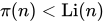
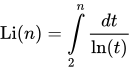
The Skewes number is the smallest positive integer. , such that, starting with it, the inequality stops running where - distribution function of primes , - shifted integral logarithm [1] .


John Littlewood in 1914 gave unconstructive evidence that such a number exists.
Stanley Skewes in 1933 estimated this number, based on the Riemann hypothesis , as Is the first number of Skuse , denoted by .


In 1955, he also assessed without assuming the validity of the Riemann hypothesis: - the second number of Skuse , denoted by . This is one of the largest numbers ever used in mathematical proofs, although much less than the Graham number .


In 1987, RJ (HJJ te Riele), without assuming the Riemann hypothesis, limited the Squuse number to which is approximately 8.18510 370 .

By 2018, it is known that the Skuse number is between 10 19 [2] and 1.3971672 · 10 316 ≈ e 727.951336108 [3] .
Notes
- ↑ Yu. V. Matiyasevich . Alan Turing and Number Theory // Mathematics in Higher Education. - 2012. - No. 10. - S. 111-134.
- ↑ Jan Büthe. An analytic method for bounding ψ ( x ) // Math. Comp. - 2018 .-- Vol. 87. - P. 1991-2009. - arXiv : 1511.02032 . - DOI : 10.1090 / mcom / 3264 . The proof uses the Riemann hypothesis.
- ↑ Yannick Saouter, Timothy Trudgian, and Patrick Demichel. A still sharper region where π ( x ) - li ( x ) is positive // Math. Comp. - 2015. - Vol. 84. - P. 2433-2446. - DOI : 10.1090 / S0025-5718-2015-02930-5 . MR : 3356033 . The indicated estimate does not require the Riemann hypothesis.