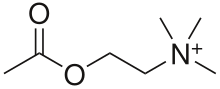
Cholinergic receptors ( acetylcholine receptors ) are transmembrane receptors whose endogenous ligand is an acetylcholine agonist .
Acetylcholine serves as a neurotransmitter both in pre- and postganglionic synapses of the parasympathetic system and in preganglionic sympathetic synapses, in a number of postganglionic sympathetic synapses, neuromuscular synapses (somatic nervous system), as well as in some parts of the central nervous system . Nerve fibers that secrete acetylcholine from their endings are called cholinergic.
Acetylcholine synthesis occurs in the cytoplasm of nerve endings; its reserves are stored in the form of bubbles in presynaptic terminals. The appearance of a presynaptic action potential leads to the release of the contents of several hundred vesicles into the synaptic cleft. Acetylcholine released from these vesicles binds to specific receptors on the postsynaptic membrane, which increases its permeability to sodium, potassium, and calcium ions and leads to the appearance of an exciting postsynaptic potential. The action of acetylcholine is limited by its hydrolysis using the enzyme acetylcholinesterase .
Types of cholinergic receptors
From a pharmacological point of view, specific cholinergic receptors are divided into nicotinic (H-receptors) and muscarinic (M-receptors).
Nicotinic cholinergic receptors
The effects of acetylcholine in the region of the preganglionic synapses of the parasympathetic and sympathetic systems can be reproduced by the introduction of nicotine alkaloid , therefore, all autonomous ganglia are called nicotinic. Nicotine-like transmission of nerve impulses is also carried out in the neuromuscular synapse, central nervous system, adrenal medulla and in some sympathetic postganglionic areas.
Nicotinic cholinergic receptors are ionotropic and are sodium channels. They consist of five protein subunits, usually two of them have acetylcholine binding sites.
17 types of nicotinic receptor subunits (α1-10, β1-4, γ, δ, ε) were identified. Apparently, they can form many different combinations, but some of them are most common and most important, these are: (α1) 2 β1δε (muscle type), (α3) 2 (β4) 3 (ganglion type), (α4) 2 (β2) 3 (CNS type) and (α7) 5 (another CNS type).
Muscarinic cholinergic receptors
The action of acetylcholine in the region of postganglionic nerve endings is reproduced using another alkaloid - muscarin . In addition to postganglionic synapses, muscarinic-like transmission of nerve impulses is carried out in some parts of the central nervous system.
Muscarinic receptors are metabotropic and belong to receptors conjugated with G-proteins .
Medical Importance
Exposure to poisons and drugs
Nicotine receptors are blocked by poisons such as curare and α-bungarotoxin , and muscarinic ones by atropine and scopolamine , which determines the symptoms of poisoning with the corresponding poisons. Blockade of nicotinic receptors using curare or curare-like drugs is used to immobilize patients during surgery.
Myasthenia gravis
In this disease, autoantibodies are produced against muscle type nicotinic cholinergic receptors, which leads to progressive muscle weakness.