Saturn is the sixth planet from the Sun and the second largest planet in the Solar System after Jupiter . Saturn, as well as Jupiter, Uranus and Neptune , are classified as gas giants . Saturn is named after the Roman god of agriculture .The symbol of Saturn is the sickle ( Unicode :).
| Saturn | |||||||||||||||||||||
|---|---|---|---|---|---|---|---|---|---|---|---|---|---|---|---|---|---|---|---|---|---|
| Planet | |||||||||||||||||||||
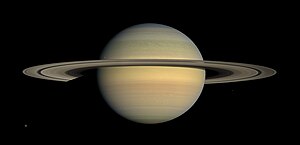 Photo of the planet from Cassini station | |||||||||||||||||||||
| Orbital characteristics | |||||||||||||||||||||
| Perihelion | 1,353,572,956 km 9.048 a. e. | ||||||||||||||||||||
| Aphelion | 1,531,325,783 km 10,116 a. e. | ||||||||||||||||||||
| Semi-axis ( a ) | and | ||||||||||||||||||||
| The eccentricity of the orbit ( e ) | 0.055 723 219 | ||||||||||||||||||||
| Sidereal period of circulation | 10,759.22 days (29.46 years) [1] | ||||||||||||||||||||
| Synodic period of circulation | 378.09 days | ||||||||||||||||||||
| Orbital speed ( v ) | 9.69 km / s | ||||||||||||||||||||
| Inclination ( i ) | 2.485 240 ° 5.51 ° (relative to the solar equator) | ||||||||||||||||||||
| Ascending node longitude ( Ω ) | 113.642 811 ° | ||||||||||||||||||||
| Pericenter Argument ( ω ) | 336,013 862 ° | ||||||||||||||||||||
| Whose companion | |||||||||||||||||||||
| Satellites | 62 [2] | ||||||||||||||||||||
| physical characteristics | |||||||||||||||||||||
| Polar compression | 0.097 96 ± 0.000 18 | ||||||||||||||||||||
| Equatorial radius | 60,268 ± 4 km [3] | ||||||||||||||||||||
| Polar radius | 54,364 ± 10 km [3] | ||||||||||||||||||||
| Average radius | 58,232 ± 6 km [4] | ||||||||||||||||||||
| Surface Area ( S ) | 4,272⋅10 10 km² [5] | ||||||||||||||||||||
| Volume ( V ) | 8.2713⋅10 14 km³ [6] | ||||||||||||||||||||
| Mass ( m ) | 5.6846⋅10 26 kg [6] 95.2 terrestrial | ||||||||||||||||||||
| Average density ( ρ ) | 0.687 g / cm³ [3] [6] | ||||||||||||||||||||
| Acceleration of gravity at the equator ( g ) | 10.44 m / s² [6] | ||||||||||||||||||||
| First cosmic velocity ( v 1 ) | 25.535 km / s [7] | ||||||||||||||||||||
| Second cosmic velocity ( v 2 ) | 35.5 km / s [6] | ||||||||||||||||||||
| Equatorial rotation speed | 9.87 km / s | ||||||||||||||||||||
| Rotation period ( t ) | 10 h 32 min 45 s ± 46 s [8] [9] | ||||||||||||||||||||
| Tilt axis | 26.73 ° [6] | ||||||||||||||||||||
| North pole declination ( δ ) | 83.537 ° | ||||||||||||||||||||
| Albedo | 0.342 ( albedo bond ) 0.47 ( geom. Albedo ) [6] | ||||||||||||||||||||
| Apparent magnitude | from +1.47 to −0.24 [10] | ||||||||||||||||||||
| Absolute magnitude | +28 m | ||||||||||||||||||||
| Corner diameter | 14.5 "—20.1" | ||||||||||||||||||||
| Temperature | |||||||||||||||||||||
| |||||||||||||||||||||
| level 1 bar |
| ||||||||||||||||||||
| 0.1 bar |
| ||||||||||||||||||||
| Atmosphere | |||||||||||||||||||||
Composition:
| |||||||||||||||||||||
Basically, Saturn consists of hydrogen , with admixtures of helium and traces of water, methane , ammonia and heavy elements. The inner region is a relatively small core of iron, nickel and ice, covered with a thin layer of metallic hydrogen and a gaseous outer layer. The outer atmosphere of the planet seems from space to be calm and homogeneous, although sometimes long-term formations appear on it. The wind speed on Saturn can reach 1800 km / h in places, which is significantly more than on Jupiter. Saturn has a planetary magnetic field, which occupies an intermediate position in tension between the Earth’s magnetic field and Jupiter’s powerful field. Saturn's magnetic field extends 1,000,000 kilometers towards the Sun. The shock wave was recorded by Voyager-1 at a distance of 26.2 times the radius of Saturn from the planet itself, and the magnetopause is located at a distance of 22.9 times the radius .
Saturn has a prominent ring system consisting mainly of ice particles, fewer heavy elements and dust. Around the planet turns 62 currently known satellite [2] . Titan is the largest of them, as well as the second largest satellite in the Solar System (after the satellite of Jupiter, Ganymede ), which exceeds Mercury in size and has the only dense atmosphere among the satellites of the planets of the Solar System.
Saturn's orbit was an automatic interplanetary station (AMS) " Cassini ", launched in 1997 and reached the Saturn system in 2004. The AMC task was to study the structure of the rings, as well as the dynamics of the planet’s atmosphere and magnetosphere . September 15, 2017 the station completed its mission, burnt in the atmosphere of the planet [13] .
Saturn among the planets of the solar system
Saturn belongs to the type of gas planets : it consists mainly of gases and does not have a solid surface. The equatorial radius of the planet is 60,300 km , the polar radius is 54,400 km [14] ; of all the planets in the solar system, Saturn has the greatest contraction. The mass of the planet is 95.2 times the mass of the Earth, but the average density of Saturn is only 0.687 g / cm ³ [14] , which makes it the only planet in the solar system whose average density is less than the density of water. Therefore, although the masses of Jupiter and Saturn differ by more than 3 times, their equatorial diameter differs only by 19%. The density of the remaining gas giants is significantly greater (1.27–1.64 g / cm ³) . The acceleration of gravity at the equator is 10.44 m / s² , which is comparable to the values of the Earth and Neptune , but much less than that of Jupiter.
Orbital characteristics and rotation
The average distance between Saturn and the Sun is 1,430 million km ( 9.58 a.e. ) [14] . Moving at an average speed of 9.69 km / s , Saturn revolves around the Sun for 10,759 days (approximately 29.5 years ). The distance from Saturn to the Earth varies from 1195 ( 8.0 a. E. ) To 1,660 ( 11.1 a.e. ) million km, the average distance during their confrontation is about 1280 million km [14] . Saturn and Jupiter are almost at exactly 2: 5 resonance . Since the eccentricity of Saturn's orbit is 0.056, the difference in the distance to the Sun at perihelion and aphelion is 162 million km [14] .
Visible when observing the characteristic objects of the atmosphere of Saturn rotate at different speeds depending on the latitude. As in the case of Jupiter, there are several groups of such objects. The so-called “Zone 1” has a rotation period of 10 h 14 min 00 s (that is, the angular velocity is 844.3 ° / day, or 2.345 turns / day ). It extends from the northern edge of the southern equatorial belt to the southern edge of the northern equatorial belt. At all other latitudes of Saturn, constituting the “Zone 2”, the rotation period was initially estimated at 10 hours 39 minutes 24 seconds (speed 810.76 ° / day or 2.2521 turns / day ). Subsequently, the data were revised: a new assessment was given - 10 hours, 34 minutes and 13 seconds [8] [9] . “Zone 3”, the existence of which is supposed to be based on observations of the radio emission of the planet during the Voyager-1 flight, has a rotation period of 10 hours 39 minutes 22.5 s (speed 810.8 ° / day or 2.2522 turns / day ).
The duration of Saturn's turn around the axis is taken as 10 hours , 34 minutes, and 13 seconds [15] . Saturn is the only planet whose axial rotational velocity at the equator is greater than the orbital rotational speed ( 9.87 km / s and 9.69 km / s, respectively). The exact value of the rotation period of the inner parts of the planet remains hard to measure. When the Cassini reached Saturn in 2004, it was found that, according to radio observations, the duration of the internal parts turnover exceeds the rotation period in “Zone 1” and “Zone 2” and is approximately 10 h 45 min 45 s (± 36 s) [16] .
The differential rotation of the atmosphere of Saturn is similar to the rotation of the atmospheres of Jupiter and Venus, and also of the Sun. The speed of rotation of Saturn is variable not only in breadth and depth, but also in time. This was first discovered by A. Williams [17] . An analysis of the variability of the rotation period of the equatorial zone of Saturn over 200 years showed that the semi-annual and annual cycles make the main contribution to this variability [18] .
In March 2007, it was discovered that the rotation of the radiation pattern of Saturn's radiation was generated by convection currents in the plasma disk, which depend not only on the rotation of the planet, but also on other factors. It was also reported that the fluctuation of the rotation period of the radiation pattern is related to the activity of the geyser on the satellite of Saturn - Enceladus . Charged particles of water vapor in the orbit of the planet lead to a distortion of the magnetic field and, as a consequence, the picture of radio emission. The picture revealed gave rise to the opinion that, to date, there is no at all a correct method for determining the speed of rotation of the planet’s core [19] [20] [21] .
Origin
The origin of Saturn (as well as Jupiter) is explained by two main hypotheses. According to the " contraction " hypothesis, the similarity of the composition of Saturn with the Sun is that both celestial bodies have a large proportion of hydrogen, and, as a result, low density can be explained by the fact that during the formation of planets in the early stages of the solar system development massive "thickening" that gave rise to the planets, that is, the sun and the planets were formed in a similar way. However, this hypothesis cannot explain the differences in the composition of Saturn and the Sun [22] .
The “accretion” hypothesis states that the process of the formation of Saturn took place in two stages. First, for 200 million years [22], the process of forming solid dense bodies, like the terrestrial planets, went on. During this stage, part of the gas from the regions of Jupiter and Saturn dissipated , which then affected the difference in the chemical composition of Saturn and the Sun. Then the second stage began, when the largest bodies reached the doubled mass of the Earth. For several hundred thousand years, the process of gas accretion onto these bodies from the primary protoplanetary cloud lasted. At the second stage, the temperature of the outer layers of Saturn reached 2000 ° C [22] .
Atmosphere and structure
The upper atmospheric layers of Saturn are 96.3% hydrogen (by volume) and 3.25% helium [23] (compared to 10% in Jupiter's atmosphere). There are impurities of methane , ammonia , phosphine , ethane and some other gases [24] [25] . Ammonia clouds in the upper atmosphere are more powerful than Jovian ones. The lower atmosphere clouds consist of ammonium hydrosulfide (NH 4 SH) or water [26] .
According to the Voyagers , strong winds blow on Saturn, up to 500 m / s [27] . Winds blow mainly in the east direction (in the direction of axial rotation). Their strength weakens with distance from the equator ; when moving away from the equator, western atmospheric currents also appear. A number of data indicates that the circulation of the atmosphere occurs not only in the upper cloud layer, but also at a depth of at least 2 thousand km. In addition, the Voyager-2 measurements showed that the winds in the southern and northern hemispheres are symmetrical about the equator. There is an assumption that symmetric flows are somehow connected under a layer of the visible atmosphere [27] .
In the atmosphere of Saturn sometimes appear sustainable formations, which are super-powerful hurricanes. Similar objects are observed on other gas planets in the solar system (see the Big Red Spot on Jupiter, the Big Dark Spot on Neptune ). The giant “ Big White Oval ” appears on Saturn about once in 30 years , the last time it was observed in 2010 (smaller hurricanes are formed more often).
On November 12, 2008, Cassini station cameras received images of the North Pole of Saturn in the infrared. On them, the researchers found auroras , the likes of which have not yet been observed in the solar system. Also, these auroras were observed in the ultraviolet and visible ranges [28] . Auroras are bright continuous oval-shaped rings surrounding the planet's pole [29] . The rings are located at latitude, as a rule, at 70–80 ° [30] . The southern rings are located at an average latitude of 75 ± 1 ° , and the northern ones are closer to the pole by about 1.5 °, due to the fact that the magnetic field is somewhat stronger in the northern hemisphere [31] . Sometimes rings become spiral instead of oval [28] .
In contrast to Jupiter, Saturn's auroras are not associated with uneven rotation of the plasma layer in the outer parts of the planet’s magnetosphere [30] . Presumably, they arise due to magnetic reconnection under the action of the solar wind [32] . The form and type of Saturn auroras vary greatly over time [29] . Their location and brightness are strongly associated with the pressure of the solar wind: the greater it is, the brighter and brighter the rays are toward the pole [29] . The average value of the aurora power is 50 GW in the range of 80–170 nm (ultraviolet) and 150–300 GW in the range of 3–4 µm (infrared) [30] .
During the storms and storms on Saturn, there are powerful discharges of lightning . The electromagnetic activity of Saturn, caused by them, varies over the years from the almost complete absence to very strong electrical storms [33] .
On December 28, 2010, Cassini photographed a storm resembling cigarette smoke [34] . Another, especially a powerful storm, was recorded on May 20, 2011. [35]
Hexagonal formation at the north pole
The clouds at the north pole of Saturn form a giant hexagon ( hexagon ). This was first discovered during the Voyager spans around Saturn in the 1980s [36] [37] [38] , a similar phenomenon has never been observed anywhere else in the solar system . The hexagon is located at a latitude of 78 °, and each side is approximately 13,800 km , that is, it is larger than the diameter of the Earth and four Earths can fit inside it. The period of its rotation is 10 hours 39 minutes . This period coincides with the period of change in the intensity of radio emission, which, in turn, is assumed to be equal to the period of rotation of the inner part of Saturn.
The strange structure of the clouds is shown in an infrared image obtained by the Cassini spacecraft circulating around Saturn in October 2006. The images show that the hexagon remained stable all 20 years after the flight of the Voyager [36] , with the hexagonal structure of the clouds being preserved during their rotation. Separate clouds on the Earth can have the shape of a hexagon, but, unlike them, the hexagon on Saturn is close to the correct one . It is assumed that in the area of the hexagon there is a significant unevenness of cloudiness. The areas in which clouds are practically absent have a height of up to 75 km [36] .
A complete explanation of this phenomenon is not yet available, but scientists managed to conduct an experiment that quite accurately modeled this atmospheric structure [39] . A 30-liter water bottle was placed on a rotating unit, and inside were placed small rings rotating faster than the container. The greater the speed of the ring, the more the shape of the vortex, which was formed during the cumulative rotation of the elements of the installation, differed from the circular. In this experiment, a 6-coal vortex was also obtained [40] .
Internal structure
In the depths of the atmosphere of Saturn, pressure and temperature increase, and hydrogen becomes liquid, but this transition is gradual [41] . At a depth of about 30 thousand km, hydrogen becomes metallic (the pressure there reaches about 3 million atmospheres ). The circulation of electric currents in metallic hydrogen creates a magnetic field (much less powerful than that of Jupiter). In the center of the planet is a massive core of hard and heavy materials - silicates , metals and, presumably, ice. Its mass is about 9 to 22 Earth masses [42] . The core temperature reaches 11 700 ° C , and the energy that Saturn radiates into space is 2.5 times greater than the energy that the planet receives from the sun. A significant part of this energy is generated by the Kelvin – Helmholtz mechanism (when the temperature of the planet falls, the pressure in it drops, as a result, it is compressed, and the potential energy of its substance is converted into heat). At the same time, however, it was shown that this mechanism cannot be the only source of energy of the planet [43] . It is assumed that an additional part of heat is created due to condensation and the subsequent fall of helium droplets through a layer of hydrogen (less dense than droplets) into the core [44] [45] . The result is the transfer of the potential energy of these droplets into heat. The core area is estimated to be approximately 25,000 km in diameter [45] .
Magnetic field
The magnetosphere of Saturn was discovered by the Pioneer-11 spacecraft in 1979. In size, it is inferior only to the Jovian magnetosphere. The magnetopause, the boundary between the magnetosphere of Saturn and the solar wind, is located at a distance of about 20 radii of Saturn from its center, and the tail of the magnetosphere extends hundreds of radii. The magnetosphere of Saturn is filled with a plasma produced by the planet and its satellites. Among the satellites, Enceladus plays the most important role; geysers emit water vapor, part of which is ionized by Saturn's magnetic field [46] [47] .
The interaction between the Saturn magnetosphere and the solar wind generates bright ovals of aurora around the poles of the planet, observed in visible, ultraviolet and infrared light.
The magnetic field of Saturn, as well as Jupiter, is created due to the effect of dynamo during the circulation of metallic hydrogen in the outer core. The magnetic field is almost dipole, as well as on Earth, with the north and south magnetic poles. The north magnetic pole is in the northern hemisphere, and the south - in the south, in contrast to the Earth, where the location of the geographic poles is opposite to the magnetic one [32] . The magnetic field at the equator of Saturn is 21 μT (0.21 G) , which corresponds to a dipole magnetic moment of approximately 4.6 × 10 18 Tl · m³ [48] . The magnetic dipole of Saturn is rigidly connected with its axis of rotation, therefore the magnetic field is very asymmetrical. The dipole is slightly displaced along the axis of rotation of Saturn to the north pole. The magnetic axis of Saturn almost coincides with the axis of its rotation - the deflection angle does not exceed 0.01 ° (at the Earth - 11 °) [49] .
The internal magnetic field of Saturn deflects the solar wind from the surface of the planet, preventing its interaction with the atmosphere, and creates an area called the magnetosphere and filled with a completely different plasma than the plasma of the solar wind. The magnetosphere of Saturn is the second largest magnetosphere in the solar system, the largest - the magnetosphere of Jupiter. As in the Earth’s magnetosphere, the boundary between the solar wind and the magnetosphere is called the magnetopause. The distance from the magnetopause to the center of the planet (in a straight line the Sun - Saturn) varies from 16 to 27 R R ( R ♄ = 60,330 km - the equatorial radius of Saturn) [47] [50] . The distance depends on the pressure of the solar wind, which depends on solar activity . The average distance to the magnetopause is 22 R ♄ . On the other side of the planet, the solar wind stretches Saturn’s magnetic field into a long magnetic tail.
Planet Studies
Saturn is one of the five planets of the solar system, easily visible to the naked eye from Earth. In the maximum, the brightness of Saturn exceeds the first magnitude . To observe the rings of Saturn, you need a telescope with a diameter of at least 15 mm [51] . With a tool aperture of 100 mm , a darker polar cap is visible, a dark stripe near the tropic and the shadow of the rings on the planet. And at 150-200 mm , four to five bands of clouds in the atmosphere and heterogeneity in them will become visible, but their contrast will be noticeably less than that of Jovian ones.
Observing Saturn through a telescope for the first time in 1609-1610, Galileo Galilei noticed that Saturn does not look like a single celestial body, but like three bodies almost touching each other, and suggested that these are two large "companions" (satellite) of Saturn. Two years later, Galileo repeated the observations and, to his amazement, did not find "satellites" [52] .
In 1659, with the help of a more powerful telescope, Huygens found out that the “companions” are in fact a thin, flat ring that encircles the planet and does not touch it. Huygens also discovered Saturn’s largest satellite, Titan . Since 1675, Cassini has been studying the planet. He noted that the ring consists of two rings, separated by a clearly visible gap - the Cassini gap , and discovered several other large Saturn's moons: Iapetus , Tefiya , Diona and Ray [53] .
Further significant discoveries were not until 1789, when William Herschel discovered two more satellites - Mimas and Enceladus . Then a group of British astronomers discovered the Hyperion satellite, with a shape that was very different from a spherical one, which was in orbital resonance with Titan [54] . In 1899, William Pickering discovered Phoebus , which belongs to the class of irregular satellites and does not rotate synchronously with Saturn like most satellites. The period of its circulation around the planet is more than 500 days, while the circulation goes in the opposite direction . In 1944, Gerard Kuiper discovered the presence of a powerful atmosphere on another satellite - Titan [55] [56] . This phenomenon is unique to the satellite in the solar system.
In the 1990s, Saturn, its moons and rings were repeatedly investigated by the Hubble Space Telescope . Long-term observations gave a lot of new information that was not available to the "Pioneer-11" and "Voyagers" with their one-time passage past the planet. Also several Saturn's moons were discovered, and the maximum thickness of its rings was determined. In the measurements carried out on November 20–21, 1995, their detailed structure was determined [57] . During the period of maximum inclination of the rings in 2003, 30 images of the planet were obtained in different wavelength ranges, which at that time gave the best spectral coverage in the entire history of observations [58] . These images allowed scientists to better study the dynamic processes occurring in the atmosphere and create models of the seasonal behavior of the atmosphere. Also, large-scale observations of Saturn were conducted by the South European Observatory from 2000 to 2003. Several small satellites of irregular shape were discovered [59] .
Spacecraft Research
In 1979, the US Pioneer 11 automatic interplanetary station (AMC) flew near Saturn for the first time in history. The study of the planet began on 2 August 1979. The final rapprochement with Saturn took place on September 1, 1979 [61] . During the flight, the device approached the layer of maximum cloudiness of the planet at a distance of 21,400 km [62] . Images of the planet and some of its satellites were obtained, but their resolution was not enough to see the details of the surface. Also, due to the low illumination of Saturn by the Sun, the images were too dim. The device also flew under the plane of the rings to study them. Among the discoveries was the discovery of a thin ring F. In addition, it was found that many areas that were visible from Earth as light were visible from Pioneer 11 as dark, and vice versa [61] . Also, the apparatus was measured temperature of Titan. The exploration of the planet continued until September 15, after which the apparatus began to move away from Saturn and the Sun [62] .
In 1980-1981, the American Pioneer-11, Voyager-1 and Voyager-2 , also followed the Pioneer-11. Voyager 1 got close to the planet on November 13, 1980, but his exploration of Saturn began three months earlier. During the passage was taken a series of photos in high resolution. It was possible to get the image of satellites: Titan , Mimas , Enceladus , Tethys , Dione , Rhea . At the same time, the vehicle flew near Titan at a distance of only 6500 km , which made it possible to collect data on its atmosphere and temperature [63] . It was found that the atmosphere of Titan is so dense that it does not allow enough light in the visible range, so photographs of the details of its surface could not be obtained. After this, the device left the ecliptic plane of the Solar System to photograph Saturn from the pole [64] .
A year later, on August 25, 1981, Voyager 2 approached Saturn. During its flight, the device made a study of the atmosphere of the planet using radar. Data were obtained on the temperature and density of the atmosphere. About 16,000 observation photographs were sent to Earth. During the flights, the camera rotation system was wedged for several days, and part of the necessary images could not be obtained. Then the apparatus, using the force of gravity of Saturn, turned and flew towards Uranus [64] . Also, these devices first discovered the magnetic field of Saturn and investigated its magnetosphere , watched the storms in the atmosphere of Saturn, received detailed images of the structure of the rings and found out their composition. The Maxwell slot and the Keeler slot in the rings were opened. In addition, several new satellites of the planet were discovered near the rings.
In 1997, the Cassini-Huygens AMC was launched to Saturn, which, after 7 years of flight , reached the Saturn system on July 1, 2004 and entered orbit around the planet. The main objectives of this mission, initially calculated for 4 years , were to study the structure and dynamics of rings and satellites, as well as to study the dynamics of the atmosphere and magnetosphere of Saturn and a detailed study of the largest satellite of the planet - Titan .
Before it entered orbit in June 2004, the AMC passed Phoebe and sent her high-resolution images and other data to Earth. In addition, the American Cassini orbiter flew repeatedly from Titan. Images of large lakes and their coastline with a significant number of mountains and islands were obtained. Then the special European probe " Huygens " separated from the apparatus and, by parachute, on January 14, 2005, descended to the surface of Titan. The descent took 2 hours and 28 minutes . During the descent, Huygens took samples of the atmosphere. According to the interpretation of data from the Huygens probe, the upper part of the clouds consists of methane ice, and the lower part consists of liquid methane and nitrogen [65] .
Since the beginning of 2005, scientists have observed radiation coming from Saturn. On January 23, 2006, a storm occurred on Saturn, which gave a flash that is 1000 times more powerful than normal radiation in the radio frequency range [66] . In 2006, NASA reported that the device had detected obvious traces of water that are erupted by Enceladus geysers [67] . In May 2011, NASA scientists stated that Enceladus "turned out to be the most adapted place for life in the solar system after the Earth" [68] [69] .
Photos taken by Cassini allowed other significant discoveries to be made. They revealed the previously undiscovered rings of the planet outside the main bright region of the rings and inside the rings G and E. These rings were named R / 2004 S1 and R / 2004 S2 [71] . It is assumed that the material for these rings could have been formed as a result of a blow to Janus or Epimeteus of a meteorite or comet [72] .
In July 2006, Cassini images revealed the presence of a hydrocarbon lake near the north pole of Titan. This fact was finally confirmed by additional photographs in March 2007 [73] . In October 2006, a hurricane with a diameter of 8,000 km was discovered at the south pole of Saturn [74] .
In October 2008, Cassini transmitted images of the northern hemisphere of the planet. Since 2004, when Cassini has flown to it, there have been noticeable changes, and now it is painted in unusual colors. The reasons for this are not yet clear. It is assumed that the recent color change is due to the changing seasons. From 2004 to November 2, 2009, 8 new satellites were discovered using the device. The main mission of "Cassini" ended in 2008, when the device made 74 turns around the planet. Then the probe's tasks were extended until September 2010, and then until 2017 to study the full cycle of Saturn's seasons [75] .
In 2009, a joint US-European project by NASA and ESA was launched to launch the AMC Titan Saturn System Mission to study Saturn and its satellites Titan and Enceladus. During it, the station 7-8 years will fly to the Saturn system, and then become a satellite of Titan for two years. Also, a balloon-probe will be lowered into the atmosphere of Titan and a landing module (possibly floating) [76] [77] .
Satellites
The largest satellites - Mimas , Enceladus , Tethys , Dion , Ray , Titan and Japet - were discovered by 1789, but to this day they remain the main objects of research. The diameters of these satellites vary in the limit from 397 (Mimas) to 5150 km (Titan), the greater semi-axis of the orbit from 186 thousand km (Mimas) to 3561 thousand km (Iapet). The mass distribution corresponds to the diameter distribution. The greatest eccentricity of the orbit has Titan, the smallest - Dion and Tefiya. All satellites with known parameters are located above the synchronous orbit [78] , which leads to their gradual removal.
The largest of the satellites is Titan . He is also the second largest in the solar system as a whole, after the satellite Jupiter Ganymede . Titanium consists of about half of water ice and half of rock. Such a composition is similar to some other large satellites of gas planets, but Titan is very different from them in the composition and structure of its atmosphere, which mainly consists of nitrogen , there is also a small amount of methane and ethane , which form clouds .Also, Titan is the only body other than the Earth in the Solar System, for which the existence of a liquid on the surface has been proved [79] . The possibility of the emergence of the simplest organisms is not excluded by scientists [80] . The diameter of Titan is 50% larger than that of the Moon. It also surpasses the size of the planet Mercury , although it is inferior to it in mass.
Другие основные спутники также имеют характерные особенности. Так, Япет имеет два полушария с разным альбедо ( 0,03—0,05 и 0,5 соответственно). Поэтому, когда Джованни Кассини открыл данный спутник, то обнаружил, что он виден только тогда, когда он находится по определённую сторону от Сатурна [81] . Ведущее и заднее полушария Дионы и Реи также имеют свои отличия. Ведущее полушарие [82] Дионы сильно кратерировано и однородно по яркости. Заднее полушарие содержит тёмные участки, а также паутину тонких светлых полосок, являющихся ледяными хребтами и обрывами. Отличительной особенностью Мимаса является огромный ударный кратер Гершель диаметром 130 км . Аналогично Тефия имеет кратер Одиссей диаметром 400 км . Энцелад согласно изображениям « Вояджер-2 » имеет поверхность с участками разного геологического возраста, массивными кратерами в средних и высоких северных широтах и незначительными кратерами ближе к экватору [83] .
По состоянию на февраль 2010 г. известно 62 спутника Сатурна. 12 из них открыты при помощи космических аппаратов: « Вояджер-1 » ( 1980 ), « Вояджер-2 » ( 1981 ), « Кассини » ( 2004 — 2007 ). Большинство спутников, кроме Гипериона и Фебы , имеет синхронное собственное вращение — они повёрнуты к Сатурну всегда одной стороной. Информации о вращении самых мелких спутников нет. Тефии и Дионе сопутствуют по два спутника в точках Лагранжа L4 и L5 [84] .
В течение 2006 г. команда учёных под руководством Дэвида Джуитта из Гавайского университета , работающих на японском телескопе Субару на Гавайях , объявляла об открытии 9 спутников Сатурна. Все они относятся к так называемым нерегулярным спутникам , которые отличаются ретроградной орбитой . Период их обращения вокруг планеты составляет от 862 до 1300 дней [85] .
В 2015 году впервые были получены качественные снимки с изображением одного из спутников Тефии с хорошо освещенным гигантским ударным кратером, названным Одиссеем [86] .
Rings
Сегодня известно, что у всех четырёх газообразных гигантов есть кольца, но у Сатурна они самые заметные. Кольца расположены под углом приблизительно 28° к плоскости эклиптики. Поэтому с Земли в зависимости от взаимного расположения планет они выглядят по-разному: их можно увидеть и в виде колец, и «с ребра». Как предполагал ещё Гюйгенс , кольца не являются сплошным твёрдым телом, а состоят из миллиардов мельчайших частиц, находящихся на околопланетной орбите. Это было доказано спектрометрическими наблюдениями А. А. Белопольского в Пулковской обсерватории [87] и двумя другими учёными в 1895—1896 гг. [88]
Существует три основных кольца и четвёртое — более тонкое. Все вместе они отражают больше света, чем диск самого Сатурна. Три основных кольца принято обозначать первыми буквами латинского алфавита. Кольцо В — центральное, самое широкое и яркое, оно отделяется от внешнего кольца А щелью Кассини шириной почти 4000 км , в которой находятся тончайшие, почти прозрачные кольца. Внутри кольца А есть тонкая щель, которая называется разделительной полосой Энке . Кольцо С, находящееся ещё ближе к планете, чем В, почти прозрачно [89] [90] .
Кольца Сатурна очень тонкие. При диаметре около 250 000 км их толщина не достигает и километра (хотя существуют на поверхности колец и своеобразные горы [91] ). Несмотря на внушительный вид, количество вещества, составляющего кольца, крайне незначительно. Если его собрать в один монолит, его диаметр не превысил бы 100 км . На изображениях, полученных зондами, видно, что на самом деле кольца образованы из тысяч колец, чередующихся со щелями; картина напоминает дорожки грампластинок. Частички, из которых состоят кольца, имеют размер от 1 сантиметра до 10 метров [92] . По составу они на 93 % состоят изо льда с незначительными примесями (которые могут включать в себя сополимеры , образующиеся под действием солнечного излучения, и силикаты ) и на 7 % из углерода [93] [94] .
Существует согласованность движения частиц в кольцах и спутников планеты. Некоторые из них, так называемые «спутники-пастухи» , играют роль в удержании колец на их местах. Мимас , например, находится в резонансе 2:1 c щелью Кассини и под воздействием его притяжения вещество удаляется из неё [95] , а Пан находится внутри разделительной полосы Энке [96] . В 2010 году были получены данные от зонда Кассини , которые говорят о том, что кольца Сатурна колеблются. Колебания складываются из постоянных возмущений, которые вносит Мимас и самопроизвольных возмущений, возникающих из-за взаимодействия летящих в кольце частиц [97] . Происхождение колец Сатурна ещё не совсем ясно [98] . По одной из теорий, выдвинутой в 1849 году Эдуардом Рошем , кольца образовались вследствие распада жидкого спутника под действием приливных сил [52] . По другой — спутник распался из-за удара кометы или астероида [98] .
Существует гипотеза, согласно которой кольца также могут быть у одного из спутников Сатурна — Реи .
| Year | Раскрытие колец Сатурна (градусы) [99] |
|---|---|
| 1965 | 0 |
| 1972 | 26,73 |
| 1980 | 0 |
| 1987 | -26,73 |
| 1994 | 0 |
| 2002 | 26,73 |
| 2009 | 0 |
| 2016 | -26,73 |
Наблюдать кольца Сатурна удобнее всего, когда их раскрытие максимально. В это время на Сатурне либо зима, либо лето.
Слух в 1921 году
В 1921 году разнесся слух о том, что Сатурн лишился своих колец, а их частицы летят в том числе и на Землю. Ожидаемое событие настолько взбудоражило умы людей, что публиковались расчёты, когда на Землю упадут частицы колец. Слух появился из-за того, что кольца попросту повернулись ребром к земным наблюдателям, а так как они очень тонкие, то в приборы того времени их было невозможно разглядеть. Люди поняли «исчезновение колец» в прямом смысле, что и породило слух [100] .
In culture
Название планеты
По Цицерону , древние греки называли Сатурн (звезду Сатурна) Φαίνων (Фенон / Фаэнон / Фэйнон Фоцифер ("сияющий") [101] ) [102] .
Гигин сообщает, что также называлась звездой Солнца [103] .
Сатурн , в честь которого названа планета, был первоначально римским богом земледелия. Позднее он был отождествлён с Кроносом , предводителем титанов . Так как титан Кронос пожирал своих детей, то у древних греков он не был популярен. У римлян же бог Сатурн пользовался большим почётом и уважением. Согласно легенде, он научил людей обрабатывать землю, выращивать растения и строить дома. Время его предполагаемого правления описывается как «золотой век человечества», и в его честь проводились празднования, которые назывались Сатурналии [104] . Во время этих торжеств рабы на короткое время получали свободу, потому что в золотой век не было рабов и хозяев.
В индийской мифологии планете Сатурн соответствует Шани [104] .
Тимуридский поэт Алишер Навои называл в одном месте Сатурн злой планетой Кейван ( Kayvon ) ( Хамса , I:XLII), а в другой Зуҳал [105] .
В оккультизме
В оккультизме Сатурн соотносится со сфирой Бина. (См. также Халдейский ряд ) [106] .
В фантастике, фильмах и играх
Сатурн стал, как и другие планеты Солнечной системы, темой некоторых научно-фантастических книг. Ещё в 1752 году Вольтер в повести « Микромегас » описал встречу на Сатурне местного жителя и гигантского существа с планеты, вращающейся вокруг Сириуса . В современной фантастике Роджер Желязны в рассказе «Песня чужого мира» описал обитателей Сатурна, как разумных пузырей, которые при помощи водородных шарльеров поддерживают высоту своего парения в области, пригодной для их жизни. Там же он высказал мнение, что планета может быть полезна Земле, как источник уникальных газов и органических соединений [107] .
В «Дознании» из цикла « Рассказы о пилоте Пирксе » Станислава Лема кульминация сюжета разворачивается возле Сатурна, через кольца которого «взбунтовавшийся» робот направил звездолёт.
Кроме того, в литературе часто упоминается его спутник Титан , в том числе потому, что он является самым крупным спутником Сатурна, имеет плотную атмосферу, а также имеет жидкость (метан) на своей поверхности. Например, в «Дьявольском интерфейсе» Альфреда Бестера метановая вода Титана включает в себя очень ценный комплекс органических соединений, нужный для Земли [107] . В книге Курта Воннегута «Сирены Титана» главные персонажи перелетают жить на этот спутник.
Широкое внимание фантастов привлекли и кольца Сатурна. Они упоминаются в повести братьев Стругацких « Стажёры ». По мнению одного из героев романа, планетолога Юрковского, кольца имеют искусственное происхождение. В повести Айзека Азимова «Путь марсиан» кольца становятся важным источником воды для марсианской колонии Земли [107] .
Сатурн является темой и для других видов творчества. В манге и аниме-мультсериале « Сейлор Мун » планету Сатурн олицетворяет девушка-воительница Сейлор Сатурн , она же Хотару Томоэ. Её атака заключается в силе разрушения, является воином смерти и перерождения [108] . В игре Dead Space 2 действие происходит рядом с Сатурном на космической станции, которая находится на осколках Титана . Сатурн и его кольца можно увидеть в данной игре как из иллюминатора космической станции, так и в открытом космосе, выполняя поставленные задачи [109] [110] [111] .
See also
- «Кассини» — космический аппарат
Notes
- ↑ Courtney Seligman. Rotation Period and Day Length (англ.) . cseligman.com. Дата обращения 31 июля 2011. Архивировано 11 августа 2011 года.
- ↑ 1 2 JPL/NASA. About Saturn & Its Moons (англ.) . saturn.jpl.nasa.gov. Дата обращения 25 августа 2015.
- ↑ 1 2 3 Yeomans, Donald K. HORIZONS System . NASA JPL (13 июля 2006). Дата обращения 8 августа 2007. Архивировано 25 июня 2007 года. —Перейдите в "web interface" , выберите "Ephemeris Type: ELEMENTS", "Target Body: Saturn Barycenter" и "Center: Sun".
- ↑ Report of the IAU Working Group on Cartographic Coordinates and Rotational Elements: 2009, page 23
- ↑ NASA: Solar System Exploration: Planets: Saturn: Facts & Figures . Solarsystem.nasa.gov (22 марта 2011). Дата обращения 8 августа 2011. Архивировано 6 октября 2011 года.
- ↑ 1 2 3 4 5 6 7 Williams, Dr. David R. Saturn Fact Sheet (недоступная ссылка) . NASA (7 сентября 2006). Дата обращения 31 июля 2007. Архивировано 21 августа 2011 года.
- ↑ Первая космическая скорость, онлайн расчет . Калькулятор – справочный портал. Дата обращения 26 июля 2019.
- ↑ 1 2 Helled Ravit , Galanti Eli , Kaspi Yohai. Saturn's fast spin determined from its gravitational field and oblateness // Nature. — 2015. — 25 марта ( т. 520 , № 7546 ). — С. 202—204 . — ISSN 0028-0836 . — DOI : 10.1038/nature14278 .
- ↑ 1 2 Астрономы уточнили продолжительность суток на Сатурне . Lenta.ru (26 марта 2015). The appeal date is March 28, 2015.
- ↑ Schmude, Richard W Junior Wideband photoelectric magnitude measurements of Saturn in 2000 . Georgia Journal of Science (2001). Дата обращения 14 октября 2007.
- ↑ Institut de mécanique céleste et de calcul des éphémérides https://www.imcce.fr/langues/fr/grandpublic/systeme/promenade/pages1/123.html
- ↑ Standish E. M. Keplerian elements for approximate positions of the major planets — 2015. — 3 p.
- ↑ Сигнал потерян: зонд Cassini сгорел в атмосфере Сатурна.
- ↑ 1 2 3 4 5 Saturn Fact Sheet (англ.) (недоступная ссылка) . Дата обращения 31 октября 2010. Архивировано 21 августа 2011 года.
- ↑ University of Louisville: Study puts new spin on Saturn's rotation (англ.) . Дата обращения 31 октября 2010. Архивировано 21 августа 2011 года.
- ↑ Scientists Find That Saturn's Rotation Period is a Puzzle . NASA (28 июня 2004). Дата обращения 22 марта 2007. Архивировано 21 августа 2011 года.
- ↑ Williams AS //Monthly Notices Roy. Astron. Soc., 1894, 54 , p. 297.
- ↑ Кригель А. М. Полугодовые колебания в атмосферах планет.//Астрономический журн. — 1986. — Т. 63 , № 1. — С. 166—169.
- ↑ NASA Jet Propulsion Laboratory (March 22, 2007). Enceladus Geysers Mask the Length of Saturn's Day . Press release . Проверено 2007-03-22 .
- ↑ Gurnett DA et al. The Variable Rotation Period of the Inner Region of Saturn's Plasma Disc (англ.) // Science : journal. - 2007. - Vol. 316 , no. 5823 . — P. 442 . — DOI : 10.1126/science.1138562 . — . — PMID 17379775 .
- ↑ Bagenal F. A New Spin on Saturn's Rotation (англ.) // Science. - 2007. - Vol. 316 , no. 5823 . — P. 380—381 . — DOI : 10.1126/science.1142329 .
- ↑ 1 2 3 Астронет>Происхождение Солнечной системы (планетная космогония) . Дата обращения 5 октября 2010. Архивировано 10 августа 2011 года.
- ↑ Saturn Universe Guide (недоступная ссылка) . Дата обращения 14 августа 2012. Архивировано 16 августа 2012 года.
- ↑ Courtin R. et al. The Composition of Saturn's Atmosphere at Temperate Northern Latitudes from Voyager IRIS spectra (англ.) // Bulletin of the American Astronomical Society : journal. — American Astronomical Society , 1967. — Vol. 15 . — P. 831 . — .
- ↑ Fraser Cain. Atmosphere of Saturn . Universe Today (22 января 2009). Дата обращения 20 июля 2011. Архивировано 5 октября 2011 года.
- ↑ Martinez Carolina. Cassini Discovers Saturn's Dynamic Clouds Run Deep . NASA (5 сентября 2005). Дата обращения 29 апреля 2007. Архивировано 5 октября 2011 года.
- ↑ 1 2 Calvin J. Hamilton. Voyager Saturn Science Summary (недоступная ссылка) . Solarviews (1997). Дата обращения 5 июля 2007. Архивировано 5 октября 2011 года.
- ↑ 1 2 Kurth WS et al. Auroral Processes // Saturn from Cassini–Huygens. — Springer Netherlands, 2009. — P. 333–374. — ISBN 978-1-4020-9217-6 . — DOI : 10.1007/978-1-4020-9217-6_12 .
- ↑ 1 2 3 Clark JT et al. Morphological differences between Saturn's ultraviolet aurorae and those of Earth and Jupiter (англ.) // Nature : journal. - 2005. - Vol. 433 , no. 7027 . — P. 717—719 . — DOI : 10.1038/nature03331 . — . — PMID 15716945 . Архивировано 16 июля 2011 года.
- ↑ 1 2 3 Bhardwaj A.; Gladstone, G. Randall. Auroral emissions of the giant planets (неизв.) // Reviews of Geophysics. — 2000. — Т. 38 , № 3 . — С. 295—353 . — DOI : 10.1029/1998RG000046 . — .
- ↑ Nichols JD et al. Saturn's equinoctial auroras (неизв.) // Geophysical research Letters. — 2009. — Т. 36 , № 24 . — С. L24102:1—5 . — DOI : 10.1029/2009GL041491 . — .
- ↑ 1 2 Kivelson MG The current systems of the Jovian magnetosphere and ionosphere and predictions for Saturn (англ.) // Space Science Reviews : journal. — Springer, 2005. — Vol. 116 , no. 1—2 . — P. 299—318 . — DOI : 10.1007/s11214-005-1959-x . — .
- ↑ News Flash: Cassini Captures First Movie of Lightning on Saturn . Дата обращения 14 августа 2012. Архивировано 18 августа 2012 года.
- ↑ На Сатурне сфотографировали «сигаретный дым» . Лента.Ру (28 декабря 2010). Дата обращения 28 декабря 2010. Архивировано 21 августа 2011 года.
- ↑ На Сатурне произошел шторм планетарного масштаба , Лента.ру (20 мая 2011). Дата обращения 21 мая 2011.
- ↑ 1 2 3 Гигантский гексагон на Сатурне интригует планетологов . membrana.ru. Дата обращения 31 июля 2011. Архивировано 21 августа 2011 года.
- ↑ Godfrey, DA A hexagonal feature around Saturn's North Pole (англ.) // Icarus . — Elsevier , 1988. — Vol. 76 , no. 2 — P. 335 . — DOI : 10.1016/0019-1035(88)90075-9 . — .
- ↑ Sanchez-Lavega A. et al. Ground-based observations of Saturn's north polar SPOT and hexagon (англ.) // Science : journal. — 1993. — Vol. 260 , no. 5106 . — P. 329 . — DOI : 10.1126/science.260.5106.329 . — . — PMID 17838249 .
- ↑ Ball P. Geometric whirlpools revealed (англ.) // Nature . — 2006. — 19 May. — DOI : 10.1038/news060515-17 .
- ↑ Гексагон Сатурна воссоздан в лаборатории
- ↑ Structure of Saturn's Interior . Windows to the Universe. Дата обращения 19 июля 2011. Архивировано 21 августа 2011 года.
- ↑ Fortney JJ Looking into the Giant Planets (англ.) // Science. - 2004. - Vol. 305 , no. 5689 . — P. 1414—1415 . — DOI : 10.1126/science.1101352 . — PMID 15353790 .
- ↑ Patrick GJ Irwin. Giant Planets of Our Solar System: Atmospheres, Composition, and Structure . — Springer, 2003. — ISBN 3540006818 .
- ↑ NASA – Saturn (недоступная ссылка) . NASA (2004). Дата обращения 27 июля 2007. Архивировано 21 августа 2011 года.
- ↑ 1 2 Saturn . BBC (2000). Дата обращения 19 июля 2011. Архивировано 21 августа 2011 года.
- ↑ Sittler EC et al. Ion and neutral sources and sinks within Saturn's inner magnetosphere: Cassini results (англ.) // Planetary and Space Science : journal. — Elsevier , 2008. — Vol. 56 , no. 1 . — P. 3—18 . — DOI : 10.1016/j.pss.2007.06.006 . — .
- ↑ 1 2 Gombosi TI et al. Saturn's Magnetospheric Configuration // Saturn from Cassini-Huygens. — Springer Netherlands, 2009. — P. 203–255. — ISBN 978-1-4020-9217-6 . — DOI : 10.1007/978-1-4020-9217-6_9 .
- ↑ Belenkaya ES et al. Definition of Saturn's magnetospheric model parameters for the Pioneer 11 flyby (англ.) // Annales Geophysicae : journal. - 2006. - Vol. 24 , no. 3 — P. 1145—1156 . — DOI : 10.5194/angeo-24-1145-2006 . — .
- ↑ Астрономы опубликовали открытия, сделанные в предсмертном вояже зонда «Кассини» , 5 октября 2018
- ↑ Russell CT Planetary Magnetospheres (неизв.) // Reports on Progress in Physiscs. — 1993. — Т. 56 , № 6 . — С. 687—732 . — DOI : 10.1088/0034-4885/56/6/001 . — .
- ↑ Eastman J. Saturn in Binoculars (недоступная ссылка) . The Denver Astronomical Society (1998). Дата обращения 3 сентября 2008. Архивировано 21 августа 2011 года.
- ↑ 1 2 Baalke, Ron. Saturn: History of Discoveries (недоступная ссылка) . Jet Propulsion Laboratory, California Institute of Technology, NASA.. Дата обращения 19 ноября 2011. Архивировано 2 февраля 2012 года.
- ↑ Catherine Saturn: History of Discoveries (недоступная ссылка) . Дата обращения 26 июня 2011. Архивировано 21 августа 2011 года.
- ↑ Robert Nemiroff, Jerry Bonnell; Перевод: А. Козырева, Д. Ю. Цветков. Гиперион: губчатый спутник Сатурна (26 июля 2005). Дата обращения 16 сентября 2009. Архивировано 21 августа 2011 года.
- ↑ О. Л. Кусков, В. А. Дорофеева, В. А. Кронрод, А. Б. Макалкин. Системы Юпитера и Сатурна: Формирование, состав и внутреннее строение. — М. : ЛКИ, 2009. — С. 476. — ISBN 9785382009865 .
- ↑ GP Kuiper. Titan: a Satellite with an Atmosphere (англ.) // The Astrophysical Journal . - IOP Publishing , 1944. — Vol. 100 . — P. 378 . — DOI : 10.1086/144679 .
- ↑ Dušek J. Saturn bez prstence - live III (словенск.) // Kozmos. — 1995. — Zv. XXVI . — S. 20—21 . — ISSN 0323-049X .
- ↑ NASA Press Release. Saturnove prstence v najväčšom sklone (словенск.) // Kozmos. — 2003. — Zv. XXXIV . — S. 12 . — ISSN 0323-049X .
- ↑ Kulhánek P. Magnetická pole v sluneční soustavě III (неизв.) // Astropis. — 2007. — С. 15 . — ISSN 1211-0485 .
- ↑ Pale Blue Orb — Cassini Imaging (недоступная ссылка) . Дата обращения 27 декабря 2012. Архивировано 15 января 2013 года.
- ↑ 1 2 The Pioneer 10 & 11 Spacecraft (недоступная ссылка) . Mission Descriptions. Дата обращения 23 июня 2011. Архивировано 30 января 2006 года.
- ↑ 1 2 1973-019A – Pioneer 11 . Дата обращения 23 июня 2011. Архивировано 21 августа 2011 года.
- ↑ Cassini Solstice Mission: Saturn Then and Now -- Image Gallery . NASA/JPL. Дата обращения 6 декабря 2011. Архивировано 2 февраля 2012 года.
- ↑ 1 2 Missions to Saturn . The Planetary Society (2007). Дата обращения 24 июля 2007. Архивировано 21 августа 2011 года.
- ↑ Here is the weather forecast: It will pour down liquid methane (англ.) . Telegraph Media Group (27 July 2006). Дата обращения 21 ноября 2011. Архивировано 2 февраля 2012 года.
- ↑ Astronomers Find Giant Lightning Storm At Saturn . ScienceDaily LLC (15 февраля 2006). Дата обращения 23 июня 2011. Архивировано 21 августа 2011 года.
- ↑ Pence M. NASA's Cassini Discovers Potential Liquid Water on Enceladus . NASA Jet Propulsion Laboratory (9 марта 2006). Дата обращения 3 июня 2011. Архивировано 21 августа 2011 года.
- ↑ Lovett RA Enceladus named sweetest spot for alien life (неизв.) . — Nature , 2011. — 31 May.
- ↑ Kazan C. Saturn's Enceladus Moves to Top of «Most-Likely-to-Have-Life» List . The Daily Galaxy (2 июня 2011). Дата обращения 3 июня 2011. Архивировано 21 августа 2011 года.
- ↑ «Кассини» сфотографировал сразу пять спутников Сатурна . Дата обращения 3 августа 2011. Архивировано 21 августа 2011 года.
- ↑ Porco CC et al. Cassini Imaging Science: Initial Results on Saturn's Rings and Small Satellites . Дата обращения 23 июня 2011. Архивировано 21 августа 2011 года.
- ↑ Shiga D. Faint new ring discovered around Saturn . NewScientist.com (20 сентября 2007). Дата обращения 8 июля 2007. Архивировано 21 августа 2011 года.
- ↑ Probe reveals seas on Saturn moon , BBC (14 марта 2007). Дата обращения 23 июня 2011.
- ↑ Rincon P. . Huge 'hurricane' rages on Saturn , BBC (10 ноября 2006). Дата обращения 12 июля 2007.
- ↑ Mission overview – introduction . Cassini Solstice Mission . NASA / JPL (2010). Дата обращения 23 ноября 2010. Архивировано 21 августа 2011 года.
- ↑ TANDEM/TSSM mission summary . European Space Agency (20 октября 2009). Дата обращения 8 ноября 2009. Архивировано 2 февраля 2012 года.
- ↑ Nuclear-Powered Robot Ship Could Sail Seas of Titan (14 октября 2009). Дата обращения 11 декабря 2011. Архивировано 2 февраля 2012 года.
- ↑ Jacobson, RA et al. Revised orbits of Saturn's small inner satellites (англ.) // The Astronomical Journal : journal. - IOP Publishing , 2008. — Vol. 135 , no. 1 . — P. 261—263 . — DOI : 10.1088/0004-6256/135/1/261 . — .
- ↑ Stofan ER et al. The lakes of Titan (англ.) // Nature : journal. — 2007. — 4 January ( vol. 445 , no. 1 ). — P. 61—64 . — DOI : 10.1038/nature05438 .
- ↑ McKay CP, Smith, HD Possibilities for methanogenic life in liquid methane on the surface of Titan (англ.) // Icarus : journal. — Elsevier , 2005. — Vol. 178 , no. 1 . — P. 274—276 . — DOI : 10.1016/j.icarus.2005.05.018 .
- ↑ Mason J. et al. Cassini Closes In On The Centuries-old Mystery Of Saturn's Moon Iapetus . CICLOPS website newsroom . Space Science Institute (10 декабря 2009). Дата обращения 22 декабря 2009. Архивировано 2 февраля 2012 года.
- ↑ Направленное в сторону движения спутника по орбите
- ↑ Rothery, David A. Satellites of the Outer Planets: Worlds in their own right. — Oxford University Press, 1999. — ISBN 0-19-512555-X .
- ↑ Цесевич В. П. Что и как наблюдать на небе. — 6-е изд. — М. : Наука , 1984. — С. 161. — 304 с.
- ↑ Sheppard, SS; Jewitt, DC; and Kleyna, J. Satellites of Saturn (неизв.) // IAU Circular No. — 2006. — 30 June ( т. 8727 ).
- ↑ Bright Basin on Tethys | NASA
- ↑ Белопольский А. А. О вращении кольца Сатурна по измерениям спектрограмм, полученных в Пулкове // Известия Императорской Академии Наук. Серия 5. — 1895. — Т. 3 , вып. 1 . — С. 12—14 .
- ↑ Куликовский П. Г. О некоторых вопросах изучения истории астрономии // Историко-астрономические исследования . — М. : Физматгиз , 1960. — Вып. VI . — С. 18 .
- ↑ Saturnian Rings Fact Sheet (NASA). Дата обращения 12 декабря 2011. Архивировано 23 августа 2011 года.
- ↑ Catalog Page for PIA08389 . Дата обращения 12 декабря 2011. Архивировано 2 февраля 2012 года.
- ↑ Membrana: На кольцах Сатурна открыты высокие горы . Дата обращения 31 октября 2010. Архивировано 21 августа 2011 года.
- ↑ Zebker, HA, Marouf, EA, and Tyler, GL Saturn's rings – Particle size distributions for thin layer model (англ.) // Icarus : journal. — Elsevier , 1985. — Vol. 64 , no. 3 — P. 531—548 . — DOI : 10.1016/0019-1035(85)90074-0 . — .
- ↑ Nicholson PD et al. A close look at Saturn's rings with Cassini VIMS (неизв.) // Icarus . — Elsevier , 2008. — Т. 193 , № 1 . — С. 182—212 . — DOI : 10.1016/j.icarus.2007.08.036 . — .
- ↑ Poulet F.; Cuzzi JN The Composition of Saturn's Rings (англ.) // Icarus . — Elsevier , 2002. — Vol. 160 , no. 2 — P. 350 . — DOI : 10.1006/icar.2002.6967 . — .
- ↑ Lecture 41:Planetary Rings . Richard Pogge, Prof. of Ohio State University (2007-11-19-11). Дата обращения 12 декабря 2011. Архивировано 2 февраля 2012 года.
- ↑ Esposito LW Planetary rings (неизв.) // Reports on Progress in Physics. — 2002. — Т. 65 , № 12 . — С. 1741—1783 . — DOI : 10.1088/0034-4885/65/12/201 . — .
- ↑ Котляр П. . Кольца Сатурна дрожат по-галактически (рус.) , Infox.ru (4 ноября 2010). Дата обращения 3 ноября 2010.
- ↑ 1 2 The Real Lord of the Rings (недоступная ссылка) . Дата обращения 12 декабря 2011. Архивировано 2 февраля 2012 года.
- ↑ Куликовский П. Г. «Справочник любителя астрономии», 110 стр.
- ↑ Перельман Я. И. «Занимательная астрономия», 142 стр.
- ↑ источник
- ↑ Цицерон . О природе богов II 52 :
Та [планета], которую называют звездой Сатурна, а греки — Φαίνων, самая далекая от Земли, совершает свой путь приблизительно за тридцать лет, причем в этом пути она движется самым удивительным образом, то впереди [Солнца], то отставая [от него], то скрывается в вечернее время, то снова появляется в утреннее.
- ↑ Гигин. Астрономия II 42 , 2
ПЛАНЕТЫ 42. ...
2. Говорят, что вторая звезда - Солнца, но другие называют ее звездой Сатурна. Эратосфен утверждает, что она получила имя от сына Солнца, Фаэтона. Многие рассказывают, что он без позволения отца управлял колесницей и стал падать на землю. Поэтому Юпитер поразил его молнией, и он упал в Эридан; затем Солнце поместило его среди звезд. - ↑ 1 2 Starry Night Times . Imaginova Corp.. Дата обращения 5 июля 2007. Архивировано 21 августа 2011 года.
- ↑ Лейли и Меджнун (поэма Навои) , XXXI
- ↑ Регарди И. Глава третья. Сефирот // Гранатовый сад. — М. : Энигма, 2005. — 304 с. — ISBN 5-94698-044-0 .
- ↑ 1 2 3 Гремлёв, Павел. Планетарий. Сатурн. (неизв.) // Мир Фантастики.
- ↑ Такэути, Наоко. Акт 39 // Bishoujo Senshi Sailor Moon Том 14. — Kodansha , 1996-03-06. — ISBN 4-06-178826-4 .
- ↑ Dead Space 2. Приключения некро-мана . MGnews.ru (11 октября 2010). Дата обращения 12 октября 2010. Архивировано 21 августа 2011 года.
- ↑ Dead Space 2 Review (англ.) (недоступная ссылка) . GamertechTV (30 December 2010). Дата обращения 16 января 2011. Архивировано 21 августа 2011 года.
- ↑ Simon Priest. Dead Space 2 details spill, set three years after original in 'Sprawl' (англ.) (недоступная ссылка) . StrategyInformer (10 December 2010). Дата обращения 16 января 2011. Архивировано 21 августа 2011 года.
Literature
- Серафимов В. В. Сатурн, планета // Энциклопедический словарь Брокгауза и Ефрона : в 86 т. (82 т. и 4 доп.). - SPb. , 1890-1907. (свод информации на начало XX века, представляющий в основном исторический интерес).