


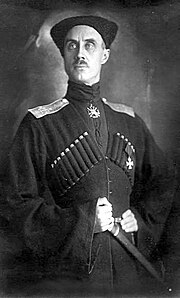
Khazyr - from the Arabic “ready” [1] ) - among the Caucasian peoples - a rifle charge consisting of a measured powder charge or a paper cartridge and a bullet. Gases were worn either in a bag-gas cylinder, or, more often, fastened in one row in breast pockets, performing the role of a cartridge belt . Later they became a decorative element, which is an integral part of the national clothes of the Caucasian peoples ( XIX - early XX century ). Gasyri usually were bone, and the front were made of silver .
They were borrowed by the Cossack units of the Russian army along with the sword , burqa , papakha and other details of military culture from the peoples of the Caucasus in the process of conquering these territories. Chest gas guns were well adapted to the conditions of the battle in the mountains in any weather, not allowing the powder to get wet while the shooter is in standing, lying or riding a horse.
Etymology: in addition to the version of the finished charges from the Turkic ӘЗЕР “ready; ready ”- hezér, possibly also with Turkic Ezәr, gesәr - n. sash (from colored fabric); (cartridge belt-sash)
Content
Interesting Facts
- Since September 1918, the last chapter of the White movement, Baron Wrangel , bore the nickname “Black Baron” for its traditional everyday form of clothing — the black Cossack Circassian with gas-plumes. During the Civil War, he preferred the Circassian other military uniforms .
- White General Grigory Lukyanovich Charnot , the character of the play by Mikhail Bulgakov and the film “Running” staged on it, as the last degree of his fall appreciated the sale of silver gas bullets from his Circassian for betting on the cockroach races in Constantinople .
- In the comedy film “The Caucasian Prisoner ”, one of the comic moments is based on the fact that pseudo-jigit Balbes has gas cigarettes and cigarettes and a cigarette lighter like a cigarette lighter .
See also
- Berendeyka
- Cartridge belt
Notes
Literature
- L.V. Belovinsky . Gazyri, khazyri, khozyri // Illustrated Encyclopedic Historical and Everyday Dictionary of the Russian People. XVIII - the beginning of the XIX century. / ed. N. Eremina . - M .: Eksmo, 2007. - p. 115. - 784 pp .: - ill. with. - 5 000 copies - ISBN 978-5-699-24458-4 .