Versailles - a palace and park ensemble in France , the former residence of French kings in the city of Versailles , now a suburb of Paris ; tourism center of world significance.
| Palace and Park Ensemble | |
| Versailles | |
|---|---|
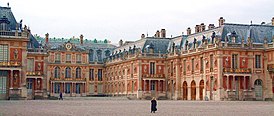 Palace of versailles | |
| A country |  France France |
| Location | |
| Architectural style | |
| Architect | , and |
| Site | |
 World Heritage Site World Heritage Site | |
| Palace and Park of Versailles (Palace and park in Versailles) | |
| Link | No. 83 on the World Heritage List |
| Criteria | i, ii, vi |
| Region | Europe and North America |
| Turning on | 1979 ( 3rd session ) |
Versailles was built under the leadership of Louis XIV since 1661 and became a kind of monument to the era of the “sun king”, an artistic and architectural expression of the idea of absolutism . Leading architects are Louis Levo and Jules Arduin-Mansart , the creator of the park is Andre Lenotre . The ensemble of Versailles, the largest in Europe, is characterized by a unique integrity of design and harmony of architectural forms and a transformed landscape. Since the end of the XVII century, Versailles served as a model for the ceremonial country residences of European monarchs and aristocracy, but he does not have direct imitations.
From 1682 to 1789, before the French Revolution , Versailles was the official royal residence. In 1801, received the status of a museum and is open to the public; since 1830, the entire architectural complex of Versailles has become a museum; in 1837, the Museum of the History of France opened in the royal palace. In 1979, the Palace of Versailles and the park were included in the UNESCO World Heritage List .
Versailles is associated with many significant events in French and world history. So, in the XVIII century, the royal residence became the place of signing many international treaties, including the treaty that ended the US War of Independence in 1783. In 1789, the Constituent Assembly working at Versailles adopted the Declaration of Human and Citizen Rights . In 1871, after the defeat of France in the Franco-Prussian War , in Versailles, occupied by German troops, the creation of the German Empire was proclaimed. Here, in 1919, a peace treaty was signed that ended the First World War and laid the foundation for the so-called Versailles system - the political system of post-war international relations.
Construction
Hunter Castle
The history of the Palace of Versailles begins in 1623 with a modest hunting castle similar to a feudal castle, built at the request of Louis XIII of brick, stone and roofing slate in the territory purchased from Jean de Soisy , whose family owned the land since the XIV century . The hunting castle was in the place where the Marble Courtyard is now located. Its dimensions were 24 by 6 meters. In 1632, the territory was expanded by the purchase of the Versailles estate from the Archbishop of Paris, Jean-Francois de Gondi , and a two-year reconstruction was undertaken.
Louis XIV
Since 1661, the “sun king” Louis XIV began to expand the palace to use it as his permanent residence, since after the Fronde Uprising, living in the Louvre seemed unsafe for him. Architects Andre Lenotre and Charles Lebrun renewed and expanded the palace in the style of classicism . The entire facade of the palace from the garden is occupied by a large gallery ( Mirror Gallery , Gallery of Louis XIV ), which makes an amazing impression with its paintings, mirrors and columns. In addition to it, the Battle Gallery , the palace chapel and the Royal Opera deserve mention.
Louis XV
After the death of Louis XIV in 1715, the five-year-old King Louis XV , his court, and the Regency Council of Philip of Orleans returned to Paris. The Russian Tsar Peter I during his visit to France stayed in May 1717 in the Greater Trianon . The 44-year-old tsar, while in Versailles, studied the design of the Palace and parks, which served as his inspiration for the creation of Peterhof on the shores of the Gulf of Finland near St. Petersburg (Verlet, 1985).
Versailles changed during the reign of Louis XV, but not as large as it was under Louis XIV. In 1722, the king and his court returned to Versailles and the first project was the completion of the Hercules Salon , the construction of which was begun in the last years of the reign of Louis XIV, but was not completed due to the death of the latter.
Significant contribution of Louis XV to the development of Versailles recognized Small apartments of the King ; The Chambers of Madame , the Chambers of Dauphin and his wife on the first floor of the Palace, as well as the private chambers of Louis XV - the King’s small apartments on the second floor (later converted into Madame Dubarri's apartments ) and the King’s small apartments on the third floor - on the second and third floors of the Palace. The main achievement of Louis XV in the development of Versailles was the completion of the Opera Hall and the Small Trianon Palace (Verlet, 1985).
An equally significant contribution is the destruction of the Stairs of the Ambassadors , the only ceremonial path to the Great Royal Chambers. This was done to build the apartments of the daughters of Louis XV.
Significant changes in the Park did not happen, compared with the times of Louis XIV; the only legacy of Louis XV in the parks of Versailles is the completion of the Neptune Basin between 1738 and 1741 (Verlet, 1985). In the last years of his reign, Louis XV, on the advice of architect Gabriel , began the reconstruction of the facades of the courtyards of the Palace. According to another project, the Palace was to receive classic facades from the city side. This project of Louis XV also continued throughout the reign of Louis XVI and was completed only in the 20th century (Verlet, 1985).
Cost
All accounts related to the construction of the palace have survived to our time. The amount, taking into account all expenses, is 25 725 836 livres (1 livre corresponded to 409 g of silver ), which in total amounted to 10 521 866, 924 kg. silver or 456 million guilders of 243 g of silver. Recalculation to modern cost is almost impossible. Based on the price of silver at 408 [3] euros per kg, the construction of the palace absorbed 4.3 billion euros [4] . Based on the purchasing power of the then guilder as 80 euros, the construction cost 37 billion euros. Putting the costs of building the palace in relation to the state budget of France in the 17th century , we get a modern amount of 259.56 billion euros [5] . Almost half of this amount was spent on the creation of interior decoration. The best masters of the Jacob era, Jean Joseph Chapuis created luxurious boiserie . These expenses were distributed over 50 years, during which the construction of the Palace of Versailles, completed in 1710, was ongoing .
The plot of the future construction required a large amount of land work. Recruiting workers from the surrounding villages took place with great difficulty. Peasants were forced to become "builders." To increase the number of workers in the construction of the palace, the king banned all private construction in the vicinity. Workers were often imported from Normandy and Flanders. Almost all orders were conducted through tenders , the costs of the contractors, exceeding the originally named, were not paid. In times of peace, the army was also involved in the construction of the palace. Finance Minister Jean-Baptiste Colbert monitored economy. The compulsory presence of the aristocracy at court was an additional precautionary measure on the part of Louis XIV, who thus secured full control over the activities of the aristocracy. Only at court it was possible to receive ranks or posts, and who left, lost their privileges.
Park
The regular park of the Palace of Versailles is one of the largest and most significant in Europe. It consists of many terraces that go down as you move away from the palace. The flowerbeds, lawns, greenhouse , pools, fountains , as well as numerous sculptures are a continuation of the palace architecture. The Versailles park also has several small palace-shaped structures, for example, the Small Trianon, the Great Trianon, the French pavilion (salon for games) and the like.
History
Around the palace, a city gradually emerged in which the artisans who supplied the royal court settled. Louis XV and Louis XVI also lived in the Palace of Versailles. During this time, the population of Versailles and the adjacent city reached 100 thousand people, however, it quickly declined after the king was forced to move to Paris .
The Age of the French Revolution and the First Empire of Napoleon
May 5, 1789 in the Versailles Palace gathered representatives of the nobility , clergy and the bourgeoisie . After the king, who was legally given the right to gather and dissolve such events, closed the meeting for political reasons, the deputies from the bourgeoisie declared themselves the National Assembly and retired to the Ballroom. After 1789, it was only difficult to maintain the Palace of Versailles.
On October 5-6, 1789, first a crowd from the Parisian suburbs, and then the national guard under the command of Lafayette, appeared in Versailles demanding that the king and his family, as well as the National Assembly, move to Paris. Subject to force pressure, Louis XVI, Marie Antoinette , their relatives and deputies moved to the capital. After that, the importance of Versailles as the administrative and political center of France decreased and was not restored in the future. In 1799, Napoleon Bonaparte came to power in France, who took Versailles under his protection. In 1805, Pope Pius VII visited Versailles. In 1806, Emperor Napoleon I ordered the French architect Jacques Honduin to begin developing a plan for the restoration of Versailles. He proposed two projects for the reconstruction and restoration of the palace, but both of them were not supported by the emperor. In 1808, the restoration of the Palace of Versailles begins: gold panels, mirrors are restored, furniture is transported from the Louvre and Fontainebleau. Also to the emperor in 1811-1812. various construction plans were presented at Versailles, but failed to implement them, as the First Empire collapsed in 1814-1815. and the Bourbon dynasty came to power again.
After the Revolution
Since the days of Louis Philippe, many halls and premises began to be restored, and the palace itself became an outstanding national historical museum, which displayed busts, portraits, paintings of battles and other works of art of predominantly historical value.
Proclamation of the German Empire
The Palace of Versailles was of great importance in German-French history. After the defeat of France in the Franco-Prussian War , from October 5, 1870 to March 13, 1871, he was the residence of the main headquarters of the German army. On January 18, 1871, the German Empire was proclaimed in the Mirror Gallery , and Wilhelm I was its Kaiser . This place was deliberately chosen to humiliate the French.
A preliminary peace treaty with France was signed a month later - on February 26 , again in the Mirror Gallery. In March, the evacuated French government moved the capital from Bordeaux to Versailles, and only in 1879 again to Paris.
Treaty of Versailles
At the end of World War I , a preliminary armistice was concluded at the Palace of Versailles, as well as the Treaty of Versailles , which the defeated German Empire was forced to sign. This time, the historical site was chosen by the French to humiliate the Germans.
The harsh conditions of the Treaty of Versailles (including huge indemnification payments and recognition of sole guilt) laid a heavy burden on the shoulders of the young Weimar Republic . Because of this, it is widely believed that the consequences of the Treaty of Versailles were the basis for the future emergence of Nazism in Germany .
After the Second World War (1945-1995)
After World War II, the Palace of Versailles became the site of German-French reconciliation. This is evidenced by the festivities on the occasion of the 40th anniversary of the signing of the Champs Elysees , held in 2003 .
In 1952, the government of the republic decided to allocate 5 billion francs for restoration and again turned to philanthropists. All of France began raising money to rebuild the palace, from the richest people to the poorest people in France. There was a cry of pain on the radio: “You say that the Palace of Versailles is in danger of ruin. Does this mean that Western culture is on the verge of losing one of its best gems. This is not only a masterpiece of French art ... ” Gradually, all values returned to Versailles. Also, the obligatory “ritual” begins in the 1950s: every head of state who visited France was supposed to meet with the French president in the Versailles Palace. Only in the mid-1990s did the “ritual” cease and the meetings moved to Paris . In the 1960s The Great Trianon was completely restored.
In 1995, by Decree No. 95-463, the French government announced the creation of the Institution of the National Museum and the property of Versailles. This new status gives the state institution financial autonomy and legal entity status. In 2010, by Decree No. 2010-1367, the name of the state authority was changed to the Public Institution of National Ownership and the Versailles Museum. The post of President of Versailles is being introduced, to which by Presidential Decree Nicolas Sarkozy of June 6, 2007 he was appointed President of the Palace of Versailles. . takes up Jean-Jacques Ayagon . October 2, 2011 as President of the Public Institution of National Ownership and the Versailles Museum he was replaced by Katerina Pegard [6] . In 1979, Versailles was included in the UNESCO World Heritage List , and since 2001 it has been included in the Association of European Royal Residences.
Born in the Palace
The following kings and members of their families were born in the Palace of Versailles:
- Philip V (King of Spain)
- Louis XV
- Louis XVI
- Louis XVIII
- Karl X
Attempts to imitate
Many palaces in Europe were built under the undoubted influence of Versailles. These include the Sanssouci palaces in Potsdam , Schönbrunn in Vienna , the Great Palaces in Peterhof , the Rapti Manor in Luga , Gatchina and Rundale ( Latvia ), as well as other palaces in Germany , Austria and Italy .
| Greater Trianon | Lesser Trianon |
Documentary Films
- 2016 - The Dirty Secrets of Versailles / Versailles: le propre et le sale / Versailles' Dirty Secrets (directed by Julia Bracher / Julia Bracher)
See also
- Lesser Trianon
- Greater Trianon
- Herrenkimsee
- List of UNESCO World Heritage Sites in France
Notes
- ↑ base Mérimée - ministère de la Culture , 1978.
- ↑ archINFORM - 1994.
- ↑ At the silver-euro exchange rate on 10/20/18
- ↑ According to the rate on 10/20/18
- ↑ Kommersant - Supreme Builders
- ↑ Catherine Pegar appointed new director of the Palace of Versailles
Literature
- Verlet, Pierre. Le château de Versailles . Paris: Librairie Arthème Fayard, 1985.
- Irina OLTETIAN, Light and shadows of the Sun King. // Newspaper “History” No. 1/2009, Publishing House “First of September”.