
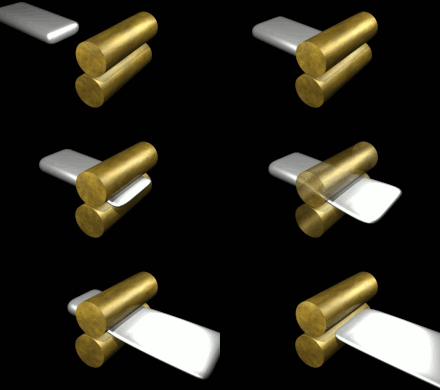
Rolling - the process of plastic deformation of bodies on a rolling mill between rotating drive rolls (part of the rolls may be non-driving). The energy necessary for the implementation of the deformation is transmitted through rolls connected to the engine of the rolling mill [1] .
Metal rolling is one of the main methods of metal forming . Rolling receive products ( rental ) of various shapes and sizes . Like any other method of metal forming, rolling serves not only to obtain the desired shape of the product, but also to form a certain structure and properties for it [2] .
Content
History
Rolling technology in antiquity was not applied. The appearance of rolling dates back to the post-medieval times (the first known mention dates back to the 16th century and is contained in the papers of Leonardo da Vinci. [3] Historically, using rolling, copper sheets for paintings were produced (such sheets, first made by forging, and then by rolling, are already known at the beginning of the XVII century [4] ). Mass application of rolling began in Europe in the XIX century.
Classification of rolling processes
Rolling processes are classified according to the following criteria:
- according to the temperature of the process, rolling is divided into
- cold (metal temperature is in the range of 10-30% of the recrystallization temperature);
- warm (metal temperature is in the range of 40-60% of the recrystallization temperature);
- hot (metal temperature above 60–70% of the recrystallization temperature [5] ;
- according to the mutual arrangement of the axes of the rolls and the strip distinguish between longitudinal (the axis of the rolled strip perpendicular to the axes of the rolls), transverse (the axis of the rolled strip is parallel to the axes of the rolls) and transverse helical or "oblique" rolling (the axis of the rolls are at some angle to each other and to the axis of the rolled stripes;
- by the nature of the effect of the rolls on the strip and the deformation conditions, rolling is symmetric and asymmetric. Symmetric rolling is a process in which the effect of each of the rolls on the strip being rolled is identical. If this condition is violated, the process should be classified as asymmetric;
- by the presence or absence of external forces applied to the ends of the strip, free and non-free rolling is distinguished. Rolling is called free if only the forces exerted by the rolls act on the strip. Non-free rolling is carried out with tension or support of the ends of the strip [6] .
The above classification of metal deformation processes is not generally accepted. For example, there are alternative classifiers of deformation methods depending on the process temperature [7] .
Longitudinal
The method of longitudinal rolling is the most common. During longitudinal rolling, the strip is brought to rolls rotating in different directions and is drawn into the gap between them due to friction forces on the contact surface. The strip is crimped in height and takes the form of a gap (caliber) between the rolls. With this rolling method, the strip moves only forward, that is, it performs only translational motion . Depending on the calibration of the rolls, the shape of the cross and longitudinal sections of the rolled product may be different. In this way, sheets, plates, tape, foil , long products, periodic profiles, bent profiles, etc. are obtained [6]
Cross rolling
During transverse rolling, the processed body (cylindrical shape) is placed in the gap between two rolls rotating in the same direction and receives rotational motion due to friction forces on the contact surface. The deformation of the body occurs when the rolls approach each other. In the longitudinal direction, the processed body does not move (if there are no special pulling devices). Cross rolling is used for the manufacture of shafts, axles, bushings and other bodies of revolution [6] .
Cross-helical rolling
Cross-helical rolling is intermediate between longitudinal and transverse. This method is widely used to obtain hollow pipe billets ( sleeves ). The body being machined (cylindrical) passing between the rollers rotates and simultaneously performs a translational motion, that is, each point of the body (with the exception of those located on its axis) moves along a helical path [6] .
See also
- Rolling mill
- Slitting
Notes
- ↑ Korotich, 2000 , p. 322.
- ↑ Rolling / E.I. Razuvaev // Big Russian Encyclopedia : [in 35 vols.] / Ch. ed. Yu.S. Osipov . - M .: Great Russian Encyclopedia, 2004—2017.
- ↑ The Grove Encyclopedia of Materials and Techniques in Art . Oxford University Press, 2008.S. 376.
- ↑ Paul Craddock. Scientific Investigation of Copies, Fakes and Forgeries . Routledge, 2009.S. 157.
- ↑ Zimmerman, Gunther, 1982 , p. 450.
- ↑ 1 2 3 4 Korotich, 2000 , p. 323.
- ↑ Shevakin Yu.F. , Shaykevich V.S. Metal forming. - M .: Metallurgy, 1982. - S. 35 .-- 248 p.
Literature
- Korotich V.I. , Naboychenko S.S. , Sotnikov A.I. , Grachev S.V., Furman E.L., Lyashkov V. B. (edited by V.I. Korotich). The Beginning of Metallurgy: A Textbook for High Schools. - Yekaterinburg: USTU, 2000 .-- 392 p. - ISBN 5-230-06611-3 .
- Zimmerman R. , Gunter K. Metallurgy and materials science / Ed. P.I. Polukhina , M.L. Bernshtein . - Ref. edition. Per. with him .. - M .: Metallurgy, 1982. - 480 p.