8th Air Army (8th VA) - Air Force of the USSR Armed Forces during the Great Patriotic War . Formed on June 13, 1942 by the order of NCO No. 00119 of June 9, 1942 on the basis of the command and control units of the Air Force of the South-Western Front [2] .
| 8th Air Army | |
|---|---|
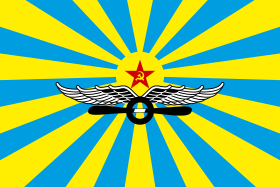 Air force flag | |
| Years of existence | June 13, 1942 - April 9, 1946 |
| A country | the USSR |
| Included in | Southwest Front Southeast Front , Stalingrad Front , South front 4th Ukrainian Front ), 1st Ukrainian Front [1] |
| Type of | air army |
| Includes | connections, parts, units |
| Function | Air conquest ground support |
| Participation in | Battle of Stalingrad Lviv-Sandomierz operation East Carpathian operation Prague operation . |
| Commanders | |
| Famous commanders | T.T. Khryukin (June 1942 - July 1944), V.N. Zhdanov (August 1944 - until the end of the war) |
Content
- 1 History of organizational construction
- 1.1 As part of associations
- 2 Combat and quantitative composition
- 2.1 Combat and quantitative composition at the time of formation
- 2.2 Combat composition
- 3 Command
- 3.1 Army commanders
- 3.2 Chiefs of Staff
- 3.3 Deputy commanders for political affairs
- 3.4 Head of Intelligence
- 3.5 Deputy Army Commanders
- 3.6 Head of Logistics - Deputy Logistics Commander
- 3.7 Head of the Political Department of the Army
- 3.8 Head of Operations
- 3.9 Army Chief Navigator
- 3.10 Chief engineer of the army
- 3.11 Head of the Air Rifle Service
- 3.12 Head of Communications
- 4 fighting
- 4.1 Participation in operations and battles
- 5 Memory
- 6 notes
- 7 Literature
- 8 References
Organization Building History
The 8th Air Army was formed in accordance with the order of the People's Commissar of Defense of the USSR of June 9 by transforming the Air Force of the South-Western Front on June 13, 1942, with aviation divisions and regiments who arrived from the reserve of the Headquarters of the Supreme High Command.
Since its inception, it has been part of the Southwestern Front . In the Battle of Stalingrad, it was part of the Southeast , then (from July 12, 1942) Stalingrad Front . Later, as part of the Southern Front ( October 20, 1943 renamed the 4th Ukrainian ). During the Lviv-Sandomierz operation, it was part of the 1st Ukrainian Front .
After the war, the 4th Ukrainian Front was disbanded on August 25, 1945 on the basis of an order of the USSR NCO on July 9, 1945, its field directorate turned to the formation of the Carpathian Military District, and the 8th Air Army transferred most of its formations to the newly formed Air Force of the Carpathian military district. The command of the 8th Air Army was relocated to Vinnitsa, where on April 9, 1946 it was reorganized into the command of the 2nd Air Army of Long-Range Aviation . On February 20, 1949, on the basis of a directive of the General Staff of the Soviet Army, it was renamed the 43rd Air Army of Long-Range Aviation. In connection with the Air Force reductions, on July 1, 1960, it was reorganized, without changing its headquarters, into the 43rd Strategic Missile Forces missile army , and the aviation units were reduced to the 2nd separate heavy bomber aviation corps .
As part of associations
| date of | Front (district) | note |
|---|---|---|
| 06/09/1942 | Southwestern front | |
| 07/12/1942 | Stalingrad Front | |
| 09/15/1942 | South east front | |
| 09/30/1942 | Stalingrad Front | |
| 12/31/1942 | South front | |
| 10.20.1943 | 4th Ukrainian Front | |
| 05/09/1945 | 4th Ukrainian Front | |
| 09/25/1945 | Carpathian Military District | |
| 04/09/1946 | Kiev Military District |
Combat and quantitative composition
Combat and quantitative composition at the time of formation
- 272nd night light bomber aviation division - the division’s command is formed from the Air Force command of the 21st Army of the South-Western Front , (commander Colonel P. O. Kuznetsov) [3] .
- 269th Fighter Aviation Division - the division’s command is formed from the Air Force command of the 28th Army of the South-Western Front , (commander Colonel N. P. Laryushkin) [3] .
- 271st night bomber aviation division - the division’s command is formed from the Air Force command of the 38th Army of the South-Western Front , (commander Colonel M.X. Borisenko) [3] .
- 270th Bomber Aviation Division — the division’s command is formed from the command of the air attack forces of the front-line subordination of the air forces of the South-Western Front , (commander Colonel O. A. Egorov) [3] .
- 268th Fighter Aviation Division — the division’s management is formed from the management of the maneuverable aviation group of the front-line subordination of the air forces of the South-Western Front , (commander Colonel B. A. Sidnev) [3] .
- 228th assault aviation division - the division’s command is formed from the command of the reserve aviation group of the front-line subordination of the air forces of the South-Western Front , (commander Colonel V. V. Stepichev ) [3] .
- 789th Fighter Aviation Regiment [4]
Initial composition:
|
Battle
as part of the Southwestern Front [6] [7]
|
as part of the Stalingrad Front [6] [7] :
|
as part of the Stalingrad Front [6] [7] :
|
as part of the Stalingrad Front [7] :
|
as part of the Stalingrad Front [7] :
|
as part of the Stalingrad Front [7] :
|
as part of the Southern Front [9] :
|
as part of the Southern Front [9] :
|
as part of the Southern Front [9] :
|
as part of the Southern Front [9] :
|
as part of the Southern Front [9] :
|
as part of the Southern Front [9] :
|
as part of the Southern Front [9] :
|
as part of the Southern Front [9] :
|
as part of the Southern Front [9] :
|
as part of the Southern Front [9] :
|
as part of the Southern Front [9] :
|
as part of the Southern Front [9] :
|
Command
Army Commanders
- May 15, 1942 - July 2, 1944 - Major General of Aviation , Lieutenant General of Aviation (since March 1943) T. T. Khryukin ;
- August 2, 1944 - until the end of the war - Lieutenant General of Aviation V. N. Zhdanov [10] [11] .
Chiefs of Staff
- from June 7, 1942 to August 17, 1942 - Major General of Aviation Ya. S. Shkurin ;
- from August 18, 1942 to February 3, 1943 - Colonel N. G. Seleznev ;
- from February 3, 1943 to June 6, 1944 - colonel from 04/30/1943 - Major General of Aviation I.M. Belov ;
- from June 6, 1944 until the end of the war, Major General of the Air Force V.I. Izotov.
Political Deputy Deputies
- from June 9, 1942 until March 3, 1944 - Brigadier Commissioner , Major General of Aviation (from December 20, 1942) A. I. Vikhorev ;
- from March 3, 1944 until the end of the war - Colonel , Major General of Aviation (from May 16, 1944) A. G. Rytov.
Head of Intelligence
- Colonel Ivan Ivanovich Sidorov [3] .
Deputy Army Commanders
- Rudenko, Sergey Ignatievich , Major General of Aviation Prior to this, he commanded the 7th strike aviation group of the Supreme Command High Command [3] .
- Samokhin, Ivan Klimentevich , Major General of Aviation From May 1943 until the end of the war.
Head of Logistics - Deputy Logistics Commander
- Major General Aviation Viktor Ivanovich Ryabtsev. Before that he was a pilot, commanded the 41st heavy bomber aviation squadron [3] .
Army Chief of Politics
- Regimental Commissar N. M. Shcherbina. Prior to that, he headed the aviation department of the political department of the South-Western Front; He was awarded the Order of the Red Banner for participating in battles [3] .
Chief of Operations Headquarters
- Colonel A. R. Perminov [3] .
Army Chief Navigator
- Lieutenant Colonel I.P. Mikhailenko [3] .
Army Chief Engineer
- 1st rank military engineer M. D. Sidorov
Head of Air Rifle Service
- 1st rank military engineer A. M. Yanchuk [3] .
Head of Communications
- Lieutenant Colonel A. D. Stepanyan [3] .
Fighting
The battle path began in the defensive battles of the South-Western Front on the Poltava, Kupyansk and Valuisk-Rossoshansk directions.
In the Battle of Stalingrad during the defensive battle and counterattack she covered from the air and supported the troops of the Southeast Front, from July 12, 1942 the Stalingrad Front, in collaboration with the 16th , 2nd and 17th Air Armies, fought for air supremacy , participated in an air blockade of an encircled enemy group, provided air support to the Ground Forces in the defeat of the Kotelnikovsky enemy group.
As part of the Southern Front (from October 20, 1943 renamed the 4th Ukrainian ), she participated in the offensive in the Rostov direction, in the air operation of the Red Army Air Force to destroy German aircraft at airfields in May 1943 , in an attempt to break through the enemy’s defense on the river. Mius during the Mius operation , in the liberation of Donbass , Melitopol and the southern part of Left-Bank Ukraine, supported the front forces during the liquidation of the enemy’s Nikopol group and in the Crimean operation (including the liberation of Sevastopol).
In the Lviv-Sandomierz operation, it acted as part of the 1st Ukrainian Front , then supported the troops of the 4th Ukrainian Front in overcoming the Carpathians (fighting on the Duklins Pass ) and the liberation of Transcarpathian Ukraine, Czechoslovakia and southern Poland. The battle path ended in the Prague operation . The pilots of the 8th Special Operated Aviation Division were the first from the Soviet Air Force to land at the Prague airfield.
In total, during the war years, the 8th Air Army made over 220 thousand sorties, conducted about 4 thousand air battles and shot down more than 3 thousand enemy aircraft, more than a thousand aircraft were destroyed and damaged at airfields. Over a million air bombs with a total weight of about 23 thousand tons, about 150 thousand rockets and up to 34 million cannon-machine gun ammunition were dropped by crews. About 4,500 tanks, more than 20 thousand vehicles with troops and military loads, about 5 thousand artillery pieces and mortars were destroyed and destroyed by bombing and assault strikes, fire was suppressed by up to 375 artillery and mortar batteries, more than 600 warehouses with ammunition and fuel were blown up. [3] .
Thousands of army soldiers were awarded orders and medals for the successful fulfillment of command tasks in the fight against Nazi invaders and their dedication, courage and courage, 424 soldiers were awarded the title of Hero of the Soviet Union , 24 pilots were awarded this title twice. Among them are A.V. Alelyukhin , Amet-Khan Sultan , V.S. Efremov and V.D. Lavrinenkov , and the famous ace A.I. Pokryshkin - three times Hero of the Soviet Union. 10 pilots who completely fulfilled their military duty and fell in the battles for freedom and independence of the motherland are forever enlisted in the lists of military units. Among them are Heroes of the Soviet Union Guard Captain M. D. Baranov, Captains M. E. Astashkin and A. A. Elokhin, Guards Senior Lieutenant N. E. Glazov, Senior Political Officer S. A. Kunitsa, Lieutenants V. T. Topolsky, M. I. Shilov [3] .
Participation in operations and battles
With the support of army aviation, 20 front-line operations were carried out. She participated in the defeat of Nazi troops near Stalingrad, in the liberation of Donbass, Northern Tavria, the Crimean Peninsula, Transcarpathian Ukraine, southern Poland and Czechoslovakia [3] :
- Stalingrad strategic defensive operation
- Defensive battle on the distant approaches to Stalingrad - from July 17, 1942 to August 17, 1942.
- Defensive battle on the near approaches to Stalingrad and in the city - from August 19, 1942 to November 18, 1942.
- Stalingrad strategic offensive operation
- Kotelnikovsky offensive operation - from December 12, 1942 to December 30, 1942.
- Rostov offensive operation - from February 5, 1943 to February 18, 1943.
- Mius operation ( Offensive operation on the Mius river ) - from July 17, 1943 to July 27, 1943.
- Donbass strategic offensive operation
- The Miuss-Mariupol offensive operation - from August 18, 1943 to September 22, 1943.
- Nizhnedneprovsk strategic offensive operation
- Melitopol offensive operation - from September 26, 1943 to November 5, 1943.
- Dnieper-Carpathian strategic offensive operation
- Nikopol-Kryvyi Rih offensive operation - from January 30, 1944 to February 29, 1944.
- Crimean strategic offensive operation
- Perekop-Sevastopol offensive operation - from April 8, 1944 to May 12, 1944.
- Lviv-Sandomierz strategic offensive operation
- The Stanislavsky offensive operation - from July 13, 1944 to July 27, 1944.
- East Carpathian strategic offensive operation
- Carpathian-Uzhgorod offensive operation - from September 9, 1944 to October 28, 1944.
- West Carpathian strategic offensive operation
- The Kosice-Poprad offensive operation - from January 12, 1945 to January 28, 1945.
- Belgian offensive operation - from January 29, 1945 to February 18, 1945.
- Pleshevets-Breznov offensive operation - from January 12, 1945 to February 18, 1945.
- Prague strategic offensive operation
- Olomouc offensive operation - from May 6, 1945 to May 9, 1945.
- Moravian-Ostrava offensive operation - from March 10, 1945 to May 5, 1945.
- Prague operation - from May 5, 1945 to May 12, 1945.
Memory
- In the hero city of Volgograd , a street named after the 8th Air Army was named in honor of the exploits of the aviators participating in the Battle of Stalingrad [3] .
- The street in Sevastopol is named after the 8th Air Army [3] .
- The state farm in the Bykovsky district of the Volgograd region is named after the 8th Air Army [3] .
- A memorial plaque was installed on the building of boarding school No. 1 of Volgograd, where the army headquarters was located in 1942 [3] .
- At the boarding school No. 4 of the Traktorozavodsky district of the city of Volgograd, on the diorama of the school museum, created by the artists of the Studio of military artists named after M. Grekov, the feat of the pilots of the 8th Air Army is captured when repelling the attempt of enemy mechanized units to break into the city from the side of the Tractor Plant. At the request of the Council of Veterans of the 8th Air Army, memorial plaques were also installed in the areas where the army units are based near Stalingrad [3] .
- Streets in Volgograd, Sevastopol and the White Church are named after the army commander T. T. Khryukin . Fishery trawler Timofey Khryukin, assigned to the seaport of Kaliningrad, is furrowing the waters of the Atlantic. In Moscow, a memorial plaque was erected on the house where T. T. Khryukin lived, and at the Novodevichy cemetery, a bust carved from marble by sculptor E. V. Vuchetich crowns his grave [3] .
- In the hero city of Sevastopol, a monument has been erected.
- A memorial plate has been installed in the city of Simferopol.
Monument to pilots of the 8th Air Army in Sevastopol
On the memorial plate near the tank-monument to the liberators of Simferopol in Victory Square in Simferopol
Monument to pilots of the 8th Air Army in Sevastopol
Notes
- ↑ in the order of joining the fronts
- ↑ BOB-60. 8th Air Army
- ↑ 1 2 3 4 5 6 7 8 9 10 11 12 13 14 15 16 17 18 19 20 21 22 23 Gubin B.A., Kiselev V.D. Eighth air. Military-historical outline of the combat path of the 8th Air Army during the Great Patriotic War. - M .: Military Publishing, 1986.- 240 p. - (War memoirs).
- ↑ Anokhin V. A., Bykov M. Yu. All Stalin's fighter aviation regiments. The first complete encyclopedia. - Popular science publication. - M .: Yauza-press, 2014 .-- S. 720 .-- 944 p. - 1,500 copies - ISBN 978-5-9955-0707-9 .
- ↑ 8th Air Army. Allaces.ru
- ↑ 1 2 3 8th Air Army
- ↑ 1 2 3 4 5 6 Team of authors. The combat structure of the Soviet Army. Part II (January - December 1942) / Grylev A.N .. - Military Scientific Directorate of the General Staff. - M .: Military Publishing House of the Ministry of Defense of the USSR, 1966. - 266 p.
- ↑ 1 2 3 JSC “558th Aircraft Repair Plant”
- ↑ 1 2 3 4 5 6 7 8 9 10 11 12 The team of authors. The combat structure of the Soviet Army. Part III. (January - December 1943) / G.T. Zavizion. - Military Scientific Directorate of the General Staff. - M .: Order of the Red Banner of Labor Military Publishing House of the Ministry of Defense of the USSR, 1972. - 336 p.
- ↑ Commanders of the air armies of the Red Army Air Force in the period 1942-1945.
- ↑ The leadership of the Air Force of the Soviet Army during the Great Patriotic War of 1941-1945.
Literature
- Blyumsky V. T. Only by plane can one fly // Melitopol Local History Journal, 2014, No. 3, p. 18-24
- Gubin B.A., Kiselev V.D. The eighth air. Military-historical outline of the combat path of the 8th Air Army during the Great Patriotic War. - M .: Military Publishing, 1986.- 240 p. - (War memoirs).
- Schwabedissen V. Stalin's Falcons: Analysis of the actions of Soviet aviation in 1941-1945. - Mn .: Harvest, 2001.
- Team of authors. The combat structure of the Soviet Army. Part II (January - December 1942) / Grylev A.N .. - Military Scientific Directorate of the General Staff. - M .: Military Publishing House of the Ministry of Defense of the USSR, 1966. - 266 p.
Links
- 8th Air Army // Allaces.ru
- Gubin B.A., Kiselev V.D. Eighth Air. Military-historical outline of the combat path of the 8th Air Army during the Great Patriotic War. - M .: Military Publishing House, 1980.
- Rytov A.G. Knights of the Fifth Ocean. - M.: Military Publishing, 1968.
- 8th separate reconnaissance order of the Melitopol Bogdan Khmelnitsky and Red Star Aviation Regiment
- JSC “558th Aircraft Repair Plant” From the history of the 38th mobile aircraft repair railway workshop.
- List No. 32 "Repair and evacuation and trophy units and institutions with the terms of their entry into the army during the Great Patriotic War of 1941-1945. Section 9. Repair shops. ”