A helium flash is the explosive beginning of helium burning in the triple alpha process (see below) in the degenerate nuclei of low-mass (up to ~ 2.25 solar) red giants .


During the evolution of main sequence stars, hydrogen burns out in the bowels of the star. In this case, a sufficiently dense helium core is formed, in which thermonuclear reactions no longer occur; the equilibrium, which was supported by energy release, is disturbed and the star’s core begins to shrink. When a sufficient density of the nucleus is reached, the gas of plasma electrons degenerates and the nucleus ceases to compress.
A feature of a degenerate gas is an extremely weak dependence of pressure on temperature: in the nonrelativistic case, pressure . The star’s core is surrounded by a layer of hydrogen in which it burns, the core temperature begins to rise almost without changing the density, until a combination of temperature (~ 10 8 K) and density (~ 10 6 g / cm 3 ) is reached to start the triple helium reaction :

4 He + 4 He = 8 Be
8 Be + 4 He = 12 C + 7.3 MeV .
The temperature dependence of energy release in the triple helium reaction is extremely high, for example, for the temperature range ~ (1-2) ⋅10 8 K energy release :


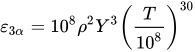
Where - the partial concentration of helium in the nucleus (in the case of hydrogen “burnout” under consideration, it is close to unity).

In the absence of degeneracy, an increase in temperature would lead to the expansion of the nucleus, a decrease in the density and equilibrium rate of the thermonuclear reaction, however, due to degeneracy, the temperature increases at an almost constant density, which leads to a constant increase in the energy release of the triple helium reaction in the nucleus until the temperature increases until degeneracy is removed at a given density.
A helium flash develops within a few minutes and the luminosity of the nucleus at the peak of the flash reaches 10 10 solar. After the degeneracy is removed, the nucleus expands rapidly, while the released thermal energy passes into potential energy. As a result, the luminosity of a star during a flash almost does not change. As a result of subsequent evolution, the radius of the outer shells decreases rapidly and the luminosity of the star decreases [1] .
| Nuclear processes |
|---|
Radioactive decay
Nucleosynthesis
|
See also
- White dwarf
- Red giant
- Degenerate gas
- Carbon detonation
Links
- Pogge, Richard W. The Once and Future Sun (English) (lecture notes) (1997). Date of treatment December 27, 2009. Archived August 22, 2011.
- Robin Ciardullo, Lection 23 Giants and Post-Giants: The Helium Flash // Astro 534, Penn State University