Prospekt Mira (until 1957, 1st Meshchanskaya Street , Troitskoye Highway , Bolshaya Alekseevskaya Street , Bolshaya Rostokinskaya Street and part of the Yaroslavl Highway ) - avenue in the north-east of Moscow . Located between Sukharevskaya Square on the Garden Ring, being a continuation of Sretenka , passing into the Yaroslavl highway [ style ] .
| Peace Avenue | |
|---|---|
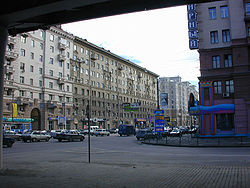 View of Mira Avenue from Riga Station | |
| general information | |
| A country | Russia |
| City | Moscow |
| County | TsAO , NEAD |
| Area | Meshchansky Marina Grove Alekseevsky Ostankino Sviblovo Rostokino |
| Length | 8.9 km |
| Underground |  " VDNH " " VDNH " Rostokino Rostokino |
| Former names | 1st Meshchanskaya street Trinity highway Bolshaya Alekseevskaya street Bolshaya Rostokinskaya street Yaroslavl highway |
| Name in honor | |


Content
- 1 History
- 2 Noteworthy buildings and structures
- 2.1 Odd
- 2.2 On the even side
- 3 Transport
- 4 notes
- 5 Literature
- 6 References
History

Since the XII century it was a road to Yaroslavl , along which stood the villages of Alekseevskoye, Rostokino and others. At the end of the XVII century, at the beginning of the modern Avenue of the World, the Meshchanskaya Sloboda arose (hence the former name of the street). In 1706, on the initiative of Peter I, the Pharmaceutical Garden (later the University Botanical Garden) was created. In the 1740s, the Krestovsky outpost of the Kamer-Kollezhsky shaft (now Riga Square ) was established, where the street ended. In 1770, the house of L.I. Dolgov was built (No. 16, architect V.I. Bazhenov , rebuilt in 1838), and at the end of the XVIII - beginning of the XIX centuries - house No. 50 (architect E. S. Nazarov).
Since the second half of the XIX century, the street was built up with tenement houses and mansions. At the end of the 19th century, houses No. 5 for the Perlovs tea dealers (architect R.I. Klein ) and No. 43a (architect F.O. Shekhtel ) were built, in 1885 - No. 3 (architect V.P. Zagorsky ), in 1909 - No. 30 belonging to I.K. Baev (architect V.I. Chagin ), where V. Ya. Bryusov lived in 1910. Now in house number 30 is the Silver Age Museum .
In 1931, the first Meshchanskaya street was paved with specialists of the American company Sibruk, but two years later the coating crumbled, unable to withstand temperature extremes [1] . In 1934, the street began to expand due to the elimination of tram tracks and the demolition of fences and front gardens next to houses; by September 1935, all tram tracks were transferred to the neighboring 2nd Meshchanskaya Street [2] [3] . Active reconstruction of the street began in 1936, when it was decided to transfer to the Ostankino area the construction site of the All-Union Agricultural Exhibition (it was originally planned to be arranged in the Koptevo area) [3] .
The development of a street reconstruction plan was entrusted to the 4th Architectural Planning Workshop (APU) of the Moscow City Council, led by architect G. B. Barkhin . As a basis, a draft design of the beam design, Dzerzhinsky Street - Sretenka - 1st Meshchanskaya, drawn up by the workshop back in 1933-1934, was envisaged, which provided for the large-scale destruction of all previous buildings on the 1st Meshchanskaya. The plan provided for the construction of 19-20 multi-section seven-story buildings between the Kolkhoznaya and Riga railway stations, for which it was planned to demolish 102 (out of a total of 172) small buildings that stood on 1st Meshchanskaya Street; It was decided to build up the preserved buildings to level the high-rise silhouette of the street [4] .
Due to the tight design and construction timelines (initially it was planned to open the All-Union Agricultural Exhibition already in 1937) and the lack of a detailed urban development plan, the reconstruction of 1st Meshchanskaya Street was almost left to chance: the architectural appearance of specific buildings began to be determined by the authors themselves, who often did not take into account the style buildings erected in the neighborhood and did not comply with the principle of ensemble development [5] . The street was divided into sections and assigned to the architects of APU No. 4 - D. D. Bulgakov , K. I. Dzhus-Danilenko , E. P. Egorov, V. N. Kolpakova, M. S. Zhirov, Maximov; architects and other workshops of the Moscow Soviet - S. G. Andrievsky (APU No. 6), architects V. I. Minkov and P. A. Nesterov in the workshop of D. F. Fridman (APU No. 5), A. G. Turkenidze ( APU No. 11) and others. In the spring of 1936, the first projects began to arrive in the design department of the Moscow Soviet. Most of them were immediately approved with minor adjustments, but a number of proposed solutions were still rejected. So, the project proposed by Konstantin S. Melnikov rejected the project of a house near the Botanical Garden, the buildings of which were connected by light arches similar to plants dried for herbarium, and the balconies looked like bouquets of flowers [6] .
In the 1930s, the reconstruction of 1st Meshchanskaya Street, Troitskoye Shosse, Bolshaya Alekseevskaya and Bolshaya Rostokinskaya Streets began in connection with the construction of the All-Union Agricultural Exhibition , in front of the northern entrance of which was installed a sculpture group by V. I. Mukhina “ Worker and Collective Farm Girl ” in 1939. In 1937, the new Big and Small Krestovsky viaducts were built .
In July 1941, units of the militia division of the Rostokinsky district were formed in houses 87 and 97.
In the 1930-1950s, mass housing construction began on the modern Avenue of the World (architects M.F. Gunger, K.I. Dzhus-Danilenko , M.S. Sherfetdinov, M.I. Pekarev, A.G. Rochegov , I I. Loveyko and others). In 1949, 800 poplars were planted along the street.
In 1957, the street was renamed Prospekt Mira: this event was timed to coincide with the International Student Youth Festival, held in Moscow [7] . In the same year, the Second Rostokinsky Bridge was built, and the 1st Meshchanskaya Street, its streets and a section of the Yaroslavl Highway, were merged into a single highway, built up in the 1960s and 1970s.
In the 1960s, Cosmonauts Alley was created on Mira Avenue . Since the early 1960s, mass construction has been ongoing in the area of the village of Alekseevsky and Rostokin. In 1999, the Novorizhsky overpass was built.
| Historical photographs | ||||||||||||
| ||||||||||||
Noteworthy buildings and structures
Street construction on both sides was opened by decorative towers attached to the corners of houses No. 1 and 2 in 1938 according to the project of architect M. Rubin. The towers were originally decorated with the number 1939, indicating the year of the opening of the All-Union Agricultural Exhibition; in the postwar years, they were rebuilt and replaced by the opening date of 1954 [8] . Until today, the tower on the right (even) side of the street has been preserved.
Odd side
- No. 1, architectural monument (newly identified object) - Romanov's inn. The building, built on the foundation of the XVIII century, belonged to the merchant K. D. Dudyshkin, then - the dynasty of innkeepers Bakastovs, who leased it to the innkeeper Romanov. In 1917, there were the revolutionary committee of the city district of the RSDLP (memorial plaque on the facade) and the District Council of Workers' Deputies, then - the district council and the district party committee and the Komsomol.
- No. 3, building one, architectural monument (newly identified object) - the apartment building of the merchant Kamzolkin (1885 on the basis of the city estate of the XVIII century, the architect - V.P. Zagorsky ).
- No. 5 - the house of the Perlovs tea dealers (1893, architect - R.I. Klein ).
- No. 7, p. 1; No. 9, p. 1 and No. 11, architectural monument (newly identified object) - ensemble of residential buildings of the People’s Commissariat of Communications (mid-19th century, architect - A. P. Beloyartsev ; 1937-1944, architect - D. D. Bulgakov ). Bulgakov connected and built up to the total height of two tenement houses standing on this place. Particularly elegant decoration of the side wall of the house is explained by the fact that, according to the Master Plan for the reconstruction of Moscow in 1935, a new highway was to pass here, connecting the Belorussky Station with Komsomolskaya Square [5] .
- No. 13 - a shelter of the Moscow Society for Charity, Education and Training for Blind Children with the Church of St. Mary Magdalene (1911-1912, architect - G. A. Gelrich ).
- No. 15 - Residential building of the Police Department (1938, architect K. I. Dzhus-Danilenko ) [5] , now the administrative building of the Moscow City Hall [9] .
- No. 17 - Meshchanskaya electric tram substation (1907-1912, architect - N. N. Sychkov ).
- No. 19 - the apartment building of A.F. Chulkov (Samgina’s gymnasium) (1903, architect - N.P. Matveev [10] ).
- No. 25, p. 1, architectural monument (regional) - the mansion of E. A. Svechina - S. F. Zimmerman - S. P. Morgunova (1st third of the 19th century, rebuilt in 1902 by architect A. S. Grebenshchikov [11] [12] ).
- No. 27 - a residential building (1951, architects - P. I. Skokan , G. S. Dukelsky, L. Inber, engineer N. Ivanov) [13] .
- No. 29, 31 - residential buildings (1949-1951, architects P. I. Skokan , G. S. Dukelsky). The chess player Yefim Geller lived in house number 29 [14] .
- No. 39 - the profitable house of P. P. Zolotov (1908, - architect F. F. Voskresensky ) [15] .
- No. 41, p. 1, architectural monument (federal) - City estate of E. A. Zarin - N. S. Dolgorukov - N. V. Kuznetsova (1793-1795, rebuilt in 1893 by architect I. S. Kuznetsov , sculptor - S. T. Konenkov ). From 1874 until his death in 1911, the “king of Russian porcelain” Matvey Kuznetsov and his family lived here (his wife, Nadezhda Vukolovna, owned the house until her death in 1903).
- No. 41, p. 2 - the engineering building of the Moscow Metro , an administrative building, an example of structuralism architecture.
- No. 43, architectural monument (regional) - the mansion of N.V. Kuznetsova (1895-1897, architect - F.O. Shekhtel with the participation of M.E. Priymyshev ). Built in and rebuilt.
- No. 45 - a residential building (1938, architect P. I. Frolov, S. G. Andrievsky) [5] .
- No. 49, the corner with Kapelsky Lane - the building of the USSR Ministry of Coal Industry (1949-1952, architects KM Metelsky, B. S. Vilenkin, B. S. Babiev, engineer I. V. Kazakov). Initially, in this place in 1947 it was decided to build a residential building of the Ministry of Procurement under the project of Z. M. Rosenfeld and V. M. Galkin, but later they abandoned this idea and erected a modern 14-story building resembling a high-rise building on Smolenskaya Square (now - Ministry of Foreign Affairs of Russia), deprived of a wedding [16] .
- No. 49a - the apartment building of V.V. Nazarevsky (1904, architect I.P. Mashkov ). The facade is decorated with tiles from the Abramtsevo workshop , designed by M. A. Vrubel [17]. It was partially rebuilt in 1914-1916 by the architect V. I. Motylev .
- No. 51 - a residential building built in 1937-1938 according to the project of the architect G. I. Glushchenko for TASS employees [8] . In the house lived the poet and translator Georgy Shengeli [18] , cameraman Sergey Urusevsky [19] , pianist Emil Gilels [20] .
- No. 53 - Residential building, based on the apartment building of M. Kanfel (1906, architect - V.E. Dubovsky ). It was rebuilt and superstructured in 1937 by the architects of APU No. 4 V. P. Egorov and V. N. Kolpakova [21] .
- No. 55 is a residential building built in the 1930s by architect Maximov [5] . It was added at the same time as neighboring building No. 53 and connected to it by a common facade.
- No. 71 - residential building of the Moscow-Volga Canal Management (1937, architects of APU No. 5 V. I. Minkov and P. A. Nesterov) [22] . Here lived the Soviet physicist, rector of Moscow State University Rem Khokhlov [23] .
- No. 73 - a residential building (1939, architect - L.O. Paper). After completion of construction in 1939, the architect's house was awarded the Moscow City Council Prize, awarded for the best building of the year [24] .
- No. 79 - the residential building has a special urban significance - marks the completion of the construction of the left side of the street in front of the Riga Station Square. Initially, the building began to be built in 1936 by order of the Housing-Rental Cooperative Partnership (ZhAKT) according to the project of architect M. G. Barkhin . However, shortly after the start of construction, the ZhAKT was replaced by house management, the requirements for the house changed, and the project was revised by the architect Raginsky. The obtained result again did not satisfy the customer and the design was transferred to P.I. Frolov and A.P. Golubev. The construction of the house was frozen and resumed several times; finally the building was ready only in 1939 [25] .
- No. 81 - residential building (1950s, architects V. S. [26] Andreev, G. M. Wulfson, L. S. Sherstneva, engineer L. A. Muromtsev) [27] . Here lived the puppeteer Marta Tsifrinovich .
- No. 85 - a residential building of the Ministry of Engineering was built in the 1950s according to the project of architects A. G. Turkenidze and V. G. Lazarev. In 1956, due to non-compliance with the construction technology, the house collapsed; was later restored [28] .
- No. 87 - the school building was built in 1935 according to the project of architect A.E. Arkin [29] . Nowadays - Gymnasium No. 1518.
- No. 95— a large-block school building was built in 1936 according to the project of architect A. N. Dushkin [29]
- No. 99, 103 - large-block residential buildings (early 1950s, architects I. I. Loveyko (manager), S. Khanin, B. Brailovsky, engineers A. A. Rumyantsev, I. I. Turkov) [30] [31 ] ] . Hockey player V. N. Elizarov lived in house number 103 [32] .
- No. 101 - a school building for 1,500 students was built in 1931-1933 according to the project of architects A. I. Antonov and S. V. Semenov [29] [33] . Nowadays - Financial University under the Government of the Russian Federation.
- No. 105 - Goznak's printing plant was built in 1936-1938 according to the project of the architect M. L. Zilbergleit, engineers K. I. Abramovich and S. B. Kaganovich. The neoclassical building is decorated with reliefs with allegories that embody the right of Soviet citizens to work, education and rest [34] .
- No. 111, architectural monument (federal) - a monument in honor of space explorers and a monument to Konstantin Tsiolkovsky (1964, sculptor A.P. Faydysh-Krandievsky , architects A.N. Kolchin and M.O. Barshch ).
- No. 119 (numerous buildings) - pavilions of VDNH .
- No. 125, p. 1 - the building of the Mostechfilm film studio (1939-1941, architects I. Golosov , P. Antonov, A. Zhuravlev, M. Khomutov) [35]
On the even side
- No. 2 - the building of the former Partnership " Paul Malyutin Sons."
- No. 4 - possessions of E. M. Asikritova (perestroika and outbuildings of 1909, architect - S. F. Kulagin ).
- No. 12, p. 2, architectural monument (federal) - the house of Ivan Isaev, which is traditionally associated with the name of Jacob Bruce (XVIII century), but there is no evidence for this. The main house of the early XIX century. (a memorial plate on the building).
- No. 14, p. 1, architectural monument (regional) - a residential building with benches by A. Ya. Shamardin - L. A. Gurevich (1860s).
- No. 14, p. 10, monument of architecture (federal) - the house of the late XVIII century.Here in the Ganshin’s apartment there was an underground printing house, where in the beginning of October 1894 the works of V. I. Ulyanov-Lenin were illegally printed .
- No. 16, p. 1, architectural monument (federal) - the house of L. I. Dolgov in the style of classicism (1770). The authorship of the original building is attributed to V.I. Bazhenov , to whom Dolgov was a father-in-law. The house burned down during the Moscow fire of 1812 acquired a modern look in 1838 [36] .
- No. 16, p. 2, an architectural monument (a newly identified object) - a residential wing of the Dolgovy estate (late 18th – 19th centuries).
- № 20 — особняк В. А. Арацкого (1909, архитектор — П. П. Висневский , совместно с Александром и Виктором Весниными ).
- № 20, корп. one, памятник архитектуры (федеральный) — дом Долговых (1770-е). В 1865—1897 годах здесь жил и работал врач Г. А. Захарьин .
- № 20, корп. 2 — часовня Серафима Саровского при подворье Троицкого Серафимо-Дивеевского монастыря (2011; в основе здание 1911—1912 гг., архитектор — П. В. Харко ).
- № 22, стр. 1, памятник архитектуры (региональный) — жилой дом А. П. Богданова (1901—1902, архитектор — Анатолий Гунст ) [37] [38]
- № 24 — жилой дом (1911, архитектор — Г. Н. Кручинин ).
- № 26, памятник архитектуры (региональный) — Аптекарский огород , филиал Ботаническиого сада МГУ . Зелёные насаждения занимают 6,3 гектара.
- № 30, стр. 1, памятник архитектуры (федеральный) — дом И. К. Баева (1909, архитектор — В. И. Чагин [39] ). Начиная с 1910 года и до своей смерти в 1924 году здесь жил поэт Валерий Брюсов .
- № 30, стр. 2, памятник архитектуры (вновь выявленный объект) — хозяйственный корпус (1895, архитектор — В. И. Чагин ).
- № 36 — доходный дом (1910, архитектор — Сергей Чернавский ).
- № 38 — Тринадцатиэтажный жилой дом возведён по заказу управления Московского метрополитена в 1950—1953 годах по проекту архитекторов А. Е. Аркина , А. В. Машинского и инженера Н. Иванова. В центральную часть постройки изначально был включён вестибюль станции Кольцевой линии метрополитена «Ботанический сад» (ныне — « Проспект Мира »). Здание примкнуло к построенному ранее соседнему дому № 40, который превратился в левое крыло обширного комплекса. Дореволюционный доходный дом справа (№ 36) предполагали надстроить и заново отделать, чтобы он также воспринимался единым целым с домом № 38, однако эти планы не были реализованы [40] .
- № 40, памятник архитектуры (вновь выявленный объект) — жилой дом Наркомата совхозов (1938, архитектор — И. Н. Соболев при участии А. В. Апостоловой, архитектурная мастерская Михаила Парусникова ). Дом представляет собой первую очередь огромного комплекса, который должен был протянуться до Ботанического сада, однако в связи с началом Великой отечественной войны планы реализованы не были [41] [42] .
- № 46а — жилой дом (1927—1928, архитектор — А. Я. Лангман ). Здесь жил шахматист Михаил Ботвинник [43] .
- № 48 — Жилой дом построен по проекту архитекторов А. В. Пекарева и М. С. Шерфединова. Его сооружение начали в 1936 году — первым из возводимых в ходе реконструкции 1-й Мещанской улицы зданий. Первую очередь дома, которая предназначалась для сотрудников Артиллерийской академии, завершили в 1938 году, вторую (первоначально для ОГИЗа , затем — Наркомата электростанций) начали строить в 1940-м, а завершили в 1946 году [8] .
- № 48, стр. 3 (во дворе) — Учебный корпус Рабфака имени М. И. Калинина построен в 1934 году по проекту архитектора К. П. Афанасьева. Позднее в здании размещалась Высшая пограничная школа [44]
- № 50, памятник архитектуры (федеральный) — дом Ф. Ф. Набилкова, затем — Набилковское коммерческое училище (1816—1817, на основе строения конца XVIII века, архитектор — Е. С. Назаров ).
- № 52, памятник архитектуры (региональный) — особняк И. Д., Н. К., С. К. и А. К. Баевых со службами (1910, архитекторы — И. С. Кузнецов и В. И. Чагин ). Здание занимает посольство Замбии в России .
- № 52, стр. 1, памятник архитектуры (вновь выявленный объект) — жилой дом, часть ансамбля городской усадьбы Баевых (1896, архитектор — В. И. Чагин ).
- № 52, стр. 2, памятник архитектуры (вновь выявленный объект) — жилой дом, часть ансамбля городской усадьбы Баевых (1816, перестраивался в 1867, архитектор — И. В. Штром ).
- № 52, стр. 4, памятник архитектуры (вновь выявленный объект) — жилой дом, часть ансамбля городской усадьбы Баевых (1910, архитектор — И. С. Кузнецов ; 1933, архитектор — И. А. Фомин ).
- № 54 — жилой дом по проекту архитектора А. В. Власова начали строить в 1940 году для сотрудников завода имени Коммунистического интернационала (КИМ). Летом 1941 года в связи с началом войны работы остановили; закончили строительство лишь в 1946 году — для работников Министерства транспортного машиностроения [45]
- № 56 — Жилой дом (1933, архитектор Г. И. Глушенко) [46] . В рамках гражданской инициативы « Последний адрес » на доме установлены мемориальные знаки с именами инженера Тевеля Львовича Каплинского [47] , расстрелянного органами НКВД в годы сталинских репрессий и юриста Николая Леонидовича Веймарна [48] , скончавшегося от паралича сердца 16 декабря 1939 года в Севвостлаге на Колыме . В базе данных правозащитного общества « Мемориал » есть имена 24-х жильцов этого дома, расстрелянных в годы террора [49] . Число погибших в лагерях ГУЛАГа не установлено.
- № 62 — доходный дом (1905, архитектор — Роман Клейн ).
- № 68 — жилой дом сотрудников Наркомвода (1937) [50] [51] . Здесь в 1956—1987 годах жил лётчик-испытатель П. Ф. Чупиков [52] , в 1964—1986 годах — художник-график Л. В. Шепелев [53] .
- № 70 — жилой дом построен в 1952 году по проекту архитекторов А. В. Машинского и Б. С. Мезенцева [54] . Здесь жил учёный-механик С. А. Шестериков [55] .
- № 70а (стоит по Переяславскому переулку ) — жилой дом. Здесь в 1935—1959 годах жили климатолог Е. Е. Фёдоров [56] , геолог С. С. Соболев [57] .
- № 74 — первоначальный эскизный проект жилого дома выполнили в 1946 году архитекторы А. А. Зубин и А. Е. Яковлев. В 1948 году технический проект дома на 122 квартиры по заказу Минтяжмаша выполнили А. А. Зубин, Н. И. Хлынов и А. И. Рочегов . Строительство дома было закончено в 1952 году [54] .
- № 76—78 — как и здание напротив (№ 79), жилой дом, оформляющий окончание первого отрезка проспекта (бывшее окончание 1-й Мещанской улицы), несколько раз перепроектировали. Первоначально с конца 1930-х годов над проектом дома (в настоящее время № 76) работали архитекторы М. Г. Куповский (АПМ № 6) и А. В. Кулагин (Трансгражданпроект). Когда выяснилось, что архитектурный облик здания не согласуется с окружением, надзор за проектированием поручили М. Г. Бархину — архитектору дома № 79. Начатое строительство несколько раз останавливали и возобновляли. Окончательно здание достроили лишь в 1952 году по проекту, разработанному в 1950 году архитектором А. М. Горбачёвым. Здание было построено в укороченном виде и завершалось глухим неприглядным брандмауэром , что входило в противоречие с достроенным к тому времени домом № 79 и не отвечало градостроительной роли здания. Спустя несколько лет торец дома скрыл пристроенный вплотную дом № 78, выстроенный для Управления охраны железных дорог по проекту А. М. Горбачёва [58] . Руководитель мастерской Моспроекта-1 В. С. Андреев, занимавшийся в 1950-х годах реконструкцией магистрали, посчитал выстроенные к тому времени дома № 76—78 маловыразительными и стилистически не увязанными с домом № 79, и разработал проект строительства новых архитектурных доминант, оформляющих окончание первого отрезка улицы (на месте современной Рижской эстакады ), однако эти планы реализованы не были [59] . В доме № 74 жил писатель С. С. Смирнов (мемориальная доска, 1983, архитектор В. А. Климов) [60] .
- № 82—88 — жилой дом (1930-е, архитектор М. С. Жиров) [61]
- № 98—112 — жилой дом (1930-е, архитектор Н. И. Транквилицкий) [61]
- № 102 — административное здание Машгиза (1954—1955, архитектор В. А. Бутузов ) [62]
- № 102, корп. 36 памятник архитектуры (федеральный) — северный флигель Пятницкого кладбища (XIX век).
- No. 108 - a ten-story residential building (1950s, architects Y. A. Air-Babamyan, V. Yu. Brandenburg, V. N. Sokolova, engineer G. V. Chernysheva) [62] . The physicist E. L. Feinberg [63] and the scout A. S. Feklisov [64] lived here.
- No. 110 - 17-storey residential building (1966, architects T. Zaikin, I. Belavin) - one of the first buildings in Moscow from self-supporting panels [65]
- % 116 - a residential building designed by architect M.K. Dormidontov began to be built in 1939, but work was suspended when the war began. In the postwar years, the house was completed in a truncated version [66] .
- No. 116-b - a residential building. Here lived the composer P. K. Aedonitsky (in 1963-2003) [67] , the animated film director A. G. Snezhko-Blotskaya [68] .
- No. 118–122 - large-block apartment buildings (1956 architects I. I. Loveyko (manager), S. Khanin, B. Brailovsky, engineers A. A. Rumyantsev, I. I. Turkov [30] [31] . In house 118 lived acoustics scientist VV Furduyev [69] ; hockey player Valery Kharlamov [70] lived in house number 118a, and V. V. Struminsky , a scientist in the field of aerodynamics and aircraft [71] , lived in house number 122 in 1979-1987 lived astronaut K. P. Feoktistov [72] .
- No. 124 - the residential complex of the People's Commissariat of Industry - an extended residential building, composed of several buildings of various heights, was built in 1936-1938 according to the project of architect M. Gunger [73] . In building 16, there lived a historian of construction and construction equipment, a Moscow scholar Georgy Scherbo [74] .
- No. 126 - the office of the Zvezda TV channel (since 2007) [75] .
- No. 128 - the school building was built in 1936 according to the project of the architect K. S. Ryzhkov [29] . Nowadays - school number 279.
- No. 130, architectural monument (federal) - Tikhvin Church (1676–1682).
- No. 150 - Cosmos Hotel (1980, architects V. Andreev, T. Zaikin, V. Steyskal, engineers I. Samosonov, N. Ivanov and others; from the French side, O. Kakub, P. Jugle, S. Epstein) [76]
- No. 184, building one, an architectural monument (regional) - a residential building of the Supreme Council of the National Economy (VSNH) (1955-1957, architects I. V. Zholtovsky , M. Kruglov, B. Lazarev) [77] .
- No. 184, building 2 - high-rise panel house (1969, architects V. Andreev, T. Zaikin) [65] . Here lived the Soviet chess player Mikhail Yudovich [78] , the hockey player Viktor Singer [79] .
- No. 186, building 2 architectural monument (newly identified object) - a club complex with a hostel of the former Cotton Factory (1928, architects M. Ya. Ginsburg , S. A. Lisagor ) [46] .
architectural monument (federal) : also parallel to Prospect Mira, near the 2nd Rostokinsky bridge (in the VDNH area) is the Rostokinsky aqueduct across the Yauza (1779-1785, engineers F.V. Bauer and I.K. Gerard ).
Transport
- Metro Station Sukharevskaya , Prospect Mira / Prospect Mira , Riga , Alekseevskaya , ENEA .
- Bus routes run along Prospect Mira, tram routes from Boris Galushkin Street to Severyaninsky Bridge.
- Buses
- m2 : Riga Station - Prospect Mira / Prospect Mira - Sukharevskaya - Lubyanka - Library named after Lenin / Arbat - Kutuzovskaya - Victory Park - Bagrationovskaya - Fili
- M9 Vladykino / Vladykino - ENEA - Alekseevskaya - Riga Station - Prospect Mira / Prospect Mira - Sukharevskaya - Lubyanka - Kitay Gorod (also short flights to VDNH and Kapelsky Lane)
- t14 : Northerner platform - Rostokino - ENEA - Alekseevskaya - Riga Station - Komsomolskaya / Komsomolskaya - Electrozavodsky bridge
- t76 : Kholmogorskaya street - Rostokino - ENEA
- 33 Vladykino - Botanical Garden - ENEA - Alekseevskaya - Riga Station
- 56 : VDNH -North - VDNH - pl. Yauza
- 85 VDNH Hotels - Vladykino / Vladykino - ENEA - Alekseevskaya - Riga Station - Kapelsky Lane
- 93 : VDNH -North - VDNH - Northerner platform - Rostokino - Medvedkovo
- 136 : VDNH -North - ENEA - Rostokino - Lianozovo Platform
- 172 : Riga Station - Alekseevskaya - ENEA - Rostokino - Medvedkovo
- 195 : VDNH -North - ENEA - Botanical Garden / Botanical Garden - Rusanova Drive
- 244 : VDNH- South - ENEA - Rostokino - Fedoskinskaya street
- 286 : VDNH - Pavel Korchagin Street
- 375 : ENEA - Rostokino - Platform Elk
- 379 : Hotel Ostankino - ENEA - Alekseevskaya - Riga Station - Groholsky Lane
- 496 : VDNH - Moscow City Council
- 544 : VDNH- South - ENEA - Rostokino - Roterta Street
- 714 Riga Station - Pavel Korchagin Street
- 714k Alekseevskaya - Pavel Korchagin Street
- 789 : Kholmogorskaya street - Rostokino (only in the direction of Kholmogorskaya street) - Botanical Garden / Botanical Garden
- 834 : VDNH South - ENEA - Rostokino - Street Red Pine
- 903 : Kholmogorskaya street - Rostokino - ENEA - Alekseevskaya - Riga Station - Prospect Mira - Peace Avenue
- 903k : Kholmogorskaya street - Rostokino - ENEA
- H6 : Ostashkovskaya street - Medvedkovo - Grandmother's - Sviblovo - Botanical Garden / Botanical Garden - ENEA - Riga Station - Prospect Mira - Prospect Mira - Sukharevskaya - Lubyanka - China town
- Trams
- 17 : Medvedkovo - Babushkinskaya - Northerner platform - Rostokino - VDNH - Ostankino
Notes
- ↑ Rogachev, 2015 , p. 37.
- ↑ Dlugach V.L., Portugalov P.A. Inspection of Moscow. Guide. - 2nd. - M .: Moscow Worker, 1938 .-- S. 165. - 267 p.
- ↑ 1 2 Rogachev, 2015 , p. 38.
- ↑ Rogachev, 2015 , p. 38-40.
- ↑ 1 2 3 4 5 Rogachev, 2015 , p. 41.
- ↑ Rogachev, 2015 , p. 41-44.
- ↑ Smolitskaya, 1982 , p. 114.
- ↑ 1 2 3 Rogachev, 2015 , p. 47.
- ↑ Geidor T., Kazus I. Styles of Moscow architecture. - M .: Art — XXI century, 2014 .-- S. 360. - 616 p. - ISBN 978-5-98051-113-5 .
- ↑ Nashchokina M.V. Moscow Art Nouveau. - 2nd ed. - M .: Giraffe, 2005 .-- S. 406. - 560 p. - 2500 copies. - ISBN 5-89832-042-3 .
- ↑ Nashchokina M.V. Moscow Art Nouveau. - 2nd ed. - M .: Giraffe, 2005 .-- S. 344. - 560 p. - 2500 copies. - ISBN 5-89832-042-3 .
- ↑ Register of historical and cultural monuments . The official website of the Moscow Heritage. Date of treatment October 2, 2011. Archived February 16, 2012.
- ↑ Rogachev, 2015 , p. 59-60.
- ↑ Geller Efim Petrovich // Moscow Encyclopedia. / Ch. ed. S.O. Schmidt . - M. , 2007-2014. - T. Volume I. Faces of Moscow : [in 6 books].
- ↑ Nashchokina M. B. Architects of Moscow Art Nouveau. Creative portraits . - 3rd ed. - M .: Giraffe , 2005 . - S. 128. - 2500 copies. - ISBN 5-89832-043-1 .
- ↑ Rogachev, 2015 , p. 63.
- ↑ Nashchokina M.V. , Arzumanova O. I., Lyubartovich V. A. Ceramics Abramtseva in the meeting of Moscow State University of Environmental Engineering. - M .: Giraffe, 2000 .-- S. 101 .-- 224 p. - 3000 copies. - ISBN 5-89832-017-2 .
- ↑ Shengeli Georgy Arkadievich // Moscow Encyclopedia. / Ch. ed. S.O. Schmidt . - M. , 2007-2014. - T. Volume I. Faces of Moscow : [in 6 books].
- ↑ Urusevsky Sergey Pavlovich // Moscow Encyclopedia. / Ch. ed. S.O. Schmidt . - M. , 2007-2014. - T. Volume I. Faces of Moscow : [in 6 books].
- ↑ Gilels Emil Grigorievich // Moscow Encyclopedia. / Ch. ed. S.O. Schmidt . - M. , 2007-2014. - T. Volume I. Faces of Moscow : [in 6 books].
- ↑ Rogachev, 2015 , p. 41, 49.
- ↑ Rogachev, 2015 , p. 48.
- ↑ Khokhlov Rem Viktorovich // Moscow Encyclopedia. / Ch. ed. S.O. Schmidt . - M. , 2007-2014. - T. Volume I. Faces of Moscow : [in 6 books].
- ↑ Rogachev, 2015 , p. 51.
- ↑ Rogachev, 2015 , p. 57-58.
- ↑ Tsifrinovich Marta Vladimirovna // Moscow Encyclopedia. / Ch. ed. S.O. Schmidt . - M. , 2007-2014. - T. Volume I. Faces of Moscow : [in 6 books].
- ↑ Rogachev, 2015 , p. 77.
- ↑ Rogachev, 2015 , p. 78-79.
- ↑ 1 2 3 4 Rogachev, 2015 , p. 72.
- ↑ 1 2 Master of complex development (inaccessible link) . Moscow architecture. Date of treatment January 5, 2014. Archived on January 6, 2014.
- ↑ 1 2 Rogachev, 2015 , p. 74-75.
- ↑ Elizarov Vladimir Nikolaevich // Moscow Encyclopedia. / Ch. ed. S.O. Schmidt . - M. , 2007-2014. - T. Volume I. Faces of Moscow : [in 6 books].
- ↑ Rogachev, A.V. The Great Buildings of Socialism. - M .: Centerpolygraph, 2014 .-- S. 48. - 480 p. - ISBN 978-5-227-05106-6 .
- ↑ Rogachev, 2015 , p. 71-72.
- ↑ Rogachev, 2015 , p. 74.
- ↑ Geidor T., Kazus I. Styles of Moscow architecture. - M .: Art — XXI century, 2014 .-- S. 81. - 616 p. - ISBN 978-5-98051-113-5 .
- ↑ Moscow, which is / I.A.Savina, M.V. Lyapina, E.I. Stepanova. - M .: CJSC United Humanitarian Publishing House, 2012. - S. 218. - ISBN 978-5-94282-690-1 .
- ↑ Register of historical and cultural monuments . The official website of Moskomnaslediya . Date of treatment December 26, 2010. Archived February 29, 2012.
- ↑ Nashchokina M.V. Moscow Art Nouveau. - 2nd ed. - M .: Giraffe, 2005 .-- S. 500 .-- 560 s. - 2500 copies. - ISBN 5-89832-042-3 .
- ↑ Rogachev, 2015 , p. 63-64.
- ↑ Rogachev, 2015 , p. fifty.
- ↑ Monuments of architecture of Moscow. Moscow architecture 1933-1941 / Author-comp. N.N. Bronovitskaya. - M .: Art — XXI century, 2015 .-- S. 134. - 320 p. - 250 copies. - ISBN 978-5-98051-121-0 .
- ↑ Moscow Encyclopedia / S.O. Schmidt . - M .: Publishing Center "Moskvovedenie", 2007. - T. I, Faces of Moscow. - S. 216. - 639 p. - 10,000 copies. - ISBN 978-5-903633-01-2 .
- ↑ Rogachev, 2015 , p. 54.
- ↑ Rogachev, 2015 , p. 51-52.
- ↑ 1 2 Vasiliev N. Yu., Evstratova M.V., Ovsyannikova E. B., Panin O. A. Architecture of the avant-garde. The second half of the 1920s - the first half of the 1930s. - M .: S. E. Gordeev , 2011 .-- S. 284, 285. - 480 p. .
- ↑ Moscow, Prospect Mira, 56, p. 2 (formerly 1st Meshchanskaya, d. 66/68). May 15, 2016 Last Address website.
- ↑ Moscow, Prospect Mira, 56, p. 2 (formerly 1st Meshchanskaya, d. 66/68). October 22, 2017 Last Address website.
- ↑ Database "Victims of Political Terror in the USSR" Shot in Moscow at addresses.
- ↑ Dlugach V.L., Portugalov P.A. Inspection of Moscow. Guide. - 2nd. - M .: Moscow Worker, 1938 .-- S. 166. - 267 p.
- ↑ Rogachev, 2015 , p. 49.
- ↑ Chupikov Pavel Fedorovich // Moscow Encyclopedia. / Ch. ed. S.O. Schmidt . - M. , 2007-2014. - T. Volume I. Faces of Moscow : [in 6 books].
- ↑ Shepelev Lev Viktorovich // Moscow Encyclopedia. / Ch. ed. S.O. Schmidt . - M. , 2007-2014. - T. Volume I. Faces of Moscow : [in 6 books].
- ↑ 1 2 Rogachev, 2015 , p. 60.
- ↑ Shesterikov Sergey Alexandrovich // Moscow Encyclopedia. / Ch. ed. S.O. Schmidt . - M. , 2007-2014. - T. Volume I. Faces of Moscow : [in 6 books].
- ↑ Fedorov Evgraf Evgrafovich // Moscow Encyclopedia. / Ch. ed. S.O. Schmidt . - M. , 2007-2014. - T. Volume I. Faces of Moscow : [in 6 books].
- ↑ Sobolev Sergey Stepanovich // Moscow Encyclopedia. / Ch. ed. S.O. Schmidt . - M. , 2007-2014. - T. Volume I. Faces of Moscow : [in 6 books].
- ↑ Rogachev, 2015 , p. 55-58.
- ↑ Rogachev, 2015 , p. 62.
- ↑ Smirnov Sergey Sergeevich // Moscow Encyclopedia. / Ch. ed. S.O. Schmidt . - M. , 2007-2014. - T. Volume I. Faces of Moscow : [in 6 books].
- ↑ 1 2 Rogachev, 2015 , p. 44.
- ↑ 1 2 Rogachev, 2015 , p. 76.
- ↑ Feinberg Evgeny Lvovich // Moscow Encyclopedia. / Ch. ed. S.O. Schmidt . - M. , 2007-2014. - T. Volume I. Faces of Moscow : [in 6 books].
- ↑ Feklisov Alexander Semenovich // Moscow Encyclopedia. / Ch. ed. S.O. Schmidt . - M. , 2007-2014. - T. Volume I. Faces of Moscow : [in 6 books].
- ↑ 1 2 Rogachev, 2015 , p. 79.
- ↑ Rogachev, 2015 , p. 71.
- ↑ Moscow Encyclopedia / S.O. Schmidt . - M .: Publishing Center "Moskvovedenie", 2007. - T. I, Faces of Moscow. - S. 26. - 639 p. - 10,000 copies. - ISBN 978-5-903633-01-2 .
- ↑ Snezhko-Blotskaya Alexandra Gavrilovna // Moscow Encyclopedia. / Ch. ed. S.O. Schmidt . - M. , 2007-2014. - T. Volume I. Faces of Moscow : [in 6 books].
- ↑ Furduev Vadim Vladimirovich // Moscow Encyclopedia. / Ch. ed. S.O. Schmidt . - M. , 2007-2014. - T. Volume I. Faces of Moscow : [in 6 books].
- ↑ Kharlamov Valery Borisovich // Moscow Encyclopedia. / Ch. ed. S.O. Schmidt . - M. , 2007-2014. - T. Volume I. Faces of Moscow : [in 6 books].
- ↑ Struminsky Vladimir Vasilievich // Moscow Encyclopedia. / Ch. ed. S.O. Schmidt . - M. , 2007-2014. - T. Volume I. Faces of Moscow : [in 6 books].
- ↑ Feoktistov Konstantin Petrovich // Moscow Encyclopedia. / Ch. ed. S.O. Schmidt . - M. , 2007-2014. - T. Volume I. Faces of Moscow : [in 6 books].
- ↑ Rogachev, 2015 , p. 71, 73.
- ↑ Shcherbo Georgy Mikhailovich // Moscow Encyclopedia. / Ch. ed. S.O. Schmidt . - M. , 2007-2014. - T. Volume I. Faces of Moscow : [in 6 books].
- ↑ The Zvezda channel began broadcasting from the new digital Television Technical Complex . Media-online (July 5, 2007).
- ↑ Rogachev, 2015 , p. 86.
- ↑ Rogachev, 2015 , p. 85.
- ↑ Yudovich Mikhail Mikhailovich // Moscow Encyclopedia. / Ch. ed. S.O. Schmidt . - M. , 2007-2014. - T. Volume I. Faces of Moscow : [in 6 books].
- ↑ Singer Victor Alexandrovich // Moscow Encyclopedia. / Ch. ed. S.O. Schmidt . - M. , 2007-2014. - T. Volume I. Faces of Moscow : [in 6 books].
Literature
- Rogachev A.V. Prospectus of Soviet Moscow. The history of the reconstruction of the main streets of the city. 1935-1990. - M .: Tsentrpoligraf, 2015 .-- 448 p. - ISBN 978-5-227-05721-1 .
- Smolitskaya G.P., Gorbanevsky M.V. Toponymy of Moscow / ed. Ivanova V.V. - Moscow: Nauka, 1982. - S. 114-117. - 176 p.
Links
- Street map
- The Federal Property Management Agency faced the risk of losing dozens of historic buildings . dom.lenta.ru (March 29, 2012). Date of treatment March 29, 2012.