Mexican puffer [1] [2] , or escorpion [3] , or tolahini [3] ( lat. Heloderma horridum ) is a poisonous lizard of the puffer family.
| Mexican puffer | ||||||||||||||||
|---|---|---|---|---|---|---|---|---|---|---|---|---|---|---|---|---|
 | ||||||||||||||||
| Scientific classification | ||||||||||||||||
| ||||||||||||||||
| Latin name | ||||||||||||||||
| Heloderma horridum Wiegmann , 1829 |
Security status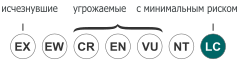 IUCN 3.1 Least Concern : 9864 |
Content
Description
Appearance
It differs from the vestment in larger sizes (old individuals reach almost 90 cm in length, of which almost half occupies the tail, and weights up to 4.5 kg), as well as a darker color with spots and stripes of yellow tones, usually not forming the correct transverse pattern . There are also monochromatic, grayish-brown and almost black specimens. The back is covered with scales. The lower teeth are poisonous: the salivary glands located under the lower jaw produce poison.
Distribution
Distributed on the coast of the Gulf of California in western and southwestern Mexico , penetrating about 275 km inland. In the south of the range, it penetrates into Guatemala ( subspecies Heloderma horridum alvarezi and Heloderma horridum charlesbogerti ), and in the north a relatively small population (subspecies Heloderma horridum exasperatum ) lives on the border of the Mexican states of Sonora and Sinaloa .
Inhabits semi-arid rocky terrain; It is found at the bottom of canyons , in dry riverbeds and in light forests.
In the afternoon, the escortion hide in holes that they dig for themselves or occupy those that other animals left. They may not creep out and spend here motionless for several days. They begin to move with the onset of darkness, but so slowly that they can neither escape nor pursue [4] .
Nutrition
It hunts snakes, small rodents, other lizards, birds and bird eggs. Stocks of fat are deposited in the tail.
Reproduction
Breeding season - in February – March; after 2 months, the female lays 3–13 slightly oblong eggs, digging them to a depth of 12 cm; incubation lasts 6 months.
Guard Status
The Mexican pufferfish has few enemies besides coyotes , some birds of prey, and humans.
The number of escort is relatively stable, but in some places decreases due to the destruction of habitats. Of particular concern is the condition of the isolated narrowly subspecies subspecies Heloderma horridum charlesbogerti , which lives in the dry forests of the Motagua Valley in northeast Guatemala. The abundance of this endemic subspecies of the Mexican puffer in nature does not exceed 200 individuals. Heloderma horridum charlesbogerti is one of the rarest and endangered lizards of the world fauna .
Mexican pufferfish is listed in the IUCN Red List and CITES Convention on International Trade.
Classification
The species forms 4 subspecies [5] :
- Heloderma horridum horridum - distributed in Mexico from Sonora to Oaxaca
- Heloderma horridum alvarezi - distributed in the Mexican state of Chiapas and in northwestern Guatemala; among the lizards of this subspecies, monochromatic dark-colored, almost black specimens are often found
- Heloderma horridum exasperatum - distributed from the southern part of Sonora to the northern part of Sinaloa
- Heloderma horridum charlesbogerti - lives only in the Motagua Valley in northeast Guatemala
The ranges of the three subspecies overlap, and Heloderma horridum charlesbogerti is isolated from other subspecies.
See also
- Housing
- Maw teeth
Notes
- ↑ Darevsky I.S. , Orlov N.L. Rare and endangered animals. Amphibians and reptiles: Ref. allowance / ed. V. E. Sokolova . - M .: Higher school, 1988. - S. 297. - 463 p., [16] p. silt - 100,000 copies. - ISBN 5-06-001429-0 .
- ↑ A systematic list of vertebrates in zoological collections on 01/01/2012 // Andreeva T.F., Vershinina T.A., Goretskaya M. Ya., Karpov N.V., Kuzmina L.V., Ostapenko V.A., Sheveleva V.P. Informational collection of the Eurasian Regional Association of Zoos and Aquariums. Issue No. 31. Volume II. Mezhved. collection. scientific and scientific method. tr / Ed. V.V. Spitsina. - M.: Moscow Zoo, 2012 .-- S. 264. - 570 p. ISBN 978-5-904012-37-3 PDF Archived May 24, 2013.
- ↑ 1 2 Ananyeva N. B. , Borkin L. Ya. , Darevsky I.S. , Orlov N.L. The Pyatiling Dictionary of Animal Names. Amphibians and reptiles. Latin, Russian, English, German, French. / edited by Acad. V. E. Sokolova . - M .: Rus. Yaz., 1988 .-- S. 205 .-- 10,500 copies. - ISBN 5-200-00232-X .
- ↑ Large Atlas of animals / per. with ital. L.V. Zoloeva. - M .: Astrel, AST, 2001 .-- S. 126. - 256 p. - ISBN 5-17-005253-7 . - ISBN 5-271-01295-6 .
- ↑ The Reptile Database: Heloderma horridum
Literature
- Darevsky I.S., Orlov N.L. Rare and endangered animals. Amphibians and reptiles: Ref. allowance. - M .: Higher. Shk., 1988 .-- S. 297.
- The life of animals in 7 tons / Ch. Editor V.E. Sokolov. T. 5. Amphibians and reptiles. / A. G. Bannikov, I. S. Darevsky, M. N. Denisova and others ; under the editorship of A. G. Bannikova - 2nd ed., Rev. - M .: Education, 1985 .-- S. 253.
- Ariano-Sánchez, D. 2008. Envenomation by a wild Guatemalan beaded lizard Heloderma horridum charlesbogerti . Clinical toxicology 46 (9): 897-899. [one]
- Ariano-Sánchez, D. 2006. The Guatemalan beaded lizard: endangered inhabitant of a unique ecosystem. Iguana 13: 178-183. [2]
- Ariano-Sánchez, D. & G. Salazar. 2007. Notes on the distribution of the endangered lizard, Heloderma horridum charlesbogerti , in the dry forests of eastern Guatemala: an application of multi-criteria evaluation to conservation. Iguana 14: 152-158. [3]