The Wolf-Oboroten [1] [2] [3] [4] [5] , werewolf ( German Werwolf ) [6] , werewolf ( English werewolf ), lycanthrope [7] ( Greek λυκάνθρωπος [8] ), the wolf-man [9] [10] ( English wolfman ), in the Slavic tradition of wolkolak [6] - in mythology and works of art a person who for a certain period has turned or is able to turn into a wolf . The term lycanthropy is used to indicate this ability.
| Werewolf, werewolf, lycanthrope | |
|---|---|
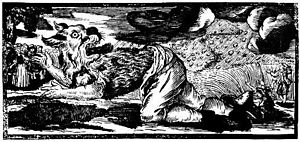 German engraving of 1722 | |
| a person transformed for a certain period of time or able to turn into a wolf | |
| Mythology | mythologies of the peoples of Eurasia and North America |
| Related characters | other werewolves |
Beliefs in werewolves were prevalent everywhere wolves lived, that is, in Eurasia and North America, and in European folklore, werewolves were the most popular type of werewolves. Werewolf stories were found in ancient Greece and ancient Rome , Scandinavian sagas and medieval poetry . In the French and German-speaking countries in the late Middle Ages, werewolf was equated with witchcraft and a hunt for werewolves was launched, as a result of which hundreds of people were executed. Since the 19th century, werewolves have become popular characters in works of art. The sources of ideas about werewolves are sought in humans, by their appearance or behavior resembling wolves, in ancient mythological representations and in psychology.
In general, mythical and artistic werewolf wolves can be divided into three types: those that can be transformed at will by magical means (for example, an enchanted belt or skin, magic ointment), which turn periodically and uncontrollably (usually at night) and turn into wolves by sorcerers or higher powers. A werewolf can be a person of any gender and age. In the wolf form, the werewolves appeared as ordinary wolves, although often more and stronger than the average. It was believed that the wound inflicted on the werewolf, is preserved in the human form. In myths and in fiction, lycanthropes can be represented as evil creatures that harm people, as well as positive and even heroic characters.
The spread of myth
The idea of turning into wolves was found almost everywhere where these animals lived [11] , that is, in most of Eurasia and North America [11] , and disappeared during the extinction of wolves in this territory [11] [12] . Werewolves are the most popular werewolf species in [8] [11] [13] [14] , although bear werewolves compete with them in Northern Europe [8] . Representations of lycanthropy were especially widespread in the late Middle Ages and early Modern times , primarily among the and Germans . [15] In the 19th century, according to a number of sources, faith in werewolf wolves was best preserved among the Germans and some Slavs . [11] Nowadays, reports of the observation of werewolves are found among the evidence of cryptids , for example, some considered it to be a werewolf of the so-called beast from Bray Road , about which meetings were reported in Wisconsin in the middle of the 20th century. [sixteen]
Beliefs in werewolves as a whole play an outstanding role in folk tales and are distributed throughout the globe [11] [17] , but in different countries, depending on the composition of the local fauna [11] [15] [18] , the dominant place of the wolf is occupied by other predatory animals: in North America, Northern Eurasia and Iran - a bear [11] [18] [19] [20] , in China [13] [18 ] and Japan [18] [19] - a fox, in South and East Asia - a tiger, and in India also a snake, in Indonesia - a crocodile, in South America - a jaguar , in Africa - a leopard, lion, hyena [ 11] [17] [18] [19] [20] and the crocodile [11] . It is worth noting that the images of werewolf wolves are very close to the images of werewolf dogs and are often combined. [11]
Research History
According to researcher , there is still a lack of modern, truly scientific literature on the topic of werewolf wolves, both generalizing and considering individual aspects. The available numerous works are either largely outdated, like Der Werwolf. Beitrag zur Sagengeschichte ”(1862) by ,“ Book of Werewolves ”(1865) by ,“ The Werewolf ”(1933) by Montague Summers ; or consider mainly werewolves from modern culture; either written too “popularly”, such as “The Beast Within” (1992)Adam Douglas , “The Complete Idiot's Guide to Werewolves” (2009) N. R. Brown or “The Girl's Guide to Werewolves” (2009) Barba Harga . [21] Most of the existing works suffer from mixing images of werewolves / lycanthropes from folk beliefs, from demonological and medical treatises, from ancient and medieval fiction and from modern popular culture, as well as often fundamentally different representations of different countries and eras. [21] In Russian, serious generalizing literature on werewolves is practically absent.
Names
The ancient Greek word lycanthropus is derived from λύκος - “wolf” and ἄνθρωπος - “man”. [18] [19] [22] It was used to refer to people who believe that they turn into animals - this condition is now known in psychiatry as clinical lycanthropy . [22] To refer to the mythical ability to turn into wolves, the term lycanthropy was first used in the treatise " Hammer of the Witches " in the 1669 edition [c. 1] [22] . It was later used by some authors in a broader sense - as the ability to turn around to any animal [19] , for which there is now a more correct word therianthropy (from θηρίον - “wild animal”) [23] . In the Greek language, the name was somewhat distorted and sounded like likokantzaros . [18] In classical Latin, there was no special word for werewolves, but a more general word was found - to refer to any werewolf versipelles (literally "replacing the skin"). [18]
Likewise, the English werewolf , the German Werwolf , the Dutch weerwolf and the All- Scandinavian varulv , according to the most widespread, but not the only theory, are derived from the ancient German - “man” [c. 2] and wolf - “wolf” [18] [21] [22] [5] . Possible connection of the first part with the other-scand. vargr - "rogue, savage, wolf." [5] In the Old German language, this word was first recorded in the X century in the work of [18] . In the ancient English language it is first encountered (as a synonym for the Devil ) [c. 3] under King Knud (1016-1035) [21] [22] [24] ; at about the same time this word was used by the influential archbishop (d. 1023), who also signed as bishop Wolf and famous for furious sermons [5] . In modern English, the word werewolf served as a model for the formation of names of people who can turn into various animals, for example, wereleopard - "leopard-werewolf", werebear - "bear-werewolf". [five]
Other European names include the French loup-garou [8] [18] [22] [25] (in the etymological plan it is a tautology: loup is a wolf, gar is a man and the reduced wulf is a wolf [18] [22] ); Old Norse ulfhedhinn ("wolf skin", many including ulfhedhnar ), ulfhar (“wolf hair”) and ulfhamr (“wolf-shaped”); Italian lupo mannaro ("wolf-man") [18] [21] [22] [25] ; Spanish [22] hombre lobo ("the wolf man"); Portuguese lobisomem ("the wolf-man") [17] [18] [22] ; Lithuanian vilktaki [17] (“running by the wolf”) [26] ; Armenian Mardagail ( armenian մարգագայլ - “Wolfman”) [27] .
The common Slavic name for werewolves is wolf (d) varnish , which stands for “wolf skin” [18] [22] [28] or as “wolf bear” [28] . However, in the Russian language it is found mainly in scientific and popular science literature on Slavic mythology and works of art based on it [1] [29] . Borrowed words werewolf / werewolf and lycanthrope are also used quite rarely. [1] The most common word for this mythological character in Russian is the more general word werewolf [1] [3] [29] , and if necessary, the construction of a wolf-werewolf [4] or werewolf-wolf [30] is used .
Such a variety of names suggests that ideas about werewolves arose after the collapse of the Indo-European community . [18]
Written Information
Ancient World
The earliest story about the transformation of man into a wolf is contained in the Akkadian Epic of Gilgamesh (XVIII-XVII centuries BC), which mentions the transformation by the goddess Ishtar of her annoying shepherd fan into a wolf, after which her own dogs tear it apart. [24]
Herodotus (484? - 430-420 BC) writes in the “ History ” [c. 4] about the Neuro tribe living in the upper Dniester and Southern Bug , in the Pripyat basin, whose members were able to turn into wolves for several days a year. [8] [11] [15] Virgil writes in the eighth eclogue “ ” (c. 37 BC) . 5] about the sorcerer Meris , who turned with the help of Pontic herbs into a wolf, after which he went into the forest and caused the souls of the dead. [15] [24] Petronius in the Satyricon (c. 54–68) tells the story of the transformation of a soldier who, on a moonlit night, passing a cemetery, undressed, urinated around his clothes, after which she petrified , and he became a wolf, howled and ran into the forest, and then killed all the animals in the local stable, but was wounded in the neck, due to which his companion recognized him Niceros (narrator). [15] [22] [24] (c. 117-161) in a passage that has reached us Περί λυκανθρώπου from his medical poem suggests that lycanthrope attacks on people occur mainly at the beginning of the year, especially in February, these are crazy people who live like wolves and spend nights in solitary cemeteries. [15] [22] [31]
A number of ancient Greek and Roman sources link the werewolf to Mount Lykeon ("Wolf Mountain") in Arcadia [8] [15] [24] . There is a widespread assertion that in its area from antiquity there was a cult of transformation into wolves [21] [32] , but this, however, is perhaps just a historiographic myth [21] . Ovid in “ Metamorphoses ” (8th year CE) [c. 6] , as well as a number of other authors [to. 7] , tell the story of the ancient Greek king Arkady Lycaon , who proposed to Zeus , wanting to check his omniscience, the meat of a baby and turned into a wolf by God. [15] [24] mentions a certain Demenet , who, during human sacrifices in honor of Zeus Likeisky, ate the bodies of the murdered, after which he turned into a wolf; the human appearance returned to him only nine or ten years later, and he even participated in the Olympics . [15] [24] Pliny the Elder in " Natural History " (c. 77 years), referring to the stories of turning into wolves as a lie, refers to the Greek Evanta also reports that during the festivities in honor of Zeus Likeisky in the family Antei chose one young man who was supposed to jump into the waters of Lake Arcadia; it was believed that he turns into a wolf for 9 years, after which he can again become a man, however, the reverse transformation was possible only if he did not eat human meat over the years. [15] [24]
Middle Ages
Transformations into wolves are repeatedly mentioned in the Scandinavian sagas . So, in the " Volsunga Saga " it is told [to. 8] how who hunted robberies in the forests, and their son found in the house of two royal sorcerers and, putting them on, turned into wolves, continuing to attack people in this form. [11] [15] In the same saga, [k. 9] about turning into a she-wolf through the witchcraft of the mother of king , who was killed by Sigmund. [15] from the Icelandic Sagas of the Egil was considered a , becoming at dusk a silent and uncommunicative “evening wolf”. [13] The transformation of man into a wolf by a sorcerer is mentioned in the Faroese song about Finn’s deeds [c. 10] [15] , in the [33] and the [c. 11] [15] “Songs of Helga, Hunding the Killer” and in “ Vision of the Gülvi ” in “ Younger Edda ” [33] .
Christian theologians in the first centuries of the existence of Christianity spoke out against superstitions about werewolves. [24] Tertullian (c. 160–235) in the treatise “ ” and Ambrose the Mediolansky, in a memorial speech on the death of his brother (375), expressed in the spirit that the human soul is not able to exist in the body of an animal , since there is a fundamental difference between man and animal, man, as the creation and likeness of God, cannot be changed. [24] Aurelius Augustine in his work “ On the City of God ” (413-423) states that only God can change the human form (as evidenced in the Bible), while the Devil can only create the illusion of change; this interpretation of werewolf remained the most influential among theologians for over a thousand years. [24] Folk beliefs in the werewolves, relying on the views of Aurelius Augustine, were subsequently condemned by Saint Boniface (672–754) [15] , Regino Prymsky (c. 840–915) [24] , (c. 965-1025) [c. 12] [15] [24] , William of Malmesbury (c. 1090–1143) [24] , Albert the Great (c. 1200–1280) [18] , Guillaume of Auvergne (1190– 1249), Thomas Aquinas (1225–1274) [24] , etc.
The Cumbrian Girald in his treatise " " (1188) describes [c. 13] the priest performed the over the dying werewolf at the request of her husband, also a werewolf. who tells the priest that they belong to an Irish family that was cursed by Natalie Ulstersky (d. 564), so that its members had to wander through the forests for seven years by wolves. [15] [18] [24] Characteristic features are the ability of these werewolves to speak in a wolf form and the presence of the human body under wolf skin. The Girald insisted on the veracity of history, justifying its possibility by the fact that the transformation was accomplished with the permission of God. [24] The Norwegian text “The ” (13th century) describes the transformation of St. Patrick (4th – 5th centuries) into wolves of the Irish clan led by King Vereticus for blasphemy and insulting Patrick himself (howling like a wolf, when he tried to preach to them) - they were doomed to spend seven years in a wolf form. [8] [15] [24] Two stories of French werewolves are contained in the ”(1212) by [24] [5] , transformation into them occurs when long skating naked on the sand is also indicated by the influence of the moon [5] . 9th-century Chinese history tells of the mother of General Wang Hau, a brutal witch who can turn into a she-wolf. [18]
A number of literary works about werewolves appeared in the XII-XIV centuries [24] , and in almost all of them they are positive characters [8] : heroic, kind and faithful people who became victims of villains [24] . In the French romantic poem “ ” (c. 1200), the main characters are two princes, one of whom was raised by a werewolf, and the other turned into a wolf by his stepmother in infancy. [8] [22] [24] Maria of France in The (c. 1200) tells a story - based on Breton folklore - about the baron, who turns into a wolf for three days every week when his unfaithful wife finds out about this, she deliberately hides his clothes so that he cannot return the human form. [8] [24] [32] [34] In the anonymous Breton le " " (1190-1204), a knight turns into a wolf to kill a deer at the request of his wife, but she steals a magic ring, necessary for turning and escapes with a squire. [24] anonymous story “ ” (XIV century) also tells of the betrayal of his wife; transformation in it occurs with the help of a magic tree. [24] The French troubadour Peyre Vidal (end of XII - beginning of XIII century) wrote in his poem about the readiness to become a wolf for the love of a female she-wolf. [15] Werewolves are mentioned in a number of works of English medieval literature. [22] Lycanthropy was found in folk tales, for example, in early versions of the fairy tale about Little Red Riding Hood . [35] [36]
Late Middle Ages / Early Modern Times
In the XV-XVIII centuries, werewolves in the sources are considered as supposedly real creatures, moreover, malicious in relation to ordinary people. [24] The attitude of the church towards werewolf changed - if in the 15th century faith in werewolves was still considered heresy , then at the end of the 16th century the existence of werewolves began to be regarded as evidence of witchcraft , which unbelief was considered to be heresy at that time. [4] [24] [25] Demonologists have stated that sorcerers and witches turn into strong, fast and powerful wolves because of their greed, cruelty, thirst for human flesh and blood in order to remain unidentified in their terrible atrocities. [25]
Olaus Magnus in the work “ ” (1555) [k. 14] tells of werewolf wolves who terrorized the inhabitants of Prussia , Livonia and Lithuania on the night of Christmas : flocks of these creatures destroyed everything in their path, burst into houses, killed and devoured cattle and people, drank the entire supply of alcohol. [15] At night, thousands of werewolves gathered at the ruins of an old castle on the border of Lithuania, Livonia and Courland : they jumped on its wall, and those who could not jump because they were too fat were killed by the leaders. [15] Caspar Peizer (1591) [c. 15] and 16] talked about the huge numbers of werewolves gathered in Livonia for Christmas, those who did not want to go, others were driven with iron lashes; these flocks attacked cattle, but usually did not touch people, and their leaders were able to push the waters of rivers blocking their path. [15]
Johann Weyer and , referring to Guillaume of Brabant (probably Thomas from Cantimpre , 1201–1270 / 1272), talked about a noble man possessed by the devil who thought he was a wolf and ran away into the forest and sometimes even attacked children, but subsequently these attacks he stopped. [15] Jacob Friedrich Müller [c. 17] with reference to Philip Kluver and tells of Albertus Perikoftsius, a nobleman with a bad character who allegedly lived in Muscovy , who, having turned into a wolf, gobbled up his own herd. [15] According to , in 1542 the vicinity of Istanbul was overrun by werewolves, and that the emperor himself, at the head of his army, went to battle with them and destroyed one and a half hundred of them. [15] [22] Evidence of turning into wolves is also given by Jean Boden (1530-1596) [15] and [c. 18] . [15] During the hunt for the Zhevodansky beast in France in the 1760s, one of the hypotheses about its nature was werewolf. [16] [25] [36] The Swedes during one of the Russian-Swedish wars spread the legend that the Russians turned captured Swedes into wolves, who returned to their native lands and ruined them, which explained the abundance of wolves in the last year war in the vicinity of the city of Kalmar . [15] It is worth noting that in England and Scotland reports about werewolves were rare [15] , which is probably due to the extinction of wolves in Great Britain by the 17th century [8] [16] [25] .
In 1591–1686, more than 400 treatises were written on werewolves and lycanthropy [25] , which developed practices for protection from werewolves and actively debated theoretical possibilities and the nature of werewolf. [22] [24] [37] [38] . The main question was to determine whether someone other than God - man alone with the help of various means, or the Devil - is able to transform the human body into the body of an animal. Demonologists have expressed the view that lycanthropy is either an obsession with the Devil, or the illusion of transformation created by him, or instilling it in real wolves and suggesting to sleeping sorcerers and witches that this happens to them, or a mental illness . [15] [22] [25] [39] Among the most notable writings that developed the theme: The Hammer of the Witches (1486) by Heinrich Cramer [24] [39] [ 40] , “De lamiis et phitonicis mulieribus” (1495) by [39] , “ ” (1563) by Johann Weyer , “De la Démonomanie des sorciers” (1580) by Jean Boden , “ ”(1584) ,“ Dialogue de lycanthropie ”(1596) ,“ ”(1597) by King James I ,“ Discours de la lycantropie ” (1599) Jean Beauvois de Chauvincourt, Discours exécrable des Sorciers (1602) Boget , Tableau de l'inconstance des mauvais anges et démons (1612) . [24] [40]
Trials of Werewolves
- Main article: .
In 1407-1720 [41] (most in 1576-1675 [37] with a peak in 1630 [21] ), in Europe, mainly in French and German-speaking countries [8] [37] , trials of the “werewolves” took place. The persecution of the “werewolves” began as part of a witch hunt . [24] [25] [37] “evidence” on such vessels was usually the observation of a wolf and a person sequentially in the same place, matching the location of the wound in a wolf and a person [25] , confessions extracted under torture [25] [42] , and dubious testimonies [25] [42] . The total number of such courts and those executed by their decision, the person remains unaccounted for properly. The figures given in a number of sources - 200 people in the French land of Labourdan in the Pyrenees , 300 people in the German Julich in 1591, 600 people in the French land of Franche-Comté , and 30 thousand throughout Europe - are based on unreliable sources and are, apparently highly inflated, or even completely false. [21] The most complete list of known persons includes 280 accused. [21]
One of the earliest werewolf ships was in Switzerland : in 1407 in Basel , in 1448 in the canton of Vaud , in 1459 in Andermatt . Although most Swiss courts also passed in the 16th and 17th centuries, including in 1580, 1602, 1604, 1624, 1670. [25] reported on the trial of the Prussian Duke Albrecht (1490-1568) over the Mazurian peasant who was accused of assaulting the cattle of neighbors in a wolf form, which he gradually acquired by the day of John the Baptist and by Christmas; he was detained pending conversion, but nothing happened; later it was apparently burned. [15] [42] [43] He also wrote about the treatment of the alleged werewolf, which was almost committed lynching, by the Italian philosopher Pietro Pomponazzi . [15] in his treatise [c. 19] talks about how in 1541 a peasant from the Italian city of Pavia , accused of werewolfing and serial killings, allegedly claimed that he was no different from a wolf, only his hair grew inside; the magistrate ordered his hands and feet to be cut off, which is why he died. [15] [25] In 1589, the farmer was detained in the German city of Bedburg near Cologne , under the risk of torture, he confessed to a werewolf (allegedly he used the belt given by the Devil somewhere disappeared after arrest), serial killings, rape and cannibalism, after which he was wheeled and his wife and daughter were burned as his accomplices along with his body. [22] [25] According to Raneusu , in 1684, in Courland, the innkeeper allegedly turned into a wolf to steal a sheep from the landowner, while another accused of lycanthropy allegedly was able to bite a cow in the guise of a wolf, while he was sleeping in a cell under guard. [15] In 1685, the in the Bavarian principality of Ansbach , believing that he was a werewolf, and hanged on his corpse, putting on him human clothes, a wig and a mask recently deceased burgomaster, whose embodiment he was considered. [25]
In the territory of modern France, about 50 ships over “werewolves” passed. [21] The most famous cases were as follows. In 1521, in the city of Besancon , peasants were tried on suspicion of lycanthropy and serial killings. Pierre Burgo, Michel Verdan and Philibert Montotte , who, under torture, admitted that they gained the ability to be a werewolf by concluding a contract with the devil , which gave them a magic ointment to turn into wolves, after which they were burned alive. [15] [22] [25] In 1530 and 1558, executions took place on charges of lycanthropy in Lorraine . [25] In 1573, in the city of Dole, local residents were allowed to arrange a werewolf hunt, which was associated with the killings in the vicinity; in the end they were accused of the hermit , who had given under torture the confessions similar to the above and burned alive. [8] [15] [25] In 1598, four people from the family were accused of werewolfing in Burgundy Гандийон , также якобы использовавших для превращения волшебную мазь; одна из них была забита разъярённой толпой, а трое сожжены заживо властями. [8] [15] [25] В том же году был обвинён в ликантропии и убийстве детей и сожжён портной из Шалона [15] ; в его доме якобы нашли бочки с человеческими костями. [25] В способности превращаться в волков и волчиц примерно в то же время «признались» на судах, обвиняемые в колдовстве и впоследствии сожжённые заживо Тьевенна Паже , Клода Исана Прост , Клода Исана Гийом , Исана Рокэ [15] [25] , Жак Боке , Клода Гайяр , Иа Мишолет , Франсуа Сикретен [25] . Редким исключением из череды смертельных приговоров были следующие два дела обвиняемых в оборотничестве и убийствах [25] : в 1598 году Жак Руле из Анже был по апелляции в Париже вместо казни приговорён к двум годам в психиатрической лечебнице, причём родственники, на которых он давал показания, были оправданы [8] [15] [25] ; в 1603 году в связи с малолетством и психической отсталостью был приговорён к жизни в монастыре [8] [15] [25] [44] .
На рубеже XVI—XVII веков во Франции постепенно стала преобладать точка зрения сторонников психиатрической природы «оборотничества» и преследования «вервольфов» вскоре сошли на нет. В Германии же сторонники объяснения ликантропии связью с дьяволом сохраняли своё влияние на протяжении всего XVII века, соответственно всё это время продолжались и суды над «оборотнями». [21]
Поверья
Поверья и легенды о волках-оборотнях имеют свои особенности в разных странах. [21] Кроме того, они изменялись в течение времени, так, детали, фиксируемые в записях фольклористов XIX—XX века, сильно отличаются от тех, что содержались в сообщениях XV—XVII веков на тех же территориях. [21] Для разных регионов характерен также различный уровень влияния судов над «оборотнями» на народные воззрения. [21] Кроме того, записи новейшего времени находятся под влиянием печатных произведений. [21]
В западно-и центральноевропейской мифологии раннего Нового времени вервольфы воспринимались как жуткие вредящие людям монстры [6] [8] [11] [15] [22] , которые «могут нарушать любые правила, делать всё, что не дозволено человеку», особенно жестокие убийства без разбора, в том числе убийства детей, каннибализм , инцест [4] , изнасилования , скотоложество [38] .
Оборотничество могло рассматриваться как результат врождённого, например, у незаконнорождённых детей (у французов) [15] или у рождённых в Рождество или полнолуние (у итальянцев) [38] , или приобретённого вследствие проклятия свойства регулярно и неконтролируемо превращаться в волка [16] . В Нормандии бытовало представление, что оборотни происходят от проклятых мертвецов, восставших из могилы в образе волка. [15] У датчан было поверье, что если женщина в полночь растянет между четырёх палок кобылий послед и голая проползёт под ним, то её роды пройдут безболезненно, но у неё будут рождаться одни вервольфы и ведьмы. [15] [34] В Квантуне считали, что в волчицу способна превращаться мать семерых детей. [18] У фризов и в Португалии было поверье, что из семи детей одного пола, родившихся подряд в одной семье, один обязательно окажется оборотнем. [15] [21] Считалось, что превращения происходят в основном ночью [11] [15] [16] , когда оборотни в волчьем виде бродят по лесам, заходя в деревни и нападая на скотину и людей. [16] У французов [38] и славян пик активности оборотней приходился на Рождество [15] [28] . Было распространено представление, что представители такого вида оборотней не помнят, что с ними происходило в волчьем виде. [11]
Оборотничество могло упоминаться и как сознательное превращение в волка колдуна или ведьмы при помощи магических средств или демонов . [16] [24] Упоминаются различные способы превращения человека в волка, в том числе: надеть заколдованные пояс [8] [15] [21] [22] (иногда из человеческой или волчьей кожи) [8] [18] , накидку [11] или волчью шкуру [6] [8] [21] , натереться волшебной мазью [8] [22] , выпить воду из волчьего следа, съесть волчьи мозги, выпить волшебный напиток [8] , окунуться ночью в водоём [15] и т. д.. [11] В Нормандии считали, что оборотни надевают по ночам волчью шкуру, дарованную им дьяволом, который сопровождает их и бьёт кнутом по ногам на каждом перекрёстке. [15] Для обратного превращения обычно необходимо было проделать те же или обратные действия. [11] Народные взгляды на то, что происходит при уничтожении (обычно сжигании) волчьей шкуры или волшебного пояса расходятся иногда даже в одном и том де регионе [21] : это действие может как избавить оборотня от превращений [15] [21] , так и уничтожить его [15] [18] или обречь на вечное проклятие [21] .
Считалось, что колдун или ведьма могли превратить человека в волка и против его воли. [24] В этом случае для возвращения человеческого облика также указывались различные способы: произнести заклинание над превращённым, снять заколдованный пояс, быть в волчьем облике перекрещённым или (трижды) поприветствованным по крёстному имени [8] [15] [18] , быть трижды ударенным в лоб ножом, пролить три капли своей крови [8] [15] , простоять неподвижно на коленях сто лет ( у литовцев ) [8] [15] , съесть плод мальчика из живота беременной женщины (у датчан) [34] , съесть людской пищи (у эстонцев) [18] , особенно хлеба ( у славян и эстонских шведов ) [18] .
Считалось, что оборотничество в человеческом виде проявляется , странными зубами, волосатостью рук и тела, кривыми ногами [38] , сросшимися бровями [15] [38] . Французы считали, что в человеческом облике оборотня можно узнать по широким ладоням и коротким пальцам, между которыми растут волосы. [15] Немцы и русские представляли, что суставы на задних лапах у ликантропа повёрнуты вперёд как у человека , а не назад, как у волка . [28] [38] В некоторых странах считалось, что оборотень в человеческом облике носит с собой или где-то прячет волчий хвост. [38] В волчьем же облике вервольфы описывались в целом как обычные волки, но зачастую больше и сильнее среднего. [25]
Было широко распространено представление, что рана, нанесённая вервольфу в волчьем облике, сохраняется и после превращения в человека, что служило доказательством, что именно этот человек является оборотнем. [16] [18] [25] Встречалось также мнение, что при ранении оборотень превращается в человека [11] [15] [18] [25] , что объяснялось разрушением тонкой дьявольской иллюзии [25] , и использовалось как удобное объяснение, почему «оборотней» всегда ловили в человеческой форме — ведь избежать ранения при поимке очень сложно [11] . Также повсеместно встречались сюжеты наподобие такого: муж, вынужденный в очередной раз против своей воли превратиться в волка, неудачно атакует свою жену, а потом она узнаёт его по куску её платья, застрявшему у него в зубах. [21]
За пределами Западной и Центральной Европы, а также во времена Античности [11] , образ волков-оборотней был далеко не столь отрицательным. Относительно миролюбивыми предстают восточнославянские и польские волколаки : были широко распространены представления, что они не нападают ни на скот, ни на людей, приходят к своим близким, по которым скучают, и ищут их помощи. [12] [15] [20] [28] У этих народов были популярны истории о превращении в волков целых свадеб, члены которых перешагивали через порог, под который ведьма положила заговорённый пояс. [15] [17] [45] На севере Швеции образ вервольфов был связан с воззрениями про путешествие души . [21] Волки-оборотни могли рассматриваться и как существа, достойные уважения. [46] В тюркском эпосе в волков способны превращаться богатыри. [18] [46] У эвенов в мифологическом предании « Каэнгэн » волк-оборотень является справедливым судьёй в отношении своего обидчика-человека. [46]
Мифические волки-оборотни могли быть как мужчинами, так и женщинами, и даже детьми. [16] [22] Однако, у отдельных народов наблюдались отклонения в ту или иную сторону. Например, у славян рассказы о волчьем оборотничестве женщин практически не известны. [47] В то же время армянская мардагайл имеет преимущественно женский образ. [27] Это существо появляется после того как бог, желая наказать женщину за грехи, даёт ей волчью шкуру и приказывает надеть. В волчьем облике мардагайл проводит семь лет, превращаясь в волчицу по ночам, а днём снимая с себя шкуру. Она теряет рассудок, убивает и поедает собственных детей, затем детей родственников, а когда их не останется — принимается за детей незнакомцев. [8] [18] Причём, при её приближении открываются даже запертые двери. [8]
В ряде народных традиций образ волка-оборотня сливается с образами других персонажей. Так норвежцы считали , что оборотни — это либо тролли , либо существа, заколдованные троллями. [15] В балканском же фольклоре образ волка-оборотня сливается с образом вампира , так греческие вриколакасы впадают в каталептический транс, во время которого их душа покидает тело, вселяется в волка и жаждет крови, помимо прочего считалось, что они добивают раненых солдат на поле боя. [15] [21] В Лимбурге и окрестных голландских и немецких землях вервольфы выступают в качестве существ, прыгающих ночью на спину прохожего и катающихся так на своей жертве, пока им не надоест, или пока жертва не окажет им активное сопротивление; это международный мотив, но в других местах на спинах катаются иные мифические существа. [21]
Истоки образа
Происхождение представлений об оборотничестве может объясняться наблюдением людей с психическими отклонениями, воображающих себя волками или ведущих себя «по-волчьи» — так называемая клиническая ликантропия ; людей, впадающих в неконтролируемый гнев и нападающих на окружающих, подобно бешеным зверям, а также людей, получающих удовольствие от убийств . [7] [11] [15] [25] Достаточно много подобных случаев приводится судебными врачами, описывавшими процессы средневековой инквизиции . [7] [31] Также прообразами оборотней могли стать преступники-изгнанники [11] и дети-маугли [25] . Есть гипотезы об индуцировании мифов о вервольвах наблюдением отравлений спорыньёй ( эрготизм ) [38] и другими ядовитыми и/или галлюциногенными растениями [22] [25] , больных порфирией [25] [38] [48] и бешенством (как людей, так и волков) [11] [25] . На мысли об оборотничестве могли натолкнуть и люди с различными «звериными» чертами во внешности, например, страдающие гипертрихозом . [10] [38]
Свою роль также, вероятно, сыграла демонизация обычных волков, время от времени нападавших на скот [11] [25] , а также, по-видимому, поедавших трупы павших на полях сражений [25] . Ещё до начала активного преследования «оборотней» в Средневековье, волки рассматривались демонологами как дьявольские создания, на которых, например, ведьмы ездят на шабаш . [25] Представления о ликантропах-людоедах могли возникнуть среди народов, переставших практиковать каннибализм, но всё ещё наблюдавших людоедство среди соседей. [16] Представление о кровожадных оборотнях могли служить также своеобразной психологической защитой , отделяя от человека его жестокость, порой чрезмерную и неконтролируемую, и другие табуированные действия, объявляя их чем-то чужеродным человеку. [4] [38] [5] С другой стороны, есть мнение, что на широкое распространение народных представлений о кровожадных оборотнях могли повлиять античные и средневековые литературные работы. [5] [49] [50]
Распространено мнение о том, что представления об оборотничестве уходят корнями к тотемизму и культу умерших предков . [11] [14] [51] Древние охотники одновременно боялись и уважали волка, который является одним из наиболее грозных животных, в тех местах, где он обитает, стремились подражать ему, приобрести его сильные качества. [52] В этой связи можно вспомнить существование имени или титула Волк у разных народов. [5] На мысль об оборотничестве могло натолкнуть ношение и масок в охотничьих, военных и ритуальных целях, сопровождавшееся имитацией поведения животного, которое было описано у североамериканских индейцев [11] [18] ; исследователи указывают, что переодевающийся волком человек с мифологическим сознанием считал, что он на самом деле уподобляется волку, становится им [11] [21] [51] [53] [52] . С идеей оборотничества могли быть связаны «волчьи» союзы и обряды инициации молодых воинов, которые обособлялись от социума, жили в лесу и занимались разбоем. [18] [51] [54] [55] [56] Однако, в процессе отхода от языческих верований, оборотничество, рассматривавшееся некогда как знак «приобщения индивида к божественному либо священному животному», стало считаться демоническим символом. [11] [14]
В работах сторонников сверхъестественных явлений, которые публикуются в наши дни, миф о ликантропии объясняется чёрной магией , одержимостью дьяволом [22] , существованием астральных двойников [34] и др.
In modern culture
Вервольфы являются популярными персонажами книг, фильмов и игр [10] , они являются наиболее распространённым видом оборотней в западном кинематографе и занимают заметное место в ряду киномонстров . Основными жанрами, в которых встречаются вервольфы являются ужасы [57] и городское фэнтези (в том числе поджанр « ») [58] . Часть произведений содержит также элементы детектива , однако загадка обычно заключается не в том, кто является оборотнем, а в том, когда и как произойдёт превращение, что вызывает тревожное ожидание читателя или зрителя. [57]
Представление о ликантропах в массовой культуре сформировалось в первой половине XX века. В его основу легли англосаксонские взгляды на вервольфов [21] [37] , подвергшиеся воздействию рационалистической мифологии Нового времени, и представления о способности к оборотничеству у некоторых представителей неевропейских народов (например, североамериканских индейцев или японцев ) [37] .
In the literature
В XV—XVIII веков вервольфы, за редким исключением, например, « » (1617) Мигеля де Сервантеса [18] , где один из героев подвергается нападению превратившейся в волчицу колдуньи, практически не появляются в художественных произведениях. Их возвращение в литературу происходит только в конце XVIII века. [35]
В XIX — первой половине XX века вервольфы появлялись в художественных произведениях почти исключительно как создания зла в литературе ужасов . Среди заметных произведений с участием волков-оборотней «Koenigsmark the Robber» (1790) Рудольфа Эриха Распе , « Боров-волк » (1812) Иоганна Августа Апеля [35] , « Вервольф Хьюго » (1838) Сазерленда Мензиса , ставший знаменитым « » (1847) (в котором доктор Фауст дарит главному герою молодость, но плата за это — оборотничество), « Предводитель волков » (1857) Александра Дюма-отца [4] , « Легенда об Уленшпигеле » (1867) Шарля де Костера [18] , « » (1909) Саки [35] , «The Door of the Unreal» (1919) [21] , «The Undying Monster» (1922) Джесси Дуглас Керрюш , «The Demon Lover» (1927) Дион Форчун , « » (1928) Джеймса Брэнча Кейбелла [35] , вызвавший большое количество подражаний [4] « » (1933) Гая Эндора [4] [35] , « » (1935) , «Grey Shapes» (1937) [35] , « Принц Каспиан » (1951) Клайва Стейплза Льюиса [23] [35] , « » (1958) Акселя Сандемусе [18] .
С середины XX века начали появляться произведения чисто отрицательный подход к оборотничеству. В рассказе « » (1925) повествование ведётся с точки зрения вервольфа. В романе « » (1948) Джека Уильямсона герой вынужден выбирать, какую сторону ему выбрать в давней борьбе между видом людей и видом оборотней, которые собираются взять господство над миром. В повести « Настоящий вервольф » (1942) Энтони Бучера и романе « » (1971) Пола Андерсона главные герои — вервольфы выступают на стороне добра. Оборотни из романа « » (1941, 1950) Лайона Спрэга де Кампа и Флетчера Прэтта [35] и цикла « Плоский мир » Терри Пратчетта [23] [35] слишком благородны, чтобы охотиться на людей. Из более поздних произведений можно назвать роман « Цикл оборотня » (1983) Стивена Кинга и его же роман « Талисман » (1984) в соавторстве с Питером Страубом , в котором вервольф выступает компаньоном главного героя в его путешествии, роман «Vargr-Moon» (1986) Бернарда Кинга , романы [35] , трилогию «David Lydyard» («Werewolves», 1990—1994) Брайана Стэблфорда , цикл об Аните Блейк (с 1993) Лорел Гамильтон [4] , цикл о Гарри Поттере (с 1997) Джоан Роулинг [4] [21] [23] , серия книг « Дневники вампира » (1991-1992) и цикл «Ночной мир» (1996-1998) Л.Дж.Смит , цикл « Сумерки » (2005—2008) Стефани Майер , роман « Последний вервольф » (2011) [4] .
In movies
Первыми фильмами о вервольфах были несохранившиеся немые короткометражки на основе индейских легенд « Оборотень » (1913) [4] [57] [59] и «The White Wolf» (1914) [59] . Первым звуковым фильмом стал «Le Loup-garou» (1923). [4] Одними из основополагающих работ жанра были фильмы студии Universal « Лондонский оборотень » (1935) и « Человек-волк » (1941) [4] [21] [37] [57] [59] , породивший [21] [59] . Другие студии вскоре выпустили свои фильмы о вервольфах: « Безумный монстр » (1942), « » (1942), « » (1944), « Женщина-волк из Лондона » (1946). [59]
Ликантропы появились во множестве фильмов третьей четверти XX века, однако далеко не все из них были надлежащего качества. Можно назвать « Проклятие оборотня » (1960), « » (1960), « » (1961), «Devil Wolf of Shadow Mountain» (1964), « Дом ужасов доктора Террора » (1965), « » (1966), « » (1966), «The Mummy and the Curse of the Jackals» (1969), испанская серия фильмов об оборотне (c 1968), « » (1971), « » (1973), « » (1973), « » (1974), « » (1975). [59]
Новое дыхание образ вервольфа получил в 1980-х годах. Фильм « Вой » (1980) породил . Фильм « Американский оборотень в Лондоне » (1981) успешно совместил ужасы с комедией, а его сиквел « Американский оборотень в Париже » (1997) оказался провальным. Большую известность приобрёл короткометражный фильм — видеоклип на песню Майкла Джексона « Триллер » (1983). Вышли экранизации литературных произведений « Волки » (1981), « Серебряная пуля » (1985), « В компании волков » (1984) [59] , « Зловещая луна » (1996) [57] . Неожиданную популярность приобрёл фильм « Волчонок » (1985), породивший сиквел (1987), мультипликационный (1986—1987) [59] и драматический (с 2011) [21] [59] сериалы. Большим бюджетом отличился фильм « Волк » (1994) [56] [59] . Оборотни — одни из главных персонажей киносериалов « Другой мир » (с 2003) [57] и « Сумерки » (2008—2012) [21] [57] .
Вервольфы также появились в ряде телефильмов: « » (1972), « » (1974), «Hugues de Loup» (1974), « » (1974), « Смертельная луна » (1978), « Полное затмение » (1993). Кроме того, были сняты сериалы « Семейка монстров » (1964—1966), « » (1978—1979), « » (1988—1991), « » (1987—1988), « » (1990—1991) [59] , « Быть человеком » (2008—2013), « Настоящая кровь » (2008—2014) [21] , « Дневники вампира » (с 2009), « Из рода волков » (с 2012) [21] , « Первородные » (с 2013), « Укушенная » (2014—2016), « Волчонок » (2011—2017).
В других формах
Вервольфы встречаются в таких настольных играх как Dungeons & Dragons (с 1974) [к. 20] и Warhammer (с 1983) [10] , а игры по Миру Тьмы (с 1992) [3] [10] и Werewolf: The Forsaken (с 2005) полностью посвящены оборотням [3] [56] . В играх присутствуют такие разные образы оборотней как воины-волки и кровожадные чудовища. [56] Так же в серии The Elder Scrolls оборотни встречаются в качестве противников, и имеют полноценную сюжетную миссию в TES 5: Skyrim.
Общие особенности
Типичные характеристики оборотничества в массовой культуре XIX—XXI веков: доминирует превращение в волка [10] [37] ; связь превращений с фазами луны , особенно полнолунием [21] [35] [37] [56] [к. 21] [21] [5] ; вздыбленная чёрная [37] или серая шерсть [56] , огромные клыки, красные светящиеся глаза оборотня [37] ; невозможность контролировать своё тело в волчьем облике [10] [37] [56] ; усиление у вервольфа всех чувств и возможностей [10] [37] [56] ; в основном недобровольное превращение — по рождению [37] , от укуса другого оборотня [21] [37] , в результате неудачного магического эксперимента [37] ; быстротечность трансформации — она обычно длится от нескольких секунд до минуты [10] ; возможность избавиться от ликантропии при помощи специальных средств и волшебных артефактов [37] ; использование серебряного или реже обсидианового оружия против оборотней [4] [10] [35] ; связь вервольфов с растением аконит (волчий корень) [35] ; антагонизм с вампирами [4] [21] .
Основными мотивами произведений об оборотнях являются противопоставления «человеческого» и «животного», тела и разума, природы и культуры, «внешнего» и «внутреннего», «примитивного» и «цивилизованного», «публичного» и «приватного», «рационального» и «инстинктивного», «сознательного» и «подсознательного», «чужого» и «своего», а также проблемы чудовищности , двойственной личности и гибридизации «внутреннего я» [23] , отношения с «внутренним зверем» [23] [56] [60] .
Для произведений о волках-оборотнях, появившихся ранее последней четверти XX века, характерно разграничение между сменяющими друг друга обликами человека и волка как в физическом, так и в душевном плане. [4] [57] Например, в « Человеке-волке » акцентируется внимание на том, что даже чистый душой человек может обратиться кровожадным волком при определённых условиях. [57] Оборотничество воспринималось в этих работах как трагедия, проклятие. Процесс превращения обычно сопровождался мучительной болью. [57] Одним из основных мотивов в книгах о волках-оборотнях было проявление тёмной, животной стороны души человека [4] [58] , обретение ею собственной формы, как, например, в романе « » (1948) Джека Уильямсона [58] .
В более поздних произведениях часто происходит взаимное проникновение и даже слияние человеческого и животного в оборотне. [4] [57] Так, у героя уже в человеческом виде начинают обостряться ночное зрение [10] , обоняние и слух, например, персонаж фильма « Волчонок » (1985) начинает слышать свисток для собак, а персонаж « Волка » (1994) распознаёт добавленный в кофе алкоголь. Поведение персонажа становится ближе к волчьему, например, герой фильма « Вой » (1981) отказывается от вегетарианства, герои « Зловещей луны » (1996) и «Волка» начинают метить территорию , рычать и огрызаться. Люди-оборотни становятся сильней, энергичней [57] и сексуальней [4] [57] . У них начинают интенсивно расти волосы на теле, что обыгрывается как возмужание или омоложение, изменяется цвет глаз, вырастает хвост. Для ролей поздних оборотней подбираются актёры с «демонической харизмой», такие как Эверетт Макгилл , Джек Николсон , Бенисио Дель Торо . [57] Кроме того, у оборотней в кино появляются и некоторые сверхъестественные способности, например, гигантская сила [10] [37] , быстрое заживление ран, неподвластность болезням и старению [10] [57] . Кроме того, вервольфы в кино часто стали изображаться не как обыкновенные волки, а как огромные [10] [56] , мощные гибридные существа с волчьими чертами — густой шерстью, вытянутой мордой, острыми зубами, когтями [10] , способные передвигаться [56] на сгибающихся назад задних лапах, с передними лапами со способными к сложным действиям пальцами. [ten]
По сравнению с классическими произведениями изменилось и восприятие героем превращения. В поздних работах оборотни начинают оправдывать своё звериное поведение, как священник-оборотень в « Серебряной пуле » (1985), считающий свои зверства богоугодными, или профессора́ в «Вое» и «Волке», которые призывают вернуться к «благородной дикости», последний даже просит сделать его оборотнем. Персонажи учатся использовать преимущества оборотничества, оно начинает рассматриваться как дар. [57] Меняется и процесс превращения — герои начинают получать от него удовольствие, ярким примером является, например, первое превращение в «Вое», происходящее во время секса с женщиной-оборотнем. [57] В поздних произведениях появляется мотив альтернативного общества — коллектива вервольфов [10] [57] , как, например, в рассказе « Проблема верволка в средней полосе » (1991) Виктора Пелевина [10] . В 2000-x годах происходит смена жанра фильмов об оборотнях — ныне они ближе не к фильмам ужасов и «античным трагедиям » как классические картины, а к волшебной сказке и фэнтези , ярким примером чего являются киносериалы « Другой мир » (с 2003) и « Сумерки » (2008—2012). [57] Значительная часть произведений ориентируется на подростковую аудиторию. [21]
Таким образом, происходит возврат к более древней форме представлений об оборотничестве — «смене облика при неизменности сущности», в отличие от более поздней, при которой смена облика сопровождается «борьбой и сменой сущностей, их вытеснением и подменой». Указанные перемены в фильмах об оборотнях могут служить одним из признаков «радикальной трансформации проекта Просвещения и производимой им научной нормативности», определявшей рассматривание монструозности как «отклонения от предписанных просвещенческой наукой представлений о естественном порядке вещей», развитием « постгуманизма и нового реализма». [57]
Отдельные темы
В ряде произведений авторы пытаются придумать научно-фантастическую основу для ликантропии. Возможно, первыми фильмами, в которых человек-волк появляется в результате научного эксперимента, являются « Безумный монстр » (1942) и « » (1942). В рассказах « » (1950) Джеймса Блиша и «League of the Living Dead» (или «The Breakfast Party», 1953) читателю предлагается биологическая рационализация ликантропии. [58] В фильме « » (1956) превращение вызывают экспериментальные лекарства. В фильме « Я был подростком-оборотнем » (1957) трансформация происходит в результате гипноза. [58] [59] Искусственно созданный вервольф появляется также в фильме « » (1957). [59] В романе « Принцип оборотня » (1967) Клиффорда Саймака генетически модифицированный исследователь космоса способен принимать вид встретившихся ему инопланетян, один из которых оказывается волкообразным. В романе « » (1978) Уитли Стрибера вервольфы представлены как вид- криптид . В романе «The Orphan» (1980) Роберта Столмэна вервольфы происходят от инопланетян. [58] Среди более поздних научно-фантастических работ роман «Moon Dance» (1989) С. П. Сомтоу [35] [58] , цикл романов «David Lydyard» («Werewolves», 1990—1994) Брайана Стэблфорда , роман «Wolf Flow» (1992), цикл романов «Psy-Changelings» (с 2006) [58] .
В некоторых работах происходит не физическое превращение человека в волка, а появление некой астральной проекции в виде этого зверя, как, например, в повести « Лагерь зверя » (1908) Элджернона Блэквуда . [58] В некоторых произведениях людям лишь приписывают превращения в волков. Так, в провальной опере комик «Le Loup-garou» (1827) на либретто Эжена Скриба за волка-оборотня принимают в деревне главного героя, что усложняет его любовные похождения. [18] В трагедии « » (1911) Аугуста Кицберга селяне обвиняют дочь казнённой колдуньи в ликантропии и она в конце концов на самом деле уходит жить в лес с волками. [18] Есть произведения, в которых ликантропия является психической проблемой, например, роман « » (1933) Гая Эндора . В рассказе « » (1972) Ларри Нивена не человек превращается в волка, а волк в человека. [58]
Рассказчиком в произведениях об оборотнях нередко выступает некий просвещённый человек, например, владелец антикварного магазина в «Вое», или профессор, занимающийся оккультизмом в «Волке». Источником знаний о ликантропии также могут выступать рукописные тексты, например, дневник-самонаблюдение в «Зловещей луне», различные печатные издания, а в поздних фильмах — фрагменты классических картин. Впрочем, в последнем случае сведущий персонаж часто комментирует, что всё на самом деле не так, как в фильмах. [57]
Вервольфом преимущественно становится мужчина, что связанно с яркой маскулинностью этого персонажа, а также наличием ассоциирующегося больше с мужчинами мотива подавления «внутреннего зверя». [23] Среди исключений , например, рассказы « Волчица » (1938) Кэтрин Мур [35] , фильмы « Американский оборотень в Париже » (1997) и « Псы-воины » (2002) [10] . В рассказах « Лила, оборотень » (1969) Питера Бигла и « Сиськи » (1989) Сьюзи Макки Чарнас и эпизоде «The Curse» (1985) комиксов « » обыгрывается влияние луны как на оборотней, так и на менструацию. [35] [58] Женская тема присутствует также в переосмысляющих « Красную Шапочку » рассказах « Оборотень » и « Волчье братство » (оба 1977) из сборника « » Анджелы Картер [35] [58] [61] ; рассказах «Wolfland» (1980), «Lycanthia, or The Children of Wolves» (1981), «Blood-Mantle» (1985) и романе «Heart-Beast» (1992) Танит Ли [35] [58] ; романе «Wilderness» (1991) [35]. In images of werewolf wolves, often from the standpoint of ecofeminism , “feminine” and “natural” are synthesized, as, for example, in the works of Ursula Le Guin . [23]
Other
The words Werwolf and its distortion under the influence of folk etymology Wehrwolf ("defending wolf") were used in Nazi Germany , for example, as the name of the partisan militia . [18]
Comments
- ↑ Part I, section X, page 67.
- ↑ It is included, for example, in the word wergeld , which denotes monetary compensation for the murder of a free man.
- ↑
As a shepherd, he must be very vigilant and immediately call on those who must protect people from pests; so the priests guard their spiritual flock with wise teachings, so that the impudent, impudent werewulf would not tear and bite her too often.
Original textThonne moton tha hyrdas beon swythe wacore and geornlice clypigende, the widh thonne theodsceathan folce sceolan scyldan, thaet syndon biscopas and maessepreostas, the godcunde heorda bewarian and bewerian sceolan, mid wislica nelefelta neléléfélana neralta of godcundse heorde.
[Therefore must be the shepherds be very watchful and diligently crying out, who have to shield the people against the spoiler; such are bishops and mass-priests, who are to preserve and defend their spiritual flocks with wise instructions, so that the madly audacious werewulf do not too widely devastate nor bite too many of the spiritual flock.]- , XXVI. English translation from the book of M. Summers . - ↑
Translation by T. Kazakova and E. Tretyakova :
Neuros are apparently sorcerers. The Scythians and the Greeks living among them, at least, claim that each neur annually for several days turns into a wolf, and then again takes on a human form.
Original text (other Greek)κινδυνεύουσι δὲ οἱ ἄνθρωποι οὗτοι γόητες εἶναι. λέγονται γὰρ ὑπὸ Σκυθέων καὶ Ἑλλήνων τῶν ἐν τῇ Σκυθικῇ κατοικημένων ὡς ἔτεος ἑκάστου ἅπαξ τῶν Νευρῶν ἕκαστος λύκος γίνεται ἡμέρας ὀλίγας καὶ αὖτις ὀπίσω ἐς τὠυτὸ κατίσταται. ἐμὲ μέν νυν ταῦτα λέγοντες οὐ πείθουσι, λέγουσι δὲ οὐδὲν ἧσσον, καὶ ὀμνῦσι δὲ λέγοντες- Book IV, 105 - ↑
Translation by S. V. Shervinsky :
Poison herbs and poisons found on Ponte
Meris gave me himself - a lot of them will be born in Ponte.
I saw, and more than once, how I turned into a wolf from them
Meris and went into the woods; often the souls of the dead
He called from the graves and brought crops to a neighbor.Original text (lat.)Has herbas, atque hæc Ponto mihi lecta venena
Ipse dedit Mœris; nascuntur plurima ponto.
His ego sæpe lupum fieri et se conducere sylvis
Mœrim, sæpe animas imis excire sepulchris,
Atque satas alio, vidi traducere messes. - ↑
Translation by S. V. Shervinsky :
... Howls, trying to speak in a simple manner. Already gaining
Fury of old mouth, with habitual passion for killing
He attacks cattle - and until now he has fun on the blood!
Wool is already instead of clothes; become paws of the hand.
Here he is - a wolf, but he retains his tracks as before:
The same gray hair on it, and the ferocity still in the face,
Eyes shine in the same way, and the same fury.- Book I, 237 - ↑ Pausanias " Description of Hellas ", book VIII, 2, § 1; John Tzets of the " Scholia to Lycophron ", 481; Eratosthenes " Catastrophes ", book I, 8.
- ↑ The Welsung Saga, Chapter VIII Sigmund and his son put on a wolf's skin.
- ↑ Chapter V, The Death of Welsung.
- ↑
Translation by T. Kazakova and E. Tretyakova :
Finn realized that he was in trouble,
That succumbed to witchcraft
The wolf was then converted:
The wolf ruined many lives.Original text (dr.)Hegar ίð Finnur hetta sær,
Mannspell var at meini,
Skapti hann seg í varglíki:
Hann feldi allvæl fleiri. - ↑
Translation by T. Kazakova and E. Tretyakova :
... Let it not strike
your sword in battle
unless you yourself
you will be struck by it!
It would be revenge
for Helga’s death,
if you were a wolf
wandered in more often
poor and impoverished
always hungry
unless corpses
you would be saturated!- Stanza 33 - ↑
Translation by T. Kazakova and E. Tretyakova :
That is, really, when a person is born, they < parks > can predetermine his fate as they want; regardless of the will of the person himself, are they able to turn him into a wolf, what the unenlightened call a werewolf, or give him any other appearance?
Original text (lat.)... id est, dum aliquis homo nascitur, et tunc valeant ilium designare ad hoc quod velint, ut quandocunque homo ille voluerit, in lupum transformari possit, quod vulgaris stultitia, werwolf vocat, aut in aliam aliquam figuram?- Quoted from the work of Veterum scriptorum et monumentorum historicorum, dogmatiorum et moralium amplissima collectio E. Marten and J. Duran , IX: 217. - ↑
The two of us, a man and a woman, come from Ossori, who, according to the curse of Natalia, a saint and an abbot, are forced to lose the appearance of a person every seven years and leave our homes. Discarding the entire human form, we accept the wolf. After seven years, if we happen to survive, the other two will take our place, and we will return to our homeland and to our former appearance. And now she, my companion in misfortune, lies mortally ill without God's mercy and comfort that your holy dignity would give her.
Original textThere are two of us, a man and a woman, natives of Ossory, who through the curse of one Natalis, saint and abbot, are compelled every seven years to put off the human form and depart from the dwellings of men. Quitting entirely the human form, we assume that of wolves. At the end of the seven years, if they chance to survive, two others being substituted in their places, they return to their country and their former shape. And now, she who is my partner in this visitation lies dangerously sick not inspired by divine charity, to give her the consolations of your priestly office. - ↑ Olaus Magnus. Historia de Gentibus Septentrionalibus. Basil. 15. Lib. Xviii. Cap. 45, 47.
- ↑ Peucer K. Commentarius de Praecipuis Divinationum Generibus. 1591. P. 169.
- ↑ Majoli Episc. Vulturoniensis, Dies Caniculares. Helenopolis, 1612. Tom. II. Colloq. 3.
- ↑ De Λυκανθρωπία (Disputationem De lykanthröpia, seu, Transmutatione hominum in lupos). Lipsiæ, 1673.
- ↑ Nynauld J. de. De la lycanthropie, transformation et extase des sorciers. - Paris, 1615. - P. 52.
- ↑ Fincelius. De Mirabilibus. Lib. Xi.
- ↑ refers to creatures that can turn into all kinds of animals, not just wolves.
- ↑ Indications of the extensive folklore basis of this view are probably erroneous.
Notes
- ↑ 1 2 3 4 From translators / T. Kazakova, E. Tretyakova // Book of werewolves / Per. T. Kazakova and E. Tretyakova. - M .: ABC, 2010 .-- 256 p. - (ABC classic). - 5,000 copies. - ISBN 978-5-389-01025-3 .
- ↑ Toporkov A. L. Russian werewolf and his English victims // New Literary Review . - 2010. - No. 103 . - S. 140-151 . - ISSN 0869-6365 .
- ↑ 1 2 3 4 Prutkov L. The Red Book. Werewolves // Best computer games . - 2010. - No. 9 (106) .
- ↑ 1 2 3 4 5 6 7 8 9 10 11 12 13 14 15 16 17 18 19 20 Golovacheva I.V.Alivet of all the living: the werewolf as a bodily triumph in the new monsterology // International Journal of Cultural Studies. - 2012. - No. 3 (8) . - S. 62-68 .
- ↑ 1 2 3 4 5 6 7 8 9 10 11 Carren B. Werewolves: Human Wolves, 2010 , Introduction. Walk on the dark side.
- ↑ 1 2 3 4 Werewolf / M.A. Yusim // Myths of the World : Encycl. in 2 t / hl ed. S. A. Tokarev . - 2nd ed. - M .: Soviet Encyclopedia , 1987-1988.
- ↑ 1 2 3 Lycanthropy // Brockhaus and Efron Encyclopedic Dictionary : in 86 volumes (82 volumes and 4 additional). - SPb. , 1890-1907.
- ↑ 1 2 3 4 5 6 7 8 9 10 11 12 13 14 15 16 17 18 19 20 21 22 23 24 25 26 27 Werwolf / NW Thomas , JF McLennan // Encyclopædia Britannica . - 11th ed . - 1911. - Vol. 28. - P. 524-526. (eng.)
- ↑ Carren B. Werewolves: Human Wolves, 2010 .
- ↑ 1 2 3 4 5 6 7 8 9 10 11 12 13 14 15 16 17 18 19 Popov M. Bestiary. Werewolves and werewolves // World of fiction . - No. 8; April 2004 . Archived July 19, 2013.
- ↑ 1 2 3 4 5 6 7 8 9 10 11 12 13 14 15 16 17 18 19 20 21 22 23 24 25 26 27 28 29 30 Stewart CT The origin of the werewolf superstition . - Columbia: University of Missouri , 1909. - P. 1–37 (253–289). - (The University of Missouri Studies. Social science series, vol. 2, no. 3). (eng.)
- ↑ 1 2 Wilczyńska E. Przemiany wilkołaka w folklorze polskim // Wilki i ludzie. Małe kompendium wilkologii . - Katowice, 2014 .-- S. 237-254. - ISBN 978-83-934011-4-7 . (polish)
- ↑ 1 2 3 Werewolf / S. Yu. Neklyudov // Myths of the World : Encycl. in 2 t / hl ed. S. A. Tokarev . - 2nd ed. - M .: Soviet Encyclopedia , 1987-1988.
- ↑ 1 2 3 Krinichnaya N.A. Werewolves // Russian Mythology: The World of Folklore Images. - M .: Academic project; Gaudeamus, 2004. - S. 640-704. - 1008 s. - (Summa). - ISBN 5-8291-0388-5 , ISBN 5-98426-022-0 .
- ↑ 1 2 3 4 5 6 7 8 9 10 11 12 13 14 15 16 17 18 19 20 21 22 23 24 25 26 27 28 29 30 31 32 33 34 35 36 37 38 39 40 41 42 43 44 45 46 47 48 49 50 51 52 53 54 55 56 57 58 59 60 61 62 63 64 The Book of Were-Wolves: Being an Account of a Terrible Superstition . - London: Smith, Elder & Co., 1865. - 266 p. Russian translation: Baring-Gould S. Book of werewolves / Per. T. Kazakova and E. Tretyakova. - M .: ABC, 2010 .-- 256 p. - (ABC classic). - 5,000 copies. - ISBN 978-5-389-01025-3 .
- ↑ 1 2 3 4 5 6 7 8 9 10 Guiley R. Werewolf // The Encyclopedia of Vampires, Werewolves, and Other Monsters . - N. Y .: Infobase Publishing, 2004 .-- P. 316. - 369 p. - ISBN 1-4381-3001-5 , ISBN 978-1-4381-3001-9 . (eng.)
- ↑ 1 2 3 4 5 Volkulak // Brockhaus and Efron Encyclopedic Dictionary : in 86 volumes (82 volumes and 4 additional). - SPb. , 1890-1907. - T. 7. - S. 42-43.
- ↑ 1 2 3 4 5 6 7 8 9 10 11 12 13 14 15 16 17 18 19 20 21 22 23 24 25 26 27 28 29 30 31 32 33 34 35 36 37 Słupecki LP Wojownicy i wilkołaki = Wilkołactwo. - Wyd. 3 popr. i rozsz .. - Wydawnictwo Naukowe PWN, 2011 .-- 240 S. - ISBN 9788301165901 . (polish)
- ↑ 1 2 3 4 5 Lycanthropy / NW Thomas // Encyclopædia Britannica . - 11th ed . - 1911. - Vol. 17. (English)
- ↑ 1 2 3 Tokarev S. A. Beliefs about animals // Religious beliefs of the East Slavic peoples of the XIX - early XX centuries / Otv. ed. S. I. Kovalev. Ed. 2nd. - M .: Librocom, 2012 .-- S. 45. - 168 p. - (Academy of Basic Research: Ethnology). - ISBN 978-5-397-02283-5 .
- ↑ 1 2 3 4 5 6 7 8 9 10 11 12 13 14 15 16 17 18 19 20 21 22 23 24 25 26 27 28 29 30 31 32 33 34 35 36 37 38 39 40 41 Blécourt W. de. The Differentiated Werewolf: An Introduction to Cluster Methodology // Werewolf Histories / Ed. by . - Palgrave Macmillan, 2015 .-- P. 1-24. - 280 p. - (Palgrave Historical Studies in Witchcraft and Magic). - ISBN 1137526343 , ISBN 9781137526342 . (eng.)
- ↑ 1 2 3 4 5 6 7 8 9 10 11 12 13 14 15 16 17 18 19 20 21 22 23 24 25 26 Summers M. The Werewolf in Lore and Legend . - Mineola, NY: Dover Publications, 2003 .-- 336 p. - ISBN 0-486-12270-0 , ISBN 978-0-486-12270-0 . (eng.)
- ↑ 1 2 3 4 5 6 7 8 Tikhomirova E. The motive of revolutionism in fantasy literature // Scientific and Literary Studios . - K. , 2011. - Issue. 8 . - S. 577-589 .
- ↑ 1 2 3 4 5 6 7 8 9 10 11 12 13 14 15 16 17 18 19 20 21 22 23 24 25 26 27 28 29 30 31 32 33 Sconduto LA Metamorphoses of the Werewolf: A Literary Study from Antiquity through the Renaissance . - Jefferson, North Carolina; London: McFarland, 2008 .-- 228 p. - ISBN 0-7864-5216-1 , ISBN 978-0-7864-5216-3 . (eng.)
- ↑ 1 2 3 4 5 6 7 8 9 10 11 12 13 14 15 16 17 18 19 20 21 22 23 24 25 26 27 28 29 30 31 32 33 34 35 36 37 38 Sidky H. Werewolves and Witches // Witchcraft, Lycanthropy , Drugs, and Disease: An Anthropological Study of the European Witch-Hunts . - N. Y .: Wipf and Stock Publishers, 2010 .-- P. 215-254. - 344 p. - (American university studies: Anthropology / sociology. T. 70). - ISBN 1608996166 , ISBN 9781608996162 . (eng.)
- ↑ Wilktaki / V.V. Ivanov , V.N. Toporov // Myths of the world : Encycl. in 2 t / hl ed. S. A. Tokarev . - 2nd ed. - M .: Soviet Encyclopedia , 1987-1988.
- ↑ 1 2 Mardagail / S. B. Harutyunyan // Myths of the world : Encycl. in 2 t / hl ed. S. A. Tokarev . - 2nd ed. - M .: Soviet Encyclopedia , 1987-1988.
- ↑ 1 2 3 4 5 Volkolak / A.V. Gura , E. E. Levkievskaya // Slavic antiquities : Ethnolinguistic dictionary: in 5 volumes / under the general. ed. N. I. Tolstoy ; Institute of Slavic Studies RAS . - M .: Int. Relations , 1995. - T. 1: A (August) - G (Goose). - S. 418-420. - ISBN 5-7133-0704-2 .
- ↑ 1 2 Vlasova M.N. Volkodlak // Encyclopedia of Russian Superstitions. - SPb. : ABC classic, 2008 .-- 622 p. - 15,000 copies. - ISBN 978-5-91181-705-3 .
- ↑ Novichkova T.A. Volkodlak // Russian Demonological Dictionary. - SPb. : Petersburg writer, 1995. - P. 114-117. - 640 s. - 4100 copies. - ISBN 5-265-02803-X .
- ↑ 1 2 Metzger, N. Battling Demons with Medical Authority: Werewolves, Physicians and Rationalization // . - 2013. - No. 24 . - S. 341-355 .
- ↑ 1 2 Comments / T. Kazakova // Book of werewolves / Per. T. Kazakova and E. Tretyakova. - M .: ABC, 2010 .-- 256 p. - (ABC classic). - 5,000 copies. - ISBN 978-5-389-01025-3 .
- ↑ 1 2 Elifyorova M.V. Were the berserkers werewolves? A critical review of sources // Werewolves and Werewolves: strategies for description and interpretation. Materials of the international conference (Moscow, RANEPA , December 11-12, 2015) / Ed. ed. and comp. D.I. Antonov. - M .: Delo, 2015 .-- S. 80. - 156 p. - ISBN 978-5-7749-1103-5 .
- ↑ 1 2 3 4 Preface to the 1996 Edition: Overview of studies // Witches, Werewolves, and Fairies: Shapeshifters and Astral Doubles in the Middle Ages = Fées, sorcières et loups-garous: histoire du double au Moyen Âge / Translated by Cl. Frock. - Inner Traditions / Bear & Co, 2003 .-- 224 p. - ISBN 1-59477-682-2 , ISBN 978-1-59477-682-3 . (eng.)
- ↑ 1 2 3 4 5 6 7 8 9 10 11 12 13 14 15 16 17 18 19 20 Werewolves / D. Langford // The Encyclopedia of Fantasy / Ed. by J. Clute and J. Grant . - London: Orbit, 1997 .-- ISBN 978-1-85723-368-1 . (eng.)
- ↑ 1 2 Melnikov A. Yu. The Tale of Little Red Riding Hood: Three Centuries of Misconceptions // Werewolves and Werewolf: Strategies for Description and Interpretation. Materials of the international conference (Moscow, RANEPA , December 11-12, 2015) / Ed. ed. and comp. D.I. Antonov. - M .: Delo, 2015 .-- S. 51-56. - 156 p. - ISBN 978-5-7749-1103-5 .
- ↑ 1 2 3 4 5 6 7 8 9 10 11 12 13 14 15 16 17 18 Baiduzh M. I. Werewolves and werewolf in demonological representations of the modern city // Werewolves and werewolf: strategies for description and interpretation. Materials of the international conference (Moscow, RANEPA , December 11-12, 2015) / Ed. ed. and comp. D.I. Antonov. - M .: Delo, 2015 .-- S. 135-143. - 156 p. - ISBN 978-5-7749-1103-5 .
- ↑ 1 2 3 4 5 6 7 8 9 10 11 12 Salnikov A.V. Episodes of West European everyday life of the late Middle Ages - early modern times, which contributed to the spread of faith in werewolves as adherents of the dark forces (religious and scientific aspect) // Science Time. - 2014. - No. 2 (2) . - S. 56-62 . - ISSN 2310-7006 .
- ↑ 1 2 3 4 Bakus G.V. Man-beast-demon: a play of images in G. Y. K. Grimmelshausen’s novel “Simplicissimus” and understanding of the problem of werewolf in early demonological treatises // Demonology as a semiotic system. Abstracts of the IV International Scientific Conference. Moscow, Russian State Humanitarian University, June 15-17, 2016 / Comp. and ed. D.I. Antonov, O. B. Khristoforova . - M. , 2016 .-- S. 14-17. - 164 p.
- ↑ 1 2 Such an Impure, Cruel, and Savage Beast ... Images of the Werewolf in Demonological Works // Werewolves, Witches, and Wandering Spirits: Traditional Belief and Folklore in Early Modern Europe / Ed. by KA Edwards. - Kirksville: Truman State University Press, 2002 .-- P. 181-197. - 264 p. - (Sixteenth Century Essays & Studies. Volume 62). - ISBN 1931112096 , ISBN 9781931112093 .
- ↑ Eine Liste von Hexerei-Prozessen (Werwolf-Prozessen) in der Frühen Neuzeit, bei denen der Vorwurf der Wolfsverwandlung eine Rolle spielt; mit Quellen und Literaturangaben . Der Seite von Elmar M. Lorey (2002—). Date of treatment June 5, 2016. Archived on May 30, 2016. (German)
- ↑ 1 2 3 Wilkołaki // W kręgu upiorów i wilkołaków. - Łódź: Wydawnictwo Łódzkie, 1981. - S. 148-149. - 326 S. - ISBN 83-218-0072-6 . (polish)
- ↑ Wilkołaki // Polska demonologia ludowa. - Warszawa, 1987. - S. 201-202. - 236 S. - ISBN 83-207-0610-6 . (polish)
- ↑ Oates C. The Trial of a Teenage Werewolf, Bordeaux, 1603 // Criminal Justice History. - 1988. - No. 9 . - P. 1-29.
- ↑ Werewolf / L.N. Vinogradova // Slavic antiquities : Ethnolinguistic dictionary: in 5 volumes / under the general. ed. N. I. Tolstoy ; Institute of Slavic Studies RAS . - M .: Int. Relations , 2004. - T. 3: K (Circle) - P (Quail). - S. 467. - ISBN 5-7133-1207-0 .
- ↑ 1 2 3 Khazankovich Yu. G. The image of the “wolf” in folklore and literature: on the archetype problem // Bulletin of the St. Petersburg University of Economics and Finance . - 2009. - No. 2 . - S. 187 . - ISSN 2073-0802 .
- ↑ Aydachich D. Reverb (VVK) in schіdnoslov'yansky literatures // MOV і culture / Transl. L. Markevich. - 2011 .-- T. 4 , no. 14 . - S. 238 . (Ukrainian)
- ↑ Illis L. On Porphyria and the ologytiology of Werwolves // Proc R Soc Med. - 1964. - Vol. 57. - P. 23–26. - PMID 14114172 . (eng.)
- ↑ Ivanov P.V. Vovkulaki (materials for characterizing the worldview of small-peasant peasants) // Anniversary collection in honor of Vsevolod Fedorovich Miller, published by his students and admirers / Ed. N.A. Yanchuk . - M .: Tipolithography of A. V. Vasiliev, 1900. - S. 292, 297. - XXII, 369, [3] p. - (Bulletin of the Society of Lovers of Natural History, Anthropology and Ethnography , T. XCVII; Proceedings of the Ethnographic Department, T. XIV).
- ↑ Berwiński RW Studia o literaturze ludowej ze stanowiska historycznej i naukowej krytyki . - Poznań: Nakładem autora, 1854. - T. 2. - S. 50-68. - 224 S. (Polish)
- ↑ 1 2 3 Gieysztor A. Duchy leśne i zwierzęce // Mitologia Słowian. - Warszawa, 1982. - S. 230—231. - 407 S. - ISBN 978-83-235-0234-0 . (polish)
- ↑ 1 2 Carren B. Werewolves: Human Wolves, 2010 , Shadow of the Wolf.
- ↑ Ridley RA Wolf and Werewolf in Baltic and Slavic Tradition // . - 1976. - No. 4 . - P. 326, 330. - ISSN 0092-2323 . (eng.)
- ↑ Balushok V.G. Wolf and Volkolak in the Slavic tradition in connection with the archaic ritual // Etnolingwistyka: problemy języka i kultury . - 2001 .-- T. 13 . - S. 215-226. - ISSN 0860-8032 .
- ↑ Bondarenko A.O. The cult of the war-sound in the milieu traditions in the territory of Ukraine. Dissertatsiya ... candidate of historical sciences / Kyiv National University ім. T. Shevchenko . - K. , 2015 .-- 209 p. (Ukrainian)
- ↑ 1 2 3 4 5 6 7 8 9 10 11 Sieroń A. Wilk i wilkołak w kulturze (w kontekście gry RPG "Wilkołak") // Anthropos ?. - Wydział Filologiczny, Uniwersytet Śląski w Katowicach , 2005. - No. 4-5 . - ISSN 1730-9549 . (polish)
- ↑ 1 2 3 4 5 6 7 8 9 10 11 12 13 14 15 16 17 18 19 20 21 Chulakov D.K. Representation of werewolf in genre cinema: from curse to gift // Werewolves and werewolf: strategies for description and interpretation. Materials of the international conference (Moscow, RANEPA , December 11-12, 2015) / Ed. ed. and comp. D.I. Antonov. - M .: Delo, 2015 .-- S. 129-134. - 156 p. - ISBN 978-5-7749-1103-5 .
- ↑ 1 2 3 4 5 6 7 8 9 10 11 12 13 Werewolves / D. Langford and P. Nicholls // The Encyclopedia of Science Fiction / Eds. J. Clute , D. Langford , and . - London: Gollancz, March 16, 2016. (English)
- ↑ 1 2 3 4 5 6 7 8 9 10 11 12 13 Werewolf Movies / St. Jones // The Encyclopedia of Fantasy / Ed. by J. Clute and J. Grant . - London: Orbit, 1997 .-- ISBN 978-1-85723-368-1 . (eng.)
- ↑ Coudray Ch. B. The Curse of the Werewolf: Fantasy, Horror and the Beast Within . - NY : IB Tauris , 2006 .-- 224 p. - ISBN 1-84511-158-3 . (eng.)
- ↑ Чемодурова З. М., Лиджи-Горяева А. С. Постмодернистская игровая репрезентация литературных сказок // Международный научно-исследовательский журнал. — 2015. — № 1—3 (32) . — С. 55—58 . — ISSN 2227-6017 .
Literature
В мифологии
- Иванов А. И. Народное поверье. Ликантропы: люди-волки, люди-медведи // Олонецкие губернские ведомости . 1853. № 20.
- Книга оборотней = The Book of Were-Wolves: Being an Account of a Terrible Superstition (1865) / Пер. Т. Казаковой и Е. Третьяковой. — М. : Азбука, 2010. — 256 с. — (Азбука-классика). — 5000 экз. — ISBN 978-5-389-01025-3 .
- Каррен Б. Оборотни: люди-волки = Werewolves: A Field Guide to Shapeshifters, Lycanthropes, and Man-Beasts / Пер. Э. И. Мельник . — Эксмо, 2010. — 284 с. — (Жители сумерек). — ISBN 5-699-40145-8 , ISBN 978-5-699-40145-1 .
- Beresford M. The White Devil: The Werewolf in European Culture . — Reaktion Books, 2013. — 224 p. — ISBN 1-78023-205-5 , ISBN 978-1-78023-205-8 . (eng.)
- Werwolf / NW Thomas , JF McLennan // Encyclopædia Britannica . — 11th ed . — 1911. — Vol. 28. — P. 524—526. (eng.)
- Der Werwolf. Beitrag zur Sagengeschichte . — Stuttgart: A. Kröner, 1862. — 134 S. (нем.)
- Metamorphosis: The Double and Werewolves; The Trial of the Werewolf // Witches, Werewolves, and Fairies: Shapeshifters and Astral Doubles in the Middle Ages = Fées, sorcières et loups-garous: histoire du double au Moyen Âge / Translated by Cl. Frock. — Inner Traditions / Bear & Co, 2003. — 224 p. — ISBN 1-59477-682-2 , ISBN 978-1-59477-682-3 . (eng.)
- Lidman M. Wild Men and Werewolves: An Investigation of the Iconography of Lycanthropy // . — Fall 1976. — Vol. X. Iss. 2. — P. 388—397. (eng.)
- Milin G. Les chiens de Dieu. La représentation du loup-garou en Occident (XIe-XIXe siècles). — Brest: Centre de recherche bretonne et celtique, Université de Bretagne occidentale, 1993. — 205 p. — (Cahiers de Bretagne occidentale. T. 13). — ISBN 2-901-737-12-9 ; ISSN 0-396-146 X. (фр.)
- Sconduto LA Metamorphoses of the Werewolf: A Literary Study from Antiquity through the Renaissance . — Jefferson, North Carolina; London: McFarland, 2008. — 228 p. — ISBN 0-7864-5216-1 , ISBN 978-0-7864-5216-3 . (eng.)
- Sidky H. Werewolves and Witches // Witchcraft, Lycanthropy, Drugs, and Disease: An Anthropological Study of the European Witch-Hunts . — N. Y. : Wipf and Stock Publishers, 2010. — P. 215—254. — 344 p. — (American university studies: Anthropology/sociology. T. 70). — ISBN 1608996166 , ISBN 9781608996162 . (eng.)
- Słupecki LP Wojownicy i wilkołaki = Wilkołactwo. — Wyd. 3 popr. i rozsz.. — Wydawnictwo Naukowe PWN, 2011. — 240 S. — ISBN 9788301165901 . (polish)
- Stewart CT The origin of the werewolf superstition . — Columbia: University of Missouri , 1909. — P. 1—37 (253—289). — (The University of Missouri studies. Social science series, vol. 2, no. 3). (eng.)
- Summers M. The Werewolf in Lore and Legend = The Werewolf (1933). — Mineola, NY: Dover Publications, 2003. — 336 p. — ISBN 0-486-12270-0 , ISBN 978-0-486-12270-0 . (eng.)
- Werewolf Histories / Ed. by . — Palgrave Macmillan, 2015. — 280 p. — (Palgrave Historical Studies in Witchcraft and Magic). — ISBN 1137526343 , ISBN 9781137526342 . (eng.)
- Woodward I. The Werewolf Delusion. — Paddington Press, 1979. — 256 p. — ISBN 0709208731 , ISBN 9780709208730 . (eng.)
В современной культуре
- Головачева И. В. Живее всех живых: волк-оборотень как триумф телесного в новой монстрологии // Международный журнал исследований культуры. — 2012. — № 3 (8) . — С. 62—68 .
- Оборотни и оборотничество: стратегии описания и интерпретации. Материалы международной конференции (Москва, РАНХиГС , 11-12 декабря 2015) / Отв. ed. and comp. Д. И. Антонов; [статьи А. Ю. Мельникова, М. В. Елифёровой, Д. К. Чулакова, М. И. Байдуж]. — М. : Дело, 2015. — С. 51—56; 79—86; 129—143. — 156 с. — ISBN 978-5-7749-1103-5 .
- Попов М. Бестиарий. Оборотни и вервольфы // Мир фантастики . — № 8; апрель 2004 . Архивировано 19 июля 2013 года.
- Bodart JR Shapeshifters: The Transforming Monster // They Suck, They Bite, They Eat, They Kill: The Psychological Meaning of Supernatural Monsters in Young Adult Fiction . — Scarecrow Press, 2012. — P. 75—138. — 268 p. — (Scarecrow studies in young adult literature. № 43). — ISBN 0-8108-8227-2 , ISBN 978-0-8108-8227-0 . (eng.)
- Brown NR The Complete Idiot's Guide to Werewolves . — Penguin, 2009. — 288 с. — ( ). — ISBN 1-101-15581-7 , ISBN 978-1-101-15581-3 . (eng.)
- Copper B. The Werewolf: In Legend, Fact & Art. - St. Martin's Press, 1977. — 240 p. — ISBN 0312862229 , ISBN 9780312862220 . (eng.)
- Coudray Ch. B. The Curse of the Werewolf: Fantasy, Horror and the Beast Within . — N. Y. : IB Tauris , 2006. — 224 p. — ISBN 1-84511-158-3 . (eng.)
- The Werewolf Complex: America's Fascination with Violence / Trans. by Am. Pingree. — Oxford & NY: Berg, 1998. — ISBN 1-85973-146-5 , ISBN 978-1-85973-146-8 . (eng.)
- Douglas A. The Beast Within: A History of the Werewolf. — London: Avon Books, 1994. — 360 p. — ISBN 0-380-72264-X , ISBN 978-0-380-72264-8 . (eng.)
- Werewolves / D. Langford ; Werewolf Movies / St. Jones // The Encyclopedia of Fantasy / Ed. by J. Clute and J. Grant . — London : Orbit, 1997. — ISBN 978-1-85723-368-1 . (eng.)
- Werewolves / D. Langford and P. Nicholls // The Encyclopedia of Science Fiction / Eds. J. Clute , D. Langford , and . — London : Gollancz, 16 March 2016. (англ.)
- The Essential Guide to Werewolf Literature / Ed. Br. J. Frost. — Popular Press, 2003. — 364 p. — ISBN 0-87972-860-4 , ISBN 978-0-87972-860-1 . (eng.)
- Gemra A. Wilkołak // Od gotycyzmu do horroru: wilkołak, wampir i monstrum Frankensteina w wybranych utworach. — Wrocław: Wydawnictwo Uniwersytetu Wrocławskiego, 2008. — 425 S. — (Acta Universitatis Wratislaviensis (№ 3006), Uniwersytet Wrocławski, ISSN 0239-6661). — ISBN 8322928955 , ISBN 9788322928950 . (polish)
- Jones S. The Illustrated Werewolf Movie Guide. — Titan Books, 1996. — 143 p. — ISBN 1852866586 , ISBN 9781852866587 . (eng.)
- Karg B. The Girl's Guide to Werewolves: All You Need to Know about the Original Untamed Bad Boys . — Adams Media, 2009. — 192 p. — ISBN 1440513759 , ISBN 9781440513756 . (eng.)
- McMahon-Coleman K., Weaver R. Werewolves and Other Shapeshifters in Popular Culture. A Thematic Analysis of Recent Depictions . — McFarland, 2012. — 211 p. — ISBN 0786492503 , ISBN 9780786492503 .
- Lawrence E. Werewolves in Psyche and Cinema: Man-Beast Transformation and Paradox // Journal of American Culture. — Fall 1996. — Vol. 19. Iss. 3. — P. 103—112. (eng.)
- A Lycanthropy Reader: Werewolves in Western Culture / Ed. Ch. F. Otten. — Syracuse: Syracuse University Press, 1986. — 337 p. — ISBN 0-8156-2384-4 , ISBN 978-0-8156-2384-7 . (eng.)
- She-Wolf: A Cultural History of Female Werewolves / Ed. by H. Priest. — Manchester University Press, 2015. — 240 p. — ISBN 978-0719089343 , ISBN 0719089344 . (eng.)
- The Werewolf Book: The Encyclopedia of Shape-Shifting Beings . — Visible Ink Press, 2011. — 384 p. — ISBN 1-57859-376-X , ISBN 978-1-57859-376-7 . (eng.)
- Stypczynski BA Evolution of the Werewolf Archetype From Ovid to JK Rowling (PhD Dissertation) . — Kent State University, 2008. — 270 p. (eng.)
- Stypczynski BA The Modern Literary Werewolf: A Critical Study of the Mutable Motif . — McFarland, 2013. — 228 p. — ISBN 1-4766-0354-5 , ISBN 978-1-4766-0354-4 . (eng.)
Links
- Zum Thema Hexenverfolgung und zu den speziellen Fällen der «Werwolf-Prozesse» . Der Seite von Elmar M. Lorey (2002—2015). Дата обращения 5 июня 2016. Архивировано 30 мая 2016 года. (нем.) [в том числе наиболее полный из известных список судов над «вервольфами»]