7TP - Polish light tank of the 1930s [2] .
| 7TP | |||||||||||||||||||
|---|---|---|---|---|---|---|---|---|---|---|---|---|---|---|---|---|---|---|---|
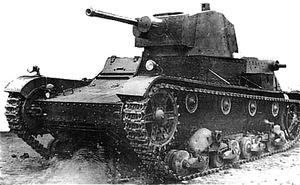 7TP (single turret) | |||||||||||||||||||
| 7TP (double-topped) | |||||||||||||||||||
| Classification | light tank [1] | ||||||||||||||||||
| Combat weight, t | 9.9 [2] | ||||||||||||||||||
| Layout scheme | single turret [2] | ||||||||||||||||||
| Crew , pers. | 3 [2] | ||||||||||||||||||
| Story | |||||||||||||||||||
| Manufacturer | |||||||||||||||||||
| Years of production | 1935 - 1939 [2] | ||||||||||||||||||
| Years of operation | 1935 - 1939 | ||||||||||||||||||
| Number issued, pcs. | |||||||||||||||||||
| Main operators |  | ||||||||||||||||||
| Dimensions | |||||||||||||||||||
| Case length, mm | 4750 [1] | ||||||||||||||||||
| Width, mm | 2400 [1] | ||||||||||||||||||
| Height mm | 2181 [1] | ||||||||||||||||||
| Clearance , mm | 376 | ||||||||||||||||||
| Booking | |||||||||||||||||||
| Armor type | steel rolled surface hardened | ||||||||||||||||||
| The forehead of the body (top), mm / deg. | 10—17 / 32—60 ° | ||||||||||||||||||
| The forehead of the body (middle), mm / deg. | 11/82 ° | ||||||||||||||||||
| The forehead of the body (bottom), mm / deg. | 11—17 / 10—50 ° | ||||||||||||||||||
| Board of the case (top), mm / hail. | 10—15.5 / 0—17 ° | ||||||||||||||||||
| Board of the case (bottom), mm / hail. | 10—17 / 0 ° | ||||||||||||||||||
| Body feed (top), mm / deg. | 9—9.5 / 60 ° | ||||||||||||||||||
| Body feed (middle), mm / deg. | 8/10 ° | ||||||||||||||||||
| Body feed (bottom), mm / deg. | 9.5 / 80 ° | ||||||||||||||||||
| Bottom, mm | five | ||||||||||||||||||
| Roof of the case, mm | five | ||||||||||||||||||
| Front of the tower, mm / deg. | 13/0 ° | ||||||||||||||||||
| Mask guns , mm / hail. | 13/0 ° | ||||||||||||||||||
| Board turret, mm / deg. | 13/0 ° | ||||||||||||||||||
| Tower feed, mm / deg. | 13/0 ° | ||||||||||||||||||
| The roof of the tower, mm | five | ||||||||||||||||||
| Armament | |||||||||||||||||||
| Caliber and brand gun | 1 × 37 mm Bofors wz. 37 [2] | ||||||||||||||||||
| Gun type | rifled | ||||||||||||||||||
| Ammunition guns | 80 | ||||||||||||||||||
| Machine guns | 1 × 7.92 mm [2] | ||||||||||||||||||
| Mobility | |||||||||||||||||||
| Engine type |
| ||||||||||||||||||
| Speed on the highway, km / h | 32 [2] | ||||||||||||||||||
| Cruising on the highway , km | 150 [1] - 160 [2] | ||||||||||||||||||
| Cruising over rough terrain, km | 130 | ||||||||||||||||||
| Specific power, l. s./t | 11.1 | ||||||||||||||||||
| Suspension type | four at a time, on horizontal springs | ||||||||||||||||||
| Track width, mm | 268 | ||||||||||||||||||
| Ground pressure, kg / cm² | 0.6 | ||||||||||||||||||
| Overcoming rise, hail. | 35 [1] | ||||||||||||||||||
| Breakable wall, m | 0.7 [1] | ||||||||||||||||||
| Overcoming ditch, m | 1.8 [1] | ||||||||||||||||||
| Overcoming ford , m | 1.0 [1] | ||||||||||||||||||
Content
History
The Polish version of the " Vickers 6-ton ", one of the most common tanks of the interwar period. Based on the results of exploitation in the Polish army of 38 Vickers tanks (purchased in August 1931), the prototype was created in 1933, mass production began at the Ursus plant in Warsaw in 1935 and was discontinued after the start of the Second World War in September 1939 [2 ] [1] .
On September 21, 1938 , during the Sudeten crisis , the Polish government presented an ultimatum to Czechoslovakia about the return of the Teshino region . On September 30, 1938, Poland sent another ultimatum to the government of Czechoslovakia and at the same time with the German troops deployed army units in the Cieszyn region. Tanks 7TP participated in the operation.
By the beginning of World War II, 7TP was the most efficient Polish tank [2] .
By September 1, 1939, 7 Polish tank army battalions were equipped with 7TP tanks: the 1st light tank battalion (of 49 tanks) and the 2nd light tank battalion (of 49 tanks) [1] that were part of the Prussians army .
On September 4, 1939, the 1st Tank Company of the Warsaw Defense Command was formed out of 11 7TP tanks at the Training Center for Tank Forces in the city of Modlin . Later, the 2nd tank company of the Warsaw Defense Command was formed from tanks of this type, both companies participating in the defense of Warsaw [1] .
Tanks 7TP participated in hostilities against the German troops until September 26, 1939 (on September 17, 1939, the personnel of the 2nd battalion of light tanks crossed the border with Hungary and was interned. On September 20, 1939, the 1st battalion of light tanks capitulated, September 27, 1939 years after the surrender of the Warsaw garrison, several 7TP tanks became German trophies) [1] .
Description
The tank is equipped with an Austrian-made Saurer VBLD diesel engine, the installation of which led to a change in the hull shape above the engine compartment [2] .
The conical cannon turret of the one-mounted version (with a course machine gun) was developed by the Swedish company "Bofors" [1] . Mounted on a tank Swedish 37-mm gun Bofors wz. 37 was produced under license in Poland [2] .
Also, in comparison with the English model, changes were made to the observation devices: the tank was equipped with a tank periscope designed by Captain Gundlyakh [2] .
Since 1938, tanks were produced with a rectangular niche in the aft of the tower, which served to install the N2C radio station [1] .
Combat use
September 1, 1939 in the German army there were seven tank divisions and four light divisions. In the second echelon, there were two tank battalions with 144 tanks.
Each tank division of the state prescribed 308-375 tanks. Only in the 10th Panzer Division and the Kempf tank group there were 154 and 150, respectively. In the light divisions were from 74 to 156 tanks. Thus, the total number reached 2586 tanks, but not all of them were combat, there were up to 200 commander tanks [3] .
7TR tanks were in the 2nd and 3rd Polish Tank Battalions - about 60 and 51 and 11 in reserve [4] .
German light machine-gun tanks Pz. IA and Pz. IB (combat weight - 5.4-5.8 tons, armor - 13 mm) is incomparably weaker than the Polish 7TR. PzII (combat weight - 8.9 tons, armor - 14 mm, speed - 40 km / h) are armed with a 20-mm cannon. And 7TR could fight with them with the hope of success [3] .
Czech tanks in the German army Pz.35 (t) and Pz.38 (t) with a 37-mm cannon are more or less equivalent to the Polish 7TR [3] .
Medium tanks Pz.III with a 37-mm cannon surpassed 7TP in armor and speed [3] .
So the Polish 7TR cannon tanks could safely take the fight to the German light tanks. Tankettes TK-3 and TKS were not suitable for combat with tanks, but only for reconnaissance and security [3] .
But the Germans operated in large groups of tanks (even a tank battalion with more than 70 tanks). And only the reconnaissance patrols of the Germans on light tanks and armored cars are a desirable booty for Polish tanks, although they were more often acted upon by platoons and rarely by companies of mouth [3] .
On September 1-3, there were fights at the border, ten Polish cavalry brigades, eight tank divisions, 11 separate tank companies (OTR), eight armored trains participated in them. This is mainly the actions of reconnaissance groups and attempts to counter-attack with companies and tank squadrons. There were up to thirty such clashes, but Polish tankers avoided meeting with German tanks. The loss of about 60 tanks and armored vehicles - 10% of the number of participants in this. Tanks, armored cars and two armored trains supported the Volyn cavalry brigade near Mokra [3] .
On September 4-6, battles began on the main line of the Polish defense. By this time, armored forces had almost reached their intended numbers, i.e., 580 tankettes and tanks and ten armored trains. In twenty battles, up to 100 Polish tankettes, tanks and armored cars were lost, of which 50 in the Lodz army [3] .
At the same time was the first tank battle in the entire Second World War (better to say the battle of armored vehicles, i.e. tanks and armored vehicles). On September 4, the 1st Panzer Division of the Germans attacked the 146th Infantry Regiment of the 44th Reserve Infantry Division near the River Prudka on the left flank of the Petrkuv operative group (Lodz Army). The commander of the task force ordered the 2nd tank battalion to help the infantry. The battalion did not participate in the battle [3] .
At about 15 o'clock two platoons of the 1st company, supported by infantry, drove the German patrol with an armored car, attempting to move to the left bank of the Prudka River. At 18 o'clock German light tanks and armored cars forced the river and lost three armored vehicles attacked by tanks of the 1st company. The 1st company lost one tank burned down and two damaged, the 146th regiment withdrew without incident [3] .
To the left of the 1st company was the 2nd company. She was in a skirmish with the German detachment, detaining him, but two tanks were damaged, towed to the rear [3] .
On September 5, the advancing Germans were attacked by the 1st and 3rd companies, which were ordered to cut the highway to Piotrkow. Polish tanks met with light tanks of the 1st German Tank Division. The Germans were initially taken aback and lost four armored vehicles. Then the German tanks went around from the flanks and forced the Polish tankers to withdraw to the north, losing eight tanks. The 2nd company also tried to stop the Germans by destroying two armored cars, but the forces were unequal and the company moved away. Its loss is five burned down and five damaged tanks [3] .
By evening, after leaving the battlefield, 24 tanks were collected in the forest, six damaged in tow. The 3rd company of 12 tanks was in another place. There was not enough fuel. Part of the tanks thrown. The battalion briefly restrained the advance of the Germans, destroying up to 15 combat vehicles. The remnants of the battalion on September 6 gathered in the forest near Andrespol and then began to retreat to the northeast, losing tanks from aircraft damage and attacks. Only 20 tanks reached Brest nad Bug, where after repair a separate tank company was formed. On September 15 and 16, the company fought with the Germans at Vlodawa and on September 17 received an order to go to the Romanian border. But the border - Hungarian - only people crossed - damaged tanks that had no fuel were destroyed and abandoned. The battle of Petroków is the largest tank battle of the Polish tank forces in 1939 [3] .
September 8 began the defense of Warsaw. At 21.00 a platoon of 7TR collided with a platoon of German tanks near the cemetery in Vzhisheve. The Germans did not expect an attack and lost three of the four tanks. Already in the dark there was still a battle with German tanks, the Poles suffered some losses [3] .
From September 7 to 9, the Polish units moved to the Vistula and beyond the Vistula. Both motorized rifle brigades and other units acted on the front: only 480 armored vehicles. Losses for these days in twenty fights above 100 armored units [3] .
On September 12, a combined detachment of 7TR tanks attacked the Germans in the Okents area. At the same time captured one German medium tank. Tanks broke away from the infantry and attacked by the Germans. Having lost 7 of 21 tanks, the Poles withdrew [3] .
From 10 to 13 September, the Poles tried to attack at the river Bzura. By this time, the formation of all parts with armored vehicles was completed, but many that existed had already disappeared. There were consolidated units with a force of no more than a company. Both motorcycle brigades and nine armored trains operated at the front. In total with tankettes about 430 units of armored vehicles. Of these, 150 are lost in thirty battles [3] .
From September 14 to September 17, almost all the units of the Polish army were defeated. Broken on Bzur armor retreated to Warsaw. The fights continued with both brigades, reduced to light tank battalions, eight divisions and ten mouths of tanks, totaling about 300 armored units. Many cars destroyed because of the impossibility of repair or lack of fuel. At that time, about 170 tanks and armored vehicles were lost, mainly on the Bzura River [3] .
On September 18 - 29, only a few small armor of the detachments continued to fight in the centers of resistance. [3]
All tanks, tankettes and armored cars destroyed or captured by the Germans. And only about 50 armored units, crossing the border, were interned in Romania and Hungary. This is a percentage: 45% - combat losses, 30% - technical, 10% - abandoned and destroyed due to lack of fuel and 10% - surrendered during surrender [3] .
The loss of the German Wehrmacht. In September 1939, the total number of Wehrmacht armored units decreased by 674 tanks and 318 armored vehicles. According to German data, 198 are irretrievably lost and 361 tanks damaged, including the commander ones. Polish sources talk about 250 tanks by type: 89 - Pz. I (together with the commanders), 83 - Pz. II, 26 - Pz. III, 19 - Pz. IV, 26 - Pz. 35 (t), and 7 Pz. 38 (t). Basically, the Germans had losses from Polish anti-tank guns, anti-tank guns and hand grenades. Some losses and Polish aviation. Polish tanks, armored cars and armored trains destroyed 50 and, possibly, 45 more German units. In the collisions of armored vehicles, both sides lost approximately 100 armored units each. The 4th Light Division of the Germans (about 25 armored units) in the battles from the 10th Motorized Cavalry and Warsaw armored motorized brigades and the 4th Panzer Division of the Germans (about 20 armored units) suffered the greatest losses [3] .
In the battles with the Red Army advancing from the east, the Polish armor was not enough. These are the remnants of several companies and divisions. There are only two or three clashes with Soviet units. Polish authors believe that the Red Army lost about 200 armored units - tanks and armored vehicles from Polish artillery and grenade infantry. Our sources report combat losses of 42 tanks (and, apparently, BA): 26 at the Belarusian and 16 at the Ukrainian fronts. 52 tankers were killed and 81 wounded [3] .
800 Polish tankettes and tanks did not change a single battlefield. Although the Polish army had no chance to win the campaign [3]
Polish tank units did what they could and how could. Polish tankers fought selflessly and engaged in hopeless battles with a superior opponent [3] .
Evaluation
7TP superior German light tanks PzKpfw I and PzKpfw II [2] . In terms of combat power, it is comparable with the Soviet T-26 tank and Czechoslovak LT vz.38 [5] , but the tanks were not seriously affected by the outcome of the September campaign .
Variants and modifications
Taking into account the experimental and pre-production samples, 134 tanks were built, of which 132 are serial.
- 7TPdwuwieżowy - the first version, a double- topped tank with machine-gun armament [2] , is armed with two 7.92-mm Ckm wz.30 machine guns with 6000 rounds of ammunition. 2 prototypes and 22 serial tanks were released;
- 7TP jednowieżowy - single- turreted tank with a 37-mm cannon Bofors wz. 37 , the main option, mass production started in 1936. 110 units released;
- 9TP - a prototype, developed in 1938, Prototype release not confirmed
- C7P - armored artillery tractor based on a 7TP tank [1]
Reflection in culture and art
Mention of 7TP tanks can be found in literary and artistic works, as well as in computer games ( Blitzkrieg , Codename Panzers: Phase One, World of Tanks).
Gallery
British prototype
Literature
- M. Baryatinsky. Armored vehicles of European countries 1939-1945 - M .: Armored collection, issue number 5, 1999
- J. Magnuski, J. Jędryka. Czolg Łekki 7 TP . - Militaria, 1996. ISSN 1231-692X
Notes
- ↑ 1 2 3 4 5 6 7 8 9 10 11 12 13 14 15 16 17 18 19 20 Czolg lekki (light tank) 7TP // MB Baryatinsky. Light tanks of the Second World War. M., Collection, Yauza, EKSMO, 2007. p.53-55
- ↑ 1 2 3 4 5 6 7 8 9 10 11 12 13 14 15 16 17 Infantry satellites // Journal of Youth Technique, No. 4, 1980. pp.36-37
- ↑ 1 2 3 4 5 6 7 8 9 10 11 12 13 14 15 16 17 18 19 20 21 22 23 24 Polish armored troops in battle
- ↑ History of the armored forces of the Polish Republic. 1918-1939
- ↑ Zaloga, Steve, 1952 – Armored champion: top tanks of World War II [ clarify ]
Links
- 7TP at wwiivehicles.com (English)
- 7TP on faceofwar.ru (inaccessible link)