
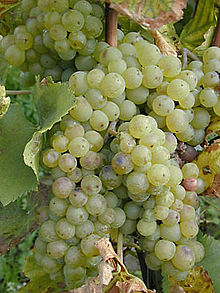
White wine - wine made from both white and red or pink grape varieties under fermentation in the absence of grape skin. It is the absence of the skin that determines the light shade - the juice of the pulp of the berries of the vast majority of grape varieties is almost colorless [1] .
Content
White grape varieties
- Chardonnay
- Riesling
- Aligote
- Sauvignon Blanc
- Semillon
- Tokaj
- Muscadet (Muscadet, Melon de Bourgogne)
- Petit Manseng and Gro Manseng (Petit Manseng, Gros Manseng)
- Chenin Blanc
- Gewürztraminer
- Muscat
- Müller-Thurgau (Müller-Thurgau, Riesling-Silvaner, Rivaner)
- Viognier
- Muscadelle
- Pinot Gris (Pinot Gris, Pinot Gridgio, Tokay Pinot Gris)
- Pinot Blanc (Pinot Blanc, Pino Blanco, Weifiburgunder)
- Sylvaner (Silvaner, Sylvaner)
- Marsanne (Marsanne, Ermitage)
- Russan (Roussanne)
- Savagnin
- Grüner Veltliner
- Vernaccia (Vernaccia)
- Greco (Greco)
- Macabeo (Macabeo, Viura)
- Albarino (Albarino, Alvarinho)
- Verdelho (Verdelho, Verdejo)
- Furmint
- Malvasia (Malvasia, Malmsey)
- Trebbiano (Trebbiano, Ugni Blanc)
- Garganega
- Cortese
Production
In most grape varieties, coloring substances ( anthocyanins ) are found only in the skin, so white wine can be made from grapes of any color (white, pink, red). A prerequisite for this is to prevent contact of the juice with the skin. The exception is grades - “dyers”, also called “Tenturier” ( French teinturier ), having originally colored juice. These varieties include, in particular, Saperavi , Alicante Boucher and some others.
To minimize the time of contact between the grape must and the skin of berries, grapes are pressed as soon as possible upon arrival at the winery, often without even combing, with whole clusters.
Two technologies are used to clean the wort from grape particles and small debris (grains of sand, pieces of vine): centrifugation or sedimentation of the wort in a natural way.
During fermentation, more careful temperature control is important for white wine than red wine production, and periodic wort cooling is required. For the successful operation of wine yeast in white wine, it is necessary to maintain a temperature of 20 degrees Celsius. With age, white wines acquire darker tones, while red wines, on the contrary, become lighter and precipitate.
See also
- Red wine
- Pink wine
Notes
- ↑ K. MacNeil The Wine Bible pg 31 Workman Publishing 2001 ISBN 1-56305-434-5
Links
- Wikimedia Commons has media related to White Wine
- Varieties of white wines - (English) (French)