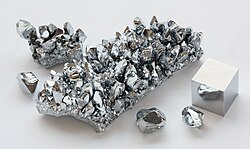
Chromium is an element of the secondary subgroup of the 6th group of the 4th period of the periodic table of chemical elements of DI Mendeleev with atomic number 24. It is denoted by the symbol Cr ( lat. Chromium ). Simple substance chrome - solid metal bluish-white. Chromium is sometimes referred to as ferrous metals .
| Chromium | ||||
|---|---|---|---|---|
| ← Vanadium | Manganese → | ||||
| ||||
| The appearance of a simple substance | ||||
| Bluish-white solid metal | ||||
 | ||||
| Atom properties | ||||
| Name, symbol, number | Chromium / Chromium (Cr), 24 | |||
| Atomic mass ( molar mass ) | 51,9961 (6) [1] a. e. m. ( g / mol ) | |||
| Electronic configuration | [Ar] 3d 5 4s 1 | |||
| Atomic radius | 130 pm | |||
| Chemical properties | ||||
| Covalent radius | 118 pm | |||
| Ion radius | (+ 6e) 52 (+ 3e) 63 pm | |||
| Electronegativity | 1.66 (Pauling scale) | |||
| Electrode potential | −0.74 | |||
| Oxidation states | 6, 3, 2, 0 | |||
| Ionization energy (first electron) | 652.4 (6.76) kJ / mol ( eV ) | |||
| Thermodynamic properties of a simple substance | ||||
| Density (at n. In. ) | 7.19 g / cm³ | |||
| Melting temperature | 2130 K (1856,9 ° C) | |||
| Boiling temperature | 2945 K (2671.9 ° C) | |||
| Ud. heat of fusion | 21 kJ / mol | |||
| Ud. heat of evaporation | 342 kJ / mol | |||
| Molar heat capacity | 23.3 [2] J / (K · mol) | |||
| Molar volume | 7.23 cm ³ / mol | |||
| Crystal lattice of simple matter | ||||
| Grid structure | cubic body-centered | |||
| Grid parameters | 2.885 Å | |||
| Debye temperature | 460 K | |||
| Other features | ||||
| Thermal conductivity | (300 K) 93.9 W / (m · K) | |||
| CAS number | ||||


| 24 | Chromium |
Cr 51,9961 | |
| 3d 5 4s 1 | |
History
Origin of title
The name element received from the Greek. χρῶμα - color , paint - due to the variety of colors of its compounds.
History
Opened in the Middle Urals, in the Berezovsky gold deposit. It is first mentioned in the work of M. V. Lomonosov “The First Foundations of Metallurgy” (1763), as red lead ore, PbCrO 4 . The modern name is Crocoit . In 1797, the French chemist L. N. Voklen isolated a new refractory metal from it (most likely, Voklin received chromium carbide ). He calcined green oxide Cr 2 O 3 with coal and isolated a refractory metal (with an admixture of carbides). The oxide Cr 2 O 3 Voklen itself was obtained by decomposition of the “Siberian red lead” - the mineral of crocoite PbCrO 4.
The modern method of obtaining pure chromium (since 1894) differs from the Vaklena method only by the type of reducing agent. The process of electrolytic coating of iron with chromium was developed in the 1920s.
Being in nature
Chromium is a fairly common element in the crust (0.03% by mass) [3] . The main compounds of chromium are chromic iron ore ( chromite ) FeO · Cr 2 O 3 . The second most important mineral is Crocoite PbCrO 4 .
Deposits
The largest deposits of chromium are located in South Africa (1st place in the world), Kazakhstan , Russia , Zimbabwe , Madagascar . There are also deposits in Turkey , India , Armenia [4] , Brazil , and the Philippines [5] .
The main deposits of chrome ores in the Russian Federation are known in the Urals (the Don and Saranovskoe).
Explored reserves in Kazakhstan amount to over 350 million tons (2nd place in the world) [5] .
Geochemistry and mineralogy
The average content of chromium in various igneous rocks is sharply variable. In ultrabasic rocks ( peridotites ) it reaches 2 kg / t, in basic rocks (basalts, etc.) - 200 g / t, and in granites tens of g / t. Clark Chrome in the Earth's crust 83 g / t. It is a typical lithophilic element and almost all is enclosed in minerals such as chromospinelids. Chromium together with iron, titanium, nickel, vanadium and manganese constitute one geochemical family.
There are three main chromium minerals: magnochromite (Mg, Fe) Cr 2 O 4 , chromic picotite (Mg, Fe) (Cr, Al) 2 O 4 and aluminum chromite (Fe, Mg) (Cr, Al) 2 O 4 . In appearance, they are indistinguishable, and they are not accurately called "chromites". Their composition is variable:
- Cr 2 O 3 18–62%,
- FeO 1–18%,
- MgO 5-16%,
- Al 2 O 3 0.2 - 0.4 (up to 33%),
- Fe 2 O 3 2 - 30%,
- impurities TiO 2 up to 2%,
- V 2 O 5 to 0.2%,
- ZnO up to 5%
- MnO up to 1%; Co , Ni and others are also present.
Actually, chromite, that is, FeCr 2 O 4 is relatively rare. In addition to various chromites, chromium is part of a number of other minerals - chromic mica (fuchsite), chromium chlorite, chromium vesuvian, chrome diopside, chromturmalin, chrome garnet (uvarovite), etc., which often accompany the ores, but have no industrial value. Under exogenous conditions, chromium, like iron, migrates in the form of suspensions and can accumulate in clays. The most mobile form is chromates.
Getting
Chromium is found in nature mainly in the form of chromium iron ore Fe (CrO 2 ) 2 (iron chromite). From it, ferrochrome is produced by reduction in electric furnaces with coke (carbon):
Ferrochrome is used for the production of alloyed steels.
To obtain pure chromium, the reaction is carried out as follows:
1) alloy chromite of iron with sodium carbonate (soda ash) in the air:
2) dissolve sodium chromate and separate it from iron oxide;
3) transfer the chromate to dichromate, acidifying the solution and crystallizing the dichromate;
4) get pure chromium oxide by reduction of sodium dichromate with carbon:
5) using aluminothermy get metallic chromium:
6) using electrolysis , electrolytic chromium is obtained from a solution of chromic anhydride in water containing an additive of sulfuric acid . In this case, on the cathodes, there are mainly 3 processes:
- restoration of hexavalent chromium to trivalent with its transition into a solution;
- discharge of hydrogen ions with the release of gaseous hydrogen;
- discharge of hexavalent chromium containing ions with metallic chromium precipitation;
Physical Properties
In its free form, a bluish-white metal with a cubic body-centered lattice , a = 0.28845 nm. Below a temperature of 38 ° C, it is an antiferromagnet, and above it goes into a paramagnetic state ( the Neel point ).
Chromium has a Mohs 8.5 scale hardness [6] , one of the hardest pure metals (second only to iridium , beryllium , tungsten and uranium ). Very pure chrome is well machined.
Isotopes
Chromium isotopes are known with mass numbers from 42 to 67 (the number of protons is 24, neutrons are from 18 to 43) and 2 nuclear isomers .
Natural chromium consists of four stable isotopes ( 50 Cr ( isotopic abundance of 4.345%), 52 Cr (83.789%), 53 Cr (9.501%), 54 Cr (2.365%)).
Among artificial isotopes, the longest-lived is 51 Cr ( half-life is 27 days). The half-life of the others does not exceed one day.
Chemical Properties
Typical oxidation states
Chromium is characterized by oxidation states +2, +3 and +6 (see table). Virtually all chromium compounds are colored [7] .
| Oxidation state | Oxide | Hydroxide | Character | Predominant forms in solutions | Notes |
|---|---|---|---|---|---|
| +2 | CrO (black) | Cr (OH) 2 (yellow) | Basic | Cr 2+ (salts of blue) | Very strong reducing agent |
| +3 | Cr 2 O 3 (green) | Cr (OH) 3 (gray-green) | Amphoteric | Cr 3+ (green or purple salts) [Cr (OH) 4 ] - (green) | |
| +4 | CrO 2 | does not exist | Non-salt-forming | - | Rare, not very typical |
| +6 | CrO 3 (red) | H 2 CrO 4 H 2 Cr 2 O 7 | Acid | CrO 4 2− (chromates, yellow) Cr 2 O 7 2− (dichromates, orange) | The transition depends on the pH of the medium. The strongest oxidizer, hygroscopic, very poisonous. |
Simple substance
It is steady on air due to passivation . For the same reason, does not react with sulfuric and nitric acids. At 2000 ° C burns with the formation of green chromium (III) oxide Cr 2 O 3 , which has amphoteric properties .
Compounds of chromium with boron ( borides Cr 2 B, CrB, Cr 3 B 4 , CrB 2 , CrB 4 and Cr 5 B 3 ), with carbon ( carbides Cr 23 C 6 , Cr 7 C 3 and Cr 3 C 2 ) were synthesized, with silicon ( silicides Cr 3 Si, Cr 5 Si 3 and CrSi) and nitrogen ( nitrides CrN and Cr 2 N).
Cr Connections (+2)
The degree of oxidation +2 corresponds to the basic oxide CrO (black). Cr 2+ salts (blue solutions) are obtained by reducing the Cr 3+ salts or dichromates with zinc in an acidic medium (“hydrogen at the moment of extraction”):
All these salts Cr 2+ are strong reducing agents, to the extent that upon standing they displace hydrogen from water [8] . With oxygen in the air, especially in an acidic environment, Cr 2+ is oxidized, with the result that the blue solution quickly turns green.
The brown or yellow hydroxide Cr (OH) 2 precipitates upon the addition of alkali to the solutions of chromium (II) salts.
Chromium dihalides CrF 2 , CrCl 2 , CrBr 2 and CrI 2 are synthesized
Cr (+3) connections
The degree of oxidation +3 corresponds to amphoteric oxide Cr 2 O 3 and hydroxide Cr (OH) 3 (both are green). This is the most stable degree of oxidation of chromium. Chromium compounds in this oxidation state have a color ranging from dirty lilac (in aqueous solutions, Cr 3+ ion exists in the form of aquacomplex [Cr (H 2 O) 6 ] 3+ ) to green (anions are present in the coordination sphere ).
Cr 3+ tends to form double sulfates of the form M I Cr (SO 4 ) 2 · 12H 2 O ( alum )
Chromium (III) hydroxide is obtained by acting on ammonia on chromium (III) salt solutions:
Alkali solutions can be used, but soluble hydroxo complex is formed in their excess:
Alloying Cr 2 O 3 with alkalis, get chromites :
Untreated chromium (III) oxide is dissolved in alkaline solutions and in acids :
When chromium (III) compounds are oxidized under alkaline conditions, chromium (VI) compounds are formed:
The same thing happens when chromium (III) oxide is fused with alkali and oxidizing agents, or with alkali in air (the melt acquires a yellow color):
Chromium compounds (+4)
With careful decomposition of chromium (VI) oxide CrO 3 under hydrothermal conditions , chromium (IV) oxide CrO 2 , which is a ferromagnet and has metallic conductivity, is obtained.
Among chromium tetrahalides, CrF 4 is stable, chromium tetrachloride CrCl 4 exists only in pairs.
Chromium compounds (+6)
The degree of oxidation +6 corresponds to acidic chromium (VI) oxide CrO 3 and a number of acids, between which there is an equilibrium. The simplest of them are chromic H 2 CrO 4 and two -chromium H 2 Cr 2 O 7 . They form two rows of salts: yellow chromates and orange dichromates, respectively.
Chromium (VI) oxide CrO 3 is formed by the interaction of concentrated sulfuric acid with dichromate solutions. A typical acid oxide, when interacting with water, it forms strong unstable chromic acids: chromic H 2 CrO 4 , dichromic H 2 Cr 2 O 7 and other isopolyacids with the general formula H 2 Cr n O 3n + 1 . The increase in the degree of polymerization occurs with a decrease in pH, that is, an increase in acidity:
But if an alkaline solution is added to the orange K 2 Cr 2 O 7 solution, as the color turns yellow again, as K 2 CrO 4 chromate forms again:
It does not reach a high degree of polymerization, as occurs in tungsten and molybdenum , since polychromic acid decomposes into chromium (VI) oxide and water:
The solubility of chromates approximately corresponds to the solubility of sulfates. In particular, yellow barium chromate BaCrO 4 drops out when adding barium salts to both chromate solutions and dichromate solutions:
The formation of blood-red poorly soluble silver chromate is used to detect silver in alloys using assay acid .
Chromium pentafluoride CrF 5 and low stability chromium hexafluoride CrF 6 are known. Volatile oxyhalides of chromium CrO 2 F 2 and CrO 2 Cl 2 ( chromyl chloride ) were also obtained.
Chromium (VI) compounds are strong oxidizing agents , for example:
Addition of hydrogen peroxide, sulfuric acid and organic solvent (ether) to the dichromates leads to the formation of blue chromium monoperoxide (VI) CrO 5 (CrO (O 2 ) 2 ), which is extracted into the organic layer; This reaction is used as an analytical.
Application
Chromium is an important component in many alloyed steels (in particular, stainless steel ), as well as in a number of other alloys. The addition of chromium significantly increases the hardness and corrosion resistance of alloys.
Used as wear-resistant and beautiful electroplating ( chrome plating ).
Chromium is used for the production of alloys: chromium-30 and chromium-90, indispensable for the production of nozzles of powerful plasma torches and in the aerospace industry.
Biological role and physiological action
Chromium is one of the biogenic elements that constantly forms part of the tissues of plants and animals. In animals, chromium is involved in the metabolism of lipids , proteins (part of the enzyme trypsin ), carbohydrates . Reducing the chromium content in food and blood leads to a decrease in growth rate, an increase in cholesterol in the blood.
In its pure form, chromium is quite toxic [9] , metal dust of chromium irritates lung tissue. Chromium (III) compounds cause dermatitis .
Chromium compounds in the oxidation state +6 are particularly toxic. Virtually all chrome ore is processed through conversion to sodium dichromate . In 1985, approximately 136,000 tons of hexavalent chromium was produced. [10] Other sources of hexavalent chromium are chromium trioxide and various salts, chromates and dichromates . Hexavalent chromium is used in the production of stainless steels, textile dyes, wood preservatives, chrome plating , etc.
Hexavalent chromium is a recognized carcinogen by inhalation. [11] At many workplaces, employees are exposed to hexavalent chromium, for example, electroplating or welding stainless steels. [11] In the European Union, the use of hexavalent chromium is significantly restricted by the RoHS directive.
Hexavalent chromium is transported into the cells of the human body through the sulphate transport mechanism due to its proximity to sulphates in structure and charge. Trivalent chromium, more common, is not transported into cells.
Inside the cell, Cr (VI) is reduced to metastable pentavalent chromium (Cr (V)), then to trivalent chromium (Cr (III)). Trivalent chromium, joining proteins, creates haptens , which include an immune response. After their appearance, the sensitivity to chromium does not disappear. In this case, even contact with textiles, painted with chrome paints or with leather treated with chromium, can cause skin irritation. Vitamin C and other agents react with chromates and form Cr (III) inside the cell. [12]
Hexavalent chromium products are genotoxic carcinogens. Chronic inhalation of hexavalent chromium compounds increases the risk of nasopharyngeal diseases, the risk of lung cancer . (The lungs are especially vulnerable due to the large number of small capillaries). Apparently, the mechanism of genotoxicity is triggered by pentavalent and trivalent chromium.
In the USA, the maximum permissible concentration of hexavalent chromium in the air is 5 µg / m³ (0.005 mg / m³). [13] [14] In Russia, the maximum permissible concentration of chromium (VI) is significantly lower - 1.5 µg / m³ (0.0015 mg / m³). [15]
One of the generally accepted methods for the avoidance of hexavalent chromium is the transition from the technology of electroplating to gas-thermal and vacuum spraying.
Based on real events, the film “ Erin Brokovich ”, directed by Stephen Soderberga, talks about a major lawsuit related to environmental pollution with hexavalent chromium, as a result of which many people developed serious illnesses. [sixteen]
See also
- Category: Chromium Compounds
- Khromtau
Notes
- ↑ Michael E. Wieser, Norman Holden, Tyler B. Coplen, John K. Böhlke, Michael Berglund, Willi A. Brand, Paul De Bièvre, Manfred Gröning, Robert D. Loss, Juris Meija, Takafumi Hirata, Thomas Prohaska, Ronny Schoenberg , Glenda O'Connor, Thomas Walczyk, Shige Yoneda, Xiang-Kun Zhu. Atomic weights of the elements 2011 (IUPAC Technical Report) (Eng.) // Pure and Applied Chemistry . - 2013. - Vol. 85 , no. 5 - P. 1047-1078 . - DOI : 10.1351 / PAC-REP-13-03-02 .
- ↑ Editorial: Zefirov N.S. (ch. Red.). Chemical Encyclopedia: 5 tons. - Moscow: Great Russian Encyclopedia, 1999. - V. 5. - P. 308.
- ↑ 1. Drozdov, A.A., et al. Inorganic Chemistry: In 3 tons. / Ed. YUD Tretyakov. T. 2: Chemistry of transition metals. - 2004. 2. Greenwood NN, Earnshaw A. Chemistry of the Elements. - 1984.
- ↑ article “Mineral Resources” . Encyclopedia " Krugosvet ". Archived August 21, 2011.
- ↑ 1 2 CHROME | Online Encyclopedia Krugosvet .
- ↑ Cooked A.S. Mineral hardness. - AN USSR, 1963. - p. 197-208. - 304 s.
- ↑ Remy G. Course of inorganic chemistry. T. 2. M., Mir, 1966. S. 142-180.
- ↑ Nekrasov B.V. The course of general chemistry. M :, GNHTI, 1952, p. 334
- ↑ Chromium // Big Medical Encyclopedia : in 30 t. / Ch. ed. B.V. Petrovsky . - 3 ed. - Moscow: Soviet Encyclopedia , 1986. - T. 27. Chloracon - Health Economics . - 576 s. - 150 000 copies
- ↑ Gerd Anger, Jost Halstenberg, Klaus Hochgeschwender, Christoph Scherhag, Ulrich Korallus, Herbert Knopf, Peter Schmidt, Manfred Ohlinger, Chromium Compounds in Ullmann's Encyclopedia of Industrial Chemistry, Wiley-VCH, Weinheim, 2005.
- ↑ 1 2 IARC. Volume 49: Chromium, Nickel, and Welding . - Lyon: International Agency for Research on Cancer, 1999-11-05. "" The compounds of the chromium [VI] were encountered in the chromate production, the chromate pigment production and the chromium plating industries. " - ISBN 92-832-1249-5 . Archive dated December 24, 2008 on Wayback Machine
- ↑ Salnikow, K. and Zhitkovich, A., “Genetic and Epigenetic Mechanisms in Metal Carcinogenesis and Cocarcinogenesis: Nickel, Arsenic, and Chromium”, Chem. Res. Toxicol., 2008, 21, 28-44. DOI : 10.1021 / tx700198a
- HA OSHA: Small Entity Compliance Guide for the Hexavalent Chromium Standards
- ↑ David Blowes. Tracking Hexavalent Cr in Groundwater (English) // Science . - 2002. - Vol. 295 . - P. 2024-2025 . - DOI : 10.1126 / science.1070031 . - PMID 11896259 .
- ↑ MPC air settlements
- ↑ Official site of Erin Brokovich, a page dedicated to the film
Literature
- Sally A.H. Chrome = Chromium / Trans. from English V. A. Alekseeva; Ed. Cand. tech. Sciences VA Bogolyubov. - M .: Metallurgizdat, 1958. - 292 p. - 2700 copies
- Sally A.G. , Brandz A.A. Chrome = Chromium / Trans. from English V. A. Alekseeva; Ed. Prof., Dr. Techn. Sciences VA Bogolyubov . - 2nd ed. - M .: Metallurgy, 1971. - 360 p.
- Pliner Yu. L. , Ignatenko G. F. , Lappo S. I. Chromium metallurgy . - M .: Metallurgy , 1965. - 184 p.
Links
- Chrome on Webelements
- Chromium in the Popular Chemical Elements Library
- Chrome greens, used in painting
- ATSDR Case Studies in Environmental Medicine: Chromium Toxicity US Department of Health
- 3M US: OSHA Hexavalent Chromium Standard - An overview of the Chromium Six (CrVI) standard
- Environmental Health: "Selected science: an industry-specific industry campaign to undermine an OSHA hexavalent chromium standard"
- Hexavalent chromium , a case study from [1]
- Australian National Pollutant Inventory Chromium VI fact sheet
- US OSHA Health and Safety Topics: Hexavalent Chromium "
- Finishing Today - Hexavalent Chromium: How is it affecting you?
- National Institute for Occupational Safety and Health - Hexavalent Chromium