Ashanti ( Ashanti ; self-name - asantefo , asante - means "uniting for war") - the people of the Akan group. They live in the central areas of Ghana ( Ashanti and Brongh Ahafo regions). The population is 3.3 million people. (together with their kindred peoples: denchira , adansi , aseniya-chifo , vasau , etc.). Anthropologically refer to the Negro race of the Negroid (large) race . (Shpazhnikov 2007, 76)
| Ashanti | |
|---|---|
| Abundance and area | |
| Total: 2.8 million people (2000) | |
 Ghana Ghana | |
| Tongue | twee |
| Religion | Catholicism , Protestantism , Islam , Judaism , traditional beliefs |
| Related peoples | Akans |
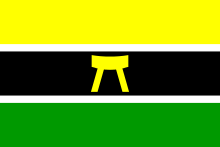
Content
Language
They speak the language of Cvi , which belong to the subgroup of the kwa of the Niger-Congolese macro - family of the Volta-Congolese group. In the 19th century, Christian missionaries created writing for the language based on Latin scripts (Shpazhnikov 2007, 76).
Religion
Among Ashanti there are many Christians ( Catholics and Protestants - Anglicans , Presbyterians , Methodists ); there are adherents of syncretic Christian-African churches and sects. In the second half of the 20th century, Sunni Muslim communities began to appear among Ashanti; ashanti make up most of the Ahmadiyya sect. They preserve the cult of their ancestors (asamanfo), the object of which was the leaders and elders, and the cult of the forces of nature (especially the spirits of rivers and other reservoirs). There is a pantheon of spirits ( obosom ) and ideas about the supernatural being Nyama (heavenly deity, demiurge, first ancestor) and the chthonic deity Asase. Widespread fetish amulets ( suiman ). Every year in September, the festival of Odjira (“purification”) is held, and every 6 weeks - the Great (Big) Adae or Small Adae (alternately), closely associated with the cult of ancestors and other traditional beliefs . Nyame and Asase, along with the wise spider Anans, are constant characters in folklore and myths. (Shpazhnikov 2007, 77)
Ethnic History
According to legends (and the whole history of Akans before the 19th century is largely based on oral tradition), the ancestors of the Akans (proto-Akans) occupied the present territory in the 13th – 15th centuries. According to some researchers, proto-canals formed in the savannah zone north of the forest belt in the interfluve of the Black Volta and Komoe and around 1000–1300. two groups migrated south to the forest zone. According to archaeological data, the earliest settlements appeared here around 1200. The oldest center of Akan civilization in the forest zone is considered to be founded in the XV century. the city of Bono Mansu , the former apparently a major shopping center. The ruins of Bono Mansu survived 180 km north of Kumasi . In the XVI century. in the interfluve of the Pra-Ofin-Birim, a pot-territorial formation of Adansi was formed, also known as Akani . Europeans often called the term “Akani” not only Adansi, but also other similar formations of this region that arose in the 16th – 17th centuries: Assin , Denchira and Inta , actually identifying them with the cultural-linguistic concept of “ Akan ”. (Popov 1982, 14-15)
By the 17th century In the forest zone, 3 main Akan test formations were formed: Denchira in the west, Aquam in the east and Achem in the center. The victory of Denchira over Adansi at the beginning of the XVII century. set in motion a mass of people, a significant part of whom moved to the country of Amanse in the region of Lake Bosomchvi. In Amanz was the city of Asantemanso , where, according to legend, all the Ashantines came from. Today, the tiny village of Asantemanso retains its significance as a religious center. This is the most sacred place for Ashantines. The second half of the XVII century. It was a time of migrations, wars, intensive commercial activity of various European powers on the Guinean coast. As a result of this, the ethnic and political maps of the forest zone of the Gold Coast changed - Akan peoples pressed the Ewe to the east, Guan - to the north, some Akans went west (to the territory of modern Côte d'Ivoire , but the bulk of the migrants rushed to the north-west in the country of Kwaman , which later became known as the country of Ashanti. Immigrants from Asantemanso defeated the military detachments of the inhabitants of Kwaman and founded the city of Kumasi . (Popov 1982, 17)
The Ashanti Confederation was created at the end of the XVII - beginning of the XVIII century as a military union of several territorial-potestary formations ( Omani ) led by the ruler of Kumasi to fight Denchira. The confederation was ruled by the supreme leader ( asantehene - hence the ethnonym “ashanti” originates), his co-ruler ( asantehema , “the queen mother”) and the council of elders , which included the leaders of the Omani ( Omanhene ) and military leaders ( Asafohene ). The term "asante" means "people united for war." This concept arose around the second half of the 17th century. in connection with the organization of a military alliance of several Omani against Denchira. The main components of the Omani structure were late primitive communities ( Akura ), large families ( Fiefo ), matrilineal clans ( Abusua ), patrilineal groups ( NTR ) and units of the military organization ( Asafo ). There was a division into the nobles , free community members and slaves . (Popov 1982, 18-19)
Almost throughout the XVIII century. The Ashanti Confederation fought with its neighbors for control of trade and routes to the south, to the coast of the Gulf of Guinea (with the victory over Denchira, the Ashantines gained the rights to exclusive trade with the Dutch fort Elmina ) and north to the countries of Western Sudan . By the beginning of the XIX century. The Ashanti Confederation turned into a powerful power, under whose control there were lands approximately corresponding to the territories of modern Ghana . (Popov 1982, 20)
Throughout the XIX century. The Ashanti Confederation fought for access to European trading posts and defended its independence in the struggle against the British and their allies ( Fenty , ha and other coastal peoples) in the so-called Anglo-Ashantine wars . The first 5 wars ended with the victory of Ashanti (1806, 1811, 1814-1815, 1823-1826, and 1863). Great Britain recognized the independence of Ashanti. According to the agreement of 1831, the border between Ashanti and the English colonial possessions was determined. During the sixth war (1873-1874), the British penetrated inland, the capital Ashanti was burned and plundered. All military fortifications and the asantehene palace were blown up, but the British failed to stay in Kumasi. Formally, the Ashantines retained their independence. However, under the agreement, they were supposed to pay Britain 50 thousand ounces of gold and abandon claims to Elmina (the reason for the war was the British unwillingness to pay Ashantines for the right to trade and have a settlement in Elmina, which they bought from the Dutch in 1872) with the loss of the latter controlled port of Elmina in 1872, the Ashantines lost the monopoly of trade with Europeans in the interior of the Gold Coast. The British were allowed free trade in the country, an official was sent to Kumasi to monitor compliance with all the conditions of the contract. (Popov 1982, 25-29)
The defeat in the Sixth War actually marked the end of the independent development of the Ashantines. The Confederation began to fall apart, many Omani declared their independence from Kumasi, and a period of disintegration and decline began. The seventh, and last, Anglo-Ashantine war in 1895-1896. ended with the complete defeat of Ashanti. The country was declared an English protectorate, and after an unsuccessful uprising in 1900 it was included in the Gold Coast colony. In 1935, the British formally restored the state of Ashanti, but in fact the power in the country remained in the hands of the English governor of the Gold Coast. After the formation of the independent state of Ghana, the territory of Ashanti under the 1957 constitution received the status of a region. (Popov 1982, 32)
Traditional Activities
Traditional occupations are manual cyclic fallow farming ( yams , sweet potatoes , cassava , taro , peanuts , millet , corn , sorghum , rice , pineapples , fruits , legumes , tomatoes , vegetables , oil palm , Cola tree), animal husbandry (cattle , pigs, poultry), gold mining . Hunting , fishing, and gathering are of secondary importance. Ashanti are employed in cocoa plantations, logging, mining and industrial enterprises in cities. From crafts developed blacksmithing, art processing of gold, silver, bronze (chasing, forging, casting), pottery, weaving, wood carving. (Bylinskaya 1966, 22–41)
Traditional dwelling
Traditional houses are quadrangular in plan, from wooden poles coated with clay, with an earthen floor and a gable roof, covered with palm leaves, grass or iron and slate. (Shpazhnikov 2007, 77)
Traditional Clothing
Traditional clothing - kente and adinkra (festive kente with embossed special stamps ornament). (Shpazhnikov 2007, 78)
Traditional food
The food is mainly vegetable (various cereals , stews, boiled and baked vegetables and root vegetables with hot spices and palm oil), as well as meat and fish. (Shpazhnikov 2007, 78)
Social Organization
They live in large family communities; marriage settlement - bilocal, polygyny is practiced. The kinship account is matrilineal with elements of patrilaterality. The initial model (protosystem) of the Ashanti relationship system is related to the Iroquois type. A feature of this system in Ashanti is the generation bevel of the Crow type. This system was transformed towards the formation of an Arab model of kinship with the gradual disappearance of features such as crow. (Popov 1977, 53)
Interesting Facts
- "Ashanti" ("Ashanti") - the British destroyer destroyer type "Tribal" , which entered service in 1938. In February 1939, he even visited Ghana at the special invitation of the leader of the Ashanti tribe.
Literature
- Shpazhnikov G.A. Ashanti // Peoples of the world / Heads. ed. L. M. Mintz. M .: Olma Media Group, 2007.
- Bylinskaya T. G. Economy of the people of Ashanti in the 19th - early 20th centuries // Economic History of Africa. M .: Nauka, 1966.S. 22-24.
- Popov V.A. Ashantians in the 19th century: the experience of ethnosocial research. M .: Nauka, 1982.P. 175.
- Popov V. A. The system of terms of kinship of the Akan peoples // Soviet Ethnography / Issue. 6. M., 1977.
Links
- Ashanti // Brockhaus and Efron Encyclopedic Dictionary : in 86 volumes (82 volumes and 4 additional). - SPb. , 1890-1907.
- Ashanti language in the Ethnologue database
- Ivory Coast Art. Mirimanov V.B. The art of tropical Africa