Crabeater seal [1] ( lat. Lobodon carcinophagus ) is the Antarctic seal , the only representative of the genus crabeater seals ( Lobodon ) of the family Real seals ( Phocidae ).
| Crabeater seal |
 |
| Scientific classification |
|---|
| No rank : | Bilateral symmetrical |
| Gender: | Crab eaters
( Lobodon Gray , 1844 ) |
|
| International scientific name |
|---|
Lobodon carcinophagus
Hombron & Jacquinot , 1842 |
| Crabeater Seal Distribution |
|---|
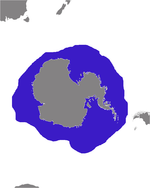 |
| Security status |
|---|
Least ConcernedIUCN 3.1 Least Concern : 12246 |
|

Crabeater seal resting on ice
The largest seal in the world, the number of which, according to various estimates, can reach from 7 to 40 million individuals. Recently, it is believed that the previous high abundance estimates were very high and the actual number of the crabeater seal does not exceed 14 million individuals. This is one of the most numerous species of large mammals on Earth after humans [2] [3] and domestic animals. In general, the biomass of crabeater seals is approximately four times the biomass of all other seals combined.
The name of this seal, both scientific and in almost all widespread European languages, refers to curious cases in science, because this species does not feed on crabs at all, and the basis of its diet is the Antarctic krill Euphausia superba .
The size of adults - from 2.2 to 2.6 m, weight - about 200-300 kg. Females are slightly larger than males. The body is elongated and rather slender. The muzzle is long and narrow. After annual molting in January-March, the new fur has a dark brown color on the back and silver gray on the sides and belly. Then the fur fades, becoming creamy white. Old seals have light fur even immediately after molting. In newborn puppies, the fur is soft, grayish-brown, sometimes with dark spots. On the skin of the seal, on the sides and back, there are usually characteristic short dark stripes - scars, which are believed to be left by the teeth of a sea leopard , which is the main enemy of young inexperienced animals. Puppies molt at the age of 2-3 weeks. A unique feature of crabeater seals is the scalloped-tuberous shape of the lateral (buccal) teeth , which are closely adjacent to each other when the jaws are closed and form a kind of sieve for filtering small Antarctic krill [2] [3] .
When observed from afar, the crabeater seal may be confused with the sea leopard and the Weddell seal . The sea leopard, unlike the crabeater seal, has a large reptilian head, very long forelimbs and a large belly. The Weddell seal has a very small head relative to its coarse-rounded body and a characteristic spotted coloration. In addition, only crabeater seals can gather on ice in very large dense groups.
The crabeater seal has characteristic cheek scalloped teeth
The marginal seas of Antarctica south of the 65th parallel. Seasonal migrations follow drifting ice. In summer, seals stay close to the coast; in autumn they migrate north along with pack ice. At times they reach New Zealand, the southern extremities of Australia, Africa and South America. The northernmost occurrence was noted off the Atlantic coast of South America in the Rio de la Plata estuary at the junction of the borders of Argentina and Uruguay [2] [3] [4] .
Rookery suits on ice. Colonies of up to several thousand animals were observed. Able to quickly move on the surface of the ice and jump out of the water onto high ice. It hunts more actively, probably at night. Dives up to 430 m in depth and is able to stay under water for about 11 minutes. It feeds mainly on Antarctic krill. Fish also has food [2] [3] [4] .
They reach puberty at the age of 2.5-6 years. Cubs are born in September-December. The size of newborn puppies is about 1.1-1.3 m in length, weight 20-40 kg. Mothers feed cubs 2-3 weeks, while puppies gain in weight up to 4 kg per day. By the end of milk feeding, puppies reach a weight of about 110 kg. The male joins the female with the calf during the feeding period, forming a kind of “triad”, not noted among other seals. The male, while feeding the cub, keeps on the ice surface near the selected female and drives away the male rivals. They mate in water after breast-feeding, in October-December, depending on the timing of the birth of each specific female.
Life expectancy is about 20 years.
The natural enemies of seals are the sea leopard and killer whale .
Edward Adrian Wilson (1872-1912), a British biologist and member of the Antarctic expedition Robert Scott in 1910-1913, believed that before his death, crabeater seals leave to die deep into Antarctica. Wilson discovered the bodies of these seals at a distance of 30 miles from the coastline, at heights of up to a thousand meters above sea level.