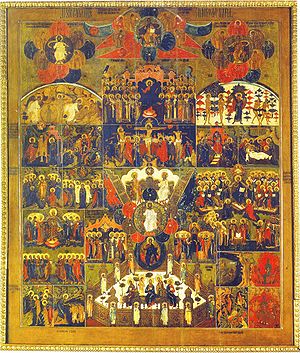
The symbol of faith ( Greek σύμβολον ) is a system of fundamental dogmas of the Christian dogma [1] . The term comes from the ancient Greek name for documents of this kind.
In Christianity, the symbols of faith have traditionally been understood as a summary of the dogmas of the Church .
Some theologians separate the “creeds of faith” themselves from the “conciliar creeds,” that is, from the teachings of the Christian creed in the acts of Ecumenical Councils , or distinguish, in addition, the “creeds of faith” published by individuals. Articles of faith are always concise; they only state in the apodictic form of simple sentences or uncontested facts the main dogmatic provisions, without evidence, as an object for perception by faith .
Content
- 1 History of Christian Creeds
- 2 The origin of the concept
- 3 Articles of Faith in Theology
- 3.1 Apostolic Creed
- 3.2 Nike-Tsaregradsky Creed
- 3.3 Other Christian Articles of Faith
- 4 notes
- 5 See also
- 6 References
History of Christian Creeds
The basis of the Christian faith is the assertion that God, in order to save people from the burden of original sin, sent his Son to the earth, who was born of the Virgin Mary and embodied (humanized) in Jesus Christ , was crucified, died and rose again on the third day, defeating death .
The first fathers of the Church presented to their students the teachings of Jesus Christ and the apostles, which constituted the norm of their pastoral activity, which was indicated by the words: πιστις κάνων αληθεία, regula veritatis (rule of truth), and was part of the Christian disciplinae arcanae ( secret teaching ). Church fathers themselves often notice that πιστις, or regula fidei (rule of faith), was taught by the apostles who themselves received it from Christ. A written account of some of the details of this regula fidei first appears around 140 in the gospel formula of baptism (“in the name of the Father and the Son and the Holy Spirit”), in Tertullian , Cyprian , Firmilian of Caesarea , in the canons of the Coptic church.
The first prototype of the article of faith appears in the Apostle Paul : “For I originally taught you that I myself accepted, that is, Christ died for our sins, according to the Scriptures, and that He was buried, and that he was resurrected on the third day, according to the Scriptures, and what appeared to Kife, then twelve; then he appeared to more than five hundred brethren at one time, of which most were still alive, and some had rested; then he appeared to Jacob, also to all the apostles ”( 1 Cor. 15: 3-7 ).
Rufin of Aquileia and Markell of Ankir cite the Ancient Roman Creed in Latin (Rufinus) and Greek (Markell). The Apostolic Creed ascends to the Old Roman.
Rufinus found the so-called Apostolic Creed , written in Latin. In the interpretation of this Creed, Rufin claimed that this is the original text of the Credential compiled by the apostles at the council in Jerusalem . Having appeared at the cathedral, the apostles had each their own special symbol, drawn up in relation to the needs of the place of preaching of each of them; then they decided by common efforts to draw up one model of faith, which could serve as a guide and rule for them during the sermon, protecting them from possible disagreement. They called their collective work “Creed”, which indicates the collection or selection of the teachings contained in it from the sermon of all the apostles. Rufin calls the symbol he found Apostolic either because each word in it is given by the apostles (1 Cor. XI, Acts XV), or because it contains faith, undoubtedly preached by the apostles.
But since every place where the apostles preached had their own creed, the name of the Apostolic Creed is also true of many other creeds.
The Roman Catholic Church considers the “Apostolic Creed” one of the most important Christian creeds, in particular, it is part of the rosary prayer. The word "Apostolic" according to modern interpretation means that the Symbol describes the faith preached by the apostles, and not the text belong to the apostles, although in the Middle Ages even attempts were made to guess which words in the Apostolic Symbol of Faith belong to which particular apostle.
Rufin himself cleared the text of the Apostolic Creed from impurities of its aquilean edition. Martigny (Dictionnaire, p. 755) reports four texts of this Symbol with different readings. The modern text of the Symbol is first found in written sources of the VI century.
From the point of view of Orthodoxy , the main document of Christology of which is the Chalcedonian creed [2] , in triadology the final act in the field of creed is the Nicene-Tsaregradsky Creed , the first part of which was composed at the Nicene Council ( 325 ), and the second at the council Of Constantinople ( 381 year ), where both parts of the Creed were combined into one document. The confession and reading of the Nicene-Tsaregradsky Symbol at baptism is an integral part of the sacrament; for baptized babies, the Creed is read by its recipient .
The origin of the concept
The very name “Creed” in ancient times was not used by the church; for the first time it occurs at Ambrosius of Mediolansky in his "message" (XLII) to Pope Syriac I. In general, the custom to call the “creeds of faith” symbols is a Western custom, and the very word “Creed” came into use when applied to what was called the teachings of the faith in the Greek East.
Eastern fathers of churches and cathedrals and in the IV century. they did not give the “creeds of faith” the name “Creed”, calling them “statements of faith” or “faith”. At the head of the “creations” made by individual theologians, Cheltsov sets the argument of presbyter Vincent , the monk of the Lerinsky monastery (c. C. 434). Beliefs and confessions are written by authoritative hierarchs or other scholars as a result of special circumstances, for example, at the request of a church that once deviated from Eastern Orthodox and universal unity.
Cheltsov gives the following headings of the symbols of faith:
- apostolic faith of the Jerusalem church;
- Church faith of Caesarea-Palestinian Church;
- the universal faith of the church of Antioch;
- Apostolic faith of the Church of Cyprus and the Churches of Asia Minor;
- apostolic dogmas of the Alexandrian church;
- apostolic creed of the roman church.
The origin of these symbols of faith from the apostles themselves is evidenced by the conviction of all antiquity, as well as the almost complete identity of all the six symbols in content.
Irenaeus and Tertullian , pointing to the forms of the symbols of faith, speak of them not as something new, but as apostolic tradition (1 Tim. VI, 12; 1 Peter III, 21). Tertullian calls the creed, read by every adult at baptism, “the rule established by Christ, the highest for us all perplexities” . He notes that those who are baptized pronounce the rule of faith in the form of answers to questions given by the baptizing presbyter, moreover, "the questioned answer in more detail than the Lord established in the Gospel . "
Cyril of Jerusalem The Creed of the Jerusalem Church, preserved by him in the inscriptions of his announcing teachings, calls “the holy and apostolic faith”; The Macarius of Jerusalem , according to the testimony of Gelasius of Kizic , at the Council of Nicaea, called the same Creed of Jerusalem “the apostolic immutable faith, which the church of Christ preserves from the beginning, according to the legend from the Lord himself, through the apostles, from generation to generation, and will keep forever . ” John Cassian , citing the text of the Antiochian Creed, remarks that it contains the faith of all churches, since there is one faith for all. Alexander, Bishop of Alexandria , calls the Alexandrian Creed “the apostolic dogmas of the Church,” that is, originating from the apostles themselves.
Articles of Faith in Theology
For almost two millennia of the existence of Christianity in the world, every Christian society has been developing its own creeds. A new branch of theology has arisen - symbolism, studying comparatively the creeds of faith of different faiths and with great success replacing the so-called polemical, or accusatory, theology of the old time. Schleiermacher calls symbolism "comparative dogma," Pelt means "knowledge of the confessional principles of all faiths."
Apostolic Creed
The earliest creed, which was given its own name, was the Apostolic Creed . Christian tradition attributes it to all twelve apostles : supposedly each of them said one sentence of this creed. Such an attribution itself is hardly true, but the Apostolic Creed is itself quite old; most likely it was compiled on the basis of the catechism used in adult baptism , and in this form it could have been compiled in the 2nd century . The Apostolic Creed was most likely formulated as opposed to docetism and other similar ideas.
Nicene Tsaregradsky Creed
Compiled by the First Ecumenical Council ( Nicaea , Asia Minor ) in 325 (see Nicene Creed ); in 381 it was expanded and supplemented by the Second Ecumenical Council ( Constantinople ). According to the names of the places where the cathedrals took place, it received the name of the Niko-Constantinople or Niko-Tsaregradsky Symbol. The Nicene-Tsaregradsky Creed inherited its main provisions from the Apostolic Creed . In addition, the provisions of Christology and the Trinity were added to it by the First Ecumenical Council , aiming to reject Arianism (in particular, by a separate decision, the First Ecumenical Council established that Arianism is heresy).
The Nicene-Tsaregradsky Creed is used both in Orthodoxy and in Catholicism . In the latter case, usually with the addition of “ filioque ” (indicating the descent of the Holy Spirit not only from God the Father, but “also from the Son” ). The filioque is obligatory in the Latin rite of the Catholic Church, however, in a number of Eastern Catholic churches (for example, the Greek ) the filioque is not used.
Other Christian Creeds
Among the rest of the many symbols of faith, the following can be distinguished:
- Symbol or "Statement of Faith" by Gregory of Neocaesarea ;
- Afanasyevsky Creed ;
- Chalcedon Creed ;
- The Trent Creed - the Catholic Creed adopted at the Council of Trent;
- Symbol of Faith of the People of God of Pope Paul VI , ( 1968 );
- Augsburg Confession of 1530 ;
- 39 articles - the religion of the Anglican Church ;
- Creed of the Methodist Church .
Notes
- ↑ Encyclopedia of Religion Archived June 8, 2009 to Wayback Machine (unavailable link from 06/14/2016 [1182 days]) .
- ↑ His principles are unchanged, but not categorically forbidden, unlike the Nicene-Tsaregradsky creed, the Churches change words to clarify it, as the Armenian Apostolic Church did in the confession of Narses Schnorali ; in a broad sense, Christology also includes ecclesiology and sacramentology - the doctrine of the sacraments, so if chalcedonites usually take communion to join the Orthodox Church, then anti-Chalcedonites, including those moving from the Churches where the Orthodox Church, the Chalcedon Cathedral and the Chalcedonian Creed are presented Orthodox churches, as well as Jews and Gentiles, need baptism.
See also
- Credo
- Profession de foi