Combed crocodile
| Combed crocodile | |||||||||||||||
 | |||||||||||||||
| Scientific classification | |||||||||||||||
|---|---|---|---|---|---|---|---|---|---|---|---|---|---|---|---|
intermediate ranks [показать]
| |||||||||||||||
| International scientific name | |||||||||||||||
Crocodylus porosus schneider , 1801 | |||||||||||||||
| Area | |||||||||||||||
| |||||||||||||||
| Security status | |||||||||||||||
| Geochronology appeared 3.6 million years [показать] | |||||||||||||||

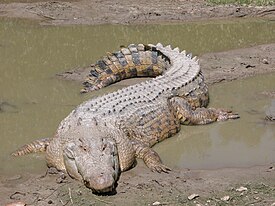
Saltwater crocodile [1] ( lat. Crocodylus porosus ) is a large modern reptile belonging to the family of real crocodiles of the crocodile order. The largest land predator and reptile on the planet. [2]
The largest representative of his squad, as well as the largest land or coastal predator. Males of this species can reach a length of seven meters with a mass of about two tons [3] ; the only modern crocodiles regularly growing more than 5.2 meters in length. On the other hand, female combed crocodiles are noticeably smaller than males and are generally inferior in size to females of some other species of crocodiles.
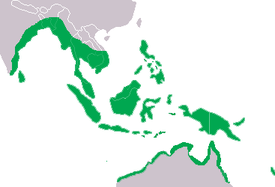
A combed crocodile can live in salt water, but, as a rule, lives in mangrove swamps, deltas, lagoons and in the lower reaches of rivers. It is distributed much more widely than any other modern type of crocodile: its range begins from the east coast of India, passing south through the territories of most states of Southeast Asia, up to Northern Australia. In the past, the combed crocodile was even more widespread, found on the east coast of Africa and the southern shores of Japan.
It occupies the top position in the food chain throughout its vast habitat. There are cases of combed crocodiles attacking other higher predators - sharks and big cats. Young individuals and females feed mainly on small animals, while adult males prefer to hunt large ones. A combed crocodile is also known as a cannibal crocodile, although the number of deaths caused by crocodile attacks is often exaggerated.
Both males and females of combed crocodiles lead a territorial lifestyle. Males are intolerant of each other during the breeding season and often engage in violent (often fatal) fights.
Since ancient times (like the Nile crocodile ) it has been the object of fear and worship in many cultures due to its strength, danger and fearlessness.
Content
- 1 Name
- 2 Evolution
- 2.1 Possible subspecies and status of the complex of species
- 3 Area
- 4 Appearance
- 5 Anatomy and physiology
- 5.1 Osmoregulation
- 5.2 Bite Strength
- 6 sizes
- 6.1 Average sizes
- 6.2 Maximum dimensions
- 6.2.1 Examples of large crocodiles
- 7 Lifestyle
- 7.1 Social structure
- 8 Power
- 8.1 Diet of young crocodiles
- 8.2 Diet of adult crocodiles
- 8.3 Alternative power supplies
- 9 Attacks on people
- 10 Reproduction
- 11 Population Status
- 12 Notes
- 13 Links
Name
Scientific species epithet Lat. porosus (literally "nostril") is given due to the fact that the muzzle of old crocodiles is covered with tubercles [4] .
This crocodile received the Russian name “comb” for a pair of powerful ridges extending from the eyes to almost the front third of the muzzle. Other sometimes used names reflect the features of his lifestyle: “sea crocodile”, “cannibal crocodile”, “underwater crocodile”, “salti”, “estuarine crocodile” or “Indo-Pacific crocodile” [5] .
Evolution

It is believed that all modern crocodiles, including Crocodylus porosus, are direct descendants of crocodilomorphs similar to them - euzuhi , who lived near the reservoirs of the Gondwan supercontinent about 98 million years ago and survived the Cretaceous-Paleogene extinction .
The fossil Isisfordia duncani , found in the western part of Queensland on the territory of the inland sea that once existed there, although it is much smaller than the combed crocodile, but by some indications is very much like modern crocodiles. Most likely, Isisfordia duncani occupied similar habitats, and the structure of her vertebrae indicates that she was able to make a “deadly rotation”. It is believed that this is a representative of the branch of evolution that directly leads to modern crocodiles [6] [7] [8] .
Due to the incompleteness of the fossil record, it is rather difficult to determine the time of occurrence of the combed crocodile as a species. The earliest fossil evidence of the existence of combed crocodiles is approximately 4.0-4.5 million years old [9] . However, according to scientists, Crocodylus porosus is a more ancient species; it arose from 12 to 6 million years ago [10] [11] [12] . From Queensland , a fragment of the lower jaw of an approximately 6.1-meter individual living in the Pliocene is known [13] .
According to morphological characteristics, the combed crocodile is most similar to the New Guinean ( Crocodylus novaeguineae ), Philippine ( Crocodylus mindorensis ) and Australian ( Crocodylus johnstoni ) freshwater crocodiles. But genetic research indicates that the combed crocodile is most closely associated with Asian species of crocodiles, although to a slightly lesser extent than they are related to each other. Sibling crocodiles ( Crocodylus palustris ) and Siamese ( Crocodylus siamensis ) crocodiles are close relatives of crested crocodiles [14] [15] [16] [17] .
The genome was completely sequenced in 2007 [18] .
Possible subspecies and status of the species complex

Currently, most sources claim that the combed crocodile does not form subspecies [19] . However, relying mainly on morphological variability, some scientists came to the conclusion that there are not only subspecies of C. porosus, but that the combed crocodile is actually a complex of different species. In 1844, S. Muller and G. Schlegel tried to describe the crocodiles living in Java and Kalimantan as a new species, which they named Crocodylus raninus . C. raninus subsequently received the informal name "Indonesian crocodile," or "Bornean crocodile." According to Ross (1992), Crocodylus raninus significantly differs from Siamese and combed crocodiles in the number of ventral scales and the presence of four scutes behind the skull, which are usually absent in combed crocodiles [17] [20] [21] . At the moment, the status of this species remains unclear [22] . Another attempt to isolate a new species, this time originating from Australia, was made by Wells & Wellington (1985), relying on observations of large, massive and relatively large crocodile heads. A typical example of this “species” was a crocodile nicknamed “Sweetheart”, which drowned in 1979 due to an overdose of sleeping pills that occurred during the capture [23] . Later, this "species", named Crocodylus pethericki , began to be regarded as ordinary seasoned male combed crocodiles that underwent ontogenetic changes. However, Wells and Wellington were most likely right in suggesting that Australian combed crocodiles could be quite different from Asian crocodiles to justify the status of the subspecies [17] [24] [25] [26] .
Range
Saltwater crocodile has the largest range among modern crocodiles, which is often explained by its ability to cover significant distances by sea [27] . The animal’s range extends from Sri Lanka and eastern India , including the coast of Southeast Asia, up to the central regions of Vietnam (where it is, however, now rare), and passes to the south, through the territories of most states of Southeast Asia, all the way to Northern Australia. In South Australia, combed crocodiles are not found, due to the arid climate and low average annual temperature, although some cases of the detection of individual crocodiles south of their usual habitat are historically known [28] .
Most often, combed crocodiles are found on the northern coast of Australia, on the islands of Papua New Guinea and Indonesia . Stable populations exist in the Philippines , Palau , Vanuatu and the Solomon Islands . Small populations of combed crocodiles can be found on numerous islands in the Indian Ocean.
Earlier, combed crocodiles were found in the Seychelles (where they are now exterminated), and in historical times they even inhabited the eastern coast of the Black Continent . Some individuals were found at a considerable distance from ordinary habitats - for example, on the southern coast of Japan .
Sea crocodile is one of the three crocodiles that can be found in India, the other two are more common on the continent, a smaller mage , and a fish-eating gavial .
Appearance
The combed crocodile's face is relatively wider than most other crocodiles. The head is large, with heavy jaws; in adult males, the jaw is noticeably more massive and higher than in females or younger males. The surface of the upper jaw becomes wrinkled and bumpy with age. On the muzzle is a pair of clearly visible ridges, possibly protecting the eyes from impacts. There is a blinking membrane in front of the eyes, allowing crocodiles to look under water without the risk of damaging them [29] .
Young crocodiles are usually pale yellow-brown in color and have noticeable black stripes or spots all over their bodies. This color persists during the first few years of life, gradually becoming more dull. With age, the stripes become more vague, but never disappear completely, even among the oldest crocodiles. However, since most wild crocodiles are covered with algae and dirt, their true color is difficult to determine. In general, adults are darker, usually light brown or gray, depending on environmental conditions, especially the chemical composition of the water. Belly without stripes, yellow or white. The underside of the tail is usually gray with dark stripes. Very rarely, one or two large black spots can be found on the stomach, but they are considered an anomaly. A small percentage of animals in some regions stands out much lighter ( leukists ), or vice versa, darker ( melanists ) in color against the rest [30] .
Scales oval and relatively small. Osteoderms on the neck are clearly visible, but the scutes on the back are relatively smaller and less common than most freshwater crocodile species, which is considered an adaptation for faster swimming [31] .
Adult male combed crocodiles have a relatively wide and massive body, which is why they were previously called “alligators”. However, the historical etymology of this word did not imply representatives of the Alligatoridae family , and most likely designated large crocodiles [4] . Saltwater crocodile has proportionally the longest tail among all crocodiles, accounting for approximately 55% of the total length of the animal [32] [33] . It was also noted that male combed crocodiles have relatively longer tails than females, and combed crocodiles from Sarawka generally have relatively shorter tails than individuals of the same gender and age from Australia [34] . It is believed that the relatively long tail of crocodiles is directly related to longer periods of active swimming [34] .
The skulls of male combed crocodiles with a dorsal length of more than 70 cm are well known. The maximum reliably recorded skull size is 76 cm, with a width of 48 cm and a lower jaw 98.3 cm long (sample MNHN PMP A11803, stored in the London Museum and originally comes from Cambodia ) [32] [35] [36] . While for females, skulls longer than 45 cm are an exception [34] [37] . The usual ratio of the dorsal length of the skull to the total length of the crocodile is 1: 7.48 [37] , but in large individuals the skulls become relatively more massive, wider, shorter and higher than in their smaller relatives, and when measured along the midline, they can occupy only one eighth or one-ninth of the total length of the animal (for example, in a combed crocodile in the Madras Crocodile Bank nicknamed Jaws III, the skull occupies only 1 / 9.1 of the total length) [32] [35] .
Anatomy and physiology

Like other crocodiles, the heart of the combed crocodile is four-chamber, which allows more efficient oxygenation of the blood. It has a special valve that controls the mixing of arterial and venous blood. The latter is necessary for long dives. Usually, a combed crocodile dives for 2–5 minutes, but if necessary, can remain under water for up to 30 minutes, and with reduced activity - up to two hours [38] . The standard metabolic rate of a combed crocodile is on average 36% higher than that of the Mississippi alligator and Australian narrow-crocodile [39] , but as a cold-blooded animal, it still has a relatively slow metabolism and can go without food for a long time. Even newly hatched cubs are able to live without food for about 58 days, while losing 23% of their mass. A 200 kg combed crocodile requires five times less food than a lion of the same weight [40] . The average need for combed crocodiles for food is 4% of body weight per week [41] [42] .
Crocodile skin is equipped with special receptors that respond to changes in water pressure and are able to detect the presence of individual chemical compounds in it [43] .
The jaws have impressive power, which allows them to hold large animals. A combed crocodile usually has 64–68 conical teeth — 36–38 in the upper jaw and 28–30 in the lower jaw [44] . The teeth of newly hatched crocodiles are thin and relatively small, but the sizes and proportions of the teeth of crocodiles change significantly with age [34] . The teeth of adults are long, sharp, thick and strong, ideal for deep piercing and tearing the flesh. The teeth at the base of the jaw are dull and are characterized by increased strength, since they serve to crush the shells and bones. The fourth tooth on the lower jaw of a combed crocodile about 5 m long can reach about 9 cm without a root; its main function is to tear the skin of the thickest prey [5] [45] [46] .
Despite the fact that the brain of crocodiles is much smaller than that of mammals (not more than 0.05% of the total body weight), it is quite complex in structure, most reminiscent of a bird. Saltwater crocodiles are able to learn by developing complex behavioral patterns, can learn to track the prey migration paths, and also have a more complex body language and range of sounds than is commonly believed [47] .
Like all crocodiles, the combed crocodile has predominantly white muscle fibers in the skeletal muscles and is characterized by great physical strength [48] . Musculature occupies more than 50% of the total body weight even in young individuals [49] . Unlike many other cold-blooded higher vertebrates, the muscles of crocodiles are optimized to work in a wide temperature range and do not lose strength even with a significant decrease in body temperature [50] . Under heavy physical exertion, crocodiles rely primarily on anaerobic metabolism, designed for short-term bursts of strength [48] . Moreover, aerobic abilities, which are responsible for less powerful, but much longer movements, are less developed in them than in most warm-blooded animals [48] [49] . Although this difference is not as large as earlier studies suggested [49] : at a temperature of 30-33 ° C, aerobic metabolism makes up 30-40% of the total muscle supply of young crocodiles, and the aerobic abilities of large individuals only increase due to an allometric increase lung volume [48] . However, due to the low metabolic rate and the rate of anaerobic metabolism, crocodiles very long get rid of the lactic acid produced by the muscles [48] [51] . In combed crocodiles weighing up to 180 kg, recovery after complete exhaustion usually takes about 2 hours [48] . This is partly offset by the fact that crocodiles are very resistant to changes in pH in the blood and deposit part of lactic acid in osteoderm and skull bones [48] . The larger the crocodile, the greater the amount of lactate in the blood that it can transfer: this explains the significant increase in endurance with growth in size: large individuals are able to actively resist for 2 hours or more (in order to completely exhaust a very large male, it may take more than 6 hours [52] ), while individuals weighing 0.4 to 180 kg are completely exhausted for a period of 5 to 30 minutes, respectively [48] [49] [53] . Large combed crocodiles are considered to be champions among all vertebrates in the amount of lactic acid that they can accumulate in the muscles and blood without significant harm to themselves [48] [49] [51] . But meanwhile, due to a significant change in blood pH, the risk of potentially dangerous metabolic disturbances ( lactic acidosis ) also increases [48] [51] . Cases of the death of particularly large specimens (weighing more than 700 kg) after a long and ineffective capture can be associated with these violations [48] [51] .
Osmoregulation
Despite the fact that combed crocodiles are more common than other real crocodiles and gavials in salt water, their osmoregulation mechanisms have no fundamental differences. There are lingual salt glands and a highly keratinizing epithelium of the oral cavity, which prevents the diffusion of ions and the osmotic loss of water. An active role in osmoregulation is played by the cesspool .
Adult combed crocodiles can safely spend several months at sea without visible harm to themselves. Even cases are known where combed crocodiles were found in water twice as salty as ordinary sea water [54] . However, they are not able to drink salt water and do not do this even with extreme dehydration. Instead, crocodiles minimize water loss and can receive it with food. For young animals, the dehydration problem is more acute: the estimated survival time without periodic access to food or fresh water for a newborn crocodile weighing 100 g is about 21 days, for a young one weighing 1 kg - 50 days, for a young one weighing 10 kg - about 116 days with a lethal dehydration up to 33% of body weight [55] [56] [57] .

Bite Strength
A combed crocodile is a potential owner of the strongest bite in the animal kingdom. The estimated compression force of the jaws of a large male combed crocodile weighing 1308 kg is from 27,531 to 34,424 newtons, which is equivalent to a gravity of 2809.3–3512.7 kg. The greatest practical result was obtained by measuring the jaw pressure of a 4.59-meter male combed crocodile weighing 531 kg, contained in the zoo - 16414 N, or about 1675 kg [58] . Thus, this is the strongest bite measured in any animal, except for the pressure of 2268 kg, issued by an approximately 5-meter Nile crocodile.
Nevertheless, there is an opinion that the pressure developed by the jaws of large killer whales or sperm whales can exceed this already impressive indicator. But this is not confirmed.
Sizes
A combed crocodile is the largest modern crocodile species. The only representative of the detachment regularly reaching or growing 5.2 m in length [59] [60] . In addition, the combed crocodile is one of the largest modern predators on our planet; it surpasses even the polar bear in size and weight, but inferior in size to some toothed whales and sharks [61] . As reported, only the head of a large male combed crocodile can weigh over 200 kg [59] . It is curious that if we compare the sizes of newborn crocodiles and large males, then combed crocodiles have almost the most variable sizes among all higher vertebrates .
Medium Sizes
The length of the newly hatched crocodiles is about 25-30 cm, with a mass of about 70 g [62] (on average - 28 cm and 71 grams), and in the second year young crocodiles grow to 1 m in length and weigh about 2.5 kg [63] .

Adult combed crocodiles have the most pronounced sexual dimorphism among all modern crocodiles. Males can often be about two times longer and ten times heavier than females [34] Adult male combed crocodiles tend to stop growing when they reach 3.9-6 meters in length [64] [35] , while the usual length range males at the time of completion of growth is 4.6-5.2 m [65] . 6 and more meter specimens are rare [35] [59] . Fully grown females are usually 3.1 to 3.4 m long [65] , while most adult females that have not yet started laying eggs are usually about 2.7 meters long and weigh about 80 kg [63] . In one study in Australia in 2013, five captured male combed crocodiles occupying a given territory were 4.03 to 4.31 m long, while the other three males leading a nomadic lifestyle were from 3 , 73 to 3.89 m in length, and four adult females had a length of 2.91 to 2.93 m [66] .

The sizes of adult crocodiles, however, can vary greatly in different populations, depending on their health, genetic diversity, degree of exposure to anthropogenic factors, and environmental resources available for use by crocodiles. The main factors determining body weight are the length and age of the crocodile [67] . Adult males, as a rule, are significantly heavier than young males, even if they have reached the same length. Captive crocodiles tend to weigh more wild [30] . Saltwater crocodiles from Sarawak have relatively shorter tails, and because of this, they usually weigh more than Australian combed crocodiles of comparable length [34] . 5-meter crocodiles weigh about twice as much as crocodiles about 4 m long. The mass of combed crocodiles studied in 1998 varied from 32 to 1010 kg with a length of 2.1 to 5.5 meters, while 4.2 , 4.3, 4.6 and 4.9 meter individuals weighed 383, 408, 520 and 660 kg, respectively [68] .
The Nile crocodile competes in size with the combed, but reports until the middle of the 20th century about very large individuals of the Nile crocodile are not reliable enough. In addition, adult males of Nile crocodiles, as a rule, are inferior in size to adult males combed [30] . Nevertheless, if we take into account the pronounced sexual dimorphism of combed crocodiles - that is, take the average sizes taking into account both sexes, then on average they will not be much larger than Nile crocodiles and even some others, for example, Orinok crocodiles and false gavials [19] [ 46] [69] .
Maximum Sizes
The maximum size that male combed crocodiles can reach is a subject of debate among experts. Repeated trophy evidence of the existence of crocodiles more than seven meters long was refuted by measurements of the surviving remains of these reptiles. Many other information is simply impossible to verify and scientifically confirm [60] . Adam Britton considers the largest of the reliably measured specimens of one large crocodile, who was killed in 1983 in Papua New Guinea . Several zoologists, including Jerome Montecki , have calculated the size of this sample from the skull and preserved skin. According to their estimates, the length of the crocodile was approximately 6.2 m, which corresponded to the size of another large specimen, which was reliably recorded in Australia in 1974. However, the skin of this sample was dried, and in fact, being fresh, it was at least 10 cm longer. In addition, the method of adding the length of the skull and the preserved skin in itself reduces the total length of the crocodile. From this it follows that during life the crocodile was more than 6.3 m in length [60] , and the mass of this giant could exceed 1360 kg [70] .
Nevertheless, the existence of larger combed crocodiles, whose length reaches at least 7 meters, is not in doubt among most experts [30] [71] [72] . For example, according to Britton, a 76 cm skull of a combed crocodile from the London Museum most likely belonged to an animal about 6.84 m long [35] . Some other scientists consider reliable information on combed crocodiles of 6.7 m [58] or even 7.3 m in length [73] .
At the same time, the largest known female combed crocodile reached only 4.2 m in length and weighed about 400 kg [59] . In 2014, a 3.96 m long female combed crocodile was caught and tagged with a beacon on Borneo [74] .
Very large combed crocodiles with a length of more than 6 m and weighing more than 1000 kg in quite a large amount were observed at the beginning and end of the 20th century, but due to uncontrolled hunting and the subsequent extensive poaching during this time, now such individuals are very rare. This is due to a decrease in the genetic diversity of most populations and the fact that crocodiles require a considerable amount of time and a rich forage base to achieve such large sizes [75] . However, one of the studies conducted in Australia indicates that the largest representatives of the species inhabiting the Australian rivers are most likely to reach 6 to 7 m in length and weigh from 1000 to 2000 kg [76] . Very large crocodiles can also be found in Bhitarkanika National Park, India . In this park, replete with rivers and various large game , ideal conditions for the prosperity of giant crocodiles are created. The head of Orissa confidently reports that the park is home to one of the largest combed crocodiles in the world, if not the largest [77] . According to the latest census, 1462 crocodiles live in the park, of which 203 are adults. According to rough estimates, eight crocodiles have a length of 4.9 to 5.5 m, five have a length of 5.5 to 6 m, and three more are more than 6 m [77] .

Examples of large crocodiles
Here are collected data on combed crocodiles with a length of more than 6 meters.
- A crocodile shot in the Bay of Bengal in 1840 was reported to be 10.1 meters long, had a stomach circumference of 4.17 meters and weighed more than 3,000 kg. However, his skull was only 66.5 cm in length and clearly indicates that the originally indicated size was greatly exaggerated, and in fact this sample was no more than 6 m in length [59] [78] .
- James R. Montgomery, who ran the rubber plantation on Borneo from 1926 to 1932, claimed to have seen, killed, and measured combed crocodiles more than 6.1 meters long. He claims that one of the specimens he found on the shallows was 10.05 m. However, no one was able to confirm these figures, since not one of the crocodiles measured by Montgomery was recorded by scientists [59] [79] .
- There is information about measuring the skull of a combed crocodile about 100 cm long [34] [54] .
- A combed crocodile nicknamed Krys croc , shot dead in Queensland in 1957, was reported to be 8.6 meters long. But despite its great popularity, the lack of remains and reliable measurements by experts makes one doubt much the veracity of the dimensions ascribed to it [80] [81] . To attract tourists, a statue of this crocodile was also erected [82] .
- In 2017, two extremely large combed crocodiles were reported in the Darwarunga River and Roper River. Called "D-rex" and "Roper Ripper", they were estimated by observers at 8.6 and 8 meters respectively. However, experts analyzing photographs of these crocodiles doubt that they can be more than 4-5.4 meters in length [83] .
- The crocodile, killed after a six-hour raid by plantation workers in 1823 in Jalajala on Luzon Island, Philippines , reportedly reached 8.2 meters in length. It is claimed that a horse divided into eight pieces and 68 kg of pebbles of various sizes was found in his stomach [84] . But measurements of the preserved remains (a skull with a dorsal length of 66 cm [32] ) indicate that in fact this crocodile was no more than 6 meters in length [36] [59] .
- Presumably an 8-meter crocodile was observed in 2010 in the Normanton area (Australia), several photos were even taken, however, the size of the reptile cannot be reliably estimated [85] .
- The skull of the combed cannibal crocodile named Potassium, who was killed in 1962 on the Dhamra River, Orissa , India, was originally verified to belong to an animal 7.01-7.32 meters long. Based on the dorsal skull length of 73.3 cm, this crocodile most likely it was from 6.6 to 7 m in length [35] [78] .
- A 7.6 m combed crocodile was reportedly shot dead at Calcutta on the Hooghly River. However, a skull with a 75 cm dorsal length indicates that the animal was unlikely to be more than 7 meters in length [59] .
- Two crocodiles with a length of more than 7.2 m were seen in the Bhitarkanika National Park in the 1970s [86] . Nevertheless, these estimates were most likely made “by eye” and cannot be considered reliable.
- In 2006, the Guinness Book of Records noted a combed crocodile with a length of 7.01 m and a weight of up to 2000 kg, living in the Bhitarkanika National Park in Orissa, although it is not clear on what observations these data are based. It is known that today several more crocodiles at least 6 m long live in the same park [32] [35] [71] .
- In Ord River, a ridge crocodile about 7 meters long was seen and measured with laser instruments relatively recently [87] .
- According to estimates by Adam Britton, the largest of the crested crocodile skulls stored in museums (the Paris Museum ), reaching 76 cm, belonged to an animal of at least 6.84 m long with an originally declared length of 7 meters [35] . Many other skull skulls of combed crocodiles with a dorsal length of more than 65 cm, potentially belonging to crocodiles more than 6 meters long, are known in museum collections [32] [88] .
- S. Baker (1874) claimed that in Sri Lanka in the 1800s, approximately 6.7 meter combed crocodiles were quite common. Nevertheless, according to the Guinness Book of Records, the largest specimen reliably known from this island was a cannibal from the east coast, reaching a length of about 6 meters [59] .
- An approximately 6.7 meter combed crocodile was recently observed by Australian rangers on the Bull River, North Australia [32] .
- The largest reported size of the combed crocodile from Papua New Guinea , considered a reliable Guinness book of records, is indicated at 6.32 m. The animal was killed in May 1966 on the north-east coast. This crocodile had a girth of 2.74 m [59] .
- Another large combed crocodile from New Guinea was found dead in 1983. According to the preserved skin, the size of the reptile was originally estimated at 6.2 m, while the skull of this crocodile had a dorsal length of 72 cm [32] . During life, this crocodile was most likely more than 6.3 m in length, since the measured skin was dried [35] [60] .
- The longest confirmed length for a crocodile from Australia is indicated at 6.2 m. He was killed on the Mary River in the Northern Territory in 1974 [60] .
- Graham Webb, an Australian crocodile specialist, measured a 66.6 cm dorsal crocodile skull belonging to a recently shot crocodile with a body length excluding the head of 548 ± 8 cm. The total length of the animal was at least 6.15 m [34] [54] [78] . In this case, the skull was approximately 1 / 9.23 of the total length of the crocodile [78] .
- Lolong is a large combed crocodile that was caught in the Philippines in 2011 and died in 2013. Initially, it was incorrectly measured at 6.4 meters and weighed at 1075 kg. A more detailed measurement by Adam Britton showed that Lolong was 6.17 or 6.095 m long (using two different measurement methods), the maximum head width was 45 cm and the length was 70 cm. It was the largest combed crocodile of all. that were ever caught alive and kept thereafter in captivity [35] [89] .
Lifestyle
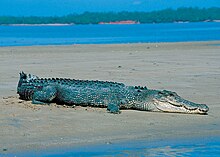
The most obvious difference in the way of life of a combed crocodile from that of other crocodiles is its tendency to live in salt water. Although all real crocodiles and gavials have the same adaptations for removing excess salt, in addition to the combed crocodile, only pointed crocodiles from neotropics regularly go to the open sea [55] .
Saltwater crocodile feels good in brackish waters, therefore it is often found in coastal areas, estuaries , estuaries and lagoons and, as you know, is capable of moving a considerable distance from the coast in search of food or a new place of residence. Often, these reptiles displace their food competitors, tiger sharks, from the coastal waters, which cannot cope with the thick skin, strength and aggressive behavior of crocodiles [90] [91] [92] [93] . Thus, during the nesting of Australian green turtles near crab islands, it is rarely possible to meet tiger sharks that stay away from the coast and certainly leave these waters when combed crocodiles arrive at the islands [94] . On the Rhine Island, on the contrary, many tiger sharks gather for seasonal feeding, since it is located at a greater distance from the continent than the crab islands, and it is more difficult for crocodiles to reach it [95] .

Time spent in the open sea is determined by the number of shells or algae on the body of a crocodile [96] . Like migratory birds using heat flow , sea crocodiles use ocean currents to travel long distances. In one study, 20 crocodiles were tagged with satellite transmitters; 8 of them sailed into the open ocean, where one sailed 590 km in 25 days. Another sample, a 4.84 m long male, swam 411 km for 20 days. The drift along the stream allows the crocodiles to save forces, the restoration of which would take a large amount of time. Saltwater crocodiles can even interrupt their travels, remaining in bays protected from strong currents, until they catch the current in the direction they need [97] .
Saltwater crocodiles periodically move up and down river systems. As a rule, individuals who do not have their own territory do this [66] [97] . This species is poorly adapted for movement on land and, as a rule, is not found at an altitude of more than 250 meters above sea level [54] . During swimming, the legs of the combed crocodile are pressed to the sides and the movement is carried out due to the wave-like movements of the tail. Cruising speed of swimming is 3.2-4.8 km / h, but pursuing prey an adult combed crocodile can reach speeds of over 29 km / h [98] . On land, combed crocodiles move crawling, unlike some other crocodiles, rarely rising on their paws and lifting their stomach from the ground. Their short legs are poorly designed for long-term movement on land, and therefore combed crocodiles avoid small and dirty ponds, which can become a death trap for them [48] . Despite this, over short distances they are able to instantly reach speeds of up to 10-11 km / h when running on land [99] . In shallow water, where a crocodile can combine tail movements with limb movements, its speed and dexterity become truly impressive.
Social structure
Combo crocodiles are not as social as most other crocodiles, and are considered the most aggressive and territorial among them. Their pronounced sexual dimorphism is the result of increased competition of males for females [100] .

Females usually occupy a relatively small area (with an area of less than one kilometer) in a freshwater pond, linking it to their favorite nesting place, and then protect their site from the invasion of other females. Males adhere to a much larger territory, which necessarily includes the territory of several females and a large freshwater reservoir suitable for breeding. They zealously guard her from other males, often engaging in fierce fights with them, sometimes ending in severe injuries, amputation of limbs or even the death of one of the rivals. In territorial conflicts, combed male crocodiles often inflict powerful head-on blows to each other, the strength of which is enough to cut the flesh of the opponent and break the bones. On the contrary, they treat females very tolerantly, sometimes even sharing their prey with them [48] [101] . The territoriality and intolerance of combed crocodiles to each other increases even more during the breeding season. Males who are unable to defend their territory are forced to hide in the territory of their more successful relatives, where they eventually die in labor, or are forced out to sea, where they move along the coast and climb river mouths in search of free freshwater sites [102 ] . Young animals that do not have their own territory are usually much more tolerant of each other. The level of aggression of captive crocodiles can also be reduced, but serious fights between them can still be [101] .
According to the studied sample of 29 individuals, more than 80% of combed crocodiles with a length of 3 meters or more carried pronounced traces of injuries sustained in conflicts with relatives on their bodies. In samples less than 2 meters long, such pathologies were noticeably rarer [103] . Despite the fact that injuries sustained by crocodiles in intraspecific battles can be very serious, their perfect immune system will help to avoid blood poisoning and quickly heal almost any wounds without leaving any visible traces [101] .
However, during a certain period of time, some combed crocodiles can leave their territories and go to places of seasonal feeding, for example, to the place of spawning of fish or nesting of sea turtles. There they can tolerate each other nearby, although food conflicts can never be completely ruled out [104] [105] . A large number of combed crocodiles can also be gathered near large carcasses, rafting down the river. In such a situation, dominant males will certainly fight each other for prey and drive away smaller crocodiles [106] . In Sri Lanka, combed crocodiles were observed, basking alongside swamp crocodiles [107] .
Nutrition
Like most crocodiles, combed crocodiles are unpretentious in choosing food and due to a slow metabolism they manage to do without food for a long period of time. Due to its wide range, strong variability in size and ontogenetic changes, a wide range of different animals is included in the diet of combed crocodiles. Adults are the highest predators in their ecosystems and complete several food chains at once.

The diet of cubs and teenagers of combed crocodiles has become the subject of a much more detailed study than the diet of adults. The aggressive behavior of large crocodiles, the inaccessibility of their habitats and the inefficiency of using tranquilizers for rapid immobilization, make combed crocodiles very difficult for animals to study [108] . The alleged diet of adults is built mainly on the evidence of reliable eyewitnesses and scientific observations in nature, and not on a detailed study of the contents of the stomachs [42] .
A combed crocodile is hunted, usually at dusk [109] . The hunting methods used by him are fuzzy and may differ from those of other crocodiles [46] . Unlike, for example, swamp or even Nile crocodiles, combed crocodiles usually do not hunt on land [110] . While hunting for rhesus monkeys, they were spotted while trying to knock down monkeys in the water with the help of tail strikes [46] . Crocodiles swallow relatively small prey in whole or in several large pieces. In the classical manner for most real crocodiles, large land animals, a combed crocodile lies in wait at a watering hole immersed in water; and when prey is nearby, he attacks, grabs it and drags it into the water, where it is more difficult for the animal to resist. On the contrary, he overtakes a large fish in the water, if possible drags him ashore. The captured animal kills the crocodile with the help of the compression of the jaws, powerful jerks of the head and the so-called “deadly rotation” - vigorous rotation around its axis, disorienting the victim underwater and tearing its body into pieces by combining the effects of water resistance, force and body weight of the crocodile. The strength of the combed crocodile is such that it can crush the buffalo skull with its jaws or crush the shell of a sea turtle. When the victim is dead, the crocodile tears pieces of suitable size from it and swallows [4] [109] [111] [112] . Food can be hidden by a well-fed crocodile for later consumption, although this can often lead to carcass eating by smaller predators such as freshwater turtles or monitor lizards [113] .
An isotopic study of the muscle tissue of crocodiles from Kakadu National Park in 2018 showed that crocodiles were between 0.85 and 4.2 meters long (76% of which were over 2.5 meters in length and 44% were closer to 2.5 meters). less than 3 meters in length) feed mainly on terrestrial animals, in particular, introduced wild boars and buffaloes, which can make up from 53% to 84% of the diet in various populations [41] .
Diet of young crocodiles
Newborn crocodiles are limited to feeding on small animals, for example, small fish, frogs, insects, and small aquatic invertebrates [114] . When crocodiles reach a length of 1-1.5 meters, small invertebrates cease to play an important role in their nutrition, and the main part of the diet becomes fish, large invertebrates (mollusks and crustaceans), birds, reptiles and small mammals [42] [114] [115 ] [115 ] ] . It is known that even young combed crocodiles, unlike adult freshwater crocodiles , can eat cane toads without the risk of poisoning [116] . Among crustaceans, large mangroves are most often consumed by growing combed crocodiles, especially in mangrove habitats. Among birds, prey most often are water birds, such as half-footed geese or herons, and among reptiles, many species of near-water snakes or lizards, less often smaller crocodiles and small turtles [117] . Sometimes even flying birds or bats can be caught by crocodiles at the surface of the water [118] . Of mammals, young crocodiles most often catch rodents and small ungulates, such as Asian deer or pork deer . Even at this age, they are capable of killing animals, at least equal in size: in Orissa, India, teenagers of combed crocodiles from 1.36 to 1.79 m in length and from 8.7 to 15.8 kg in weight were recorded domestic goats up to 92% of their own weight [119] . They can also catch monkeys, such as cynomolgus monkeys or gibbons , porcupines , wallabies , mongooses , civet , jackals , hares , badgers , marsupials , otters , fishing cats and other small animals [41] [113] [120] [121] [122] [123] [124] .
Adult Crocodile Diet

Adult combed crocodiles will also not ignore small animals if they have a good opportunity to have a bite [111] . But in general, they are not fast enough for catching small and mobile prey and therefore animals below a certain size are usually ignored [117] . Large male combed crocodiles are much more dependent on the presence of large animals in the ecosystem than young individuals, although the female diet still remains quite diverse due to their relatively small size [46] [117] [120] . The diet of adult male combed crocodiles, depending on the specific habitat, includes deer (such as zambars ), wild boars , Malayan tapirs , kangaroos, orangutans , leopards , bears , dogs ( dingoes ), pythons , monitor lizards , freshwater turtles, Asian antelopes , bantens , buffaloes , gaurs and other large animals [41] [76] [113] [125] [126] [127] [128] [129] [130] [131] [132] . Goats, horses, cattle, buffalos, and pigs were brought to many areas (such as Australia), historically inhabited by combed crocodiles, and eventually run wild. Now this new food resource is very compelling for keeping large combed crocodiles far from the abundant large aquatic animals of the sea coasts. It is known that in the Kakadu National Park, wild pigs and buffalos form the basis of the diet of adult combed crocodiles, and most often crocodiles hunt them during the dry season [41] . Any kind of domestic animals - chickens , goats, sheep , pigs , dogs , cats , horses , camels and cattle can be eaten by crocodiles if possible [46] [111] [118] [133] . In Australia, cattle make up a large proportion of the diet of adult combed crocodiles in many habitats - some large ranches report that crocodiles eat more than 300 heads of cattle each year, or 1-2 cows per day [106] [ 134] [135] [136] .
An adult male combed crocodile is an extremely powerful predator that is able to physically overcome an animal that exceeds it in weight [137] . In one reliably recorded case, a prize Suffolk stallion weighing a ton and capable of pulling more than 2000 kg was captured on the shore, dragged into the water and killed by a large male combed crocodile in less than a minute [59] . Adult bulls and buffalo bulls, which can weigh more than a ton, as well as Indian rhinos , can conditionally be considered the largest land animals that can be killed by combed crocodiles in order to obtain food. The only other modern kind of crocodile large and strong enough to be able to attack such a large prey is the Nile crocodile . But due to territoriality, unlike the Nile crocodile, which can attack large prey along with relatives, the combed crocodile always hunts alone [46] [138] .
Unlike fish, crabs, and other aquatic animals, large mammals are usually found only sporadically near the water, and therefore crocodiles will deliberately look for places of potential victims (for example, buffalo watering holes) [120] [139] . On Sumbawa, combed crocodiles are known to kill a large number of deer, who decide to set sail between the main island and the islands surrounding it, especially during seasonal migratory movements [140] .
Alternative power sources
In 2011, a fatal attack was reported on an approximately 4.2-meter combed crocodile against a 5–6 year old female Bengal tiger in Sundarban [141] [142] . Historically, the interaction between these large predators was probably more common - travelers of past centuries talked about fights of crocodiles and tigers with different results [143] [144] . In the conditions of a flooded mangrove forest, tigers are at increased risk of attack by combed crocodiles and therefore try to avoid potentially dangerous regions [141] .
For combed crocodiles, cannibalism is very characteristic. In addition, they dominate any other species of crocodiles that can be found in the wild, and if possible, even intentionally catch and eat them. In Australia, Australian narrow-toed crocodiles often fall prey to combed crocodiles, and acts of predation against adult swamp crocodiles have been recorded in Sri Lanka [31] . Studies in Sri Lanka have shown that swamp crocodiles avoid encounters with combed crocodiles by populating water bodies located far from large river systems and sea coasts, especially small lakes [145] . However, swamp crocodiles can stand up for themselves [146] , and in conditions of a reduced number of combed crocodiles in Sri Lanka, they are found in sympathy with the latter [107] . The threat of direct predation by combed crocodiles can also limit the resettlement of the false gavial, Filipino, New Guinea and Siamese crocodiles, but due to insufficient knowledge of the behavior of these animals in natural conditions, there is very little evidence [31] [147] . It is believed that direct competition with combed crocodiles could have caused the extinction of large Australian crocodiles from the mezo-sucker subfamily, such as Pallimnarchus [28] [148] .
It is believed that combed crocodiles complete several food chains at once, hunting both terrestrial or freshwater animals and marine ones [120] . There is evidence that combed crocodiles hunt not only near the coast, but also in the open sea - in their stomachs were found the remains of pelagic fish that live a few kilometers from land [149] [150] . Isotopic data indicate that large crocodiles more often prey on marine prey than small ones [41] . In sea and coastal waters, adult combed crocodiles prey on large bony fish (especially barramundi [41] and giant sea catfish [41] ), sea snakes [151] , sea turtles [152] [153] [154] (including representatives the largest modern species: leatherback turtles [154] [155] [156] and green sea turtles [157] [158] ), seabirds , dugongs [159] [160] [161] [162] , dolphins [131] [ 41] , stingrays (including large pilonos [163] [164] ) and various sharks [90] [93] [111] [152] [165] [166] . The most well-documented acts of predation of crocodiles in relation to sea turtles and their cubs, which are usually caught during the mating season off the coast [167] [168] , as well as European sawmills [163] and bull sharks [41] [113] [169 ] [170] [171] , which tends to swim in coastal waters or even swim in rivers. In Northern Australia, cases of predation of combed crocodiles in relation to adult white sharks were even recorded, and local fishermen claimed that they had repeatedly observed this in the past [59] [91] [172] . Young crocodiles feed relatively rarely in salt water, but can eat crabs, shrimps and small fish [41] .
Like other crocodiles, combed crocodiles do not disdain carrion, although they avoid rotten meat. Near the coast of Kimberley, combed crocodiles often feed on the carcasses of humpback whales [173] [174] .
Attacks on people

Saltwater crocodiles tend to view humans as potential prey and therefore have earned a reputation as cannibals for good reason. Owing to its strength, awesome size and speed, survival after a direct predatory attack by a combed crocodile becomes extremely unlikely [175] [23] [176] . While the US developed a policy of coexistence with alligators, the only effective method of protecting against combed crocodiles is to exclude their presence next to people, because crocodiles of this species are extremely aggressive and almost not afraid of humans, even if they were persecuted in periods of uncontrolled hunting [177] .
A lot of attacks of combed crocodiles on people in fresh and salt ponds are recorded annually; even land-based attacks happen, but very rarely and usually due to human faults. Accurate attack data is limited to reports from developed regions of Australia, where only one or two people are killed by crocodiles every year. From 1971 to 2013, the total number of people killed by crocodiles in Australia is 106 people [178] . Such a "low" number of deaths is a consequence of the efforts of wildlife conservation officers involved in catching "problem crocodiles" (individuals close to human settlements), learning how to deal with the threat of crocodile attacks and setting warning signs. However, some studies have shown that attempts to move potentially dangerous crocodiles away from places inhabited by people have been ineffective, as crocodiles are able to find a way back to their former territory. In the Darwin area from 2007 to 2009, 67–78% of “problem crocodiles” were identified as males [179] . Many cases of combed crocodile attacks on people in regions outside Australia are not reported, as they occur in underdeveloped countries or in rural areas. The number of casualties among Australian aborigines is also unknown. However, the prevailing allegations that combed crocodiles are responsible for thousands of human lives annually are most likely an exaggeration and probably were once spread by leather companies, hunting organizations and other sources that might benefit from a negative perception of crocodiles [180] . Nile crocodiles are considered responsible for a much larger number of human lives than combed crocodiles. This is primarily due to the noticeably large number of people in Africa who rely on coastal regions than in most Asian countries, and, of course, in Australia [181] . It is known that some combed crocodiles can become cannibals . The most notorious crested crocodile cannibal is the so-called Bujan Senan [182] .

The danger of combed crocodiles lies in the fact that they attack most often near the seashore or in fresh water, where the vigilance of people is reduced and the “victim” learns of the presence of danger too late. Even a well-fed crocodile can attack a person, sensing a threat to its territory, oppression or in the presence of an external stimulus, such as the noise of a running engine. And although such attacks are not so often fatal as those that are committed for food purposes (the crocodile at first will just try to “scare” the offender), people often get serious, sometimes incompatible with life injuries [23] . The “victim” killed by the crocodile in order to protect the territory will be eaten by him after a while and can be hidden in reserve. However, aggressive territorial behavior of crocodiles is less likely in areas that are regularly visited by people [183] .
Non-lethal attacks are usually associated with crocodiles less than 3 m long. Fatal attacks are usually caused by crocodiles from 4 meters or more in length [180] . All registered in Australia attacks of crocodiles with a length of 4.5 meters or more were fatal. A large crocodile, if desired, is able to bite an adult in two [23] . Death usually occurs as a result of decapitation, punctures of vital organs and damage to the spinal column, less commonly - profuse bleeding , pain shock or the resultant drowning in water. The recovery of people who survived the attacks of crocodiles is often complicated by infections caused by bacteria located in the oral cavity of reptiles [23] [112] [176] [184] .
On February 19, 1945, combed crocodiles killed about 1,000 Japanese soldiers on Ramri Island ; in the Guinness Book of Records, this incident is considered the most massive wildlife attack on humans [185] [186] , although some details of this incident are currently disputed:
“About a thousand Japanese soldiers tried to repel the British Royal Navy's landing assault ten miles offshore, in mangrove swamps, where thousands of crocodiles live. Twenty soldiers were later captured alive, but most were eaten by crocodiles. The hellish position of the retreating soldiers was aggravated by the huge number of scorpions and tropical mosquitoes that also attacked them, ”the Guinness book says. Naturalist Bruce Wright, participating in the battle on the side of the English battalion, claimed that most of the soldiers of the Japanese detachment ate crocodiles: “This night was the worst night that any of the fighters had ever experienced. Bloodstained screaming Japanese scattered in a black swamp liquid, squashed in the mouths of huge reptiles, and strange alarming sounds of spinning crocodiles made up a cacophony of hell. Such a sight, I think, few were able to observe on earth. At dawn, the vultures flew in to clean up what the crocodiles left ... of the 1,000 Japanese soldiers who entered Ramri’s swamps, only about 20 were found alive ” [187] .
Reproduction

Females become sexually mature at the age of 10-12 years after reaching a length of 2.2-2.5 m; males - no earlier than 16 years, upon reaching a length of 3.2 m. A combed crocodile breeds in the rainy season, from November to March, in freshwater bodies of water. The female lays from 25 to 90 (usually 40-60) eggs in a nest, which then buries. Since breeding takes place during the rainy season, an elevated place is selected for the nest, which will not be washed by streams of water. The nest is a hill of leaves and dirt up to 7 m in diameter at the base and about 1 m high. Rotting leaves absorb moisture and maintain a constant temperature in the nest of about 32 ° C. The female annually chooses the same place for the construction of the nest. She guards the masonry, remaining in a ditch dug at the nest with wet mud. Despite precaution, many clutches become prey for predators - large lizards, Australian ravens, wild pigs (in Australia ), dogs and humans. Incubation lasts 90 days, the hatching period depends on the temperature in the nest, the same factor determines the sex of the cubs - if the temperature was about 31.6 ° C, more males will be born than females.
Hearing the voices of young crocodiles, the female tears up a bunch and helps them get out. She transfers offspring to the mouth in the mouth and jealously guards them for 5-7 months. Less than 1% of hatched crocodiles reaches puberty, the rest become prey for freshwater turtles , Australian ravens , birds of prey , wild dogs, cats , herons , monitor lizards , large fish and other predators, including other crocodiles, for example, Australian freshwater crocodiles or their more large congeners [188] .
Young growths often fall prey to conflicts with adult crocodiles or direct predation on their part [189] , and also, perhaps, can sometimes be eaten by sharks in coastal waters or large land predators in the depths of the continent [46] [174] .
Population Status

A combed crocodile has a high commercial value (skin is valued), being an object of fishing and breeding on crocodile farms [190] . Crocodiles are also killed because of their craving for attacking people. The man’s development of the habitat of the combed crocodile and unregulated hunting from 1945 to 1970 greatly reduced the number of species throughout the range. He is apparently completely exterminated in Thailand ; in southern Vietnam, the population is limited to 100 animals. In India and Myanmar, there are programs to maintain the abundance of the species, including collecting eggs and growing young crocodiles on farms. After the ban on hunting for crocodiles, despite the percentage of cubs surviving to puberty, the population has grown rapidly. The leader in the field of crocodile conservation is Australia, where the largest population of this species lives on the territory of the states of Western Australia , Queensland and Northern Territory - about 100,000-200,000 individuals [30] .
Saltwater crocodile is listed in the Red Book for the low-risk category.
Saltwater crocodiles are often found in zoos or specialized farms. However, recently it has been repeatedly confirmed that in captive crocodiles behavioral deviations and various physical disturbances, such as unexplained growth delays, are often found [191] . The life span of combed crocodiles kept in captivity does not exceed 57 years, while in the wild it, according to some reports, can be twice as long [192] .
Notes
- ↑ Ananyeva N. B. , Borkin L. Ya. , Darevsky I.S. , Orlov N.L. Amphibians and reptiles. Latin, Russian, English, German, French. / edited by Acad. V. E. Sokolova . - M .: Rus. Yaz., 1988 .-- S. 139. - 10,500 copies. - ISBN 5-200-00232-X .
- ↑ The largest terrestrial, coastal predator . Yandex Zen | Platform for authors, publishers and brands. Date of treatment April 8, 2019.
- ↑ Grigg, G., & Gans, C. "Morphology & Physiology of Crocodylia" (PDF). Australian Government- Department of the Environment. Retrieved 2016-05-17.
- ↑ Перейти обратно: 1 2 3 Saltwater Crocodile facts - AC Tropical Fish.
- ↑ Перейти обратно: 1 2 Australian Saltwater Crocodile (Estuarine, Indopacific, Rawing, Maneating or Subwater Crocodile)
- ↑ Thomas, Abbie; Paul Willis (February 8, 2006). "The Dinosaur Musterers - Dawn of a crocodilian dynasty." Australian Geographic.
- ↑ " Missing link crocodile found down under ." Science buzz . Science Museum of Minnesota.
- ↑ " Ancestor of all modern crocodilians discovered in outback Queensland ." The university of queensland
- ↑ Johnson, David (November 4, 2009). The Geology of Australia . Cambridge University Press.
- ↑ A time-calibrated species tree of Crocodylia reveals a recent radiation of the true crocodiles Archived September 21, 2013 on the Wayback Machine
- ↑ Willis, PMA, 1997. Review of fossil crocodilians from Australasia. Aust. J. Zool.
- ↑ Molnar, RE, 1979. Crocodylus porosus from the Pliocene Allingham for- mation of North Queensland. Results of the Ray E. Lemley expeditions, part 5. Memoirs Of The Queensland Museum.
- ↑ Some Queensland fossil vertebrates (Eng.) // Memoirs of The Queensland Museum. - 1924. - Vol. 8 . - ISSN 0079-8835 .
- ↑ Brochu, CA 2000. Congruence between physiology, phylogenetics and the fossil record on crocodylian historical biogeography . In Grigg, GC, Seebacher, F. & Franklin, CE (eds) Crocodilian Biology and Evolution. Surry Beatty & Sons (Chipping Norton, Aus.)
- ↑ Man, Z., Yishu, W., Peng, Y. & Wu, X. 2011. Crocodilian phylogeny inferred from twelve mitochondrial protein-coding genes, with new complete mitochondrial genomic sequences for Crocodylus acutus and Crocodylus novaeguineae . Molecular Phylogenetic and Evolution.
- ↑ Oaks, JR 2011. A time-calibrated species tree of Crocodylia reveals a recent radiation of the true crocodiles .
- ↑ Перейти обратно: 1 2 3 Naish, D. " The Saltwater Crocodile, and all that it implies (crocodiles part III) ." Scientific American - Tetrapod Zoology.
- ↑ Yan Li, Xiaobing Wu, Xuefeng Ji, Peng Yan & George Amato (February 2007). "The complete mitochondrial genome of salt-water crocodile (Crocodylus porosus) and phylogeny of crocodilians." Journal of genetics and genomics = Yi chuan xue bao.
- ↑ Перейти обратно: 1 2 Brazaitis, P. (2001). A Guide to the Identification of the Living Species of Crocodilians . Wildlife Conservation Society.
- ↑ Ross, CA 1990. Crocodylus raninus S. Müller and Schlegel, a valid species of crocodile (Reptilia: Crocodylidae) from Borneo . Proceedings of the Biological Society of Washington.
- ↑ Ross, CA 1992. Designation of a lectotype for Crocodylus raninus S. Müller and Schlegel (Reptilia: Crocodylidae), the Borneo crocodile . Proceedings of the Biological Society of Washington.
- ↑ Crocodylus raninus . The Reptile Database. Date of treatment January 26, 2016.
- ↑ Перейти обратно: 1 2 3 4 5 David GE Caldicott, David Croser, Charlie Manolis, Grahame Webb, Adam Britton. Crocodile Attack in Australia: An Analysis of Its Incidence and Review of the Pathology and Management of Crocodilian Attacks in General // Wilderness & Environmental Medicine. - 2005-09-01. - T. 16 , no. 3 . - S. 143–159 . - DOI : 10.1580 / 1080-6032 (2005) 16 [143: CAIAAA] 2.0.CO; 2 .
- ↑ Wells, RW & Wellington, CR 1985. A classification of the Amphibia and Reptilia of Australia . Australian Journal of Herpetology
- ↑ Das, I., & Charles, JK (2000). A Record of Crocodylus raninus Müller & Schlegel, 1844 from Brunei, North-western Borneo . Sabah Parks Nature Journal.
- ↑ Brochu, CA (2009). Phylogenetic relationships and divergence timing of Crocodylus based on morphology and the fossil record .
- ↑ Crested Crocodile (lat.Crocodylus porosus) :: NoNaMe unopened (inaccessible link) . Date of treatment November 20, 2013. Archived March 11, 2014.
- ↑ Перейти обратно: 1 2 How far south did crocodiles once live? (en-AU), ABC News (May 3, 2018). Date of treatment May 9, 2018.
- ↑ Crocodilian Biology Database - FAQ - Do crocodiles cry “crocodile tears”?
- ↑ Перейти обратно: 1 2 3 4 5 Crocodilian Species - Australian Saltwater Crocodile (Crocodylus porosus)
- ↑ Перейти обратно: 1 2 3 Richard Shine, Ruchira Somaweera, Matthew L. Brien, (2013), The Role of Predation in Shaping Crocodilian Natural History.
- ↑ Перейти обратно: 1 2 3 4 5 6 7 8 Rom Whitaker and Nik Whitaker. Who's Got the Biggest? // Crocodile Specialist Group Newsletter 27 (4): 26-30.
- ↑ S. Charlie Manolis. Crocodiles: Inside Out: a Guide to the Crocodilians and Their Functional Morphology . - Surrey Beatty & Sons, 2002-01-01. - 188 p. - ISBN 9780949324900 .
- ↑ Перейти обратно: 1 2 3 4 5 6 7 8 Webb, GJW and Messel, H. (1978). " Morphometric analysis of Crocodylus porosus from the north coast of Arnhem Land, northern Australia ." Australian Journal of Zoology.
- ↑ Перейти обратно: 1 2 3 4 5 6 7 8 9 10 Here be a dragon: exceptional size in a saltwater crocodile (Crocodylus porosus) from the Philippines | Adam Britton - Academia.edu
- ↑ Перейти обратно: 1 2 Naish, Darren (October 30, 2008). " The world's largest modern crocodilian skull - Tetrapod Zoology ." Scienceblogs.com.
- ↑ Перейти обратно: 1 2 Greer, Allen E. (1974). "On the Maximum Total Length of the Salt-Water Crocodile (Crocodylus porosus)." Journal of Herpetology.
- ↑ How long can a crocodile stay underwater?
- ↑ CM Gienger, Matthew L. Brien, Christopher R. Tracy, S. Charlie Manolis, Grahame JW Webb. Ontogenetic comparisons of standard metabolism in three species of crocodilians // PLoS ONE. - 2017-02-09. - T. 12 , no. 2 . - ISSN 1932-6203 . - DOI : 10.1371 / journal.pone.0171082 .
- ↑ Garnett, ST (1986). "Metabolism and survival of fasting estuarine crocodiles." Journal of Zoology . 208 (4): 493-502. doi: 10.1111 / j.1469-7998.1986.tb01518.x .
- ↑ Перейти обратно: 1 2 3 4 5 6 7 8 9 10 11 Maria Fernanda Adame, Timothy D. Jardine, Brian Fry, Dominic Valdez, Garry Lindner. Estuarine crocodiles in a tropical coastal floodplain obtain nutrition from terrestrial prey (eng.) // PLOS ONE. - 2018-06-06. - Vol. 13 , iss. 6 . - P. e0197159 . - ISSN 1932-6203 . - DOI : 10.1371 / journal.pone.0197159 .
- ↑ Перейти обратно: 1 2 3 Webb, GJ, Hollis, GJ, & Manolis, SC (1991). Feeding, growth, and food conversion rates of wild juvenile saltwater crocodiles (Crocodylus porosus) .
- ↑ Administrator. Superreceptors Were discovered in crocodiles (inaccessible link) . www.worldofanimals.ru. Date of access May 21, 2017. Archived on May 30, 2017.
- ↑ Kondo-X. (1970). Grolier The Amazing World of Reptiles . New York, NY: Grolier Interprises Inc.
- ↑ Australian crocodile Elvis sinks teeth into lawnmower - CNN.com
- ↑ Перейти обратно: 1 2 3 4 5 6 7 8 Guggisberg, CAW (1972). Crocodiles: Their Natural History, Folklore, and Conservation . Newton Abbot: David & Charles.
- ↑ Big Gecko - Crocodile Management, Research and Filming . crocodilian.com. Date of treatment May 21, 2017.
- ↑ Перейти обратно: 1 2 3 4 5 6 7 8 9 10 11 12 13 Gordon Grigg, David Kirshner, Rick Shine. Biology and Evolution of Crocodylians . - 1 edition. - Comstock Publishing Associates, 2015-05-26. - 672 p. - ISBN 9780801454103 .
- ↑ Перейти обратно: 1 2 3 4 5 Maximal Aerobic and Anaerobic Power Generation in Large Crocodiles versus Mammals: Implications for Dinosaur Gigantothermy .
- ↑ Frank Seebacher, Rob S. James (2007), Plasticity of muscle function in a thermoregulating ectotherm ( Crocodylus porosus ): biomechanics and metabolism .
- ↑ Перейти обратно: 1 2 3 4 AF Bennett, RS Seymour, DF Bradford, GJW Webb. Mass-Dependence of Anaerobic Metabolism and Acid-Base Disturbance During Activity in the Salt-Water Crocodile, Crocodylus Porosus (Eng.) // Journal of Experimental Biology. - 1985-09-01. - Vol. 118 , iss. 1 . - P. 161-171 .
- ↑ Warm, fuzzy, weird, funny: The Museum (s) of Natural History spin some tall tales (English) , Harvard Gazette (July 19, 2001). Date of treatment November 8, 2017.
- ↑ AF Bennett, RS Seymour, DF Bradford, GJW Webb. Mass-Dependence of Anaerobic Metabolism and Acid-Base Disturbance During Activity in the Salt-Water Crocodile, Crocodylus Porosus (Eng.) // Journal of Experimental Biology. - 1985-09-01. - Vol. 118 , iss. 1 . - P. 161–171 . - ISSN 1477-9145 0022-0949, 1477-9145 .
- ↑ Перейти обратно: 1 2 3 4 Estuarine Crocodile, Crocodylus porosus - Australian Museum . australianmuseum.net.au. Date of treatment February 9, 2018.
- ↑ Перейти обратно: 1 2 Osmoregulation in crocodilians . ufdc.ufl.edu. Date of treatment December 14, 2015.
- ↑ LE Taplin, GC Grigg, L. Beard. Osmoregulation of the Australian freshwater crocodile, Crocodylus johnstoni, in fresh and saline waters (English) // Journal of Comparative Physiology B. - 1993-02-01. - Vol. 163 , iss. 1 . - P. 70-77 . - DOI : 10.1007 / BF00309668 .
- ↑ Louise J. Kuchel, Craig E. Franklin. <168 :: AID-JMOR7> 3.0.CO; 2-1 / full Morphology of the cloaca in the estuarine crocodile, Crocodylus porosus, and its plastic response to salinity // Journal of Morphology. - 2000.
- ↑ Перейти обратно: 1 2 Gregory M. Erickson, Paul M. Gignac, Scott J. Steppan, A. Kristopher Lappin, Kent A. Vliet. Insights into the Ecology and Evolutionary Success of Crocodilians Revealed through Bite-Force and Tooth-Pressure Experimentation // PLoS ONE. - 2012-03-14. - T. 7 , no. 3 . - S. e31781 . - DOI : 10.1371 / journal.pone.0031781 .
- ↑ Перейти обратно: 1 2 3 4 5 6 7 8 9 10 11 12 Wood, Gerald (1982). The Guinness Book of Animal Facts and Feats. ISBN 978-0-85112-235-9 .
- ↑ Перейти обратно: 1 2 3 4 5 Which is the largest species of crocodile?
- ↑ Alexey S. Zlygostev, E-Mail webmaster.innobi@gmail.com. It’s bad to be a crocodile [1992 Chegodaev A.E. - The amazing world of reptiles ] . herpeton.ru. Date of treatment May 21, 2017.
- ↑ Information About Crocodiles Archived March 26, 2014 on Wayback Machine
- ↑ Перейти обратно: 1 2 “Insights into Crocodile Lifestyles” (PDF). newholland.com.au. Archived from the original (PDF) on October 4, 2009.
- ↑ Webb, GJW; Messel, H .; Crawford, J .; Yerbury, MJ (1978). "Growth rates of Crocodylus porosus (Reptilia: Crocodilia) from Arnhem Land, northern Australia." Wildlife Research . 5 (3): 385-399.
- ↑ Перейти обратно: 1 2 Grahame Webb, S. Charlie Manolis. Crocodiles of Australia . - Reed, 1993 .-- 158 p. - ISBN 9780730103912 .
- ↑ Перейти обратно: 1 2 Hamish A. Campbell, Ross G. Dwyer, Terri R. Irwin, Craig E. Franklin. Home Range Utilization and Long-Range Movement of Estuarine Crocodiles during the Breeding and Nesting Season // PLoS ONE. - 2013-05-01. - T. 8 , no. 5 . - ISSN 1932-6203 . - DOI : 10.1371 / journal.pone.0062127 .
- ↑ “Insights into Crocodile Lifestyles” ( PDF ). newholland.com.au.
- ↑ Grigg, GC, Seebacherd, F., Beard, LA, & Morris, D. (1998). “ Thermal relations of large crocodiles, Crocodylus porosus , free — ranging in a naturalistic situation .” Proceedings of the Royal Society of London.
- ↑ Brazaitis, P. (1987). Identification of crocodilian skins . Pty Lim., Chipping Norton, Australia.
- ↑ Michael Bright. Skyhorse Publishing, Inc., Dec 13 2013 The Frog with Self-Cleaning Feet:. . . And Other Extraordinary Tales from the Animal World.
- ↑ Перейти обратно: 1 2 World's Largest Reptile Found in India - OhmyNews International
- ↑ Webb G, Manolis C (1989) Crocodiles of Australia. New South Wales: Reed.
- ↑ Kar, SK; Bustard, HR (1983). "Saltwater crocodile attacks on man." Biological Conservation 25 (4): 377–382. doi : 10.1016 / 0006-3207 (83) 90071-X .
- ↑ Largest female Croc collared in Borneo . BorneoPost Online | Borneo, Malaysia, Sarawak Daily News (February 15, 2014). Date of treatment June 16, 2016.
- ↑ Crocodiles of Australia .
- ↑ Перейти обратно: 1 2 Leach, G., Delaney, R., & Fukuda, Y. (2009). Management program for the saltwater crocodile in the Northern Territory of Australia, 2009—2014 . Department of Natural Resources, Environment, the Arts and Sport.
- ↑ Перейти обратно: 1 2 UnderwaterTimes.com | Guinness: India Park Home to World's Largest Crocodil . www.underwatertimes.com. Date of treatment January 18, 2016.
- ↑ Перейти обратно: 1 2 3 4 SIZE MATTERS! . janakilenin.blogspot.ru. Date of treatment November 13, 2017.
- ↑ Alderton David. Saltwater Crocodile . samlib.ru. Date of treatment November 13, 2017.
- ↑ Monster croc? Welcome to my nightmare. .
- ↑ Death of a monster .
- ↑ Give An Aussie A Go: towns: QLD - NORMANTON - Home of largest Crocodile ever shot! . www.giveanaussieago.com.au. Date of treatment July 18, 2017.
- ↑ Northern Territory's most famous crocodiles | NT News.
- ↑ Gilbert Phelps. Between Man and Beast: True Tales & Observations of the Animal Kingdom . - Random House Value Publishing, 1990-03-01. - 226 p. - ISBN 9780517690383 .
- ↑ Buaya monster Normanton tertangkap kamera - diperkirakan memiliki panjang 8 meter - Blog misteri enigma . www.enigmablogger.com. Date of treatment November 25, 2015.
- ↑ Sanjeev Chadha, Chandra Sekhar Kar. Bhitarkanika, Myth and Reality . - Natraj Publishers, 1999-01-01. - 480 p. - ISBN 9788185019765 .
- ↑ Jeremy Rooke. Giant crocodile Maximus - Crocstalking episode 4 (October 3, 2013). Date of treatment March 2, 2019.
- ↑ (PDF) Historical, exceptionally large skulls of saltwater crocodiles discovered at the Lee Kong Chian Natural History Museum in Singapore . ResearchGate. Date of treatment March 2, 2019.
- ↑ How strong are crocodiles? .
- ↑ Перейти обратно: 1 2 Croc Spotted Devouring a Tiger Shark . www.explore-townsville.com. Date of treatment December 28, 2015.
- ↑ Перейти обратно: 1 2 sandcroc2014. Crocodiles vs sharks (Jul 10, 2014).
- ↑ One of the most dangerous sea creatures . Pinterest Date of treatment December 28, 2015.
- ↑ Перейти обратно: 1 2 Australian bitey things! . Pinterest Date of treatment August 26, 2016.
- ↑ Crab Island Flatback Sea Turtle Research Project: Reflecting on 2008 - what a year! . crabislandflatbacks.blogspot.ru. Date of treatment December 28, 2015.
- ↑ Dr Mark Read on Raine Island (link not available) . sixtyminutes. Date of treatment December 28, 2015. Archived January 7, 2016.
- ↑ " Lepas anatifera Archived copy of October 18, 2007 on the Wayback Machine Linnaeus, 1758 Archived copy of October 18, 2007 on the Wayback Machine ." WallaWalla
- ↑ Перейти обратно: 1 2 Moskvitch, Katia (June 7, 2010). " BBC News - Crocodiles 'surf' long distance on ocean currents ."
- ↑ Saltwater Crocodile Facts For Kids With Pictures & Video (Eng.) , Active Wild (December 11, 2015). Date of treatment May 21, 2017.
- ↑ How Fast Can A Crocodile Run On Land? (Eng.) , How Fast Can (April 22, 2012). Date of treatment May 21, 2017.
- ↑ Saltwater crocodile named world's most aggressive .
- ↑ Перейти обратно: 1 2 3 Crocodilians: Natural History & Conservation: Crocodiles, Caimans, Alligators, Gharials . crocodilian.com. Date of treatment March 6, 2017.
- ↑ Saltwater crocodile habital. (inaccessible link) . Date of treatment December 28, 2013. Archived December 30, 2013.
- ↑ Abnormalities and Injuries in the Estuarine Crocodile Crocodylus Porosus (English) . ResearchGate. Date of treatment May 22, 2017.
- ↑ Crab Island . www.cape-york-australia.com. Date of treatment December 28, 2015.
- ↑ Croc Invasion Facts . Nat Geo WILD. Date of treatment December 28, 2015.
- ↑ Перейти обратно: 1 2 Crocs feast on 'DUMB' southern cows . Greg McLeanNT News.
- ↑ Перейти обратно: 1 2 Status, distribution and conservation of crocodiles in Sri Lanka (Eng.) // Biological Conservation. - 2001-02-01. - Vol. 97 , iss. 3 . - P. 305-318 . - ISSN 0006-3207 . - DOI : 10.1016 / S0006-3207 (00) 00126-9 .
- ↑ Webb, GJ, & Messel, H. (1977). Crocodile capture techniques . The Journal of Wildlife Management.
- ↑ Перейти обратно: 1 2 Estuarine Crocodile, Crocodylus porosus - Australian Museum . australianmuseum.net.au. Date of appeal May 26, 2017.
- ↑ On terrestrial hunting by crocodilians (PDF Download Available ) . ResearchGate. Date of treatment May 22, 2017.
- ↑ Перейти обратно: 1 2 3 4 Crocodile Feeding (link not available) . saltwatercrocodiles.homestead.com. Date of treatment November 25, 2015. Archived March 4, 2016.
- ↑ Перейти обратно: 1 2 Saurabh Chattopadhyay, Biplab Shee, Biswajit Sukul. Fatal crocodile attack (Eng.) // Journal of Forensic and Legal Medicine. - 2013-11. - T. 20 , no. 8 . - S. 1139–1141 . - ISSN 1752-928X . - DOI : 10.1016 / j.jflm.2013.09.09.005 .
- ↑ Перейти обратно: 1 2 3 4 Doody, JS (2009). "Eyes bigger than stomach: prey caching and retrieval in the saltwater crocodile, Crocodylus porosus ." Herpetological Review 40 (1): 26.
- ↑ Перейти обратно: 1 2 Davenport, J., Grove, DJ, Cannon, J., Ellis, TR, & Stables, R. (1990). Food capture, appetite, digestion rate and efficiency in hatchling and juvenile Crocodylus porosus . Journal of zoology
- ↑ Taylor, JA (1979). The foods and feeding habits of subadult Crocodylus porosus Schneider in northern Australia .
- ↑ saltwater crocodile | Beautiful Nightmares (link not available) . phrynus.wordpress.com. Date of treatment May 11, 2016. Archived October 11, 2016.
- ↑ Перейти обратно: 1 2 3 Messel, H., & Vorlicek, GC (1989). "Ecology of Crocodylus porosus in northern Australia", pp. 164–183 in Crocodiles: Their Ecology, Management and Conservation . IUCN. ISBN 2880329876
- ↑ Перейти обратно: 1 2 Ross, Charles A; Garnett, Stephen, eds. (1989). Crocodiles and Alligators . Checkmark Books.
- ↑ SK Kar, HR Bustard. Attacks on domestic livestock by juvenile saltwater crocodile, Crocodylus porosus, in Bhitarkanika Wildlife Sanctuary, Orissa India // Amphibia-Reptilia. - 1983-01-01. - T. 4 , no. 1 . - S. 81–83 . - ISSN 1568-5381 . - DOI : 10.1163 / 156853883X00283 .
- ↑ Перейти обратно: 1 2 3 4 Jeffrey O. Hanson, Steven W. Salisbury, Hamish A. Campbell, Ross G. Dwyer, Timothy D. Jardine. Feeding across the food web: The interaction between diet, movement and body size in estuarine crocodiles (Crocodylus porosus) (Eng.) // Austral Ecology. - 2015-05-01. - Vol. 40 , iss. 3 . - P. 275–286 . - ISSN 1442-9993 . - DOI : 10.1111 / aec.12212 .
- ↑ Galdikas, BM, & Yeager, CP (1984). "Brief report: Crocodile predation on a crab-eating macaque in Borneo."
- ↑ Otani, Y., ustine Tuugaz, A., Bernard, H., Matsuda, I., & Kinabalu, K. Opportunistic predation and predation-related events on long-tailed macaque and proboscis monkey in Kinabatangan, Sabah, Malaysia .
- ↑ Blumstein, DT, Daniel, JC, & Sims, RA (2003). "Group size but not distance to cover influences agile wallaby ( Macropus agilis ) time allocation."
- ↑ Vertebrate carnivores and predation in the Oriental (Indomalayan) Region . ResearchGate. Date of treatment November 25, 2015.
- ↑ Collins, B. (2005). Crocodiles Inside Out: A Guide to the Crocodilians and Their Functional Morphology . Australian Ecology.
- ↑ Russon, AE, Kuncoro, P., Ferisa, A., & Handayani, DP (2010). How orangutans (Pongo pygmaeus) innovate for water . Journal of Comparative Psychology.
- ↑ NG, M., & MENDYK, RW (2012). Predation of an Adult Malaysian Water monitor Varanus salvator macromaculatus by an Estuarine Crocodile Crocodylus porosus . Biawak.
- ↑ Butler, JR, Linnell, JD, Morrant, D., Athreya, V., Lescureux, N., & McKeown, A. (2013). Dog eat dog, cat eat dog: social-ecological dimensions of dog predation by wild carnivores . Free-Ranging Dogs and Wildlife Conservation.
- ↑ De Silva, M., Dissanayake, S., & Santiapillai, C. (1994). Aspects of the population dynamics of the wild Asiatic water buffalo (Bubalus bubalis) in Ruhuna National Park, Sri Lanka . Journal of South Asian Natural History.
- ↑ Bustard, HR .; Kar, SK., 1981: Crocodile kills taken as human food. British Journal of Herpetology 64: 137
- ↑ Перейти обратно: 1 2 Sheena Thomson. Crocodile rocks the river - Borneo by boat (link not available) . Bags of Adventure (June 14, 2014). Date of treatment May 22, 2017. Archived on September 16, 2017.
- ↑ Vladimir Dinets. Homepage of Vladimir Dinets - Crocs Part 18 of 20 . dinets.info. Date of appeal September 2, 2018.
- ↑ Kar, SK .; Bustard, HR., 1981: Attacks on domestic livestock by the saltwater crocodile Crocodylus porosus in Orissa, India. British Journal of Herpetology 64: 135-136.
- ↑ Losing cattle to crocs . ABC Rural. Date of treatment November 25, 2015.
- ↑ Former poacher turned hunter stalks 'world record' Northern Territory saltwater crocodile - ABC News (Australian Broadcasting Corporation) . mobile.abc.net.au. Date of treatment November 25, 2015.
- ↑ NEWSru.com News :: In Australia, giant crocodiles devour horses, cows and dogs . palm.newsru.com. Date of treatment November 25, 2015.
- ↑ Wholly cow, croc hits jackpot . au.news.yahoo.com. Date of treatment November 25, 2015.
- ↑ (PDF) Crocodile ecology and the taphonomy of early Australasian sites . ResearchGate. Date of appeal October 25, 2018.
- ↑ Messel, H., & Vorlicek, GC (1989). Ecology of Crocodylus porosus in northern Australia, pp. 164-183 in Crocodiles: Their Ecology, Management and Conservation . IUCN.
- ↑ The Behavioral Ecology of the Komodo Monitor . - University Press of Florida, 1981-11-01. - 406 p. - ISBN 9780813006215 .
- ↑ Перейти обратно: 1 2 Tigerpaper / Forest News.
- ↑ Crocodile kills tiger in Sunderbans' island (en-IN), The Hindu (August 10, 2011). Date of treatment September 23, 2015.
- ↑ Peter Boomgaard. Frontiers of Fear: Tigers and People in the Malay World, 1600-1950 . - Yale University Press, 2008-10-01. - 320 p. - ISBN 0300127596 .
- ↑ Elfinspell: Fable IX, The Tiger's mistake, Fables & Folk-Tales from an Eastern Forest, by Walter Skeat, illustrated by FH Townsend, legends, myths and fables from the Malay Peninsula, Malaysia, Orient, 20th century folklorists, Comparative Mythology, online text (SkeatFables2) (unspecified . elfinspell.com. Date of treatment September 29, 2015.
- ↑ Deraniyagala, PEP (1939). The Tetrapod Reptiles of Ceylon, Testudinates and Crocodilians . National Museums of Sri Lanka, Colombo, Sri Lanka, 412.
- ↑ (PDF) Human-crocodile conflict and conservation implications of Saltwater Crocodiles Crocodylus porosus (Reptilia: Crocodylia: Crocodylidae) in Sri Lanka . ResearchGate. Date of treatment March 2, 2019.
- ↑ van Weerd, M. (2010). Philippine crocodile Crocodylus mindorensis . Crocodiles: status, survey and conservation action plan. Third edition. Darwin: Crocodile Specialist Group, 71-78.
- ↑ John Scanlon. Giant terrestrial reptilian carnivores of Cenozoic Australia . - 2014-11-01. - ISBN 9780643103108 .
- ↑ Callaway, JM, & Nicholls, EL (Eds.). (1997). Ancient marine reptiles . Academic Press.
- ↑ Blaber, SJ (2008). Tropical estuarine fishes: ecology, exploration and conservation . John Wiley & Sons.
- ↑ Harold Heatwole. Sea Snakes . - UNSW Press, 1999 .-- 172 p. - ISBN 9780868407760 .
- ↑ Перейти обратно: 1 2 Pam Walker, Elaine Wood. The Saltwater Wetland . - Infobase Publishing, 2009-01-01. - 145 p. - ISBN 9781438122359 .
- ↑ Scott D. Whiting, Andrea U. Whiting. Predation by the Saltwater Crocodile (Crocodylus porosus) on Sea Turtle Adults, Eggs, and Hatchlings // Chelonian Conservation and Biology. - 2011-12-01. - T. 10 , no. 2 . - S. 198–205 . - ISSN 1071-8443 . - DOI : 10.2744 / CCB-0881.1 .
- ↑ Перейти обратно: 1 2 Jeanette Wyneken, Kenneth J. Lohmann, John A. Musick. The Biology of Sea Turtles . - CRC Press, 2013-03-25. - 467 p. - ISBN 9781439873083 .
- ↑ Harold F. Hirth, John Kasu, Tamari Mala. Observations on a leatherback turtle Dermochelys coriacea nesting population near Piguwa, Papua New Guinea // Biological Conservation. - 1993-01-01. - T. 65 , no. 1 . - S. 77–82 . - DOI : 10.1016 / 0006-3207 (93) 90199-B .
- ↑ K. Venkataraman, MC John Milton. Handbook, marine turtles of India . - The Survey, 2003-01-01. - 96 p. - ISBN 9788181710192 .
- ↑ Saltwater crocodile (Crocodylus porosus) with green turtle (Chelonia mydas) . Flickr - Photo Sharing !. Date of treatment January 21, 2016.
- ↑ Carl H. Ernst, Jeffrey E. Lovich. Turtles of the United States and Canada . - JHU Press, 2009-05-12. - 841 s. - ISBN 9780801891212 .
- ↑ Margaret Warner. Australian Wildlife: Information and Activities Looking at Wildlife Favorites . - Ready-Ed Publications, 2009 .-- 56 p. - ISBN 9781863977852 .
- ↑ Limarie Falcón-Matos, Antonio A. Mignucci-Giannoni, Gian M. Toyos-González, Gregory D. Bossart, René A. Meisner. Evidence of a shark attack on a West Indian manatee (Trichechus manatus) in Puerto Rico (English) // Mastozoología Neotropical. - 2003. - Vol. 10 , iss. 1 . - P. 161–166 . - ISSN 1666-0536 0327-9383, 1666-0536 .
- ↑ AV Spain, H. Marsh, J. Wake, GE Heinsohn. The dugong (Dugong dugon (Müller)) in the seagrass system (Eng.) // Aquaculture. - Vol. 12 , iss. 3 . - P. 235-248 . - ISSN 0044-8486 .
- ↑ ScienceDirect . www.sciencedirect.com. Date of treatment March 14, 2019.
- ↑ Перейти обратно: 1 2 David L. Morgan, Ruchira Somaweera, Adrian C. Gleiss, Stephen J. Beatty, Jeff M. Whitty. An upstream migration fought with danger: freshwater sawfish fending off sharks and crocodiles // Ecology. - 2017-05-01. - Vol. 98 , iss. 5 . - P. 1465-1467 . - ISSN 1939-9170 . - DOI : 10.1002 / ecy.1737 .
- ↑ FLMNH Ichthyology Department: Green Sawfish . www.flmnh.ufl.edu. Date of treatment November 25, 2015.
- ↑ George Karleskint, Richard Turner, James Small. Introduction to Marine Biology . - Cengage Learning, 2012-04-26. - 575 s. - ISBN 1285402227 .
- ↑ Full text of "Significant Trade in Wildlife: a review of selected species in CITES Appendix II. Volume 2: reptiles and invertebrates" . archive.org. Date of treatment January 21, 2016.
- ↑ Whiting, SD, & Whiting, AU (2011). "Predation by the Saltwater Crocodile ( Crocodylus porosus ) on sea turtle adults, eggs, and hatchlings."
- ↑ VIDEO: Swimming crocodile feasts on a turtle, sharks trail close behind (English) , Earth Touch News Network . Date of treatment May 22, 2017.
- ↑ A tourist filmed a bloody shark fight with a crocodile , Observer . Date of treatment May 22, 2017.
- ↑ UnderwaterTimes.com | No Bull: Saltwater Crocodile Eats Shark . www.underwatertimes.com. Date of treatment November 25, 2015.
- ↑ A huge crocodile tore the shark in two (Rus.) , TSN.ua. Date of treatment May 22, 2017.
- ↑ redOrbit . Saltwater or Estuarine Crocodile - Redorbit (English) , Redorbit . Archived March 11, 2017. Date of treatment May 22, 2017.
- ↑ Crocodile feeding frenzy on huge whale carcass (en-AU), ABC News (September 29, 2017). Date of treatment October 7, 2017.
- ↑ Перейти обратно: 1 2 Austin Gallagher, Yannis Papastamatiou, Adam Barnett. Apex predatory sharks and crocodiles simultaneously scavenge a whale carcass // Journal of Ethology. - 2018-03-09. - DOI : 10.1007 / s10164-018-0543-2 .
- ↑ Australian Crocodile Attacks - Australia. Archived December 30, 2013 on Wayback Machine
- ↑ Перейти обратно: 1 2 Yusuke Fukuda, Charlie Manolis, Keith Saalfeld, Alain Zuur. Dead or Alive? Factors Affecting the Survival of Victims during Attacks by Saltwater Crocodiles (Crocodylus porosus) in Australia // PLoS ONE. - 2015-05-11. - T. 10 , no. 5 . - ISSN 1932-6203 . - DOI : 10.1371 / journal.pone.0126778 .
- ↑ John Gaggin. Among the man-eaters. . - London: TF Unwin, 1900-01-01. - 5 sec.
- ↑ Manolis, SC, & Webb, GJ (2013, September). "Assessment of saltwater crocodile ( Crocodylus porosus ) attacks in Australia (1971-2013): implications for management," pp. 97-104 in Crocodiles Proceedings of the 22nd Working Meeting of the IUCN-SSC Crocodile Specialist Group . Gland, Switzerland: IUCN.
- ↑ Delaney, R., Fukuda, Y., & Saalfeld, K. (2009). SALTWATER CROCODILE ( Crocodylus porosus ) MANAGEMENT PROGRAM . Northern Territory Government, Department of Natural Resources, Environment, the Arts and Sport.
- ↑ Перейти обратно: 1 2 Crocodile Specialist Group - Crocodilian Attacks (May 3, 2009). Date of treatment November 28, 2015. Archived on May 3, 2009.
- ↑ iucncsg.org - Crocodilian Attacks
- ↑ James Ritchie, Johnson Jong, Chew Lun Chan, Indraneil Das. Man-eating Crocodiles of Borneo . - Natural History Publications (Borneo), 1993 .-- 136 p. - ISBN 9789838120647 .
- ↑ Saltwater Crocodiles - Territorial Conflicts.
- ↑ Pamela Nagami. Bitten: Bites and Stings from Around the World . - Vision Paperbacks, 2005 .-- 356 p. - ISBN 9781904132615 .
- ↑ Worst ever crocodile attack.
- ↑ The most massive attack of crocodiles . Date of treatment November 28, 2015.
- ↑ Bruce S Wright. Wildlife Sketches: Near and far. - 1962.
- ↑ Saltwater Crocodile Reproduction. (inaccessible link) . Date of treatment December 28, 2013. Archived December 30, 2013.
- ↑ Harry Messel. Population Dynamics of Crocodylus Porosus and Status, Management and Recovery: Update 1979-1983 . - Pergamon Press, 1984-01-01. - 308 p. - ISBN 9780080298580 .
- ↑ Saltwater Crocodile Products. (inaccessible link) . Date of treatment December 28, 2013. Archived January 21, 2014.
- ↑ C. Shilton, GP Brown, L. Chambers, S. Benedict, S. Davis. Pathology of Runting in Farmed Saltwater Crocodiles (Crocodylus porosus) in Australia (Eng.) // Veterinary Pathology. - 2014-09-01. - Vol. 51 , iss. 5 . - P. 1022-1034 . - ISSN 0300-9858 . - DOI : 10.1177 / 0300985813516642 .
- ↑ Saltwater crocodile (Crocodylus porosus) longevity, ageing, and life history . genomics.senescence.info. Date of treatment November 8, 2017.
Links
- Views out of danger
- Animals Alphabetically
- Crocodiles
- Animals described in 1801
- Reptiles Australia and Oceania
- Reptiles of Asia
All articles