Autun (Autun [1] ; fr. Autun ) is a city in Burgundy ( France ) on the Ternin River . It is the center of the municipal district in the department of Saone et Loire . In 2001, the population was 16 419 inhabitants.
| City | |||
| Autun | |||
|---|---|---|---|
| fr. Autun | |||
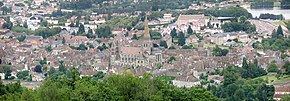 Panoramic image of Autun | |||
| |||
| A country |  France France | ||
| Region | Burgundy | ||
| History and Geography | |||
| Square | 61.52 km² | ||
| Center height | 306 m | ||
| Timezone | and | ||
| Population | |||
| Population | 16 419 people ( 2001 ) | ||
| Density | 266 people / km² | ||
| Digital identifiers | |||
| Postcode | 71400 | ||
| autun.com (fr.) | |||

History
It was founded at the end of the 1st century BC. e. under the name ( lat. Augustodunum ) by the will of the emperor Augustus . It has become the main city of the Edues in Lugdunskaya Gaul . It was surrounded by thick walls 6 km long, with 220 towers and two gates. Under the Romans, Autun was a center of learning, had a rhetorical school. In 21, he became the center of the revolt of the Gauls led by Julius Sacrovir . In the third century, it was besieged and after seven months conquered and destroyed by the usurper Victorin in 270, and then restored in the next century by Constantine I the Great . In 350, in Augustodun, the usurper Magnus Magnesius rebelled, after which the army overthrew the emperor Constant .
The city began to be called Autun most likely after its conquest by the Burgundians in the 5th century . Taking advantage of the weakness of Rome, Gundioch captured the city in 460. In 532, Hildebert I and Hlotar I invaded the Kingdom of the Burgundians and besieged Autun, where Gododom II took refuge, and then defeated the Burgundians in battle . After that, the city and its environs were annexed to the Frankish state .
Since the III century , the bishops of Otun have been known. One of them, Saint Leodegarius (c. 615–679), was tortured to death by order of Mayor Ebroin .
On August 22, 725, the city was sacked by Arabs . After the defeat of the Arab army at the Battle of Poitiers , in 733 by mayor Karl Martell subjugated Burgundy, distributing the seized possessions to his close associates: Oten, who became the capital of the county of Oten , was taken into possession of Thierry (Theoderic) I. Subsequently, this county became the core of the Duchy of Burgundy formed in 918. For some time the city was the capital of the duchy, but then the capital was transferred to Dijon . In 1379, the city was destroyed by the British. In 1482, together with the duchy, it became part of France .
In 1779, Napoleon and his elder brother Joseph Bonaparte studied at Autun.
During the Franco-Prussian war at the end of 1870, the Vosges army defended the city under the command of Giuseppe Garibaldi , who supported the Third French Republic [2] [3] .
Attractions
The oldest monument on the territory of Autun is the so-called Janus Temple (1st century AD). The most famous Roman gates are Porte Saint-André and Porte d'Arroux - ruins dating back to late antiquity (III century). Cathedral of St. Lazarus (with a magnificent tympanum and many capitals decorated with reliefs) is dated to XII in [4] .
Persons
- Gillo, Francois Xavier (1842-1910) - French botanist, mycologist, doctor.
Notes
- ↑ Topographic maps of the General Staff
- ↑ Lawiss, Rambo, 1938 .
- ↑ Howard, 1962 .
- ↑ Gurevich A. Ya. Western portal of the Saint-Lazare church in Autun and the paradoxes of medieval consciousness // Culture and society of medieval Europe through the eyes of contemporaries. Exempla, 13th century - M .: Art, 1989 .-- S. 111-113.
Literature
- Bonnerot J. Autun. - P. , 1921.
- Howard, Michael. The Franco-Prussian War: The German Invasion of France, 1870-1871. - New York: The Macmillan Company, 1962 .
- Volume 6. Revolutions and national wars. 1848-1870. Part Two // History of the XIX century. In 8 volumes (edited by professors Lavisse and Rambo) / Ernest Laviss, Alfred Rambo, Eugene Tarle. - M .: State Socio-Economic Publishing House , 1938. - 664 p. - 103,000 copies.
- Gurevich A. Ya. The Western portal of the church of Saint-Lazare in Oten and the paradoxes of medieval consciousness // Culture and society of medieval Europe through the eyes of contemporaries. Exempla, 13th century - M .: Art, 1989 .-- S. 111 - 130.