Gangian gavial [1] [2] ( lat. Gavialis gangeticus ) is a species of large reptiles from the detachment of crocodiles , the only modern species in the genus gavial [1] ( Gavialis ). The name comes from the distorted Hindi घड़ियाल (Ghaṛiyāl) , which means simply “crocodile” [3] .
| Ganges Gavial | |||||||||||||||||||||||||||||||||||||||||||||||
 | |||||||||||||||||||||||||||||||||||||||||||||||
| Scientific classification | |||||||||||||||||||||||||||||||||||||||||||||||
|---|---|---|---|---|---|---|---|---|---|---|---|---|---|---|---|---|---|---|---|---|---|---|---|---|---|---|---|---|---|---|---|---|---|---|---|---|---|---|---|---|---|---|---|---|---|---|---|
| |||||||||||||||||||||||||||||||||||||||||||||||
| International scientific name | |||||||||||||||||||||||||||||||||||||||||||||||
Gavialis gangeticus ( Gmelin , 1789) | |||||||||||||||||||||||||||||||||||||||||||||||
| Area | |||||||||||||||||||||||||||||||||||||||||||||||
| |||||||||||||||||||||||||||||||||||||||||||||||
| Security status | |||||||||||||||||||||||||||||||||||||||||||||||
| Geochronology appeared 2,588 million years
◄ Nowadays◄ Cretaceous-Paleogene extinction | |||||||||||||||||||||||||||||||||||||||||||||||

Gavial is a unique animal among modern crocodiles. Although several species existed millions of years ago, today the Gangian gavial is the last of the remaining representatives of this ancient genus, and possibly the second species of the gavial family (the other is the gavial crocodile [4] ). Gavials eat fish and live in deep bodies of water with a fast current. Of all the crocodiles, they spend the most time in water, going to land only to warm themselves or lay eggs.
Content
Appearance
The color of the back at the gavial is usually dark, brown-green, the belly is yellow-green. There are also gavials with black coloration, light green, brown or light brown, as well as the color of algae. There are almost white gavials.
By its power, the gavial is inferior to almost all real crocodiles, since it does not need it. But other animals attack adult gavials very rarely because of their size.
The gavial has a long and powerful tail, on which there are triangular lamellar growths.
The eyes of the gavials are small and round, they are located above the level of the muzzle. They look almost in opposite directions.
On the ground, the gavials always move crawling, because they can not lift the body.
Due to the aquatic lifestyle and hunting of the gavial, he received a special protection - the plates on his belly are pressed against each other. This protects him from injuries during friction against sharp stones in the water.
Some gavials spend so much time in water that epibiotic crustaceans from the suborder of marine acorns develop on their skin [5] .
Dimensions
Gavial is one of the largest modern crocodiles, slightly behind the combed ( Crocodylus porosus ).
Males can reach a length of 5–5.5 meters, although they are usually no larger than 4–4.5 m. Females reach an average of 3–3.5 meters, less often larger. Measured adults weighed 159 and 181 kg, the Gangian gavial has a lighter body weight compared to most real crocodiles and alligators . The largest known Gangan gavial was more than 6 meters long [6] . Earlier, gavials were on average somewhat larger, but due to extensive poaching during that time, such individuals are extremely rare today, because gaviales take a long time to reach such sizes.
Jaws
The shape of the jaw of the gawials is easy to distinguish from alligators and real crocodiles . They are very narrow. Their length exceeds the width of their base by almost 5 times. In cubs this difference is less.
This shape of the jaws is explained by their narrow specialization - hunting for fish. The jaws meet little resistance to water, thanks to this the gawials easily catch their prey.
The gavial has more teeth than all other crocodiles - up to a hundred. But they are much smaller than other crocodiles. They are long, thin and sharp; located somewhat obliquely - with the peaks forward and sideways. It is difficult for fish to escape from such jaws. This gavial differs from most other crocodiles , which need large, powerful jaws to hunt for larger or well-protected prey.
Habitats
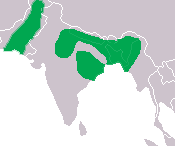
Gaviales prefer to settle in calm areas of muddy deep rivers with a fast flow and the presence of whirlpools and reaches. Such sections are, for example, river bends. The range of the gavial historically covers the Indo-Gangetic Plain and the northern part of the Hindustan Peninsula: it is found in Bangladesh (close to extinction), Bhutan (possibly disappeared), Nepal (population is recovering), Myanmar (possibly disappeared), Pakistan (close to extinction) ), India (the population is recovering). It lives in the basins of the Brahmaputra ( Bhutan , India ), Indus and its tributaries ( Pakistan ), the Ganges (India and Nepal), Mahanadi and Krishna , Meghna (India, Bangladesh), small populations on the Kaladan and Irrawaddy rivers in Myanmar are known.
Lifestyle
Gaviales are the most watery of all crocodiles, they spend the most time in water. On land, they crawl out only to warm themselves, or lay eggs.
Most of the diet of the Ganges gavial is fish. Small gavials hunt invertebrates, for example, insects. Their jaws are unable to kill and swallow prey anymore. When the gawials grow, so does the size of their prey. The largest individuals can kill small mammals. Do not disdain carrion. For people are not dangerous.
Reproduction
Females reach puberty at a length of 3 m, aged about 10 years. The male has a harem of several females and protects him from other males. The mating season lasts from November to January. With the help of a growth, the male blows bubbles under water during courtship of the females.
Eggs are laid from March to May during the drought season when sandy beaches are exposed. The female digs a hole in the sand about 3-5 meters from the water, lays eggs (usually at night) and covers them with plant material. Each egg weighs up to 160 grams - more than other crocodiles; only 35-60 eggs. The female returns to the nest every night. After 60-80 days of incubation, the cubs hatch. With a length of about 40 cm, they have a muzzle of about 5 cm, and a tail about half the length of an individual.
Unlike other types of crocodiles, the mother does not transfer them to water, because her jaws are not suitable for this. However, she continues to take care of the offspring for several weeks. Despite this concern, it is not possible to keep track of the cubs, and of all the cubs, only 1-2 reach puberty. The rest become victims of predators. There are too many of them, and the young gavials are too defenseless. Adults do not have natural enemies.
Population Status
Gavial is considered one of the rarest crocodiles, listed in the IUCN Red List under the category of “ Endangered ”. In the 1970s, the species was close to complete extinction due to the reduction of habitat, reduction in fish stocks and predatory extermination. Gaviales also often die, entangled in fishing nets. Their eggs are still collected for medical purposes, males are hunted for growths on the nose, which are considered aphrodisiacs .
In India , programs have been developed to collect eggs and breed gavial in captivity on crocodile farms ; in 1981, the first batch of animals was released into the wild. If in 1975 there were only 70 individuals, now their population in India is estimated at 200-250 animals [7] . Of the 40 young gavials in nature, only 1 reaches maturity.
A similar program has also existed since 2002 in Pakistan and since 1996 in Nepal .
Ganga Gavial and Man
The fate of the gavials is inextricably linked with the fate of the people, and both depend on the rivers. The people living side by side with the gavials are farmers, herders, fishermen and laborers. Most coastal inhabitants admitted that they do not pose a threat to humans. Gaviales eat fish, but prefer fishermen's favorite places to live. Due to the fact that the gawials eat fish, they are often accused of falling fish populations, or considered as food competitors, and therefore killed.
But in Nepal and India, gavial is a sacred animal. One of the problems of preserving the gavials is to revive the respect and reverence of the people for this ancient animal. To achieve the needs of the local population living near the gavials, actions to preserve the gavials should be mutually beneficial for people and nature.
Past efforts to conserve the population did not meet people's needs, and when the territories were declared protected, local residents lost the rights to natural resources that they had been using for several generations. This caused resentment at the gavials and conservation efforts. This experience shows that the goal of preserving the animal will not be achieved until the needs of local people are met.
The Gavial Conservation Alliance is seeking a solution to this problem in order to improve people's quality of life and achieve environmental goals. This may include alternative programs to support people currently living on poaching. Ultimately, preserving the rivers will determine the fate of both the people and the gavials. The fate of the rivers depends on the cooperation of people living on the banks of these rivers in environmental activities [8] .
Notes
- ↑ 1 2 Ananyeva N. B. , Borkin L. Ya. , Darevsky I.S. , Orlov N.L. The Pyatiling Dictionary of Animal Names. Amphibians and reptiles. Latin, Russian, English, German, French. / edited by Acad. V. E. Sokolova . - M .: Rus. Yaz., 1988 .-- S. 139. - 10,500 copies. - ISBN 5-200-00232-X .
- ↑ Zarva M.V. Russian verbal stress. Vocabulary. - M .: NTs ENAS, 2001. - P. 99. - 6000 copies. - ISBN 5-93196-084-8 .
- ↑ Gavialis gangeticus on crocodilian.com
- ↑ Willis RE, McAliley LR, Neeley ED, Densmore LD (June 2007). "Evidence for placing the false gharial ( Tomistoma schlegelii ) into the family Gavialidae: Inferences from nuclear gene sequences." Molecular Phylogenetics and Evolution.
- ↑ Reptiles and amphibians. - M. , 2013.
- ↑ Gharial biology | Gharial conservation alliance
- ↑ Conservation History | Gharial conservation alliance
- ↑ Gharials and People | Gharial conservation alliance
Links
- Gavial Research Center
- The Reptile Database: Gavialis gangeticus (English)
- crocodilian.com: Gavialis gangeticus (English)
- Gavialis gangeticus (English)
- Gavial Photos
- How to breed rare crocodiles in Nepal (rus.)