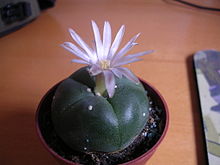

Entheogen (from other Greek ἔνθεος “inspired by a deity, in ecstasy” and γενέσθαι “become”) is the name of an informal group of various substances of plant origin containing psychoactive substances that are traditionally used to achieve an altered state of consciousness with spiritual connotations and lead to intoxication [4] . Entheogens use shamans to enter “ mystical states ” in which they “communicate with spirits and deities” [5] . In the modern world, this term combines a number of narcotic substances of plant origin, which have various ways of acting on the psyche. They are a kind of psychedelics distinguished on the basis of religious use in the cultures of individual peoples [4] . They are part of some traditional drug-containing drinks, such as Ayahuasca [6] .
The term is not a chemical classification, since the psychoactive properties of entheogens are formed by many different types of alkaloids , terpenoids , amino acids , and coumarins [7] .
Some traditional entheogens
- Leaves of Salvia divinorum ( Sage of the Fortune Teller )
- Leaves of Mitragyna speciosa ( kratom )
- Argyreia nervosa seeds ( small Hawaiian tree rose )
- Seeds Ipomoea violacea ( Morning Sunshine )
- Seeds Anadenanthera peregrina
- Seeds of Datura inoxia ( Datura Native American )
- Grass Calea zacatechichi ( Kalea zakatechichi )
- Leaves of Diplopterys cabrerana ( chaliponka , or chagropanga )
- Leaves of Psychotria viridis ( chakruna )
- The stems of the creeper Banisteriopsis caapi ( vine vine )
- Peganum harmala seeds ( common harmala )
- Root bark of Mimosa hostilis
- Seeds of Paullinia cupana ( guarana )
- Leaves of Ilex paraguariensis ( Paraguayan holly , or mate )
- Pfaffia paniculata root
- Leaves of Ginkgo biloba ( Ginkgo )
- Uncaria tomentosa bark ( Uncaria pubescent )
- Bark Pausinystalia johimbe ( yohimbe )
- The root bark of Tabernanthe iboga ( iboga )
- Leaves of Turnera diffusa ( Turner sprawling , or damiana )
- Rhizome Acorus calamus ( calamus vulgaris )
- Rhizome Nymphaea alba ( white water lily )
- Rhizome Nuphar lutea ( yellow capsule )
- Dried hats Amanita muscaria ( fly agaric )
- Fruit bodies of fungi of the genus Psilocybe ( psilocybe )
Notes
- ↑ El-Seedi HR, De Smet PA, Beck O., Possnert G., Bruhn JG Prehistoric peyote use: alkaloid analysis and radiocarbon dating of archaeological specimens of Lophophora from Texas (Eng.) // J Ethnopharmacol : journal. - 2005. - October ( vol. 101 , no. 1-3 ). - P. 238-242 . - DOI : 10.1016 / j.jep.2005.04.022 . - PMID 15990261 .
- ↑ Opler, Morris Edward The use of Peyote by the Carrizo and Lipan Apache tribes (link unavailable) . American Ethnography Quasimonthly (2008 [1938]). Date of treatment January 19, 2009. Archived December 2, 2010.
- ↑ Schultes, Richard Evans The appeal of peyote (Lophophora Williamsii) as a medicine (unavailable link) . American Ethnography Quasimonthly (2008 [1938]). Date of treatment January 19, 2009. Archived December 2, 2010.
- ↑ 1 2 Wexler P. History of Toxicology and Environmental Health: Toxicology in Antiquity II . - Elsevier Science, 2014 .-- S. 128. - ISBN 9780128016343 .
- ↑ Endredi D. Shamanism for beginners: the experience of world healers: [trans. from English ] (English) . - All, 2011 .-- S. 71-73. - (Landscapes of consciousness: drugs). - ISBN 9785957320340 .
- ↑ Blainey MG Forbidden therapies: Santo Daime, ayahuasca, and the prohibition of entheogens in Western society // Journal of religion and health. - 2015. - Vol. 54 , no. 1 . - P. 287-302 . - ISSN 1573-6571 . - DOI : 10.1007 / s10943-014-9826-2 . - PMID 24477460 .
- ↑ Ott J. Pharmacotheon, 1997 , p. 15.
Literature
- Ott J. Pharmacotheon: Entheogenic Drugs, Their Plant Sources and History . - 2nd densified ed. - Kennewick, WA: Natural Products Company, 1997. - 640 p. - ISBN 9780961423490 .