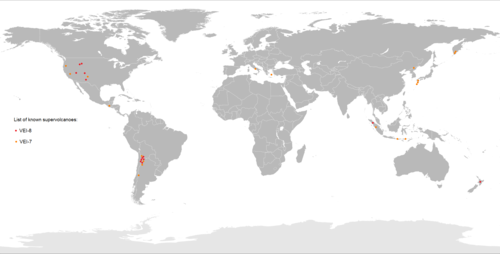

Supervolcano is a volcano whose eruption can provoke climate change on the planet ( 8 points by VEI ). There are about 20 supervolcanoes known to science on Earth. On average, eruptions occur once every 100,000 years [1] .
Content
The origin of the term
The term "Supervolcano" is not strictly scientific. The concept was first used in 2000 in the popular science-based documentary television series “ Horizon ” on the BBC television channel to denote very powerful volcanic eruptions [2] . Since 2003, eruptions reaching 8 points on a volcanic explosive index ( VEI ) scale are sometimes classified by volcanologists as “ super-eruptions ” (igneous provinces and massive eruptions). The term “megacaldera” is sometimes used to refer to very large calderas , similar to the Blake River caldera located in the Abitiba belt (Canadian provinces of Ontario and Quebec ). Supervolcanoes differ from ordinary stratovolcanoes in the absence of clearly defined cones. So, the largest of the known and most "ripe" for the eruption Yellowstone Super Volcano , whose caldera is 55 × 75 km long, can be geographically described as a slightly hilly area surrounded by mountains.
Examples
On Earth, the last such eruption , according to volcanologists, occurred 27 thousand years ago on the North Island of New Zealand. It formed Lake Taupo . 1170 km 3 of ash were thrown out.
Exploring an extinct volcano near Lake Toba on the island of Sumatra , geologist Michael Rampino from New York University reconstructed the picture of his catastrophic eruption 73 thousand years ago (almost 3 thousand km 3 of ash were thrown out). According to his calculations, then up to three billion tons of sulfur dioxide were thrown out from the crater along with clouds of dust and ash. As a result, sulfuric acid depleting vegetation rained on the Earth for six years (samples from the deep layers of the Greenland ice sheet showed this). If you add to this the dust clouds that have hid the Sun for a long time, you get something similar to the picture of a nuclear winter . Rampino believes that this “mega-eruption” was the reason that anthropologists recorded precisely in that era of the demographic crisis, when, according to scientists, no more than ten thousand people remained on the whole Earth. [3] [4] .
The Yellowstone Super Volcano (in Yellowstone National Park , USA) has not erupted for six hundred thousand years. It has been established that over the past million years the volcano erupted only twice [5] [4] .
In the region of the Chilean Andes, a supervolcano forms [6] [7] [8] [9] [10]
Consequences
The power of eruptions can vary. However, the volume of eruption products is sufficient to radically change the landscape and significantly affect the global climate of the planet, causing catastrophic consequences for life (for example, volcanic winter ).
For example, the eruption of the Yellowstone Super Volcano (occurred about 640 thousand years ago ), led to an estimated release of more than 1000 km³ of dust and lava into the atmosphere. Such a quantity of material is enough to cover a large city with a layer of several kilometers [1] .
There is an opinion that the danger of the eruption of supervolcanoes is comparable to the impact of an asteroid : the probability of an event is small, but catastrophic consequences are possible [1] .
Depending on whether the supervolcano is located on land or on the ocean floor, various climatic consequences due to its eruption should be expected.
The eruption of a supervolcano on land will be accompanied by emissions into the atmosphere of a huge amount of volcanic ash and volcanic gases - , , , , etc. The difference between a supervolcano eruption and ordinary volcanic eruptions lies in the fact that the bulk of volcanic products are not liquid, flowing lavas that form volcanic cones ( Klyuchevskaya Sopka , Fujiyama , Vesuvius ) and shields ( Kilauea ), but clouds of hot gases and “ashes” ", Consisting of small particles of obsidian . The dust and a mixture of gases that have entered the stratosphere will create a screen that is poorly permeable to sunlight, which will initially lead to the cooling of our planet by the effect of the “nuclear winter” for years and maybe decades. Then, after dust deposition and atmospheric enlightenment, due to the huge amount of carbon dioxide that entered the atmosphere during the eruption of a supervolcano, the greenhouse effect will begin to dominate and the planet will continue to heat up - volcanic winter will be replaced by volcanic summer . The eruption of a supervolcano located at the bottom of the ocean will be accompanied by powerful tsunamis that can cause extensive destruction on land, as well as the release of large amounts of water vapor into the atmosphere, which subsequently (in the short term) can lead to abnormally heavy rains and extensive local super-floods on land . A huge amount of carbon dioxide emitted by the supervolcano will fall into the atmosphere and for a long time will enhance the greenhouse effect and the heating of the planet.
The consequences of super-eruption can be catastrophic for the continent: the explosive eruption of super-volcanoes will lead to the emergence of super-powerful pyroclastic flows - “hurricanes” of volcanic gases, stones and ashes, which will cover territories of thousands and tens of thousands of square kilometers — not a single living creature caught in such a stream does not survive. Outside of these areas, the eruption can lead to serious consequences for agriculture: covering the soil with volcanic ash only one centimeter thick will lead to the death of agricultural crops. Acid rain super-eruption will lead to pollution of water sources in an even larger radius around the erupting super volcano.
Super-eruption can be detrimental to the entire population of the planet as a result of a prolonged decrease in temperature on the entire planet, the death of vegetation and changes in the composition of the atmosphere [11] .
Mechanism
Experimental studies conducted in 2013 at the accelerator complex in Grenoble ( ESRF ) showed that eruptions occur due to the "emergence" of liquid magma through the earth's crust . When “floating up” from a depth of more than 10 km, a sharp expansion of magma occurs, leading to an explosion [1] .
Understanding the mechanism of eruptions allows us to clarify forecast methods. According to researchers, a sign of danger can be a significant, hundreds of meters, elevation of the surface in the area of a possible eruption [1] .
On other planets
Supervolcanoes were also seen on the satellite of Jupiter Io and Saturn's satellites by the automatic Voyager 2 interplanetary station . However, volcanoes outside the Main Asteroid Belt are predominantly cryogenic , not magmatic. Super crater craters are also found on Mars .
See also
- 2012 (film)
- List of the largest volcanic eruptions
Notes
- ↑ 1 2 3 4 5 Supervolcano eruption mystery solved
- ↑ BBC Horizon Supervolcanoes
- ↑ Michael Rampino . Supervolcanism and other catastrophic geophysical processes ( translated from English )
- ↑ 1 2 Alexander Volkov Super Volcanoes // Knowledge is power . - 2015. - No. 5. - P. 73—85
- ↑ YELLOWSTONE SUPERVOLCANO GETTING READY TO BLOW ITS CORK Archived October 31, 2011.
- ↑ Shannon Hall. Hidden Hell // In the world of science . - 2019 .-- No. 1/2 . - S. 134-141 .
- ↑ Nature 27 Feb. 2014 Kari M. Cooper; Adam JR Kent Rapid remobilization of magmatic crystals kept in cold storage.
- ↑ Science 16 Jun. 2017 Allison E. Rubin et al Rapid cooling and cold storage in a silicic magma reservoir recorded in individual crystals
- ↑ NL Andersen et al Incremental heating of Bishop Tuff sanidine reveals preeruptive radiogenic Ar and rapid remobilization from cold storage // Proceedings of the National Academy of Sciences of the United States of America | 9 Nov 2017
- ↑ Nathan L. Andersen et al Petrochronologic perspective on rhyolite volcano unrest at Laguna del Maule, Chile // Earth and Planetary Science Letters, Volume 493, 1 July 2018, Pages 57-70
- ↑ “Would a supervolcano eruption wipe us out” , BBC, 07.24.2017
Links
- Michael Rampino Supervolcanism and other catastrophic geophysical processes
- Supervolcano. Waiting for the end of the world
- Rampino, MR, and S. Self . Climate-volcanism feedback and the Toba eruption of ~ 74,000 years ago , 1993