Clever Geek Handbook
📜 ⬆️ ⬇️

Cauchy Integral Formula

The Cauchy integral formula is a relation for holomorphic functions of a complex variable that relates the value of a function at a point to its values ​​on the contour surrounding the point.

This formula expresses one of the most important features of complex analysis : the value at any point within the region can be determined by knowing the values ​​at its boundary.

Wording

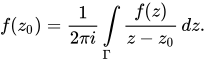
Let beD {\ displaystyle D} D - region on a complex plane with a piecewise smooth boundaryΓ=∂D {\ displaystyle \ Gamma = \ partial D} \Gamma =\partial D functionf(z) {\ displaystyle f (z)} f(z) holomorphic inD¯ {\ displaystyle {\ overline {D}}} \overline {D} , andz0 {\ displaystyle z_ {0}} z_{0} - point inside the areaD {\ displaystyle D} D . Then the following Cauchy formula holds:

f(z0)=one2πi∫Γf(z)z-z0dz.{\ displaystyle f (z_ {0}) = {\ frac {1} {2 \ pi i}} \ int \ limits _ {\ Gamma} {\ frac {f (z)} {z-z_ {0}} } \, dz.} {\displaystyle f(z_{0})={\frac {1}{2\pi i}}\int \limits _{\Gamma }{\frac {f(z)}{z-z_{0}}}\,dz.}

The formula also holds if we assume thatf(z) {\ displaystyle f (z)} f(z) holomorphic insideD {\ displaystyle D} D and continuous on closure, and also if the boundaryD {\ displaystyle D} D not piecewise smooth, but just straightened .

Proof

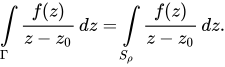
Consider the circle S ρ of sufficiently small radius ρ centered at z 0 . In the region bounded by the contours Γ and S ρ (i.e., consisting of points of the regionD {\ displaystyle D} D with the exception of points inside S ρ ), the integrand has no singularities, and by the Cauchy integral theorem the integral of it along the boundary of this region is equal to zero. This means that regardless of ρ we have the equality

∫Γf(z)z-z0dz=∫Sρf(z)z-z0dz.{\ displaystyle \ int \ limits _ {\ Gamma} {\ frac {f (z)} {z-z_ {0}}} \, dz = \ int \ limits _ {S _ {\ rho}} {\ frac { f (z)} {z-z_ {0}}} \, dz.} {\displaystyle \int \limits _{\Gamma }{\frac {f(z)}{z-z_{0}}}\,dz=\int \limits _{S_{\rho }}{\frac {f(z)}{z-z_{0}}}\,dz.}

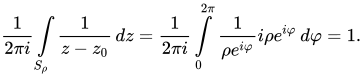
To calculate the integrals overSρ {\ displaystyle S _ {\ rho}} S_{\rho } apply parameterizationz=z0+ρeiφ,φ∈[0;2π] {\ displaystyle z = z_ {0} + \ rho e ^ {i \ varphi}, \ varphi \ in [0; 2 \ pi]} {\displaystyle z=z_{0}+\rho e^{i\varphi },\varphi \in [0;2\pi ]} .

First, we prove the Cauchy formula separately for the casef(z)=one {\ displaystyle f (z) = 1} {\displaystyle f(z)=1} :

one2πi∫Sρonez-z0dz=one2πi∫02πoneρeiφiρeiφdφ=one.{\ displaystyle {\ frac {1} {2 \ pi i}} \ int \ limits _ {S _ {\ rho}} {\ frac {1} {z-z_ {0}}} \, dz = {\ frac {1} {2 \ pi i}} \ int \ limits _ {0} ^ {2 \ pi} {\ frac {1} {\ rho e ^ {i \ varphi}}} i \ rho e ^ {i \ varphi} \, d \ varphi = 1.} {\displaystyle {\frac {1}{2\pi i}}\int \limits _{S_{\rho }}{\frac {1}{z-z_{0}}}\,dz={\frac {1}{2\pi i}}\int \limits _{0}^{2\pi }{\frac {1}{\rho e^{i\varphi }}}i\rho e^{i\varphi }\,d\varphi =1.}

We use it to prove the general case:

one2πi∫Sρf(z)z-z0dz-f(z0)=one2πi∫Sρf(z)z-z0dz-one2πi∫Sρf(z0)z-z0dz=one2πi∫Sρf(z)-f(z0)z-z0dz.{\ displaystyle {\ frac {1} {2 \ pi i}} \ int \ limits _ {S _ {\ rho}} {\ frac {f (z)} {z-z_ {0}}} \, dz- f (z_ {0}) = {\ frac {1} {2 \ pi i}} \ int \ limits _ {S _ {\ rho}} {\ frac {f (z)} {z-z_ {0}} } \, dz - {\ frac {1} {2 \ pi i}} \ int \ limits _ {S _ {\ rho}} {\ frac {f (z_ {0})} {z-z_ {0}} } \, dz = {\ frac {1} {2 \ pi i}} \ int \ limits _ {S _ {\ rho}} {\ frac {f (z) -f (z_ {0})} {z- z_ {0}}} \, dz.} {\displaystyle {\frac {1}{2\pi i}}\int \limits _{S_{\rho }}{\frac {f(z)}{z-z_{0}}}\,dz-f(z_{0})={\frac {1}{2\pi i}}\int \limits _{S_{\rho }}{\frac {f(z)}{z-z_{0}}}\,dz-{\frac {1}{2\pi i}}\int \limits _{S_{\rho }}{\frac {f(z_{0})}{z-z_{0}}}\,dz={\frac {1}{2\pi i}}\int \limits _{S_{\rho }}{\frac {f(z)-f(z_{0})}{z-z_{0}}}\,dz.}

Since the functionf(z) {\ displaystyle f (z)}   complex differentiable at the pointz0 {\ displaystyle z_ {0}}   then

f(z)-f(z0)z-z0=f′(z0)+o(one).{\ displaystyle {\ frac {f (z) -f (z_ {0})} {z-z_ {0}}} = f '(z_ {0}) + o (1).}  

Integral fromf′(z0) {\ displaystyle f '(z_ {0})}   equal to zero:

one2πi∫Sρf′(z0)dz=one2πi∫02πf′(z0)iρeiφdφ=0.{\ displaystyle {\ frac {1} {2 \ pi i}} \ int \ limits _ {S _ {\ rho}} f '(z_ {0}) \, dz = {\ frac {1} {2 \ pi i}} \ int \ limits _ {0} ^ {2 \ pi} f '(z_ {0}) i \ rho e ^ {i \ varphi} \, d \ varphi = 0.}  

Member Integralo(one) {\ displaystyle o (1)}   can be made arbitrarily small withρ→0 {\ displaystyle \ rho \ to 0}   . But since he is fromρ {\ displaystyle \ rho}   does not depend at all, which means it is equal to zero. As a result, we obtain

one2πi∫Γf(z)z-z0dz-f(z0)=one2πi∫Sρf(z)-f(z0)z-z0dz=0.{\ displaystyle {\ frac {1} {2 \ pi i}} \ int \ limits _ {\ Gamma} {\ frac {f (z)} {z-z_ {0}}} \, dz-f (z_ {0}) = {\ frac {1} {2 \ pi i}} \ int \ limits _ {S _ {\ rho}} {\ frac {f (z) -f (z_ {0})} {z- z_ {0}}} \, dz = 0.}  

Consequences

The Cauchy formula has a lot of different consequences. This is a key theorem of the whole complex analysis. Here are some of its effects:

Analyticity of holomorphic functions

In the vicinity of any pointz0 {\ displaystyle z_ {0}}   from the area where the functionf(z) {\ displaystyle f (z)}   holomorphic, it coincides with the sum of the power series :

f(z)=∑n=0∞cn(z-z0)n{\ displaystyle f (z) = \ sum \ limits _ {n = 0} ^ {\ infty} c_ {n} (z-z_ {0}) ^ {n}}   ,

and its radius of convergence is not less than the radius of a circle centered at a pointz0 {\ displaystyle z_ {0}}   in which the functionf(z) {\ displaystyle f (z)}   holomorphic, and the coefficientscn {\ displaystyle c_ {n}}   can be calculated by integral formulas:

cn=one2πi∫Γf(z)(z-z0)n+onedz{\ displaystyle c_ {n} = {1 \ over 2 \ pi i} \ int \ limits _ {\ Gamma} {f (z) \ over (z-z_ {0}) ^ {n + 1}} \, dz}   .

These formulas imply the Cauchy inequalities for the coefficientscn {\ displaystyle c_ {n}}   functions holomorphic in a circle|z-z0|<r {\ displaystyle {| z-z_ {0} | <r}}   :

cn≤r-nM(r){\ displaystyle c_ {n} \ leq r ^ {- n} M (r)}   ,

WhereM(r) {\ displaystyle M (r)}   - maximum function modulef(z) {\ displaystyle f (z)}   on the circumference|z-z0|=r {\ displaystyle {| z-z_ {0} | = r}}   , and of these, the Liouville theorem on bounded entire analytic functions: if a function is holomorphic in the entire complex plane and bounded, it is a constant.

In addition, combining the formulas for the coefficients with the theorem on the holomorphy of the sum of a power series with a non-zero radius of convergence and a formula expressing the coefficients of the power series in terms of the derivatives of its sum

cn=f(n)(z0)n!{\ displaystyle c_ {n} = {{f ^ {(n)} (z_ {0})} \ over n!}}  

an integral representation of the derivatives of the function is obtainedf(z) {\ displaystyle f (z)}   :

f(n)(z0)=n!2πi∫Γf(z)(z-z0)n+onedz.{\ displaystyle f ^ {(n)} (z_ {0}) = {n! \ over 2 \ pi i} \ int \ limits _ {\ Gamma} {f (z) \ over (z-z_ {0}) ^ {n + 1}} \, dz.}  

Estimates of derivatives analogous to Cauchy's inequalities give a theorem on equipotential continuity of a family of holomorphic functions in a bounded domainD {\ displaystyle D}   if this family is uniformly bounded inD {\ displaystyle D}   . In combination with the Arzel – Ascoli theorem , we obtain the Montel theorem on a compact family of functions : from any uniformly bounded family of functions holomorphic in a bounded domainD {\ displaystyle D}   , we can distinguish a sequence of functions that will converge inD {\ displaystyle D}   to some holomorphic function uniformly.

Representability of holomorphic functions by Laurent series in ring domains

If the functionf(z) {\ displaystyle f (z)}   holomorphic in the regionD {\ displaystyle D}   kind of{r<|z-z0|<R} {\ displaystyle \ {r <| z-z_ {0} | <R \}}   , then in it it is represented by the sum of the Laurent series:

f(z)=∑n=-∞+∞cn(z-z0)n{\ displaystyle f (z) = \ sum \ limits _ {n = - \ infty} ^ {+ \ infty} c_ {n} (z-z_ {0}) ^ {n}}   ,

moreover, the coefficientscn {\ displaystyle c_ {n}}   can be calculated by integral formulas:

cn=one2πi∫Γf(z)(z-z0)n+onedz{\ displaystyle c_ {n} = {1 \ over 2 \ pi i} \ int \ limits _ {\ Gamma} {f (z) \ over (z-z_ {0}) ^ {n + 1}} \, dz}   ,

and the series of Laurent converges inD {\ displaystyle D}   to functionf(z) {\ displaystyle f (z)}   evenly on each compact fromD {\ displaystyle D}   .

The formula for the coefficientc-one {\ displaystyle c _ {- 1}}   often used to calculate integrals of a functionf(z) {\ displaystyle f (z)}   along various contours using algebraic methods and residue theory.

Also in terms of Laurent series, the classification of isolated singular points of holomorphic functions is carried out.

Average theorems for holomorphic functions

If the functionf(z) {\ displaystyle f (z)}   holomorphic in a circle{|z-z0|<R} {\ displaystyle \ {| z-z_ {0} | <R \}}   then for eachr(0<r<R) {\ displaystyle r \, (0 <r <R)}  

f(z0)=one2π∫02πf(z0+reiφ)dφ{\ displaystyle f (z_ {0}) = {1 \ over 2 \ pi} \ int \ limits _ {0} ^ {2 \ pi} f (z_ {0} + re ^ {i \ varphi}) \, d \ varphi}  

as well as ifBr {\ displaystyle B_ {r}}   - circle of radiusr {\ displaystyle r}   centered inz0 {\ displaystyle z_ {0}}   then

f(z0)=oneπr2∫Brf(z)dxdy{\ displaystyle f (z_ {0}) = {1 \ over \ pi r ^ {2}} \ int \ limits _ {B_ {r}} f (z) \, dx \, dy}  

From the mean theorems follows the principle of maximum modulus for holomorphic functions: if the functionf(z) {\ displaystyle f (z)}   holomorphic in the regionD {\ displaystyle D}   and insideD {\ displaystyle D}   its module has a local maximum, then this function is a constant.

From the principle of maximum modulus follows the maximum principle for the real and imaginary parts of a holomorphic function: iff(z) {\ displaystyle f (z)}   holomorphic in the regionD {\ displaystyle D}   and insideD {\ displaystyle D}   its real or imaginary part has a local maximum or minimum, then this function is a constant.

Uniqueness Theorems

From the principle of maximum modulus and representability of holomorphic functions by power series, 3 more important results follow:

  • Schwartz lemma : if the functionf(z) {\ displaystyle f (z)}   holomorphic in a circle|z|<one {\ displaystyle {| z | <1}}   ,f(0)=0 {\ displaystyle f (0) = 0}   and for all pointsz {\ displaystyle z}   from this circle|f(z)|≤one {\ displaystyle | f (z) | \ leq 1}   then everywhere in this circle|f(z)|≤|z| {\ displaystyle | f (z) | \ leq | z |}   ,
  • uniqueness theorem for power series : holomorphic functions having the same Taylor series at a pointz0 {\ displaystyle z_ {0}}   coincide in some neighborhood of this point,
  • theorem on the zeros of a holomorphic function : if the zeros of a functionf(z) {\ displaystyle f (z)}   holomorphic in the regionD {\ displaystyle D}   have a limit point insideD {\ displaystyle D}   then the functionf(z) {\ displaystyle f (z)}   is zero everywhere inD {\ displaystyle D}   .

Links

  • Weisstein, Eric W. Cauchy Integral Formula on the Wolfram MathWorld website.
  • Cauchy Integral Formula Module by John H. Mathews

Literature

  • Shabat B.V. Introduction to complex analysis. - M .: Science , 1969 . - 577 p.
  • Titchmarsh E. Theory of functions: Per. from English - 2nd ed., Revised. - M .: Science , 1980 . - 464 p.
  • Privalov I. I. Introduction to the theory of functions of a complex variable: A manual for higher education. - M.-L.: State Publishing House, 1927 . - 316 p.
  • Evgrafov M.A. Analytical functions. - 2nd ed., Revised. and add. - M .: Science , 1968 . - 472 p.
Source - https://ru.wikipedia.org/w/index.php?title= Cauchy Integral Formula&oldid = 95189312


More articles:

  • Hunchun
  • Kiev (encyclopedic guide)
  • F-test
  • Kuzmitsky, Alexey Alekseevich
  • Windows CE 6.0
  • Crayfish (dish)
  • Tavern
  • Coat of arms of the Tver region
  • Battlefield: Earth (film)
  • CD-Maximum

All articles

Clever Geek | 2019