F-test or Fisher criterion (F-criterion, φ * -criterion) is a statistical criterion , the test statistics of which has a Fisher distribution (F-distribution) when the null hypothesis is fulfilled.
The test statistics in one way or another is reduced to the ratio of sample variances (sums of squares divided by “degrees of freedom”). For statistics to have a Fisher distribution, it is necessary that the numerator and denominator be independent random variables and the corresponding sums of squares have a Chi-squared distribution . This requires that the data have a normal distribution. In addition, it is assumed that the variance of random variables whose squares are added together is the same.
The test is conducted by comparing the statistics value with the critical value of the corresponding Fisher distribution at a given level of significance. Known that if then . In addition, the quantiles of the Fisher distribution have the property . Therefore, in practice, a potentially large quantity usually participates in the numerator, a smaller one in the denominator, and the comparison is made with the “right” distribution quantile. Nevertheless, the test can be both bilateral and one-sided. In the first case, at a significance level used quantile , and with a one-sided test - [1] .
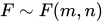


A more convenient way to test hypotheses - using p-values - the probability that a random variable with a given Fisher distribution will exceed this statistic value. If a (for a two-sided test - )) less level of significance , then the null hypothesis is rejected, otherwise accepted.


Content
F-test examples
F-test for equality of variances
Two samples
Suppose there are two samples of volume m and n, respectively, random variables X and Y, having a normal distribution. It is necessary to check the equality of their variances. Test statistics
Where - selective dispersion .
If the statistics are greater than the critical value corresponding to the selected level of significance , then the variances of random variables are considered not to be the same.
Multiple selections
Let the sample by volume N of a random variable X be divided into k groups with the number of observations in the i -th group.
Intergroup (“explained”) variance:
Intra-Group (“unexplained”) variance:
This test can be reduced to testing the significance of the regression of the variable X on dummy variables - group indicators. If the statistics exceed a critical value, then the hypothesis about the equality of the averages in the samples is rejected, otherwise the averages can be considered identical.
Checking restrictions on regression parameters
Test statistics for testing linear constraints on the parameters of the classical normal linear regression is determined by the formula:
Where -number of restrictions, n-sample size, k-number of model parameters, ESS-sum of squares of model residuals, -the coefficient of determination, the indices S and L refer to the short and long models respectively (models with constraints and models without constraints).
Note
The F-test described above is accurate in the case of a normal distribution of random model errors. However, the F-test can be applied in a more general case. In this case, it is asymptotic. The corresponding F-statistics can be calculated based on the statistics of other asymptotic tests - the Wald test (W), the Lagrange multiplier test (LM) and the likelihood ratio test (LR) - as follows:
All these statistics asymptotically have the distribution F (q, nk), despite the fact that their values on small samples may differ.
Linear Regression Validation
This test is very important in regression analysis and is essentially a special case of checking constraints. In this case, the null hypothesis is about the simultaneous equality of all coefficients to zero for the factors of the regression model (that is, the total constraints k-1). In this case, the short model is just a constant as a factor, that is, the coefficient of determination of the short model is zero. Statistics test is equal to:
Accordingly, if the value of this statistic is greater than the critical value at a given level of significance, then the null hypothesis is rejected, which means the statistical significance of the regression. Otherwise, the model is considered insignificant.
Example
Let the linear regression of the share of expenditure on food in the total amount of expenditure on a constant, the logarithm of total expenditure, the number of adult family members and the number of children under 11 be estimated. That is, in total, there are 4 estimated parameters in the model (k = 4). Let the coefficient of determination be obtained from the results of the regression assessment . According to the above formula, we calculate the value of F-statistics in case the regression is estimated according to 34 observations and 64 observations:
The critical value of statistics at the 1% level of significance (in Excel, the FEDIR function) in the first case is and in the second case . In both cases, the regression is considered significant at a given level of significance. In the first case, the P-value is 0.1%, and in the second - 0.00005%. Thus, in the second case, confidence in the significance of the regression is significantly higher (the probability of error is much less if the model is recognized as significant).
Checking heteroscedasticity
See the Goldfeld-Quandt Test
See also
- Testing statistical hypotheses
- Statistical criterion
- Wald test
- Likelihood Ratio Test
- Lagrange multipliers test
- Goldfeld-Quandt Test
Notes
- ↑ F-Test for Equality of Two Variances (English) . Nist . The appeal date is March 29, 2017.