“Kaguya” ( Japanese か ぐ や , English Kaguya ) , also known as SELENE ( dr. Greek Σελήνη , Moon ) is the second Japanese artificial moon satellite. [1] The station was created jointly by the Institute of Cosmonautics and Aeronautics (ISAS) and the National Space Research Agency (NASDA), which were later merged into the Japan Aerospace Research Agency (JAXA). The device was launched on September 14, 2007 ( UTC ) with an H-IIA launch vehicle from the Yoshinobu launch complex in Tanegashima Space Center , and ceased to exist on June 10, 2009.
| Kaguya jap. か ぐ や | |
|---|---|
| SELENE | |
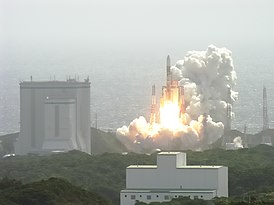 Launch of the H-IIA launch vehicle with the Kaguya apparatus | |
| Customer |  Jaxa Jaxa |
| Manufacturer | NEC Toshiba Space Systems |
| Operator | |
| Tasks | planetary exploration |
| Satellite | The moon |
| Launch pad | Tanegashima , SC "Yoshinobu" |
| Launch vehicle | H-IIA F13 |
| Launch | September 14, 2007 01:31:01 UTC |
| Descent from orbit | June 10, 2009 18:25 UTC |
| NSSDC ID | 2007-039A |
| SCN | 32054 |
| Specifications | |
| Weight | 2914 kg (base unit, starting weight) |
| Power | 3486 W |
| Orbit elements | |
| Mood | 90 ° |
| Circulation period | 2 hours |
| Apocenter | 100 km |
| Pericenter | 100 km |
| Project site | |
The name is derived from the abbreviation of the English words Sel enological and En gineering E xplorer (Selenological and technological research apparatus), Selena was the goddess of the moon in Greek mythology . The middle name of the apparatus, “Kaguya” , was traditionally chosen by the public. Kaguya ( 赫 映 姫 kaguya-hime ) is the name of the moon princess from ancient Japanese folk tales . [2] After the successful separation of the two small satellites Rstar and Vstar, they were named after Okin and Oyun , in honor of the old man with the old woman, who sheltered Princess Kaguya, from the same tale. [3]
Kaguya has become part of a resurgence of interest in moon exploration, becoming the largest lunar program since the Apollo program [4] , and following the first Japanese lunar, Hagoromo ( Hiten ), launched in 1990 . [1] [5] Following the Japanese AMS, China launched the Chang'e-1 ISL on October 24, 2007, the Indian Chandrayan-1 probe on October 22, 2008, and the Americans launched the Lunar Reconnaissance Orbiter station on June 19, 2009.
Content
History
Initially, the device was called SELENE ( SEL enological and EN gineering E xplorer), and was renamed in July 2007. The development of the device began in 1996 . Then, along with the orbital vehicle, it was also planned to launch the lander , but in July 1997, the Japanese government significantly cut the budget of the national space program, as a result of which funding for the SELENE project was reduced from $ 320 to 226 million , and the lander weighing 350 kg was refused. Instead, Japanese experts decided to carry out the descent and landing of the detachable motor module, but this experiment was canceled in early 2000.
The device was launched on September 14, 2007, on October 4, it was launched into lunar orbit . June 10, 2009 the device crashed into the surface of the moon on its visible side. [6]
Mission Objectives
The main scientific tasks of the flight were:
- Study of the origin of the moon and its geological evolution
- Obtaining data on the surface of the moon
- Performing radio experiments in ISL orbit
Design
The station has the shape of an elongated parallelepiped and structurally consists of two modules - the front one, which contains scientific equipment and the propulsion module. The total mass of the station is 2914 kg. An orientable solar panel is mounted on the left side of the device. Near the solar panel there is a narrowly directed antenna , with the help of which it communicates with the station in the X-band. The device is also equipped with four omnidirectional antennas for communication in the S-band. In the engine module there is a mid-flight propulsion system with a thrust of 500 N. To control the orientation and maintain the orbit, the station has 12 engines with a thrust of 20 N each, and for controlling the roll of 8 engines with a thrust of 1 N.
Tools
At the station, 15 scientific instruments were mounted [7] .
Optical means of observation are represented by a stereoscopic camera Terrain Camera and two spectrometer infrared (Multiband Imager) and visible range (Spectral Profiler). The camera resolution is 10 m / pixel. Using these instruments, a topographic and global mineralogical survey of the lunar surface was made.
To study the distribution of chemical elements over the lunar surface, the station has an X - ray spectrometer (XRS) designed to map the main elements of the lunar crust and a gamma-ray spectrometer (GRS) designed to determine the number of elements.
A wide-range camera (MI) and a spectral profile builder (SP) were installed to determine the mineral composition.
Using the low-frequency radar Lunar Radar Sounder, data were obtained on the lunar interior.
The LATL laser altimeter has a resolution of 5-10 meters.
There are 5 instruments for exploring the near-moon space at the station: a lunar magnetometer (LMAG), a charged particle spectrometer (CPS), and an RS (Radio science) instrument for searching the lunar ionosphere.
Two instruments are designed for Earth observation: the UPl ultraviolet telescope and the HDTV camera.
Together with the AMS “Kaguya”, the auxiliary sub-satellites Okin and Oyuna started to the moon [8] . The need for them arose because the lunar probe, exploring the reverse side of the moon, is invisible from the Earth and, therefore, data on gravitational anomalies cannot be obtained directly. Two additional microsatellites solve this problem.
Okina
Okina (originally called Rstar) is a sub-satellite repeater of the signal. He, as well as the second sub-satellite of Oyun (originally called Vstar), has the form of an octagonal prism. Okin relayed radio signals between the Earth and the Kaguya main satellite. On October 9, 2007, it separated from Kaguya AMC [9] ; on February 12, 2009, it made a planned fall to the surface of the Moon. [10] [11]
- Weight: 53 kg [12]
- Dimensions: 1.0 × 1.0 × 0.65 m
- Space stabilization: rotation stabilized satellite
- Power Consumption: 70 W
- Orbit (at the beginning):
- Elliptical orbit (100 km × 2400 km)
- 90 degree inclination
- Dimensions: 1.0 × 1.0 × 0.65 m
Oyuna
The second sub-satellite was used for more accurate measurements with an extra-long base of the moon's gravitational field. Separated from the mother ship on October 12, 2007. [13]
- Weight: 53 kg
- Dimensions: 1.0 × 1.0 × 0.65 m
- Space stabilization: rotation stabilized satellite
- Power Consumption: 70 W
- Orbit (at the beginning):
- Elliptical orbit (100 km × 800 km)
- 90 degree inclination
- Dimensions: 1.0 × 1.0 × 0.65 m
Results
The scientific program of the Kaguya probe made it possible to compile a topographic map of the moon with a resolution of about 15 km. With the help of the Okin satellite, it was possible to map the distribution of gravity on the far side of the moon. Also, the data obtained allowed us to draw conclusions about the decay of the volcanic activity of the Moon 2.84 billion years ago [14] . The Kaguya probe was the first device to look at the bottom of Shackleton Crater, where it was supposed to find ice [15] .
Notes
- ↑ 1 2 Kaguya - Another Chapter for the Lunar Saga . Red Orbit (September 14, 2007). Date of appeal September 14, 2007.
- ↑ “KAGUYA” selected as SELENE's nickname . Archived February 29, 2012.
- ↑ (2007-10-12). KAGUYA (SELENE) / Result of the Separation of the VRAD Satellite (Vstar) . Press release .
- ↑ SELENE: The largest lunar mission since the Apollo program . JAXA.
- ↑ Hiten (inaccessible link) . NASA Archived February 29, 2012.
- ↑ The Japanese Kaguya satellite crashed into the surface of the moon . Lenta.ru (June 11, 2009).
- ↑ KAGUYA . ISAS.
- ↑ Kaguya (SELENA) launch to the moon .
- ↑ Result of the Separation of the Relay Satellite (Rstar) and Moon Images Shot by the KAGUYA Onboard Camera . JAXA (October 9, 2007). Archived February 29, 2012.
- ↑ 月 周 回 衛星 「か ぐ や (SELENE)」 の 状況 に つ い て (Japanese) (PDF). JAXA (February 18, 2009). Date of treatment February 22, 2009. Archived February 29, 2012.
- ↑ The Japanese spacecraft Okin crashed into the moon . Lenta.ru (February 13, 2009).
- ↑ 平 成 19 年度 夏 期 ロ ケ ッ ト 打 ち 上 げ お よ び 追 跡 管制 計画 書 (Rocket Launch and Tracking Control Plan, Summer 2007) (Japanese) (PDF). MHI / JAXA. Archived February 29, 2012.
- ↑ Result of the Separation of the VRAD Satellite (Vstar ) . JAXA (October 12, 2007). Archived February 29, 2012.
- ↑ The moon turned out to be uneven, crooked, and mysterious . Infox.ru .
- ↑ J. Haruyama et al. Lack of Exposed Ice Inside Lunar South Pole Shackleton Crater (Eng.) // Science: journal. - 2008 .-- 7 November ( no. 5903 ). - P. 938-939 . - DOI : 10.1126 / science.1164020 .
Links
- KAGUYA (SELENE) . The official website of the mission.