Two parallel conductors
Two endless parallel conductors in vacuum
The most famous example illustrating the power of Ampere is the following problem. In a vacuum at a distance {\ displaystyle r}  from each other there are two endless parallel conductors in which currents flow in the same direction {\ displaystyle I_ {1}} and {\ displaystyle I_ {2}} . It is required to find the force acting per unit length of the conductor.
In accordance with the law of Bio - Savard - Laplace endless conductor with current {\ displaystyle I_ {1}} at a point in the distance {\ displaystyle r} creates a magnetic field with induction
- {\ displaystyle B_ {1} (r) = {\ frac {\ mu _ {0}} {4 \ pi}} {\ frac {2I_ {1}} {r}},}
Where {\ displaystyle \ mu _ {0}} - magnetic constant .
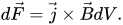
Now, according to Ampere's law, we will find the force with which the first conductor acts on the second:
- {\ displaystyle d {\ vec {F}} _ {1-2} = I_ {2} d {\ vec {l}} \ times {\ vec {B}} _ {1} (r).}
By the gimlet rule, {\ displaystyle d {\ vec {F}} _ {1-2}} directed towards the first conductor (similarly for {\ displaystyle d {\ vec {F}} _ {2-1}} , which means that the conductors are attracted).
The module of this force ( {\ displaystyle r} - distance between conductors):
- {\ displaystyle dF_ {1-2} = {\ frac {\ mu _ {0}} {4 \ pi}} {\ frac {2I_ {1} I_ {2}} {r}} dl.}
We integrate along the length of the conductor section {\ displaystyle L} (limits of integration by {\ displaystyle l} from 0 to {\ displaystyle L} ):
- {\ displaystyle F_ {1-2} = {\ frac {\ mu _ {0}} {4 \ pi}} {\ frac {2I_ {1} I_ {2}} {r}} \ cdot L.}
If a {\ displaystyle L} - unit length, this expression specifies the desired force of interaction.
The resulting formula is used in the SI to establish the numerical value of the magnetic constant {\ displaystyle \ mu _ {0}} . Indeed, the ampere , which is one of the basic SI units, is defined therein as “the force of unchanging current, which, when passing along two parallel straight conductors of infinite length and negligibly small area of circular cross-section, located in vacuum at a distance of 1 meter one from another, caused for each section of a conductor with a length of 1 meter, an interaction force equal to 2⋅10 −7 Newtons ” [1] .
Thus, from the resulting formula and the definition of ampere, it follows that the magnetic constant {\ displaystyle \ mu _ {0}} equals {\ displaystyle 4 \ pi \ times 10 ^ {- 7}} H / A² or, which is the same, {\ displaystyle 4 \ pi \ times 10 ^ {- 7}} GN / m exactly .
- Electrodynamic deformation of tires (conductors) of a three-phase alternating current at substations under the influence of short-circuit currents.
- Spreading the conductor railgun when fired.
- Any nodes in electrical engineering, where under the action of an electromagnetic field there is a movement of any elements, use the Ampere law. The most widespread and used in almost all technical constructions unit, based on its work based on the law of Ampere - is the electric motor, or, which is structurally almost the same, the generator.
It is under the action of the Ampere force that the rotor rotates, since its stator is affected by the magnetic field of the stator, setting in motion. Any vehicles on the electric coil to drive the shafts on which the wheels are located use the Ampere force (trams, electric cars, electric trains, etc.). Also, the magnetic field sets in motion the mechanisms of electric caps (electric doors, sliding gates, elevator doors). In other words, any devices that run on electricity and have moving parts are based on the operation of Ampere's law.
- It also finds application in many other types of electrical engineering, for example, in a loudspeaker. In a loudspeaker or speaker, a permanent magnet is used to excite a membrane that forms sound vibrations. Under the action of an electromagnetic field created by a nearby conductor with current, it is influenced by the Ampere force, which varies in accordance with the desired sound frequency.
- The principle of operation of electromechanical machines (the movement of the rotor winding relative to the stator winding).
- Electrodynamic plasma compression, for example, in tokamaks , Z-pinch installations.
- Electrodynamic pressing method .
In 1820, Hans Christian Oersted discovered that the wire through which current flows creates a magnetic field and causes the compass needle to deflect. He noted that the magnetic field is perpendicular to the current, and not parallel to it, as one would expect. Ampere, inspired by the demonstration of Oersted's experience, found that two parallel conductors, through which current flows, attract or repel, depending on whether current flows along one or the other sides. Thus, the current not only produces a magnetic field, but a magnetic field acts on the current. Already a week after Oersted announced his experience, Amper offered an explanation: the conductor acts on the magnet, because the magnet current flows through many small closed trajectories [2] [3] .
Let there be two thin conductors with currents {\ displaystyle I_ {1}} and {\ displaystyle I_ {2}} given by curves {\ displaystyle C_ {1}} and {\ displaystyle C_ {2}} . The curves themselves can be given by radius vectors. {\ displaystyle \ mathbf {r} _ {1}} and {\ displaystyle \ mathbf {r} _ {2}} . Let us find the force acting directly on the current element of one wire from the current element of another wire. According to the law of Bio - Savard - Laplace current element {\ displaystyle I_ {1} \ mathrm {d} \ mathbf {r} _ {1}} located at {\ displaystyle \ mathbf {r} _ {1}} creates at {\ displaystyle \ mathbf {r} _ {2}} elementary magnetic field {\ displaystyle \ mathrm {d} \ mathbf {B} _ {1} (\ mathbf {r} _ {2}) = {\ mu _ {0} \ over 4 \ pi} {\ frac {I_ {1} [\ mathrm {d} \ mathbf {r} _ {1}, \ mathbf {r} _ {2} - \ mathbf {r} _ {1}}} {| \ mathbf {r} _ {2} - \ mathbf {r} _ {1} | ^ {3}}}} . According to Ampere's law, the force acting from the field {\ displaystyle \ mathrm {d} \ mathbf {B} _ {1} (\ mathbf {r} _ {2})} on current element {\ displaystyle I_ {2} \ mathrm {d} \ mathbf {r} _ {2}} located at {\ displaystyle \ mathbf {r} _ {2}} equal to
- {\ displaystyle \ mathrm {d} ^ {2} \ mathbf {F} _ {12} = I_ {2} \ mathrm {d} \ mathbf {r} _ {2} \ times \ mathrm {d} \ mathbf { B} _ {1} (\ mathbf {r} _ {2}) = {\ mu _ {0} I_ {1} I_ {2} \ over 4 \ pi} {\ frac {[\ mathrm {d} \ mathbf {r} _ {2}, [\ mathrm {d} \ mathbf {r} _ {1}, \ mathbf {r} _ {2} - \ mathbf {r} _ {1}]]} {| \ mathbf {r} _ {2} - \ mathbf {r} _ {1} | ^ {3}}}.}
Current element {\ displaystyle I_ {2} \ mathrm {d} \ mathbf {r} _ {2}} located at {\ displaystyle \ mathbf {r} _ {2}} creates at {\ displaystyle \ mathbf {r} _ {1}} elementary magnetic field
- {\ displaystyle \ mathrm {d} \ mathbf {B} _ {2} (\ mathbf {r} _ {1}) = {\ mu _ {0} \ over 4 \ pi} {\ frac {I_ {2} [\ mathrm {d} \ mathbf {r} _ {2}, \ mathbf {r} _ {1} - \ mathbf {r} _ {2}} {| \ mathbf {r} _ {2} - \ mathbf {r} _ {1} | ^ {3}}}} .
Ampere force acting from the field {\ displaystyle \ mathrm {d} \ mathbf {B} _ {2} (\ mathbf {r} _ {1})} on current element {\ displaystyle I_ {1} \ mathrm {d} \ mathbf {r} _ {1}} located at {\ displaystyle \ mathbf {r} _ {1}} equal to
- {\ displaystyle \ mathrm {d} ^ {2} \ mathbf {F} _ {21} = I_ {1} \ mathrm {d} \ mathbf {r} _ {1} \ times \ mathrm {d} \ mathbf { B} _ {2} (\ mathbf {r} _ {1}) = {\ mu _ {0} I_ {1} I_ {2} \ over 4 \ pi} {\ frac {[\ mathrm {d} \ mathbf {r} _ {1}, [\ mathrm {d} \ mathbf {r} _ {2}, \ mathbf {r} _ {1} - \ mathbf {r} _ {2}]]} {| \ mathbf {r} _ {2} - \ mathbf {r} _ {1} | ^ {3}}}.}
In general, for arbitrary {\ displaystyle \ mathbf {r} _ {1}} and {\ displaystyle \ mathbf {r} _ {2}} strength {\ displaystyle \ mathrm {d} ^ {2} \ mathbf {F} _ {12}} and {\ displaystyle \ mathrm {d} ^ {2} \ mathbf {F} _ {21}} not even collinear, which means they do not obey Newton's third law: {\ displaystyle \ mathrm {d} ^ {2} \ mathbf {F} _ {12} + \ mathrm {d} ^ {2} \ mathbf {F} _ {21} \ neq 0} . However, nothing wrong with that. Physicists have proven that direct current can flow only in a closed loop. Therefore, the third law of Newton must act only for the forces with which the two closed conductors interact with the current. Let us make sure that for two such conductors, Newton's third law is satisfied.
Let the curves {\ displaystyle C_ {1}} and {\ displaystyle C_ {2}} are closed. Then current {\ displaystyle I_ {1}} creates at the point {\ displaystyle \ mathbf {r} _ {2}} a magnetic field
- {\ displaystyle \ mathbf {B} _ {1} (\ mathbf {r} _ {2}) = {\ mu _ {0} I_ {1} \ over 4 \ pi} \ oint \ limits _ {\ mathbb { C} _ {1}} {\ frac {[\ mathrm {d} \ mathbf {r} _ {1}, \ mathbf {r} _ {2} - \ mathbf {r} _ {1}]} {| \ mathbf {r} _ {2} - \ mathbf {r} _ {1} | ^ {3}},}
where is the integration by {\ displaystyle C_ {1}} produced in the direction of current flow {\ displaystyle I_ {1}} . Ampere force acting from the field {\ displaystyle \ mathbf {B} _ {1} (\ mathbf {r} _ {2})} on contour {\ displaystyle C_ {2}} with current {\ displaystyle I_ {2}} equal to
- {\ displaystyle \ mathbf {F} _ {12} = \ oint \ limits _ {\ mathbb {C} _ {2}} (I_ {2} \ mathrm {d} \ mathbf {r} _ {2} \ times \ mathbf {B} _ {1} (\ mathbf {r} _ {2})) = \ oint \ limits _ {\ mathbb {C} _ {2}} (I_ {2} \ mathrm {d} \ mathbf {r} _ {2} \ times {\ mu _ {0} I_ {1} \ over 4 \ pi} \ oint \ limits _ {\ mathbb {C} _ {1}} {\ frac {[\ mathrm { d} \ mathbf {r} _ {1}, \ mathbf {r} _ {2} - \ mathbf {r} _ {1}]} {| \ mathbf {r} _ {2} - \ mathbf {r} _ {1} | ^ {3}}}) = {\ mu _ {0} I_ {1} I_ {2} \ over 4 \ pi} \ oint \ limits _ {\ mathbb {C} _ {2}} \ oint \ limits _ {\ mathbb {C} _ {1}} {\ frac {[\ mathrm {d} \ mathbf {r} _ {2}, [\ mathrm {d} \ mathbf {r} _ {1 }, \ mathbf {r} _ {2} - \ mathbf {r} _ {1}]]} {| \ mathbf {r} _ {2} - \ mathbf {r} _ {1} | ^ {3} }},}
where is the integration by {\ displaystyle C_ {2}} produced in the direction of current flow {\ displaystyle I_ {2}} . Characteristically, the order of integration does not matter.
Similarly, the Ampere force acting from the field {\ displaystyle \ mathbf {B} _ {2} (\ mathbf {r} _ {1})} generated by current {\ displaystyle I_ {2}} on the contour {\ displaystyle C_ {1}} with current {\ displaystyle I_ {1}} equal to
- {\ displaystyle \ mathbf {F} _ {21} = \ oint \ limits _ {\ mathbb {C} _ {1}} (I_ {1} \ mathrm {d} \ mathbf {r} _ {1} \ times \ mathbf {B} _ {2} (\ mathbf {r} _ {1})) = {\ mu _ {0} I_ {1} I_ {2} \ over 4 \ pi} \ oint \ limits _ {\ mathbb {C} _ {1}} \ oint \ limits _ {\ mathbb {C} _ {2}} {\ frac {[\ mathrm {d} \ mathbf {r} _ {1}, [\ mathrm {d } \ mathbf {r} _ {2}, \ mathbf {r} _ {1} - \ mathbf {r} _ {2}]]} {| \ mathbf {r} _ {2} - \ mathbf {r} _ {1} | ^ {3}}} = \ oint \ limits _ {\ mathbb {C} _ {1}} \ oint \ limits _ {\ mathbb {C} _ {2}} \ mathrm {d} ^ {2} \ mathbf {F} _ {21}.}
Equality {\ displaystyle \ mathbf {F} _ {12} + \ mathbf {F} _ {21} = 0} equivalent to equality {\ displaystyle \ oint \ limits _ {\ mathbb {C} _ {2}} \ oint \ limits _ {\ mathbb {C} _ {1}} {\ frac {[\ mathrm {d} \ mathbf {r} _ {2}, [\ mathrm {d} \ mathbf {r} _ {1}, \ mathbf {r} _ {2} - \ mathbf {r} _ {1}]]} {| \ mathbf {r} _ {2} - \ mathbf {r} _ {1} | ^ {3}} = \ oint \ limits _ {\ mathbb {C} _ {1}} \ oint \ limits _ {\ mathbb {C} _ {2}} {\ frac {[\ mathrm {d} \ mathbf {r} _ {1}, [\ mathrm {d} \ mathbf {r} _ {2}, \ mathbf {r} _ {2} - \ mathbf {r} _ {1}]]} {| \ mathbf {r} _ {2} - \ mathbf {r} _ {1} | ^ {3}}} .
To prove this last equality, we note that the expression for the Ampere force is very similar to the expression for the circulation of a magnetic field along a closed contour, in which the outer scalar product is replaced by a vector product. Then it is clear in which direction to move.
Using the Lagrange identity, the double vector product on the left side of the equality to be proved can be written as:
- {\ displaystyle [\ mathrm {d} \ mathbf {r} _ {2}, [\ mathrm {d} \ mathbf {r} _ {1}, \ mathbf {r} _ {2} - \ mathbf {r} _ {1}]] = \ mathrm {d} \ mathbf {r} _ {1} (\ mathrm {d} \ mathbf {r} _ {2}, \ mathbf {r} _ {2} - \ mathbf { r} _ {1}) - (\ mathbf {r} _ {2} - \ mathbf {r} _ {1}) (\ mathrm {d} \ mathbf {r} _ {2}, \ mathrm {d} \ mathbf {r} _ {1}).}
Then the left side of the equality being proved takes the form:
- {\ displaystyle \ oint \ limits _ {\ mathbb {C} _ {2}} \ oint \ limits _ {\ mathbb {C} _ {1}} {\ frac {[\ mathrm {d} \ mathbf {r} _ {2}, [\ mathrm {d} \ mathbf {r} _ {1}, \ mathbf {r} _ {2} - \ mathbf {r} _ {1}]]} {| \ mathbf {r} _ {2} - \ mathbf {r} _ {1} | ^ {3}} = \ oint \ limits _ {\ mathbb {C} _ {1}} \ oint \ limits _ {\ mathbb {C} _ {2}} {\ frac {\ mathrm {d} \ mathbf {r} _ {1} (\ mathrm {d} \ mathbf {r} _ {2}, \ mathbf {r} _ {2} - \ mathbf {r} _ {1})} {| \ mathbf {r} _ {2} - \ mathbf {r} _ {1} | ^ {3}} - \ oint \ limits _ {\ mathbb {C} _ {1}} \ oint \ limits _ {\ mathbb {C} _ {2}} {\ frac {(\ mathbf {r} _ {2} - \ mathbf {r} _ {1}) (\ mathrm {d } \ mathbf {r} _ {2}, \ mathrm {d} \ mathbf {r} _ {1})} {| \ mathbf {r} _ {2} - \ mathbf {r} _ {1} | ^ {3}}}.}
Consider separately the integral {\ displaystyle \ oint \ limits _ {\ mathbb {C} _ {1}} \ oint \ limits _ {\ mathbb {C} _ {2}} {\ frac {\ mathrm {d} \ mathbf {r} _ {1} (\ mathrm {d} \ mathbf {r} _ {2}, \ mathbf {r} _ {2} - \ mathbf {r} _ {1})} {| \ mathbf {r} _ {2 } - \ mathbf {r} _ {1} | ^ {3}}}} which can be rewritten as follows:
- {\ displaystyle \ oint \ limits _ {\ mathbb {C} _ {1}} \ oint \ limits _ {\ mathbb {C} _ {2}} {\ frac {\ mathrm {d} \ mathbf {r} _ {1} (\ mathrm {d} \ mathbf {r} _ {2}, \ mathbf {r} _ {2} - \ mathbf {r} _ {1})} {| \ mathbf {r} _ {2 } - \ mathbf {r} _ {1} | ^ {3}}} = \ oint \ limits _ {\ mathbb {C} _ {1}} \ mathrm {d} \ mathbf {r} _ {1} \ oint \ limits _ {\ mathbb {C} _ {2}} {\ frac {(\ mathbf {r} _ {2} - \ mathbf {r} _ {1}, \ mathrm {d} (\ mathbf {r } _ {2} - \ mathbf {r} _ {1}))} {| \ mathbf {r} _ {2} - \ mathbf {r} _ {1} | ^ {3}}.}
By making the substitution of a variable in the inner integral on {\ displaystyle \ mathbf {r} = \ mathbf {r} _ {2} - \ mathbf {r} _ {1}} where is the vector {\ displaystyle \ mathbf {r}} varies in a closed loop {\ displaystyle C_ {2} '} , we find that the internal integral is a circulation of a gradient field along a closed loop. So, it is equal to zero:
- {\ displaystyle \ oint \ limits _ {\ mathbb {C} _ {2}} {\ frac {(\ mathbf {r} _ {2} - \ mathbf {r} _ {1}, \ mathrm {d} ( \ mathbf {r} _ {2} - \ mathbf {r} _ {1}))} {| \ mathbf {r} _ {2} - \ mathbf {r} _ {1} | ^ {3}} = \ oint \ limits _ {\ mathbb {C} _ {2} '} {\ frac {(\ mathbf {r}, \ mathrm {d} \ mathbf {r})} {| \ mathbf {r} | ^ {3}}} = - \ oint \ limits _ {\ mathbb {C} _ {2} '} (\ mathrm {grad} ({\ frac {1} {| \ mathbf {r} |}}), \ mathrm {d} \ mathbf {r}) = 0.}
Hence, the entire double curvilinear integral is zero. In that case, for strength {\ displaystyle \ mathbf {F} _ {12}} you can write:
- {\ displaystyle \ mathbf {F} _ {12} = {\ mu _ {0} I_ {1} I_ {2} \ over 4 \ pi} \ oint \ limits _ {\ mathbb {C} _ {1}} \ oint \ limits _ {\ mathbb {C} _ {2}} {\ frac {(\ mathbf {r} _ {1} - \ mathbf {r} _ {2}) (\ mathrm {d} \ mathbf { r} _ {2}, \ mathrm {d} \ mathbf {r} _ {1})} {| \ mathbf {r} _ {2} - \ mathbf {r} _ {1} | ^ {3}} }.}
Expression for power {\ displaystyle \ mathbf {F} _ {21}} can be obtained from the expression for strength {\ displaystyle \ mathbf {F} _ {12}} , just on the basis of symmetry considerations. To do this, we will replace the indices: 2 change to 1, and 1 to 2. In this case, for strength {\ displaystyle \ mathbf {F} _ {21}} you can write:
- {\ displaystyle \ mathbf {F} _ {21} = {\ mu _ {0} I_ {1} I_ {2} \ over 4 \ pi} \ oint \ limits _ {\ mathbb {C} _ {1}} \ oint \ limits _ {\ mathbb {C} _ {2}} {\ frac {(\ mathbf {r} _ {2} - \ mathbf {r} _ {1}) (\ mathrm {d} \ mathbf { r} _ {2}, \ mathrm {d} \ mathbf {r} _ {1})} {| \ mathbf {r} _ {2} - \ mathbf {r} _ {1} | ^ {3}} }.}
Now it is clear that {\ displaystyle \ mathbf {F} _ {12} = - \ mathbf {F} _ {21}} . Hence, the Ampere force satisfies Newton's third law in the case of closed conductors.
The law of interaction of two elementary electric currents, known as Ampere's law, was in fact later proposed by Grassmann. The original Ampere's law had a slightly different form: the force acting from the current element {\ displaystyle I_ {1} \ mathrm {d} \ mathbf {r} _ {1}} located at {\ displaystyle \ mathbf {r} _ {1}} on current element {\ displaystyle I_ {2} \ mathrm {d} \ mathbf {r} _ {2}} located at {\ displaystyle \ mathbf {r} _ {2}} equal to
- {\ displaystyle \ mathrm {d} ^ {2} \ mathbf {F} _ {12} = {\ mu _ {0} I_ {1} I_ {2} \ over 4 \ pi} {\ frac {(\ mathbf {r} _ {1} - \ mathbf {r} _ {2})} {| \ mathbf {r} _ {1} - \ mathbf {r} _ {2} | ^ {3}} (2 ( \ mathrm {d} \ mathbf {r} _ {1}, \ mathrm {d} \ mathbf {r} _ {2}) - 3 {\ frac {(\ mathbf {r} _ {1} - \ mathbf { r} _ {2}, \ mathrm {d} \ mathbf {r} _ {1}) (\ mathbf {r} _ {1} - \ mathbf {r} _ {2}, \ mathrm {d} \ mathbf {r} _ {2})} {| \ mathbf {r} _ {1} - \ mathbf {r} _ {2} | ^ {2}}).}
The force acting from the current element {\ displaystyle I_ {2} \ mathrm {d} \ mathbf {r} _ {2}} located at {\ displaystyle \ mathbf {r} _ {2}} on current element {\ displaystyle I_ {1} \ mathrm {d} \ mathbf {r} _ {1}} located at {\ displaystyle \ mathbf {r} _ {1}} equal to
- {\ displaystyle \ mathrm {d} ^ {2} \ mathbf {F} _ {21} = {\ mu _ {0} I_ {1} I_ {2} \ over 4 \ pi} {\ frac {(\ mathbf {r} _ {2} - \ mathbf {r} _ {1})} {| \ mathbf {r} _ {1} - \ mathbf {r} _ {2} | ^ {3}} (2 ( \ mathrm {d} \ mathbf {r} _ {1}, \ mathrm {d} \ mathbf {r} _ {2}) - 3 {\ frac {(\ mathbf {r} _ {1} - \ mathbf { r} _ {2}, \ mathrm {d} \ mathbf {r} _ {1}) (\ mathbf {r} _ {1} - \ mathbf {r} _ {2}, \ mathrm {d} \ mathbf {r} _ {2})} {| \ mathbf {r} _ {1} - \ mathbf {r} _ {2} | ^ {2}}).}
Formula power {\ displaystyle \ mathrm {d} ^ {2} \ mathbf {F} _ {21}} can be obtained from the formula of force {\ displaystyle \ mathrm {d} ^ {2} \ mathbf {F} _ {12}} just for symmetry reasons, i.e. replacing indices: 2 by 1, and 1 by 2. It is easy to see that {\ displaystyle \ mathrm {d} ^ {2} \ mathbf {F} _ {21} + \ mathrm {d} ^ {2} \ mathbf {F} _ {12} = 0} i.e. The original law of Ampere satisfies the third law of Newton already at the stage of the differential form. Therefore, verification of this law in the integral form is not required.
It can be proved that in the integral form of the original Ampere law, the forces with which two closed conductors interact with direct currents are the same as in Grassmann's law.
Evidence
To prove it, we write down the power {\ displaystyle \ mathbf {F} _ {21}} in the following form:
- {\ displaystyle \ mathbf {F} _ {21} = {\ mu _ {0} I_ {1} I_ {2} \ over 4 \ pi} \ oint \ limits _ {\ mathbb {C} _ {1}} \ oint \ limits _ {\ mathbb {C} _ {2}} {\ frac {(\ mathbf {r} _ {2} - \ mathbf {r} _ {1}) (\ mathrm {d} \ mathbf { r} _ {2}, \ mathrm {d} \ mathbf {r} _ {1})} {| \ mathbf {r} _ {2} - \ mathbf {r} _ {1} | ^ {3}} } + {\ mu _ {0} I_ {1} I_ {2} \ over 4 \ pi} \ oint \ limits _ {\ mathbb {C} _ {1}} \ oint \ limits _ {\ mathbb {C} _ {2}} {\ frac {(\ mathbf {r} _ {2} - \ mathbf {r} _ {1})} {| \ mathbf {r} _ {2} - \ mathbf {r} _ { 1} | ^ {3}}} ((\ mathrm {d} \ mathbf {r} _ {1}, \ mathrm {d} \ mathbf {r} _ {2}) - 3 {\ frac {(\ mathbf {r} _ {2} - \ mathbf {r} _ {1}, \ mathrm {d} \ mathbf {r} _ {1}) (\ mathbf {r} _ {2} - \ mathbf {r} _ {1}, \ mathrm {d} \ mathbf {r} _ {2})} {| \ mathbf {r} _ {1} - \ mathbf {r} _ {2} | ^ {2}}}). }
Obviously, in order for the force to be the same as in the Grassmann law, it is sufficient to prove that the second term is zero. Further, the second term will be considered without any coefficients in front of the signs of the integrals, since these coefficients in general are not equal to zero, and therefore the double curvilinear integral must be equal to zero.
So, we denote {\ displaystyle \ mathbf {P} = \ oint \ limits _ {\ mathbb {C} _ {1}} \ oint \ limits _ {\ mathbb {C} _ {2}} {\ frac {(\ mathbf {r } _ {2} - \ mathbf {r} _ {1})} {| \ mathbf {r} _ {1} - \ mathbf {r} _ {2} | ^ {3}} ((\ mathrm { d} \ mathbf {r} _ {1}, \ mathrm {d} \ mathbf {r} _ {2}) - 3 {\ frac {(\ mathbf {r} _ {2} - \ mathbf {r} _ {1}, \ mathrm {d} \ mathbf {r} _ {1}) (\ mathbf {r} _ {2} - \ mathbf {r} _ {1}, \ mathrm {d} \ mathbf {r} _ {2})} {| \ mathbf {r} _ {1} - \ mathbf {r} _ {2} | ^ {2}})} . And you need to prove that {\ displaystyle \ mathbf {P} = 0}
Assume that {\ displaystyle \ mathbf {P}} integration is done first along the contour {\ displaystyle C_ {2}} . In this case, it is possible to make a change of the variable: {\ displaystyle \ mathbf {r} = \ mathbf {r} _ {2} - \ mathbf {r} _ {1}} where is the vector {\ displaystyle \ mathbf {r}} varies in a closed loop {\ displaystyle C_ {2} '} . Then you can write
- {\ displaystyle \ mathbf {P} = \ oint \ limits _ {\ mathbb {C} _ {1}} \ oint \ limits _ {\ mathbb {C} _ {2} '} {\ frac {\ mathbf {r }} {| \ mathbf {r} | ^ {3}}} ((\ mathrm {d} \ mathbf {r} _ {1}, \ mathrm {d} \ mathbf {r}) -3 {\ frac { (\ mathbf {r}, \ mathrm {d} \ mathbf {r} _ {1}) (\ mathbf {r}, \ mathrm {d} \ mathbf {r})} {| \ mathbf {r} | ^ {2}}}).}
Now when integrating over the contour {\ displaystyle C_ {2} '} get some vector function from {\ displaystyle \ mathbf {r} _ {1}} which will then be integrated over the contour {\ displaystyle C_ {1}} .
You can prove that {\ displaystyle \ mathbf {P}} can be represented as {\ displaystyle \ mathbf {P} = - \ oint \ limits _ {\ mathbb {C} _ {1}} \ oint \ limits _ {\ mathbb {C} _ {2} '} \ mathbf {r} (\ mathrm {grad} (\ mathrm {grad} ({\ frac {1} {| \ mathbf {r} |}}), \ mathrm {d} \ mathbf {r}), \ mathrm {d} \ mathbf {r } _{one})} where both gradients are taken over the variable {\ displaystyle \ mathbf {r}} . The proof is trivial, it suffices to carry out the procedure for taking gradients.
Further, according to the Lagrange identity we can write down
- {\ displaystyle {\ begin {aligned} & & mathrm {grad} (\ mathrm {grad} ({\ frac {1} {| \ mathbf {r} |}}), \ mathrm {d} \ mathbf {r} ) = \ nabla (\ mathrm {grad} ({\ frac {1} {| \ mathbf {r} |}}), \ mathrm {d} \ mathbf {r}) = [\ mathrm {d} \ mathbf { r}, [\ nabla, \ mathrm {grad} ({\ frac {1} {| \ mathbf {r} |}})]] + (\ mathrm {d} \ mathbf {r}, \ nabla) \ mathrm {grad} ({\ frac {1} {| \ mathbf {r} |}}) = \\ & = 0 + {\ partial \ mathrm {grad} ({\ frac {1} {| \ mathbf {r} |}}) \ over \ partial x} \ mathrm {d} x + {\ partial \ mathrm {grad} ({\ frac {1} {| \ mathbf {r} |}}) \ over \ partial y} \ mathrm {d} y + {\ partial \ mathrm {grad} ({\ frac {1} {| \ mathbf {r} |}}) \ over \ partial z} \ mathrm {d} z = \ mathrm {d} (\ mathrm {grad} ({\ frac {1} {| \ mathbf {r} |}})) \\\ end {aligned}}.}
Here, zero turned out as a rotor of a gradient field. The result is a complete differential of the vector function.
{\ displaystyle \ mathrm {grad} ({\ frac {1} {| \ mathbf {r} |}})} . So now {\ displaystyle \ mathbf {P}} can be represented as {\ displaystyle \ mathbf {P} = - \ oint \ limits _ {\ mathbb {C} _ {1}} \ oint \ limits _ {\ mathbb {C} _ {2} '} \ mathbf {r} (\ mathrm {d} (\ mathrm {grad} ({\ frac {1} {| \ mathbf {r} |}})), \ mathrm {d} \ mathbf {r} _ {1})} . This integral can be taken by integrating each projection separately. For example, we integrate the projection x.
- {\ displaystyle P_ {x} = - \ oint \ limits _ {\ mathbb {C} _ {1}} \ oint \ limits _ {\ mathbb {C} _ {2} '} x (\ mathrm {d} ( \ mathrm {grad} ({\ frac {1} {| \ mathbf {r} |}})), \ mathrm {d} \ mathbf {r} _ {1}) = - \ oint \ limits _ {\ mathbb {C} _ {1}} (\ mathrm {d} \ mathbf {r} _ {1}, \ oint \ limits _ {\ mathbb {C} _ {2} '} \ mathrm {d} (x \ mathrm {grad} ({\ frac {1} {| \ mathbf {r} |}})) - \ mathrm {grad} ({\ frac {1} {| \ mathbf {r} |}}) \ mathrm {d } x).}
The integral of the total differential over any closed loop is zero: {\ displaystyle \ oint \ limits _ {\ mathbb {C} _ {2} '} \ mathrm {d} (x \ mathrm {grad} ({\ frac {1} {| \ mathbf {r} |}})) ) = 0} , so {\ displaystyle P_ {x}} take the form:
- {\ displaystyle P_ {x} = \ oint \ limits _ {\ mathbb {C} _ {1}} (\ mathrm {d} \ mathbf {r} _ {1}, \ oint \ limits _ {\ mathbb {C } _ {2} '} \ mathrm {grad} ({\ frac {1} {| \ mathbf {r} |}}) \ mathrm {d} x) = \ oint \ limits _ {\ mathbb {C} _ {1}} (\ mathrm {d} \ mathbf {r} _ {1}, \ oint \ limits _ {\ mathbb {C} _ {2}} {\ frac {\ mathbf {r} _ {1} - \ mathbf {r} _ {2}} {| \ mathbf {r} _ {1} - \ mathbf {r} _ {2} | ^ {3}} \ mathrm {d} x_ {2}).}
This time, you need to integrate the contour first. {\ displaystyle C_ {1}} . Make a change to the variable: {\ displaystyle \ mathbf {r} = \ mathbf {r} _ {1} - \ mathbf {r} _ {2}} where is the vector {\ displaystyle \ mathbf {r}} varies in a closed loop {\ displaystyle C_ {1} '} . Then you can write
- {\ displaystyle P_ {x} = \ oint \ limits _ {\ mathbb {C} _ {2}} \ mathrm {d} x_ {2} \ oint \ limits _ {\ mathbb {C} _ {1} '} (\ mathrm {d} \ mathbf {r}, {\ frac {\ mathbf {r}} {| \ mathbf {r} | ^ {3}}) = - \ oint \ limits _ {\ mathbb {C} _ {2}} \ mathrm {d} x_ {2} \ oint \ limits _ {\ mathbb {C} _ {1} '} (\ mathrm {d} \ mathbf {r}, \ mathrm {grad} ({ \ frac {1} {| \ mathbf {r} |}})) = 0,}
where the gradient is taken again by variable {\ displaystyle \ mathbf {r}} .
Since in the expression the circulation of the gradient field around the closed contour again appeared, {\ displaystyle P_ {x} = 0} .
Similarly, we can write for the remaining two projections:
- {\ displaystyle P_ {y} = - \ oint \ limits _ {\ mathbb {C} _ {1}} \ oint \ limits _ {\ mathbb {C} _ {2} '} y (\ mathrm {d} ( \ mathrm {grad} ({\ frac {1} {| \ mathbf {r} |}})), \ mathrm {d} \ mathbf {r} _ {1}) = - \ oint \ limits _ {\ mathbb {C} _ {1}} (\ mathrm {d} \ mathbf {r} _ {1}, \ oint \ limits _ {\ mathbb {C} _ {2} '} \ mathrm {d} (y \ mathrm {grad} ({\ frac {1} {| \ mathbf {r} |}})) - \ mathrm {grad} ({\ frac {1} {| \ mathbf {r} |}}) \ mathrm {d } y) = 0,}
- {\ displaystyle P_ {z} = - \ oint \ limits _ {\ mathbb {C} _ {1}} \ oint \ limits _ {\ mathbb {C} _ {2} '} z (\ mathrm {d} ( \ mathrm {grad} ({\ frac {1} {| \ mathbf {r} |}})), \ mathrm {d} \ mathbf {r} _ {1}) = - \ oint \ limits _ {\ mathbb {C} _ {1}} (\ mathrm {d} \ mathbf {r} _ {1}, \ oint \ limits _ {\ mathbb {C} _ {2} '} \ mathrm {d} (z \ mathrm {grad} ({\ frac {1} {| \ mathbf {r} |}})) - \ mathrm {grad} ({\ frac {1} {| \ mathbf {r} |}}) \ mathrm {d } z) = 0.}
So {\ displaystyle \ mathbf {P} = 0} .
Maxwell proposed the most general form of the law of interaction of two elementary conductors with a current, in which there is a coefficient k, which cannot be determined without some assumptions, followed from experiments in which the active current forms a closed loop [4] :
- {\ displaystyle \ mathrm {d} ^ {2} \ mathbf {F} _ {12} = {\ frac {1} {2}} {\ mu _ {0} I_ {1} I_ {2} \ over 4 \ pi} \ left ({\ begin {aligned} & & (3-k) {\ frac {(\ mathbf {r} _ {1} - \ mathbf {r} _ {2}) (\ mathrm {d} \ mathbf {r} _ {1}, \ mathrm {d} \ mathbf {r} _ {2})} {| \ mathbf {r} _ {1} - \ mathbf {r} _ {2} | ^ {3 }}} - 3 (1-k) {\ frac {(\ mathbf {r} _ {1} - \ mathbf {r} _ {2}) (\ mathbf {r} _ {1} - \ mathbf {r } _ {2}, \ mathrm {d} \ mathbf {r} _ {1}) (\ mathbf {r} _ {1} - \ mathbf {r} _ {2}, \ mathrm {d} \ mathbf { r} _ {2})} {| \ mathbf {r} _ {1} - \ mathbf {r} _ {2} | ^ {5}}} - \\ & - (1 + k) {\ frac { \ mathrm {d} \ mathbf {r} _ {1} (\ mathbf {r} _ {1} - \ mathbf {r} _ {2}, \ mathrm {d} \ mathbf {r} _ {2}) } {| \ mathbf {r} _ {1} - \ mathbf {r} _ {2} | ^ {3}} - (1 + k) {\ frac {\ mathrm {d} \ mathbf {r} _ {2} (\ mathbf {r} _ {1} - \ mathbf {r} _ {2}, \ mathrm {d} \ mathbf {r} _ {1})} {| \ mathbf {r} _ {1 } - \ mathbf {r} _ {2} | ^ {3}}} \\\ end {aligned}} \ right).}
In his theory, Ampere took {\ displaystyle k = -1} , Gauss accepted {\ displaystyle k = + 1} , just like Grassmann and Clausius . In non-terrestrial electronic theories, Weber accepted {\ displaystyle k = -1} and Riemann accepted {\ displaystyle k = + 1} . Ritz left {\ displaystyle k} uncertain in its theory.
If take {\ displaystyle k = -1} , get an expression for the original law of Ampere. If we take {\ displaystyle k = + 1} , we get:
- {\ displaystyle {\ begin {aligned} & & mathrm {d} ^ {2} \ mathbf {F} _ {12} = {\ mu _ {0} I_ {1} I_ {2} \ over 4 \ pi} \ left ({\ frac {(\ mathbf {r} _ {1} - \ mathbf {r} _ {2}) (\ mathrm {d} \ mathbf {r} _ {1}, \ mathrm {d} \ mathbf {r} _ {2})} {| \ mathbf {r} _ {1} - \ mathbf {r} _ {2} | ^ {3}} - {\ frac {\ mathrm {d} \ mathbf {r} _ {1} (\ mathbf {r} _ {1} - \ mathbf {r} _ {2}, \ mathrm {d} \ mathbf {r} _ {2})} {| \ mathbf {r } _ {1} - \ mathbf {r} _ {2} | ^ {3}} - {\ frac {\ mathrm {d} \ mathbf {r} _ {2} (\ mathbf {r} _ {1 } - \ mathbf {r} _ {2}, \ mathrm {d} \ mathbf {r} _ {1})} {| \ mathbf {r} _ {1} - \ mathbf {r} _ {2} | ^ {3}}} \ right) = \\ & = {\ mu _ {0} I_ {1} I_ {2} \ over 4 \ pi} \ left ({\ frac {[\ mathrm {d} \ mathbf {r} _ {2}, [\ mathrm {d} \ mathbf {r} _ {1}, \ mathbf {r} _ {2} - \ mathbf {r} _ {1}]]} {| \ mathbf {r} _ {1} - \ mathbf {r} _ {2} | ^ {3}} - {\ frac {\ mathrm {d} \ mathbf {r} _ {2} (\ mathbf {r} _ {1} - \ mathbf {r} _ {2}, \ mathrm {d} \ mathbf {r} _ {1})} {| \ mathbf {r} _ {1} - \ mathbf {r} _ {2 } | ^ {3}}} \ right) \\\ end {aligned}}.}
Here, the first two terms were united by the Lagrange identity, while the third term was integrated in closed contours. {\ displaystyle C_ {1}} and {\ displaystyle C_ {2}} will give zero. Really,
- {\ displaystyle \ oint \ limits _ {\ mathbb {C} _ {2}} \ oint \ limits _ {\ mathbb {C} _ {1}} {\ frac {\ mathrm {d} \ mathbf {r} _ {2} (\ mathbf {r} _ {1} - \ mathbf {r} _ {2}, \ mathrm {d} \ mathbf {r} _ {1})} {| \ mathbf {r} _ {1 } - \ mathbf {r} _ {2} | ^ {3}}} = \ left [{\ begin {aligned} & \ mathbf {r} = \ mathbf {r} _ {1} - \ mathbf {r} _ {2} \\ & C_ {1} \ rightarrow C_ {1} '\\\ end {aligned}} \ right] = \ oint \ limits _ {\ mathbb {C} _ {2}} \ mathrm {d} \ mathbf {r} _ {2} \ oint \ limits _ {\ mathbb {C} _ {1} '} {\ frac {(\ mathbf {r}, \ mathrm {d} \ mathbf {r})} { | \ mathbf {r} | ^ {3}}} = \ oint \ limits _ {\ mathbb {C} _ {2}} \ mathrm {d} \ mathbf {r} _ {2} \ oint \ limits _ { \ mathbb {C} _ {1} '} (\ mathrm {grad} {\ frac {1} {| \ mathbf {r} |}}, \ mathrm {d} \ mathbf {r}) = 0.}
Thus we get the form of Ampere's law given by Maxwell:
- {\ displaystyle \ mathbf {F} _ {12} = {\ mu _ {0} I_ {1} I_ {2} \ over 4 \ pi} \ oint \ limits _ {\ mathbb {C} _ {2}} \ oint \ limits _ {\ mathbb {C} _ {1}} {\ frac {[\ mathrm {d} \ mathbf {r} _ {2}, [\ mathrm {d} \ mathbf {r} _ {1 }, \ mathbf {r} _ {2} - \ mathbf {r} _ {1}]]} {| \ mathbf {r} _ {1} - \ mathbf {r} _ {2} | ^ {3} }}.}
It should be noted that although the Ampere power is always the same for different {\ displaystyle k} , the moment of forces, however, may differ. For example, when two infinite wires intersect at right angles interact, the interaction force will be zero. If we calculate the moment of forces acting on each of the wires, according to the Grassman formula, none of them will be equal to zero (although in total they will be equal to zero). If we calculate the moment of forces according to the original Ampere law, each of them will be equal to zero.
You may notice that the original Ampere law can be used to calculate the interaction force of non-closed currents, as a rule, non-constant, since Newton's third law is never violated. In the case of Grassmann's law, one has to introduce an additional physical entity — a magnetic field to compensate for the non-observance of Newton's third law.
Electric current in the conductor is the movement of charges relative to other charges. This movement leads to the SRT effects, which in classical physics are explained by a separate physical entity - magnetism. In SRT, these effects do not require the introduction of magnetism, and, as a first approximation, it suffices to consider the Coulomb interactions. To describe the Ampere law in the framework of SRT, a metallic conductor describes a straight line with a certain linear density of positive charges and a straight line with mobile charges. The charge is invariant , so the Lorentz effect of reducing the length creates a difference between the density of positive and negative charges in the initially neutral metal wire. Hence the emergence of the force of attraction or repulsion between two conductors with current. [5] [6]
- Lorenz force
- Ampere's Law on Circulation
 . Expression for power