Haya Senegalese [2] ( lat. Khaya senegalensis ) - a tree , a species of the genus Haya ( Khaya } family Melia ( Meliaceae ), grows in Africa .
| Haya Senegalese | |||||||||||||||||||||
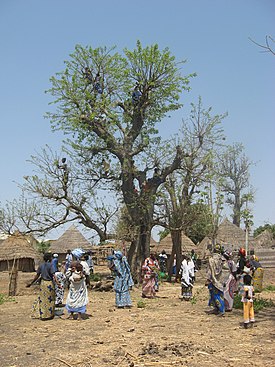 Haya Senegal, eastern Senegal . | |||||||||||||||||||||
| Scientific classification | |||||||||||||||||||||
|---|---|---|---|---|---|---|---|---|---|---|---|---|---|---|---|---|---|---|---|---|---|
| |||||||||||||||||||||
| International scientific name | |||||||||||||||||||||
Khaya senegalensis ( Desr. ) A.Juss. , 1830 | |||||||||||||||||||||
| Security status | |||||||||||||||||||||

Content
Botanical Description
Haya Senegalese, also called "African mahogany", is a medium-sized tree , reaching 15-30 m in height and up to 1 m in diameter. The bark from dark gray to taupe is smooth in the early years, then it becomes flaky. The core of the trunk is brown with a pink-red pigment consisting of coarse interlaced grains. The leaves are pinnate, with 4-6 pairs of oblong leaflets 10 cm long and 4-5 cm wide with a rounded tip. The leaves are arranged in a spiral grouped at the end of the branches. Flowering occurs at the end of the dry season or at the beginning of the rainy season. White scented flowers are pollinated by insects such as bees and butterflies. Fruits ripen 3-5 months after flowering. Trees begin to bear fruit in 20-25 years. The fruit is a vertical, almost spherical, woody capsule, 4-6 cm in diameter, from light gray to grayish-brown in color, with 4 valves, numerous disc-shaped or quadrangular seeds, highly flattened. Seeds about 2-2.5 cm, surrounded by a narrow brown wing [3] .
In the seeds of the tree, the oil content reaches 52.5%, which consists of 65% oleic acid , 21% palmitic acid and 10% stearic acid [4] .
Distribution and habitat
Found in Benin, Burkina Faso, Cameroon, Central African Republic, Chad, Cote d'Ivoire, Gabon, Gambia, Ghana, Guinea, Guinea-Bissau, Mali, Niger, Nigeria, Senegal, Sierra Leone, Sudan, Togo and Uganda . grows in coastal and savannah forests with high rainfall; in humid regions it prefers elevations. During the first year of life, a deep root system develops in the tree sprout, which makes this species the most drought-resistant representative of its kind.
Human Use
Haya Senegalese wood is used for a variety of purposes. Traditionally, it is used for carpentry, interior decoration and construction. Also, wood was used for the construction of canoe-chisels , household appliances, the manufacture of traditional West African djembe drums and as firewood. The bark of bitter taste is used for various medical purposes: with malaria fever, with stomach and headaches. The bark is used to treat external skin rashes, wounds.
From the first half of the 19th century, wood was exported from West Africa (mainly from the Gambia ) to Europe , where it was actively used for the production of wood materials. Haya wood is currently used locally. In addition, Haya Senegalese landed along the streets and roads with decorative purposes.
Outside of Africa, the tree was widely used by colonial administrations when planting malls. This species was introduced by the British in Northern Australia, and by the French in Indochina. Haya Senegalese is one of the main species of trees planted along the streets of Hanoi in Vietnam . It was also introduced in New Caledonia for landing in urban areas.
Guard Status
In the past, Haya Senegalese was actively cut down for woodworking and other purposes, and little effort was made to restore it to nature. In this regard , the IUCN Red Book considers the plant as a “vulnerable species" [5] . However, the only protection that takes place is a ban on timber exports and legal protection in some countries.
Gallery
Flowers
Leaves
Fruit
Seeds
Notes
- ↑ For the conventionality of specifying the class of dicotyledons as a superior taxon for the plant group described in this article, see the APG Systems section of the Dicotyledonous article .
- ↑ Forest savannas and savannah woodlands of tropical and equatorial Africa . World vegetation (A.V. Belikovich). Date of treatment September 4, 2019.
- ↑ Khaya_senegalensis_ (PROTA)
- ↑ Fatty acid composition of the seed oil of Khaya senegalensis (Eng.) // Bioresource Technology : journal. - 1999. - Vol. 69 , no. 3 . - P. 279-280 . - DOI : 10.1016 / S0960-8524 (98) 00190-4 .
- ↑ UICN