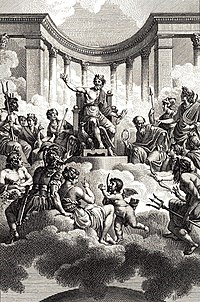

Olympians, Olympic gods ( dr. Greek Ολύμπιοι θεοί ) - in ancient Greek mythology, third-generation gods (after the original gods and titans - gods of the first and second generations), the supreme deities who lived on Mount Olympus : Apollon, Ares, Artemis, Athena, Aphrodite, Hera, Hestia / Dionysus, Hermes, Hephaestus, Demeter, Zeus, Poseidon.
The epithet "Olympian" mainly referred to their head Zeus [1] . The figurative meaning of the word “Olympian” is a person who maintains a calm (“Olympic”) calmness and outward majesty (such was Zeus portrayed) [2] [3] .
Content
- 1 List
- 2 Council of the Gods
- 3 Roman dii magni
- 4 See also
- 5 notes
- 6 Literature
- 7 References
List
Traditionally, the number of Olympics includes twelve gods [4] mainly from the third and fourth generation of divine beings “ titans (titanides)” described in Greek mythology, the so-called “Twelve Gods ” ( Δωδεκάθεον ). At the same time, the composition of the “twelve” was not canonical in ancient Greek theology, depending on local cults, the composition of the twelve-member pantheon changed, in particular, such gods at different times numbered twelve, thirteen, and fourteen.
In addition to the twelve Olympians, in ancient Greece there were many other various cult groups of twelve gods. The earliest evidence of Greek religious practice involving the twelve gods appears no earlier than the end of the VI century BC. e. [5] [6] According to Thucydides ( Thucydides , History of the Peloponnesian War. VI, 54: 6-7), the was erected on the Athenian Agora by the archonist Pisistratus the Younger (the son of the tyrant and archon Hippias and the grandson of the tyrant Pisistratus ) ok . 522 BC e. [7] The altar became the central reference point for the distance from Athens to places of worship and sanctuaries. [8]
The Olympians included the children of Kronos and Rhea (called the Kronids):
- Zeus is the supreme god of the ancient Greek pantheon, the god of thunder and lightning.
- Hera is the wife of Zeus, the patroness of marriage, family love.
- Poseidon is the god of the sea elements and the brother of Zeus.
- ( Hades is the lord of the Kingdom of the Dead and the brother of Zeus).
- Demeter is the goddess of fertility and agriculture.
- Hestia is the goddess of the hearth.
And also the descendants of Zeus:
- Athena is the goddess of wisdom, justice, science and crafts, as well as military affairs. Patroness of cities and wisdom, daughter of Zeus.
- (Persephone - the goddess of spring, the queen of the Kingdom of the Dead, the wife of Hades).
- Aphrodite is the goddess of love and beauty.
- Hephaestus is the god of fire and blacksmithing.
- Hermes is the god of trade, cunning, speed and theft, as well as eloquence. Patron of Wanderers.
- Apollo is the god of light, the patron of the arts. Also, the healing god and patron of the oracles.
- Ares is the god of war.
- Artemis is the goddess of hunting, the patroness of all life on Earth, the daughter of Zeus.
- Dionysus is the god of winemaking and fun (Hestia was supplanted in the list of 12 Olympians).
Council of the Gods
12 gods were included in the council (dii consentes), where the male and female gender were equally represented (in Roman brackets are the ancient Roman counterparts) [9] :
|
|
Roman dii magni
In addition to their own analogues dii consentes, the ancient Romans included in the composition of the higher gods the so-called dii selecti: Saturn ( Kronos ), Janus , Cybele ( Rhea ), Pluto ( Aida ), Liber ( Dionysus ), Sol ( Helios ), Moon ( Selena ) and The genius . Together, dii consentes and dii selecti were dii magni or dii maiorum gentium [9] .
See also
- Correspondence of Roman and Greek gods
Notes
- ↑ Olympians // Dictionary of Antiquity
- ↑ Vvedensky B.A. Great Soviet Encyclopedia Volume 30 - Great Soviet Encyclopedia Second Edition
- ↑ Olympic - Efremova's Explanatory Dictionary - Encyclopedias & Dictionaries
- ↑ A.A. Tahoe-Godi . "Greek mythology". - LLC OST Publishing House, 2002. - S. 115-119. - 256 s. - ISBN 5-17-014097-5 .
- ↑ Dowden K. , Olympian Gods, Olympian Pantheon. // A Companion to Greek Religion, Daniel Ogden editor. - John Wiley & Sons, 2010 .-- p. 43. - ISBN 978-1-4443-3417-3 .
- ↑ Rutherford I. , Canonizing the Pantheon: the Dodekatheon in Greek Religion and its Origins. // The Gods of Ancient Greece: Identities and Transformations, editors Jan N. Bremmer, Andrew Erskine. - Edinburgh University Press, 2010 .-- p. 43. - ISBN 978-0-7486-3798-0
- ↑ Rutherford I. , Canonizing the Pantheon: the Dodekatheon in Greek Religion and its Origins. // The Gods of Ancient Greece: Identities and Transformations, editors Jan N. Bremmer, Andrew Erskine. - Edinburgh University Press, 2010 .-- p. pp. 43-44. - ISBN 978-0-7486-3798-0
- ↑ Gadbery LM , The Sanctuary of the Twelve Gods in the Athenian Agora: A Revised View. // Hesperia. - 61 (1992). - pp. 447.
- ↑ 1 2 Lubker, 1885 , p. 320.
Literature
- Consentes dii // The Real Dictionary of Classical Antiquities / ed. F. Lubker ; Edited by members of the Society of Classical Philology and Pedagogy F. Gelbke , L. Georgievsky , F. Zelinsky , V. Kansky , M. Kutorgi and P. Nikitin . - SPb. , 1885. - S. 320.