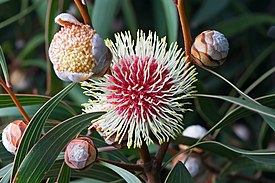
Creamy flower head
H. laurina .
Hakea laurina is an upright bush or tree reaching a height of 2.5 to 6.0 m and a width of 3.0 to 5.0 m. It has a thickening at the base of the trunk. It grows, as a rule, on sandy soils, sometimes on sandy clay; most of the registered specimens are in the southern regions of its range.
The flowers are initially pale or cream, possibly hidden by leaves in the early stages, and before opening they are contained in scaly bracts. They have a deep pink or red color in the center of the spherical process, a cluster flower in the axils of the leaves, from which pale styles arise. The flower resembles a pillow for pins. Flower heads produce nectar and a light aroma. The flowering period is from April to August. The leaves are simple and slightly blue-green, flat, smooth, have solid edges in the form of obovate or lanceolate, reaching to an acute end. The leaves vary in size, can have a width of 6-29 mm and a length of up to 180 mm. The foliage is dense and alternates on vertical branches; in some forms it can be hanging and reach the ground. The bark is gray and smooth. The fruit is retained on the plant, has an ovoid shape, with a small hook at the end and has a smooth surface at the peduncle.
The species is found on the sandy plains of the coastal southwest of Australia, the northernmost edge of the range is near the city of Narrogin and extends east to the city of Esperance [6] .
The species Hakea laurina was described by Robert Brown in 1830. The species name is from the Latin laurus , which is associated with the shape of the leaves, resembling a laurel .
The plant is propagated by seeds, used in cultivation in the eastern states of Australia, as well as hedges and street ornamental plants in America and Italy [4] . Adapts to various types of soil, frost-resistant. Use for decorating and shading on the streets, shaping the habitat of wild animals, damping winds and controlling soil erosion
In the language of flowers, Hakea laurina symbolizes nobility and longevity.