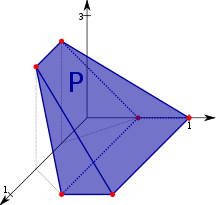
Convex analysis is a branch of mathematics devoted to the study of the properties of convex functions and convex sets , often having applications in convex programming , a subdomain of optimization theory .
Content
Convex sets
A convex set is a set for some vector space X such that for any and [one]
- .
Convex function
A convex function is any extended real-valued function {\ displaystyle f: X \ to \ mathbb {R} \ cup \ {\ pm \ infty \}} which satisfies Jensen 's inequality , that is, for any and any
- [1] .
Equivalently, a convex function is any (extended) real-valued function such that its epigraph
is a convex set [1] .
Convex Mate
Convex conjugation of an extended real-valued (not necessarily convex) function Is a function , where X * is the dual space of the space X [2] such that
Double pairing
Dual pairing function Is a pairing pairing, which is usually written as . Double conjugation is useful when you need to show that strong or is fulfilled (using ).
For anyone inequality follows from Fenchel's inequality . For f = f ** if and only if f is convex and lower semicontinuous by the Fenchel – Moreau theorem [2] [3] .
Convex minimization
The (direct) convex programming problem is a problem of the form
such that is a convex function, and is a convex set.
The dual task
The duality principle in optimization states that optimization problems can be considered from two points of view, as a direct problem or a dual task .
in the general case, given a [4] of separable locally convex spaces and function , we can define a direct problem as finding such , what In other words, Is the infimum (exact lower bound) of the function .
If there are restrictions, they can be built into the function if put where - . Let now (for another dual pair ) is a such that [5] .
The dual problem for this perturbation function with respect to the selected problem is defined as
where F * is the convex conjugation in both variables of the function F.
The duality gap is the difference between the right and left sides of the inequality
Where Is the convex conjugation of both variables, and means supremum (exact upper bound) [6] [7] [5] [6] .
This principle is the same as . If both sides are equal, they say that the problem satisfies the conditions of strong duality .
There are many conditions for strong duality, such as:
- F = F ** , where F is the for the direct and dual problems, and F ** is the double conjugation of the function F ;
- a direct task is a linear programming task ;
- Slater condition for convex programming problems [8] [9] .
Lagrange Duality
For a convex minimization problem with inequality constraints
- under conditions for i = 1, ..., m .
the dual task of Lagrange will be
- under conditions for i = 1, ..., m ,
where the objective function L ( x , u ) is the dual Lagrange function defined as follows:
Notes
- ↑ 1 2 3 Rockafellar, 1997 .
- ↑ 1 2 Zălinescu, 2002 , p. 75–79.
- ↑ Borwein, Lewis, 2006 , p. 76–77.
- ↑ The dual pair is the three where Is the vector space above the field , - the set of all linear mappings , and the third element is a bilinear form .
- ↑ 1 2 Boţ, Wanka, Grad, 2009 .
- ↑ 1 2 Csetnek, 2010 .
- ↑ Zălinescu, 2002 , p. 106–113.
- ↑ Borwein, Lewis, 2006 .
- ↑ Boyd, Vandenberghe, 2004 .
Literature
- Jonathan Borwein, Adrian Lewis. Convex Analysis and Nonlinear Optimization: Theory and Examples. - 2. - Springer, 2006. - ISBN 978-0-387-29570-1 .
- Stephen Boyd, Lieven Vandenberghe. Convex Optimization . - Cambridge University Press, 2004. - ISBN 978-0-521-83378-3 .
- R. Tyrrell Rockafellar. Convex Analysis. - Princeton, NJ: Princeton University Press, 1997. - ISBN 978-0-691-01586-6 .
- Radu Ioan Boţ, Gert Wanka, Sorin-Mihai Grad. Duality in Vector Optimization. - Springer, 2009 .-- ISBN 978-3-642-02885-4 .
- Constantin Zălinescu. Convex analysis in general vector spaces. - River Edge, NJ: World Scientific Publishing Co., Inc., 2002. - S. 106–113. - ISBN 981-238-067-1 .
- Ernö Robert Csetnek. Overcoming the failure of the classical generalized interior-point regularity conditions in convex optimization. Applications of the duality theory to enlargements of maximal monotone operators. - Logos Verlag Berlin GmbH, 2010 .-- ISBN 978-3-8325-2503-3 .
- Jonathan Borwein, Adrian Lewis. Convex Analysis and Nonlinear Optimization: Theory and Examples. - 2. - Springer, 2006. - ISBN 978-0-387-29570-1 .
- Hiriart-Urruty J.-B., Lemaréchal C. Fundamentals of convex analysis. - Berlin: Springer-Verlag, 2001 .-- ISBN 978-3-540-42205-1 .
- Ivan Singer. Abstract convex analysis. - New York: John Wiley & Sons, Inc., 1997 .-- C. xxii + 491. - (Canadian Mathematical Society series of monographs and advanced texts). - ISBN 0-471-16015-6 .
- Stoer J., Witzgall C. Convexity and optimization in finite dimensions. - Berlin: Springer, 1970. - T. 1. - ISBN 978-0-387-04835-2 .
- Kusraev AG, Kutateladze SS Subdifferentials: Theory and Applications. - Dordrecht: Kluwer Academic Publishers, 1995 .-- ISBN 978-94-011-0265-0 .
- Kusraev A.G., Kutateladze S.S. Subdifferentials. Theory and applications. Part 2 .. - 2nd, revised .. - Novosibirsk: Publishing House of the Institute of Mathematics, 2003. - ISBN 5–86134–116–8.