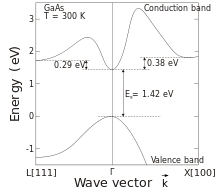
In solid-state physics , the Ridley-Watkins-Hillsum theory explains the mechanism by which differential negative resistance develops in bulk semiconductor material when voltage is applied to the sample terminals. [1] This theory underlies the operation of the Gunn diode, as well as several other microwave semiconductor devices that are used in practice in electronic generators for the production of microwave energy. It is named after the British physicists Brian Ridley, [2] Tom Watkins and Cyril Hillsum, who wrote theoretical articles about the effect in 1961.
Oscillations of negative differential resistance in bulk semiconductors were observed in the laboratory of J. B. Gann in 1962 [3] and therefore were called the "Gunn effect", but in 1964 physicist Herbert Kroemer indicated that Gunn's observations can be explained by the Ridley theory - Watkins - Hillsum. [four]
In fact, the Ridley – Watkins – Hillsum mechanism is the transfer of conduction electrons in a semiconductor from a valley with high mobility to valleys with lower mobility and higher energy. This phenomenon can only be observed in materials with such structures of energy zones .
Typically, in a conductor, an increase in the electric field causes higher velocities of charge carriers (usually electrons) and leads to a higher current in accordance with Ohm's law . In a multi-valley semiconductor, however, electrons having a higher energy can go into states located in another valley, where they actually have a higher effective mass and, thus, slow down at the same energy. In fact, this leads to a decrease in speed and a drop in current with increasing voltage. During transfer, the current decreases in the material, that is, a negative differential resistance appears. At higher voltages, the normal increase in the ratio of current to voltage resumes after the bulk of the carriers enter the valley with a larger effective mass. Therefore, negative differential resistance occurs only in a limited voltage range.
Of the types of semiconductor materials satisfying these conditions, gallium arsenide (GaAs) is the most widely studied and widespread. However, the Ridley – Watkins – Hillsum mechanism is observed in indium phosphide (InP), cadmium telluride (CdTe), zinc selenide (ZnSe), and indium arsenide (InAs) under hydrostatic or uniaxial pressure.
See also
- Diode gunn
Links
- ↑ BK Ridley. The Possibility of Negative Resistance Effects in Semiconductors (English) // Proceedings of the Physical Society : journal. - 1961. - Vol. 78 , no. 2 . - DOI : 10.1088 / 0370-1328 / 78/2/315 . - .
- ↑ Ridley. BK Ridley . www.essex.ac.uk . Date of treatment March 3, 2015.
- ↑ JB Gunn. Microwave Oscillation of Current in III-V Semiconductors (English) // Solid State Communications : journal. - 1963. - Vol. 1 , no. 4 . - P. 88 . - DOI : 10.1016 / 0038-1098 (63) 90041-3 . - .
- ↑ H. Kroemer. Theory of the Gunn effect (Eng.) // Proceedings of the IEEE : journal. - 1964. - Vol. 52 , no. 12 . - DOI : 10.1109 / proc.1964.3476 .
Other sources
- Liao, Samual Y (1990). Microvave Devices and Circuits (3rd ed.). Prentice Hall. ISBN 0-13-583204-7.
- Averkov, YO (2001). "The role of the Ridley – Watkins – Hilsum effect in stabilization of millimeter and sub-millimeter surface electromagnetic waves excited byan electron beam moving parallel to the surface of GaAs." The Fourth International Kharkov Symposium on Physics and Engineering of Millimeter and Sub-Millimeter Waves. 1. pp. 299-301. doi: 10.1109 / MSMW.2001.946832. ISBN 0-7803-6473-2.
- F; Sterzer. Transferred electron (Gunn) amplifiers and oscillators for microwave applications (Eng.) // Proceedings of the IEEE : journal. - 1971. - Vol. 59 , no. 8 . - P. 1155-1163 . - DOI : 10.1109 / PROC.1971.8361 .
- NR; Agamalyan. Photoelectric properties of lead molybdate crystals (Eng.) // Physica Status Solidi A : journal. - 1996. - Vol. 157 , no. 2 . - P. 421-425 . - DOI : 10.1002 / pssa.2211570226 . - .
- Phenomena / Theories - 1961 . Milestones in Semiconductor Science and Technology . Archived October 26, 2009.