American Abstract Artists ( AAA) is an art group created in 1936 in New York to develop abstract art . The exhibitions, publications and lectures of the art group allowed the AAA to become the main forum for the exchange and discussion of ideas, as well as for the presentation of abstract art to the general public. The art group contributed to the development and adoption of abstract art in the United States and played a historical role in its development [2] . This is one of the few organizations of artists that survived the Great Depression and continued its activities in the 21st century.
| American abstract artists | |
|---|---|
| Administrative center | |
| Type of organization | art group |
| Official language | English |
| Executives | |
| The president | Jim Osman |
| Base | |
| Established | 1936 |
Content
- 1 History
- 2 Activities
- 2.1 Modernity
- 2.2 Notes
- 2.3 Literature
- 2.4 References
History
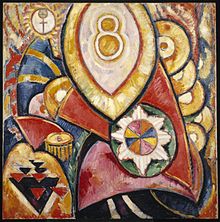
During the 1930s, critics and society were generally not very welcoming to abstract art, and it received almost no support from art galleries and museums . The American group of abstract artists was created in 1936 as a forum for discussing abstract art and providing exhibition opportunities for artists [3] . In 1937, the AAA issued The General Prospect. It outlined the purpose of organizing and the importance of exhibitions to promote the growth and acceptance of abstract art in the United States. [four]
The AAA held its first exhibition in 1937 at the Squibb Gallery in New York. It was the largest and most visited exhibition of American abstract painting and sculpture outside the museum in the 1930s. For the 1937 exhibition, AAA prepared its first printed catalog with original zinc plate lithographs instead of a paper catalog [5] . Exhibitions and publications will make AAA the main forum for the discussion and presentation of abstract art [6] .
Activities
The most influential critics considered American abstract art to be too European and, therefore, “non-American.” New York newspapers and art magazines of the time published hostile criticisms of AAA's works and exhibitions [7] . American abstract art fought for recognition, and AAA personified this struggle. The 1938 Yearbook was dedicated to criticizing the press and the public against abstract art. It also presented essays related to the principles and practice of creating abstract art. In 1940, the AAA distributed an article entitled “How Modern is the Museum of Modern Art ?” [8] . At that time, the Museum of Modern Art pursued a policy of demonstrating European abstractionism with the support of American regionalism . This policy helped reinforce the notion that abstraction is alien to American experience. [9]
Later that year, the AAA released a 12-page brochure: “Art Critics -! How do they serve society? What they're saying? How much do they know? Let's look at the records. ” The AAA publication cited critics, emphasizing distortions and contradictions in the press. The pamphlet criticized the Royal Cortissos of the New York Herald Tribune , devoted to traditionalism and negatively related to abstract and contemporary art [10] . It also characterized the aesthetic vibrations of Thomas Craven, a critic of the New York Journal American [11] , as opportunistic. In 1936, Craven called the work of Picasso "Bohemian infantilism." In subsequent years, the public increasingly appreciated abstract art, until in 1939 the critic criticized Picasso for his "unsurpassed ingenuity." The brochure positively characterized Henry McBride of The Sun and Robert Coates of The New Yorker for their positive critical articles in the field of abstract art. Art critics have shown that critics from New York newspapers and art publications did not know what was happening in 20th-century art. [12]
The AAA struggled with the predominant hostility towards abstraction and set the stage for its adoption after World War II . [7] AAA was at the forefront of abstract expressionism , helping abstract art to reveal its identity in the United States. [13]
In the early 1940s, the New York school began to gain popularity, and in the mid-1940s and 1950s, abstract expressionism began to dominate the American avant-garde. American abstractionists continued their work as supporters and advocates of abstract art. [fourteen]
Modernity
American abstract artists are active today. To date, the organization has held more than 75 exhibitions in museums and galleries throughout the United States. AAA publishes 5 magazines, in addition to brochures, books, catalogs, and organizes critical discussions and symposia. AAA distributes its published materials internationally among cultural organizations. [15] [14] [5]
In 2014, Harry Holtzman and George L.K. Morris, the founding members of American abstract artists, were united in an exhibition of two people, which was supervised by Kinney Fillinghuisen and Madalena Holtzman [16] [17] .
Notes
- ↑ https://whitney.org/artists/1497
- ↑ Pioneers of Abstract Art: American Abstract Artists, 1936–1996 , exhibition catalog. Sidney Mishkin Gallery, Baruch College, 1996. Text by Sandra Kraskin. p 5.
- ↑ Pioneers of Abstract Art: American Abstract Artists, 1936–1996 , Sandra Kraskin. p 5, 9.
- ↑ Larsen, Susan C. “The American Abstract Artists: A Documentary History 1936–1941,” Archives of American Art Journal , Vol. 14, No. 1 (1974), p 3.
- ↑ 1 2 Larsen, Susan C. “The American Abstract Artists: A Documentary History 1936–1941,” p 3.
- ↑ American Abstract Artists, The Language of Abstraction , exhibition catalog. Betty Parsons Gallery, Marilyn Pearl Gallery, 1979. Text by Susan Larson. p 2.
- ↑ 1 2 Pioneers of Abstract Art: American Abstract Artists, 1936–1996 , Sandra Kraskin. p 5.
- ↑ Larsen, Susan C. “The American Abstract Artists: A Documentary History 1936–1941,” p 4, 6.
- ↑ Pioneers of Abstract Art: American Abstract Artists, 1936–1996 , Sandra Kraskin. p 11.
- ↑ Archived copy . Date of treatment March 27, 2011. Archived on June 20, 2011.
- ↑ http://arthistorians.info/cravent
- ↑ Larsen, Susan C. “The American Abstract Artists: A Documentary History 1936–1941,” p 6, 7.
- ↑ Larsen, Susan C. “The American Abstract Artists: A Documentary History 1936–1941,” p 7.
- ↑ 1 2 Pioneers of Abstract Art: American Abstract Artists, 1936–1996 , Sandra Kraskin. p 25.
- ↑ Continuum: In Celebration of the 70th Anniversary of AAA , exhibition press release. St. Peter's College Art Gallery, O'Toole Library, Jersey City, NJ (March 21 - April 25, 2007).
- ↑ Archived copy . Date of treatment July 21, 2014. Archived July 26, 2014.
- ↑ Archived copy . Date of treatment July 21, 2014. Archived on August 9, 2014.
Literature
- American Abstract Artists, The Language of Abstraction , exhibition catalog. Betty Parsons Gallery, Marilyn Pearl Gallery, 1979. Text by Susan Larson.
- Larsen, Susan C. “The American Abstract Artists: A Documentary History 1936–1941”, Archives of American Art Journal , Vol. 14, No. 1 (1974), p 2-7.
- Pioneers of Abstract Art: American Abstract Artists, 1936–1996 , exhibition catalog. Sidney Mishkin Gallery, Baruch College, 1996. Text by Sandra Kraskin.
- Continuum: In Celebration of the 70th Anniversary of AAA , exhibition press release. St. Peter's College Art Gallery, O'Toole Library, Jersey City, NJ (March 21 - April 25, 2007).
Links
- American abstract artists
- American Abstract Artists records, 1935–1982 in the collection of the Archives of American Art