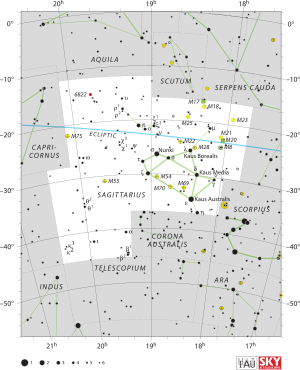
Phi Sagittarius ( φ Sgr ) is a star in the southern constellation Sagittarius . With a visible magnitude of 3.17 [2], the star is one of the brightest in the constellation and is available for observation with the naked eye. Annual parallax measurements gave an estimate of the distance to the object 73 parsecs from the Sun [1] .
| Phi sagittarius | |||
|---|---|---|---|
| Star | |||
 | |||
| Observational data ( Age J2000.0 ) | |||
| Right ascension | |||
| Declination | |||
| Distance | 239 St. years (73 pc ) | ||
| Visible magnitude ( V ) | 3.17 [2] | ||
| Constellation | Sagittarius | ||
| Astrometry | |||
| Radial velocity ( R v ) | +21.5 [2] km / s | ||
| Own movement (μ) | RA: +50.61 [1] Dec: +1.22 [1] | ||
| Parallax (π) | 13.63 ± 0.19 [1] mas | ||
| Absolute magnitude (V) | −1.16 [4] | ||
| Specifications | |||
| Spectral class | B8.5III [5] , B7IV [6] | ||
| Color Index ( B - V ) | –0.11 [7] | ||
| Color Index ( U - B ) | –0.36 [7] | ||
| Variability | |||
| physical characteristics | |||
| Weight | 4–4.2 [8] M ☉ | ||
| Radius | 4.8 [8] R ☉ | ||
| Age | 165 [8] Ma | ||
| Temperature | 14990 [6] K | ||
| Luminosity | 475 [8] L ☉ | ||
| Rotation | 35 km / s [9] | ||
| |||
| Database Information | |||
| SIMBAD | data | ||
According to several studies, the star belongs to the spectral class B8.5 III [5] or B7 IV [6] , the luminosity class III indicates that the star is a giant , and class IV means that the star is a subgiant . Both options show that the star has already run out of hydrogen in the core. Energy is emitted from the outer shell of the star at an effective temperature of 14990 K [6] , which gives the star a white-blue color for stars of spectral class B [11] .
In the past, a star was referred to as spectrally binary stars, a companion object was discovered when the star was covered by the Moon [12] . Nevertheless, the star is most likely single [8] [13] , and stars close in the picture plane are only optical components of the binary.
Name and etymology
In the catalog of the Calendar of Al Ahzazi al-Muakket, the star is called Aoul al Sadirah , which in Latin is written as Prima τού al Sadirah and means the first of the returning ostriches [14] .
In Chinese astronomy, 斗 ( Dǒu ) means Bucket and refers to asterism consisting of φ Sagittarius, λ Sagittarius , μ Sagittarius , σ Sagittarius , τ Sagittarius and ζ Sagittarius . The Chinese name for φ Sagittarius is 斗 宿 一 ( Dǒu Sù yī , the first star of the Bucket ) [15] .
This star, together with γ Sgr , δ Sgr , ε Sgr , ζ Sgr , λ Sgr , σ Sgr, and τ Sgr, constitute the Maker asterism [16] . φ Sgr, σ Sgr , ζ Sgr , χ Sgr and τ Sgr were called Al Naʽām al Ṣādirah (النعم السادرة), Returning ostriches [17] . According to the star catalog in Technical Memorandum 33-507 - A Reduced Star Catalog Containing 537 Named Stars , Al Naʽām al Ṣādirah or Namalsadirah was originally the name for four stars: φ Sgr is known as Namalsadirah I , τ Sgr as Namalsadirah II , χ 1 Sgr as III and χ 2 Sgr as Namalsadirah IV (with the exception of σ Sgr and ζ Sgr ) [18] .
Notes
- ↑ 1 2 3 4 5 6 van Leeuwen, F. (November 2007), " Validation of the new Hipparcos reduction ", Astronomy and Astrophysics T. 474 (2): 653–664 , DOI 10.1051 / 0004-6361: 20078357
- ↑ 1 2 3 Wielen, R .; Schwan, H .; Dettbarn, C. & Lenhardt, H. (1999), "Sixth Catalog of Fundamental Stars (FK6). Part I. Basic fundamental stars with direct solutions", Veroeffentlichungen des Astronomischen Rechen-Instituts Heidelberg (Astronomisches Rechen-Institut Heidelberg). - T. 35 (35): 1
- ↑ 1 2 3 4 Gaia Data Release 2 - 2018.
- ↑ Anderson, E. & Francis, Ch. (2012), " XHIP: An extended hipparcos compilation ", Astronomy Letters T. 38 (5): 331 , DOI 10.1134 / S1063773712050015
- ↑ 1 2 Houk, Nancy (1979), Michigan catalog of two-dimensional spectral types for the HD stars , vol. 3, Ann Arbor, Michigan: Dept. of Astronomy, University of Michigan
- ↑ 1 2 3 4 Zorec, J .; Cidale, L .; Arias, ML & Frémat, Y. (July 2009), " Fundamental parameters of B supergiants from the BCD system. I. Calibration of the (λ_1, D) parameters into Teff ", Astronomy and Astrophysics T. 501 (1): 297 –320 , DOI 10.1051 / 0004-6361 / 200811147
- ↑ 1 2 Johnson, HL; Iriarte, B .; Mitchell, RI & Wisniewskj, WZ (1966), "UBVRIJKL photometry of the bright stars", Communications of the Lunar and Planetary Laboratory T. 4 (99): 99
- ↑ 1 2 3 4 5 Kaler, James B., PHI SGR (Phi Sagittarii) , University of Illinois , < http://stars.astro.illinois.edu/sow/phisgr.html > . Retrieved January 15, 2012.
- ↑ Abt, Helmut A .; Levato, Hugo & Grosso, Monica (July 2002), " Rotational Velocities of B Stars ", The Astrophysical Journal T. 573 (1): 359–365 , DOI 10.1086 / 340590
- ↑ phi Sgr - Star , Center de Données astronomiques de Strasbourg , < http://simbad.u-strasbg.fr/simbad/sim-id?Ident=Phi+Sagittarii > . Retrieved January 15, 2012.
- ↑ The Color of Stars , Commonwealth Scientific and Industrial Research Organization, December 21, 2004 , < http://outreach.atnf.csiro.au/education/s Senior / astrophysics / photometry_colour.html > . Retrieved January 16, 2012.
- ↑ Finsen, WS (April 1951), " The duplicity of phi Sgr ", Astronomical Journal T. 56: 56 , DOI 10.1086 / 106589
- ↑ Eggleton, PP & Tokovinin, AA (September 2008), " A catalog of multiplicity among bright stellar systems ", Monthly Notices of the Royal Astronomical Society T. 389 (2): 869–879 , DOI 10.1111 / j.1365-2966.2008 .13596.x
- ↑ Knobel, EB (June 1895), " Al Achsasi Al Mouakket, on a catalog of stars in the Calendarium of Mohammad Al Achsasi Al Mouakket ", Monthly Notices of the Royal Astronomical Society T. 55: 430 , DOI 10.1093 / mnras / 55.8 .429
- ↑ (Chinese) AEEA (Activities of Exhibition and Education in Astronomy) 天文 教育 資訊 網 2006 年 5 月 11 日
- ↑ Teapot , constellation-guide.com , < http://www.constellation-guide.com/teapot/ > . Retrieved May 13, 2017.
- ↑ Allen, RH (1963), Star Names: Their Lore and Meaning (Reprint ed.), New York: Dover Publications Inc, p. 355, ISBN 0-486-21079-0 , < http://penelope.uchicago.edu/Thayer/E/Gazetteer/Topics/astronomy/_Texts/secondary/ALLSTA/Sagittarius*.html > . Retrieved September 4, 2012.
- ↑ Rhoads, Jack W. (November 15, 1971), Technical Memorandum 33-507-A Reduced Star Catalog Containing 537 Named Stars , Jet Propulsion Laboratory, California Institute of Technology , < https://ntrs.nasa.gov/archive/ nasa / casi.ntrs.nasa.gov / 19720005197_1972005197.pdf >