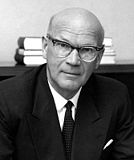
Two-stage presidential elections were held in Finland in 1962. On January 15 and 16, the public elected presidential electors to the electoral college. [1] They in turn elected the president. As a result, the winner was Urho Kekkonen, who won in the first round of voting. [2] The turnout for the popular vote was 81.5%. [3]
← 1956  1968 → 1968 → | |||
| Presidential Election in Finland (1962) | |||
|---|---|---|---|
| January 15 and 16 | |||
 |  | ||
| Candidate | Urho Kekkonen | Paavo Aitio | |
| The consignment | Agrarian Union | Democratic Union of the Finnish People | |
| Votes | 199% | 62% | |
| Election result | Urho Kekkonen | ||
| Portal: Politics |
| Finland |
 Article from the series |
State
|
Executive power
|
Legislature
|
Judicial branch
|
Administrative division
|
Content
History
After Kekkonen’s extremely insignificant victory in the 1956 presidential elections in Finland, his political opponents planned to defeat him in the 1962 elections.
In the spring of 1961, the Social Democrats, the National Coalition Party and the Swedish People’s Party, the Party of Small Farmers and the Liberal League nominated former Chancellor of Justice Olavi Honka as presidential candidate.
The goal of the Honka League was to get the majority of 300 presidential voters and thus defeat President Kekkonen.
At the end of October 1961, the Soviet government sent a diplomatic note to the Finnish government stating that neo-fascism and militarism in West Germany are growing so much that Finland and the USSR are under the threat of an attack by this country or some other NATO member states .
Thus, the USSR asked Finland to hold talks on possible joint military cooperation within the framework of the Finno-Soviet treaty.
The crisis of the note alarmed many Finns, both politicians and ordinary voters. At the end of November 1961, Honka withdrew his candidacy. Then Kekkonen went to the Soviet Union, where the Soviet leader Nikita Khrushchev held brief talks with him and assured those gathered in Novosibirsk that Finland and the Soviet Union continued to maintain good relations, although some Finns try to worsen them, and that joint military exercises are not needed Kekkonen was easily re-elected as president. [4] [5] [6]
Results
Popular vote
| The consignment | Votes | % | Places | |
|---|---|---|---|---|
| Candidacy Urho Kekkonen | Agrarian Union | 698,199 | 31.7 | 111 |
| Finnish People's Party | 165,489 | 7.5 | 21 | |
| Swedish People's Party | 35,599 | 1.6 | 6 | |
| Other | 75,961 | 3.4 | 7 | |
| Electoral Union KOK and KP | National Coalition Party | 288,912 | 13.1 | 37 |
| Finnish People's Party | 11,087 | 0.5 | one | |
| Liberal league | 7,898 | 0.4 | one | |
| Finnish People's Democratic Party | 451,750 | 20.5 | 63 | |
| Social Democratic Party | 289,366 | 13.1 | 36 | |
| Swedish People's Party | 111,741 | 5.1 | 15 | |
| Social Democratic Union of Workers and Peasants | 66,166 | 3.0 | 2 | |
| Other | 36 | 0.0 | 0 | |
| Invalid / blank bulletins | 9,237 | - | - | |
| Total | 2,211,441 | 100 | 300 | |
| Source: Nohln & Stöver | ||||
Electoral College
| Candidate | The consignment | Votes | % |
|---|---|---|---|
| Urho Kekkonen | Agrarian Union | 199 | 66.3 |
| Paavo Aitio | Democratic Union of the Finnish People | 62 | 20.7 |
| Rafael Paasio | Social Democratic Party | 37 | 12.3 |
| Emil Skog | Social Democratic Union of Workers and Peasants | 2 | 0.7 |
| Total | 300 | 100 | |
| Source: Nohlen & Stöver | |||
Notes
- ↑ Dieter Nohlen & Philip Stöver (2010) Elections in Europe: A data handbook , p606 ISBN 978-3-8329-5609-7
- ↑ Nohlen & Stöver, p630
- ↑ Nohlen & Stöver, p624
- ↑ Vihavainen, Timo. Hyvinvointi-Suomi, osio teoksesta Suomen historian Pikkujättiläinen: [ fin. ] . - Porvoo: WSOY, 1987. - p. 840–842.
- ↑ Virrankoski, Pentti. Suomen historia: [ fin. ] . - Porvoo: Suomalaisen Kirjallisuuden Seura. - p. 957–959.
- ↑ Hannu Rautkallio. Novosibirskin lavastus: [ fin. ] . - Helsinki: Tammi, 1992.