The A330 incident over the Indian Ocean is an aircraft incident that occurred on October 7, 2008 . Qantas Airbus A330-303 airliner operated a regular QF72 flight from Singapore to Perth , but 3 hours and 10 minutes after take-off, twice went into uncontrollable sharp decline, which led to injuries to passengers and crew (fractures, lacerations, spinal injuries ) The liner made an emergency landing at Lermont Airport in Exmouth (Western Australia) [1] [2] [3] [4] [5] , where he was met by the Royal Australian Doctors Service and CareFlight [6] [7] .
| Flight 072 Qantas | |
|---|---|
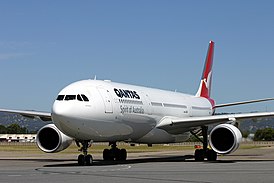 Affected aircraft 3 years and 9 months before the incident | |
| General information | |
| date of | October 7, 2008 |
| Time | 12:42 WST |
| Character | Spontaneous dive |
| Cause | Technical malfunction |
| A place |  Indian Ocean , 154 km from Exmouth ( Australia ) Indian Ocean , 154 km from Exmouth ( Australia ) |
| Coordinates | |
| Dead | 0 |
| The wounded | 119 |
| Aircraft | |
| Model | Airbus A330-303 |
| Aircraft name | Kununurra |
| Airline | Qantas |
| Departure point |  Changi ( Singapore ) Changi ( Singapore ) |
| Destination | Perth ( Australia ) |
| Flight | QF72 |
| Board number | VH-QPA |
| Date of issue | October 11, 2003 (first flight) |
| Passengers | 303 |
| Crew | 12 |
| Survivors | 315 (all) |
Of the 315 people on board the ship (303 passengers and 12 crew members), no one was killed, but 119 people were injured (9 crew members and 110 passengers), 12 of them were seriously injured; 53 people were taken to Perth hospitals, 14 of them by air [8] [9] [10] . Qantas Airlines sent two planes to Exmouth to pick up the remaining passengers and crew [11] [12] .
The causes of the incident were recognized as a malfunction of the first unit of the inertial navigation system and previously unknown software errors on-board computer of the Airbus A330.
Content
- 1 Aircraft
- 2 crew
- 3 Timeline
- 4 Investigation
- 4.1 On-board computer
- 5 Final report of the investigation
- 5.1 Analysis
- 5.2 Reasons
- 5.3 Incident with flight QF71
- 6 Compensation
- 7 Cultural Aspects
- 8 Notes
- 8.1 Comments
- 8.2 Sources
- 9 References
Aircraft
Airbus A330-303 (registration number VH-QPA, serial 553) was released in 2003 (the first flight took place on October 11 under test b / n F-WWKS). On October 31 of the same year, it was transferred to Qantas , in which it received the name Kununurra . Equipped with two General Electric CF6-80E1A3 turbofan engines . On the day of the incident, it made 3740 take-off and landing cycles and flew 20,040 hours [13] [14] .
Crew
The crew of QF72 was as follows [15] :
- The aircraft commander (FAC) is Kevin Sullivan. Very experienced pilot, served in the US Navy . He flew the aircraft Boeing 747 , Boeing 757 , Boeing 767 and Boeing 747-400 . As Airbus A330 commander, since February 17, 2004. 13 592 hours flew (7505 of them as pic), 2453 of them on the A330.
- The co - pilot is Peter Lipsett . An experienced pilot, flew the Boeing 747-400, Boeing 737-300 and Boeing 737-800 . October 7, 2005 was qualified for the commander of the Airbus A330. 11 650 hours flew (2020 of them as pic), 1870 of them on the A330.
- The replacement co-pilot is Ross Hales. In the position of co-pilot of the Airbus A330 - from January 4, 2008. 2070 hours flew, 480 of them on the A330.
9 cabin crew worked in the cabin .
Timeline
Flight QF72 departed from Singapore at 09:32 SST , with 303 passengers and 12 crew members on board. By 10:01, the liner reached the cruising level FL370 (11,300 meters).
3 hours and 8 minutes after take-off (at 12:40:26 WST ), the first inertial navigation system unit (ADIRU 1) in the cockpit began to provide incorrect data to the on-board computer. As a result of this, the autopilot automatically shuts off and after a few seconds the pilots received warning messages about malfunctions, sound delays and speeding. The FAC took control, then switched on the autopilot again and flight 072 leveled off. Then after about 15 seconds the autopilot was disabled by the team and remained disabled until the end of the flight.
At 12:42:27, the liner made a sudden uncontrollable maneuver, abruptly “diving” down; it was subsequently established that the fuselage experienced an overload of −0.8 g [* 1] , a tilt of 8.4 ° and a rapid decrease of 200 meters. 20 seconds later, the pilots were able to return the plane to a predetermined flight altitude.
At 12:45:08 flight 072 made the second uncontrolled maneuver of a similar nature with an overload of 0.2 g [* 2] , a slope of 3.5 ° and a rapid decrease of 120 meters. After 16 seconds, the plane returned to its predetermined altitude [16] [17] . Passengers and crew members (mostly those who were not fastened in) flew around the cabin along with luggage and items in the cabin, often bumping their heads against the ceiling of the cabin and injuring themselves.
At 12:49 the pilots stabilized the plane and sent a distress signal , which at 12:54 was updated to Mayday , when the crew learned about the injuries received by passengers [8] . At 13:50 WST, flight QF72 landed at Lermont Airport in Exmouth (Western Australia).
Investigation
The Australian Transport Security Bureau (ATSB) investigated the causes of the QF72 incident with the support of the Australian Civil Aviation Safety Authority (CASA) , Qantas, the French Civil Aviation Safety Investigation and Analysis Bureau (BEA) and Airbus [3] .
The damaged aircraft was equipped with ADIRU blocks manufactured by Northrop Grumman , which the investigators sent to the manufacturer in the USA for further research [18] [19] . On January 15, 2009, EASA issued an Emergency Airworthiness Directive [20] to address the aforementioned ADIRU A330 and A340 Northrop Grumman problem of incorrect response to a faulty inertial reference.
According to the preliminary report of the ATSB, the malfunction occurred in the first unit of the inertial navigation system (ADIRU 1) and is the “ probable source of the event ”: ADIRU began to provide incorrect data to other aircraft systems [21] [22] [23] .
The initial consequences of the error were [4] :
- false (contradictory) warnings about stalling and overspeeding,
- information about the loss of height on the dashboard from the side of the pic
- A few warnings from the electronic centralized on-board monitor (ECAM) system.
After about 2 minutes, ADIRU 1, which transmitted data to the dashboard from the side of the FAC, provided very high (false) readings of the aircraft angle of attack (AOA), which led to a decrease in the flight control computer that controls the plane of attack by 8.5 ° and the main malfunction flight control computer (FCPC) [4] .
On-board computer
Angle of attack (AOA) is a critical flight parameter, and the systems that the A330 and A340 are equipped with require accurate AOA data to function properly. The VH-QPA was equipped with three ADIRUs for fault tolerance, and the FCPC used three independent AOA values to verify their consistency. In the normal case, when all three AOA values were correct and consistent, the FCPC used the average values of AOA 1 and AOA 2 for their calculations. If AOA 1 or AOA 2 deviates significantly from the other two values, the FCPC uses the stored value for 1.2 seconds. The FCPC algorithm was very efficient, but it could not control the flight correctly, in which there were several peaks in AOA 1 or AOA 2, which were separated by 1.2 seconds.
As with other safety critical systems, the development of the A330 / A340 flight control system from 1991-1992 had many nuances to minimize the risk of design errors. These included peer reviews, system security assessment (SSA), and testing and modeling to verify and validate system requirements. None of these actions revealed a design flaw in the AOA FCPC algorithm.
ADIRU errors were not previously encountered and were not identified by the manufacturer during the safety analysis. In general, the design, validation, and validation processes used by Airbus did not fully take into account the potential impact of frequent emissions of ADIRU values.
Airbus said they were not aware of similar incidents on other planes of the company. Airbus issued an informational publication for the commanders of the A330 and A340 with procedural recommendations to minimize risk in the event of a similar incident [4] .
Final Report of the Investigation
Analysis
After a detailed forensic analysis of the FDR data, the primary flight control computer (FCPC) software and the ADIRU, it was determined that the latter distorted the angle of attack (AOA) data. ADIRU processor mistakenly sent elevation data equal to37 012 (at the time of the incident), instead of the expected data on the angle of attack, which was 50 625. The data type error caused the computer to process high AOA data incorrectly, starting the high-angle protection mode, which sent the command to the flight control system (EFCS) to decrease [24] .
Reasons
The final ATSB report, published on December 19, 2011, concluded that the incident occurred due to a combination of a malfunction in the software of the main flight control computer (FCPC) A330 / A340 and an error affecting one of the three inertial ADIRU units of the aircraft . This meant that in a very rare and specific situation, the angle of attack (AOA) from one of the ADIRUs could cause the FCPC to command the aircraft to decrease [24] .
QF71 Incident
A similar incident occurred on December 27, 2008, with the QF71 Perth — Singapore flight of Qantas airline (also airliner A330-300) northwest of Perth and south of Lermont Airport at 17:29 WST on the FL360 (10,950 meters). The autopilot disconnected and the crew received a warning indicating a problem with ADIRU 1. The crew used the recommendations issued by Airbus and returned to Perth without incident.
The ATSB included this incident in its investigation into the causes of the QF72 incident [25] . This incident again sparked rumors in the media about the connection of the incidents with the communications station of the Navy Harold E. Holt . The Australian and International Association of Pilots called for the prohibition of flying in the area of the signal from the tower as a precaution until additional information is known [26] [27] . The manager of the communication station stated that the influence of signals from the tower is “ very, very unlikely ” for an incident to occur [28] .
Compensation
After the accident with flight 072, Qantas provided compensation to all passengers. The airline announced that it will reimburse the cost of all tickets on the emergency flight, offer a voucher for an amount sufficient for a round-trip trip to London with the class the passengers flew, and also pay for all medical expenses associated with the incident. Further claims for compensation were considered on an individual basis [29] .
Cultural Aspects
- The incident with flight 072 Qantas is shown in the 18th season of the Canadian documentary television series Crash Investigation in the Freefall series [30] .
- In May 2019, Australia published a book by Flight Commander 072 Kevin Sullivan about the incident [31] .
- In June 2019, Sunday Night ( Seven Network ) unveiled Qantas-72 flight events featuring passengers and crew on the flight, including Commander Kevin Sullivan, flight attendant Fuzzy Maiava, and US flight commander Airways-1549 Chesley Sullenberger [32] .
Notes
Comments
- ↑ Normal conditions are +1.0 g. In aircraft in cases like this, overloads can drop to 0, after which weightlessness will appear, and with a further decrease, a negative force arises. At a negative load of −1 g, it is as if a change in gravity occurs and everything falls to the ceiling
- ↑ There was no fall to the ceiling in this maneuver, since there was no negative force, but at the same time weightlessness was felt
Sources
- ↑ Australian Transport Safety Bureau (October 8, 2008). 2008/40 - Qantas Airbus Incident Media Conference . Press release . Checked 2019-07-24 .
- ↑ Australian Transport Safety Bureau (October 9, 2008). 2008 / 40a - ATSB Airbus investigation update . Press release . Checked 2019-07-24 .
- ↑ 1 2 Australian Transport Safety Bureau (10 October 2008). 2008 / 40b - Qantas Airbus Accident Media Conference . Press release . Checked 2019-07-24 .
- ↑ 1 2 3 4 Australian Transport Safety Bureau (October 14, 2008). 2008/43 - Qantas Airbus A330 accident Media Conference . Press release . Checked 2019-07-24 .
- ↑ Siddique . Qantas flight makes emergency landing as dozens of passengers injured , The Guardian (October 7, 2008). Archived on June 17, 2019. Date of treatment October 7, 2008.
- ↑ Knowles . Mayday in WA: Dozens hurt as Qantas jet plunges 8000ft , The West Australian (October 8, 2008). Archived December 11, 2008. Date of treatment March 7, 2009.
- ↑ Weber . Confusion surrounds Qantas emergency landing , AM , Australian Broadcasting Corporation (October 8, 2008). Archived on May 9, 2019. Date of treatment March 7, 2009.
- ↑ 1 2 In-flight upset, 154 km west of Learmonth, WA, October 7, 2008, VH-QPA, Airbus A330-303 - Interim Factual (PDF). Aviation Occurrence Investigation AO-2008-070 . Australian Transport Safety Bureau (March 6, 2009). Date of treatment March 7, 2009. Archived November 23, 2018.
- ↑ Taylor . Computer glitch may have caused Qantas jet plunge (October 8, 2008). Archived on October 10, 2008. Date of treatment October 8, 2008.
- ↑ Australian jet plunge injures 40 , BBC News (October 7, 2008). Archived March 1, 2019. Date of treatment October 8, 2008.
- ↑ Simon Hradecky . Accident: Qantas A333 near Learmonth on 7 Oct 2008, sudden inflight upset injures 74 people on board , The Aviation Herald (October 7, 2008).
- ↑ AO-2008-070: In-flight upset, 154 km west of Learmonth, WA, October 7, 2008, VH-QPA, Airbus A330-303 . Aviation Safety Investigation Report - Preliminary . Australian Transport Safety Bureau (November 14, 2008). Date of treatment November 15, 2008. Archived November 10, 2008.
- ↑ Qantas VH-QPA (Airbus A330 - MSN 553) . Date accessed July 26, 2019. Archived July 26, 2019.
- ↑ VH-QPA Qantas Airbus A330-300 . Date accessed July 26, 2019. Archived July 29, 2019.
- ↑ Sunday Night: How a routine Qantas flight became a nightmare . news.com.au. Date accessed June 17, 2019. Archived July 8, 2019.
- ↑ In-flight upset, 154 km west of Learmonth, WA, October 7, 2008, VH-QPA, Airbus A330-303 unspecified . Australian Transport Safety Bureau (November 14, 2008). Date of treatment November 15, 2008. Archived October 22, 2009.
- ↑ Nicholson . Data shows Qantas jet in two sudden plunges , The Age (October 9, 2008). Archived November 2, 2012. Date of treatment October 8, 2008.
- ↑ Computer error behind Qantas midair drama , Australian Broadcasting Corporation (October 14, 2008). Archived on October 16, 2008. Date of appeal October 15, 2008.
- ↑ Steve Creedy . US tests on false data sent on Qantas jet over WA , The Australian (October 17, 2008). Archived on October 17, 2008. Date of treatment October 16, 2008.
- ↑ Emergency Airworthiness Directive No 2009-0012-E Archived on February 5, 2009.
- ↑ Computer glitch may be behind Qantas incident: ATSB , Australian Broadcasting Corporation (October 8, 2008). Archived on October 28, 2008. Date of treatment October 8, 2008.
- ↑ Qantas flight advanced computer 'irregularity' , The Australian (October 8, 2008). Archived on October 9, 2008. Date of treatment October 8, 2008.
- ↑ RICHARD SHEARS . Computer fault may have caused Qantas jet to plunge 8,000ft, say investigators , Daily Mail (October 8, 2008). Archived March 5, 2016. Date of treatment December 8, 2015.
- ↑ 1 2 In-flight upset - Airbus A330-303, VH-QPA, 154 km west of Learmonth, WA, October 7, 2008 . Date accessed July 24, 2019. Archived February 1, 2017.
- ↑ Australian Transport Safety Bureau (2 January 2009). Qantas Airbus A330 incident, 480km North West of Perth on December 27, 2008 . Press release . Checked 2019-07-24 .
- ↑ Catanzaro . Navigation failure again hits Qantas in north-west , The Age (2 January 2009). Archived March 4, 2016.
- ↑ Call for no-go zone after another Qantas forced landing , The Age (2 January 2009). Archived January 6, 2009. Date of treatment January 2, 2009.
- ↑ Hopkin . Exmouth interference 'unlikely' , The Sydney Morning Herald (January 7, 2009). Archived on November 3, 2012. Date of treatment January 7, 2009.
- ↑ Bibby . Qantas compo depends on class of seat , The Sydney Morning Herald (October 9, 2008). Archived on November 3, 2012. Date of treatment October 9, 2008.
- ↑ Air Crash Investigation - National Geographic . nationalgeographic.com.au . Date of treatment June 21, 2018. Archived on April 2, 2019.
- ↑ Sullivan, Kevin: No Man's Land: the Untold Story of Automation and QF72 Archived June 8, 2019 on the Wayback Machine . ABC Books, 2019
- ↑ QF72 | Hero pilot Kevin Sullivan's quick thinking saves 315 people | Sunday Night . Youtube (June 3, 2019). Date of treatment June 5, 2019. Archived June 12, 2019.