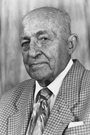
Dragoslav Avramovich ( Serb. Dragoslav Avramovi ; October 14, 1919 , Skopje , Kingdom of Yugoslavia - February 26, 2001 , Rockville (Maryland) , USA ) - Yugoslav and Serbian economist , financier , manager of the National Bank of the Federal Republic of Yugoslavia (2.3.1994 - 15.5.1996 ) Doctor of Economic Sciences. Full member of the Serbian Academy of Sciences and Arts (1994).
| Dragoslav Avramovich | |
|---|---|
 | |
| Date of Birth | |
| Place of Birth | |
| Date of death | |
| Place of death | |
| A country | |
| Occupation | |
| Autograph | |
Biography
He graduated from the Faculty of Law at the University of Belgrade . In 1956 he received a doctorate in economics.
Head of the group of experts on the mobilization of foreign funds (from 1946 to 1951), from 1951 to 1953 - adviser to the National Bank of Yugoslavia. From 1953 to 1977 he worked as an economist at the International Bank for Reconstruction and Development .
Director-General, Department of General Studies, World Bank . In 1980-1984, he worked as an adviser to the Secretary-General of the UNCTAD UN Conference on Trade, Economic Cooperation and Development of Developing Countries ( Geneva ); in 1984-1988 - Economic Advisor to the Bank for Trade and Development ( Washington ).
The author of more than 50 scientific publications and a large number of works in the field of economics and finance.
From March 2, 1994 to May 15, 1996 - Governor of the National Bank of the Federal Republic of Yugoslavia .
The author of the monetary program for the reconstruction and economic recovery of the Federal Republic of Yugoslavia , which stopped hyperinflation, introduced a new dinar , the rate of which was equated with the German mark, had a gold and foreign exchange basis and was freely converted. He was the main coordinator of the preparation and implementation of the economic, social and financial program in 1995-1997.
Under his leadership, investment projects were developed in infrastructure, water management, electric power, public transport and a number of other industries. Foreign companies got the right to invest in almost any company in the FRY, to have a controlling stake in them or to be the sole owner, to export the profits or reinvest them in the Yugoslav economy.
Since the start of the program, the National Bank has played a major role in ensuring financial stability. The economic recovery of the country was accompanied by the introduction of a new and effective tax system, which was called, in particular, to legalize the shadow economy, which had previously acquired considerable size in conditions of galloping inflation.
Expenditures on health, science, education, state administration and the army were drastically reduced. Financing of these industries and structures was carried out based on the real capabilities of the economy. Significant modernization and reduction were made in government. Social facilities previously assigned to enterprises were transferred to the balance of state and local government.
Through the adoption of federal laws on the transformation of property relations, concessions and foreign investment, the possibilities for economic development were significantly expanded, and a significant approximation of domestic legislation to European Union standards was achieved. As a result, despite all the political difficulties, in the last few years in the FRY high rates of economic development have been noted. According to the growth rate of the gross national product, which amounted to 7.8% in 1997, Yugoslavia was among the fastest growing countries.
Thus, in the extremely unfavorable conditions generated by international sanctions, the FRY managed to maintain large companies and infrastructure, considering them as the basis for future economic development and integration into the European and international community. Small and medium-sized businesses have received significant development.
He was relieved of his post after refusing to issue additional money supply to save state-owned companies from bankruptcy . As an alternative, he proposed to carry out additional market economic reforms.
After his resignation as head of the National Bank, he criticized the economic policies of the government and personally Slobodan Milosevic . His popularity with residents of the Federal Republic of Yugoslavia and his critical stance towards Milosevic made him a symbolic leader of opposition parties. In 1996, D. Avramovich was unable to act as the leader of the Zayedno opposition coalition in the local federal elections due to health problems.
In the presidential election of Yugoslavia on September 24, 2000, he was one of two candidates together with Vojislav Kostunica from the Democratic Opposition of Serbia (DOS) coalition. Refused to run for election due to health and age.
He died on February 26, 2001 in Rockville, Maryland, USA. He was buried at the New Cemetery in Belgrade .
Notes
- ↑ BNF ID : 2011 Open Data Platform .
- ↑ Record # 12070745s // general catalog of the National Library of France
Links
- Dragoslav Avramoviћ (Serb.)
- Dragoslav Avramoviћ (Serb.)