Vitebsk war - a conflict (or series of conflicts) in the territory of the Grand Duchy of Lithuania . In the chronicles and works of researchers, the causes, course and sequence of conflict events differ. According to one version (dating back to the “ Bykhovets Chronicle ”) it happened in 1392-1393 [1] / 1391 - May 1393 [2] ; according to another (dating back to the chronicle, Matey Stryikovsky ) continued until 1396 (and consisted of two episodes when Svidrigailo captured Vitebsk ). Vytautas won the conflict, and Svidrigailo was captured and sent to Jagail . The specific Vitebsk principality was liquidated.
| Vitebsk war | |||
|---|---|---|---|
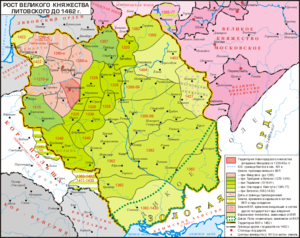 Grand Duchy of Lithuania at the beginning of the 15th century | |||
| Cause | centralization policy of Vytautas | ||
| Total | Victory of Vytautas, Principality of Vitebsk turned into governorship. | ||
| Opponents | |||
| |||
| Commanders | |||
| |||
Content
- 1 Background
- 2 war
- 2.1 Data from chronicles and research of the XV — XVI centuries
- 2.2 In the works of modern researchers
- 3 notes
- 4 Literature
- 4.1 Chronicles and research of the XV — XVI centuries
- 4.2 Research
Background
According to the Bykhovets chronicle, Svidrigailo received in the specific possession of the cities of Vitebsk and Krevo after the death of his father Olgerd [3] . ESBE claimed (probably confusing it with Skirgailo ) that by 1392 he owned Polotsk [4] . “World History - in 24 volumes” writes that Vitebsk was the widowed lot of Princess Ulyana and after her death (1391 [5] / 1392 [6] [7] / 1393 [8] ) the son “Yakov Vitebsky” was to receive [8] . Turchinovich I.V. claimed that Ulyana transferred the Principality of Vitebsk to the administration of Svidrigailo during her lifetime [9] .
In 1392, Jagiello made peace with Vytautas and appointed him viceroy in the Grand Duchy of Lithuania [10] . Having become the Grand Duke Vytautas began to strengthen his power in the principality and this led to several conflicts, one of which was the war for Vitebsk.
War
Data from chronicles and research of the XV — XVI centuries
The chronicle of Jan Dlugosh does not write about the fact that Svidrigail was sitting in Vitebsk and about the conflict with the falconer Fedor Vesna. And Svidrigaila and Vytautas calls the reasons for the war that began in 1392 the “evil envy”: Jagaila chose to appoint a cousin bypassing his relatives as the Lithuanian prince [11] . And if Skirgailo was preparing a “rebellion” against this, then Svidrigailo fled to the crusaders in 1392 and in 1394 in the retinue of the master Konrad von Jungingen participated in the campaign against Lithuania and the siege of Vilna [12] .
Bykhovets chronicle, not always indicating dates, described the development of events in a different way. When Vytautas became the Grand Duke of Lithuania, he met resistance only at Koribut [13] . And the conflict with Svidrigailo began after Jagiello gave the city of Vitebsk to his falconer . Svidrigailo kills Spring and by the will of Jagiello Vitovt and Skirgailo besiege Orsha, Vitebsk and force him to surrender and submit [14] .
Matei Stryikovsky, who used in his chronicle the work of Dlugosh, Mehovsky , Cromer, described the events in a slightly different way. He wrote that shortly after Skarigailo and Svidrigailo, dissatisfied with the appointment of "in 1392" Vytautas the Lithuanian prince, began to prepare for war. Skirgailo, “who was [the husband] of great courage and fiery heart and also had great treasures”, gathered troops, and Svidrigailo “was neither so brave nor so powerful, besides he had less means, treasures and was not particularly popular among his own ”ran for help to Prussia to the new master Konrad Jungingen. Svidrigailo with the crusaders "in 1393" took the castles of Surazh, Grodno and Stramele (owned by Vitovt) and captured three thousand people. In this situation, Jagiello reconciled Vytautas with Skirigailo, and the latter, having gone to negotiations, received a great lot. [15] “In 1394,” Svidrigailo and the crusaders besieged Vilno for two months. [16] Matei Stryikovsky, in the chapter between the events of “1394” and “1396,” put a quote from Cromer that Svidrigailo was reconciled with Jagiello and promised not to disturb Vytautas , received feeding Podolsky (bought from the sons Tryka Melshtynsky ) land. But he does not specify that Spytko from Melshtyn died in 1399 in Vorskla [17] . In a chapter dated 1396, he wrote that Svidrigailo, “being a fugitive in Prussia”, ruined Lithuania together with the crusaders, moreover, with reference to Dlugosh and Kromer, he indicates that in the campaign “1403 years” (“on the day of St. Dorothea”) he participated as Master Conrad Jungingen. These events forced Jagiello to make peace with Svidrigailo, who received the inheritance of Podolsk and Zhydachiv lands, as well as castles with counties: Stryi, Sidlov, Stobnitsa, Drugnya and Uysce, and he was also assigned payments in the form of one thousand four hundred hryvnias in royal zhups. He promised not to disturb Vytautas. But the promise was broken, since “soon” Princess Ulyana died (sources date back to 1391/1392/1393, that is, before the battle in Vorskla, where the previous owner of Podolia died). Jagiello appointed Fedor Vesna as viceroy of Vitebsk. Svidrigailo flees to Prussia, and then Livonia and captures Vitebsk, Orsha and other lands. Vytautas returns Orsha, Drutz, Vitebsk and, capturing Svidrigailo, sends him to Jagaila. Svidrigailo escaped from prison, in which he sat for several years. And then King Jagello or Vytautas caught him and put him in Kremenets. From where Svidrigailo was released at night on Good Friday "1418." All this information is indicated in a chapter dated 1396 [18] .
In the works of modern scholars
In 1392 [19] / 1393 [8] , the new Grand Duke of Lithuania Vytautas, who ruled in 1392-1430, decided to annex Vitebsk to the Grand Duchy and appointed his deputy, falconer , the favorite of Jagiel [8] [20 ] ] . Svidrigailo easily captured Vitebsk and killed Spring. Drutsk and Orsha crossed over to his side. Vytautas, having received help from Poland under the command of Skirgailo, first moved to Drutsk. The local princes took the oath of vassal submission to Vytautas. For this, Vytautas left behind the Drutsk princes all their former possessions, but already as a grant to the Grand Duke. [8] . Koribut who did not want to support Vytautas against Svidrigailo lost Novgorod-Seversky [21]
Then Vitovt forced Orsha to capitulate after a two-day siege, left his viceroy in it [8] , replenished his army with troops from Drutsk and Orsha and besieged Vitebsk, in which Svidrigailo was located. Yuri Svyatoslavich Smolensky came to the aid of Vitovt. After a four-week siege, the Allies occupied the Lower Castle and began to prepare for the assault on the Upper Castle, but the Vitebsk residents surrendered as they ran out of food. The Principality of Vitebsk was turned into governorship [8] . E. Gudavičius and the Great Russian Encyclopedia dated 1392–1393 [22] to the war for Vitebsk, and F. Shabuldo 1391 - May 1393 [23]
"World History - in 24 volumes", the ESBE, following the Chronicle of Matey Stryikovsky, claimed that Svidrigailo fled (or "was ousted") into the possession of the Teutonic Order from where he began to raid [8] [24] .
E. Gudavichus, A Barbashev, BDT following the Bykhovets Chronicle wrote that in 1393, after the fall of Vitebsk, Svidrigailo surrendered to Vitovt and was sent to Krakow, to the court of Jagiello [7] [25] . M. Grushevsky writes like Matey Stryikovsky that in 1393 he sent in shackles ( Ukrainian kaydans ), E. Gudavichus, A Barbashev, BDT do not write about shackles.
Jagiello had mercy on his rebellious brother and released him from custody [26] [27] .
I. Turchinovich wrote in a book in 1857 that “in 1393” Svidrigailo surrendered received Kreva. But after Matey Strykoysky, the author spoke of a new war for Vitebsk: “In 1393” he fled to the crusaders and in 1396 the prince with a detachment of Livonian crusaders, passing through the Pskov lands, captured Vitebsk a second time. Residents of the city, who retained sympathy for him, opened castle gates in front of Svidrigail and recognized them as their prince. Vytautas embarked on a new campaign to Vitebsk. The townspeople again desperately defended their city. After a thirty-day siege, the Lower Castle was taken by storm. Svidrigailo with the defenders and residents retreated to the Upper Castle. A lot of people gathered there, and Svidrigailo decided to take people out of the castle. While they left the castle, the Lithuanian army burst into the open gate. [28] The city fell, Svidrigail's supporters were executed, the prince himself was sent in shackles to Krakow, but Jagiello once again had mercy on his younger brother. [29] .
A. Kotzebue in the book of 1835 built a different chronology. After the appointment of Vytautas, Svidrigailo fled to the crusaders and in 1393 devastated Lithuania with them, capturing 3,000 people. In 1394 he led them in the siege of Vilna [30] In 1396, Vitebsk was captured from Livonia where he killed the “favorite of Jagaila”. And Orsha and the surrounding area join Svidrigaila. But Vytautas occupies Orsha and forcing the Princes of Drutsk and Smolensk to join him [31] for a month besieging Vitebsk. Due to hunger, the Livonian army issues Svidrigailo and Vytautas sends that Jagaille [32] . But Jagiello frees his brother. According to Kotzeb’s reference to the letter from the commander of the Dinaburg Grandmaster of the Teutonic Order, this happened due to the intervention of the Princes of Drutsky, George Smolensky , and possibly Prince Ryazansky . Kotzebue assumed that Svidrigailo joined the army of "George Smolensky" devastating the vicinity of Orsha. And this is precisely what forced Jagiel to transfer his brother Podillia to his brother [33] .
E. Gudavichus, describing the crusader wars in 1392–1396, speaks of the siege of Vilnius in August 1394 (but Svidrigailo does not name it), only Vitebsk (without mention of the order) indicates in 1392-1393 [34] .
Notes
- ↑ Gudavičius E. p. 197; Great Russian Encyclopedia: Svidrigailo
- ↑ F. Shabuldo p. 139
- ↑ Chronicle of Bykhovets 64
- ↑ ESB: Svidrigailo
- ↑ L. Voitovich;
- ↑ BDT
- ↑ 1 2 Barbashev A.I. , 1885 , S. 69.
- ↑ 1 2 3 4 5 6 7 8 Badak, A.N. et al. , 1999 , T. 9. The beginning of the revival, Ch. 3. Ukraine, Belarus and the Baltic states in the 14-15 centuries, S. 575.
- ↑ Turchinovich I.V. , 1857 , S. 100.
- ↑ Lubavsky Essays on the History of Lithuanian-Russian ... 49
- ↑ Dlugosh. Year 1392
- ↑ Dlugosh. Year 1393; Year 1394
- ↑ Chronicle of Bykhovets 63-64
- ↑ Chronicle of Bykhovets 64-65
- ↑ Matei Stryikovsky. Book 14. Chapter One. Vitolt Alexander Keystutovich, Prince of Lithuania, Zhmudsky and Russian. Year 1392
- ↑ Matei Stryikovsky. Book 14. Chapter One. About the war of Lithuania and the extraction of Vilna Svidrigail with the crusaders. Year 1394; I am Dlugosh. History of Poland 1394
- ↑ Matei Stryikovsky. Book 14. Chapter Three A Longer Evidence of Podolia
- ↑ Matei Stryikovsky. Book 14. Chapter Four. On the reconciliation of Jagello with Svidrigailo ... Year 1396
- ↑ E. Gudavičius. History of Lithuania from Ancient Times to 1569. - Volume I. p. 197
- ↑ Chronicle of Bykhovets 64
- ↑ Gudavičius E. p. 197
- ↑ Gudavičius E. p. 197
- ↑ F. Shabuldo p. 139
- ↑ ESBE: Svidrigailo; Matey Stryikovsky. Book 14. Chapter One. Vitolt Alexander Keystutovich, Prince of Lithuania, Zhmudsky and Russian. Year 1392
- ↑ BDT: Svidrigailo; E. Gudavicius p. 197; Chronicle of Bykhovets. 65
- ↑ Barbashev A.I. , 1885 , S. 70.
- ↑ BDT: Svidrigailo
- ↑ Turchinovich I.V. , 1857 , S. 102.
- ↑ Turchinovich I.V. , 1857 , S. 103.
- ↑ A. Kotzebue p. 40
- ↑ A. Kotzebue p. 41
- ↑ A. Kotzebue p. 42
- ↑ A. Kotzebue p. 43-44
- ↑ E. Gudavicius p. 197, 200–203
Literature
Chronicles and research of the XV — XVI centuries
- Jan Dlugos Chronicle
- Matei Stryikovsky Chronicle of Polish, Lithuanian, Zhmud and all of Russia
- Bykhovets Chronicle
Research
- Badak A. N., Voynich I. E., Volochek N. M., Vorotnikova O. A., Globus A. et al. World History - in 24 volumes - Mn. : "The modern writer", 1999.
(T. 9: The beginning of the Renaissance: historical literature. - 591 p.: Ill. - ISBN 9854562972 ). - Barbashev A.I. Vitovt and his politics before the Battle of Grunwald (1410). - SPb. , 1885.
- BDT: Svidrigailo
- Leonty Voitovich Princely Dynasties of Eastern Europe
- Grushevsky M.S. History of Ukraine-Russia. - К. , 1913. - ISBN 5120024688 . (Ukrainian)
- Gudavičius E. History of Lithuania from Ancient Times to 1596. - M., 2005.
- Kotzebue, Augustus . Svidrigailo, Grand Duke of Lithuania. - St. Petersburg: Printing House of the Medical Department of the Ministry of Internal Affairs, 1835. - S. 28-139. - 13+ 236 + 44 + 30 s.
- Lyubavsky M.K. Essay on the history of the Lithuanian-Russian state up to and including the Union of Lublin. - Moscow: Moscow Art Printing House, 1915. - 401 + 5 p.
- Shabuldo F. M. Land of South-Western Russia as part of the Grand Duchy of Lithuania / ed. F.P. Shevchenko. - Kiev: Naukova Dumka, 1987 .-- 182 p. - 3000 copies.