Amazonsaurus [1] (literally: Amazonian pangolin) - a genus of dinosaurs - zavropodov from the family Rebbachisauridae , who lived in the early Cretaceous period on the territory of modern South America . It was a four-legged, long-necked herbivorous dinosaur.
| † Amazonsaurus |
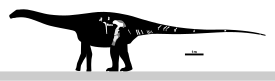
reconstruction |
| Scientific classification |
|---|
| No rank : | Bilateral symmetric |
| Infraclass : | Archosauromorphs |
| No rank : | Archosauriformes |
| Suborder : | † Zavropodomorfy |
| Infrastructure : | † Zauropods |
| Superfamily : | † Diplodocoidea |
| Family: | † Rebbachisauridae |
|
| International Scientific Name |
|---|
Amazonsaurus
Carvalho et al. , 2003 |
| Single species |
|---|
† Amazonsaurus maranhensis
(Carvalho et al. , 2003) |
Geochronology125—100 Ma | million years | Period | Era | Eon |
|---|
| 2.588 | Even | | | Ka | F
but
n
e
R
about
s
about
th | | 23.03 | Neogene | | 66.0 | Paleogene | | 145.5 | a piece of chalk | M
e
s
about
s
about
th | | 199.6 | Yura | | 251 | Triassic | | 299 | Permian | P
but
l
e
about
s
about
th | | 359.2 | Carbon | | 416 | Devonian | | 443.7 | Silur | | 488.3 | Ordovician | | 542 | Cambrian | | 4570 | Precambrian |
◄ Nowadays◄ Cretaceous-Paleogene extinction◄ Triassic extinction◄ Perm mass extinction◄ Devonian extinction◄ Ordovician-Silurian extinction◄ Cambrian explosion |
|---|
|
The amazonzavr had a body structure characteristic of all the young people: a long tail, a long neck and a small head. This lizard was relatively small for the grassroots - it reached about 12 meters in length and weighed about 5 tons. [2]
The high spinous processes of the caudal vertebrae show that the amazonzavr belongs to cvropropodam diplodoid, however, because the only discovered remains are too fragmented, it is difficult to pinpoint the position of Amazonsaurus maranhensis in the Superfamily Diplodocoidea . However, some features of the structure of the vertebrae suggest that amazonzavr may belong to the preserved line of basal eupropods. At least one published pantry analysis shows that amazonzavr is more detached than rebye's , but is basal in relation to such families as Dicraeosauridae and Diplodocidae . [3]
Despite the fact that many dinosaurs were discovered in South America, the Amazonasaur is the first lizard whose remains were found in the Amazon . The name of the genus was given in honor of the Amazon River, or rather, in honor of the Amazonia region ( en: Amazônia Legal ). The only species, Amazonsaurus maranhensis , was named after the Brazilian state of Maranhão . Brazilian paleoanthologists Ismar de Souza Carvalho and Leonardo dos Santos Avilla, as well as their Argentine counterpart Leonardo Salgado, gave the name and family and mind.
Amazon remains, including some dorsal and caudal vertebrae, as well as pelvic fragments, are the only fossils of dinosaurs found in the Itapekuru formation in Maranhão. This formation dates from the Cretaceous period, from Apte to Alba , that is, about 125 to 100 million years ago. Amazonsaurus was found in sediments that were identified by geologists as floodplain meadows in the river delta.
