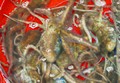
Octopus minor - a species of octopus of the genus Real octopuses . The species was described by Japanese zoologist (1883-1927) in 1920.
| Octopus minor |
 |
| Scientific classification |
|---|
| No rank : | Bilateral symmetrical |
| Superfamily : | Octopodoidea |
|
| International scientific name |
|---|
Octopus minor Sasaki , 1920 |
|
It lives off the coast of Japan , China and the Korean Peninsula ( South Korea ), in the Japanese and Yellow Seas, in the northwestern Pacific Ocean , at depths of up to 200 meters. Sizes up to 70 centimeters, usually 30 centimeters. The color is from dark gray to light gray; at the moment of danger it takes on a dark red color. The size of the mantle is up to 8 centimeters. It lives on a clay and sandy bottom. It feeds on crustaceans. Typically, the bait is small live crabs. ) species. After spawning and incubation of eggs, soon after the emergence of young from eggs, as a rule, the female dies. For breeding, the male attracts the female. During mating, the male holds the female with his hand, and introduces spermatophores with the hectocotyl into the mantle cavity of the female, where fertilization takes place. The young live for some time at the planktonic stage, until they grow up and begin to lead a benthic (bottom) lifestyle [1] .
Bilaterally symmetrical, highly organized mollusk. The body is clearly divided into arms, a head and a bag-like body. The rest of the shell is completely lost. The foot characteristic of the mollusks is transformed into a funnel and hands. Hands 8 are conical tentacles equipped with suction cups over their entire inner surface. Hands at the base are connected by a membrane (umbrellas). Suction cups are arranged in two rows, antennae and fins are absent. Suction cups are devoid of horn rings and stems; they are attached directly to the inner surfaces of the hands with their bases. The funnel is a conical tube, with a narrow end directed forward and outward, and with a wide base - back and into the mantle cavity. The funnel is used for swimming. The body is clad on all sides by a mantle, growing to it on the dorsal side and separated by a mantle cavity on the ventral side. In the mantle cavity there are gills, the anal and genital openings also open there. On the head are very complex and highly organized eyes, equipped with a cornea, iris, lens, vitreous body and a very sensitive retina. Radula is well developed. The pharynx is armed with powerful chitinous jaws, more accurately and lower, in the form reminding a parrot's beak. The ducts of the salivary glands flow into the oral cavity. An internal skeleton is developed, represented by cartilaginous formations that protect the head accumulation of the ganglia, eyes and statocysts in the form of a head capsule. Eggs attach to bottom objects. Fertilization is internal. The role of the copulative organ is performed by two altered arms, called hectocotyls. Gluttonous predator. A great swimmer, but prefers to lie for a long time at the bottom, quickly leaving him in a moment of danger or in pursuit of prey [2] .
It is an important fishing object [2] . It is eaten in China, Korea and Japan.
Caught Octopus Octopus minor
Octopus minor octopuses on the market in the Republic of Korea
Nakithan ( box 낙지탕 , wheat noodle and octopus soup)
Sannakchi (chopped octopus before serving)
Nakchijot ( cor. 낙지 젓 , salted octopus)