“The living space of Finland” ( Finnlands Lebensraum ) [1] is a book written by the historian Eino Utikkala , the geographer Väinö Auer, and the ethnographer Kustaa Vilkuna , which was published in 1941 by order of the Finnish State Intelligence Service dealing with issues of military propaganda [2] .
| Finland living space | |
|---|---|
| Finnlands lebensraum | |
 | |
| Genre | propaganda |
| Author | Väinö auer Eino jutikkala Kustaa Vilkuna |
| Original language | |
| Date of first publication | 1941 |
| Publisher | Alfred Metzner Verlag , Berlin |
Content
The content and purpose of the book
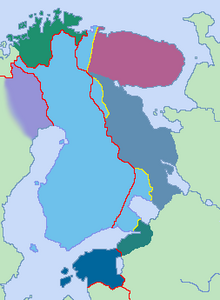
Its purpose was to scientifically substantiate the territorial claims of Finland on the lands of the Karelian-Finnish SSR and most of the Leningrad region (Inkerimaa), which was supposed to be the concept of the so-called “ Great Finland ”, which was popular in Finland’s right-wing circles [3] [4] [4] [ 5] . Such a justification was supposed to lead in three directions, proving the geographical, cultural and demographic proximity of these territories to Finland [6] . The argument for the seizure of areas to the south and east of the Soviet-Finnish border was, in particular, the rapid growth of the population of pre-war Finland, which corresponded to the aspirations of Germany , which served as one of the reasons for the outbreak of war against the USSR [7] .
The content of the book was coordinated with the Eastern policy of Nazi Germany and approved by the Ministry of Propaganda and the Ministry of Foreign Affairs of the Third Reich . Taking into account these circumstances, the original title of the book was changed from “Geographical and historical Finland” ( German: Das geographische und geschichtliche Finnland ) to “The living space of Finland”, and quotes from Adolf Hitler's speeches were added to the text. The preface for her was the Finnish anthropologist Yuryo von Gronhagen , who was at that time an employee of Anenerbe and a representative of Finnish intelligence in Berlin , who himself studied Finnish Karelia in the 1930s [8] . In 1942, the authors of the book personally traveled to Berlin to promote it in Germany [9] . According to the Finnish historian Ohto Manninen, and according to the later testimony of one of its authors, E. Utikkala, the initiative to write the book belonged to the President of Finland Risto Ryti [7] .
Along with this book, another propaganda publication was published by the historian Yalmari Yakkola , The Eastern Question of Finland ( German Die Ostfrage Finnlands ), justifying the annexation of Karelia and the Kola Peninsula . This edition has been translated into Swedish , French and English [10] .
Ratings
After the war in the 1970s, the book was subjected to sharp criticism for its manipulations and violation of scientific ethics , although its authors successfully merged into the post-war scientific environment [11] . Responding to the accusations made in the press, co-author of the book E. Utikkala argued that the publications of the intelligence department in wartime were the means of propaganda and were compiled on top of a political order. In addition, Utickala confirmed the existence of an unpublished redaction of this book, where, in addition to claims to Soviet territories, rights to the north-east of Norway , inhabited by Finnish kvens , were also claimed [12] .
See also
- Living space in the East
- Ost Master Plan
- Finnish "brotherly war"
- Soviet-Finnish War (1939–1940)
Notes
- ↑ Profile on Google Books
- ↑ Arnstad, Henrik: “Finland ljuger om nazismen” Svenska Dagbladet, November 26, 2006
- ↑ Poikonen, Jaakko "Suur-Suomea perustamassa" Poleemi 4/2006, pp. 24-27 (in Finnish)
- ↑ 1 2 Arnstad, Henrik: “Finskt livsrum” Dagens Nyheter, September 10, 2008
- ↑ Laura Hollsten. Väinö Auer, The National History, and The Big History // Åbo Akademi.
- ↑ Davidov, Veronica, 1978-. It’s a lively night for its cultural survival . - North York, Ontario, Canada. - xxi, 130 pages p. - ISBN 9781442636194 , 144263619X, 1442636181, 9781442636187.
- ↑ 1 2 Manninen, Ohto. Suur-Suomen ääriviivat. - 1980. - P. 228.
- ↑ Poikonen, Jaakko "Suur-Suomea perustamassa" Poleemi 4/2006, pp. 24-27 (in Finnish)
- ↑ Valta, Reijo: "Kongosta Suomelle siirtomaa?" Pois työpöydältä, 25.8.2009.
- ↑ Nygård, Antti-Jussi: Castor: Suomi-Eesti (1942). Agricola. Viitattu 11/11/2013.
- ↑ Thorsten Nybom. Has there ever been a Finnish-German common destiny? “Balticworlds.com ( Unsolved ) . balticworlds.com. The appeal date is July 17, 2019.
- ↑ Poikonen, Jaakko "Suur-Suomea perustamassa" Poleemi 4/2006, pp. 24-27 (in Finnish)