The White Factory ( Polish: Biała Fabryka ; also the White Factory of Geyer , Biała Fabryka Geyera ) is a classicist building in the city of Lodz , Poland , built in 1835-1839. Initially, it housed a textile factory owned by German industrialist Ludwig Ferdinand Geyer . Currently, it houses the Central Textile Museum in Lodz and the Garnam Folk Dance Ensemble. The White Factory is considered one of the most remarkable examples of early industrial architecture in Lodz [1] . The building is located in the southern part of Petrkovskaya street, south of the geographical center of the city.
| Sight | |
| White factory | |
|---|---|
| polish Biała fabryka | |
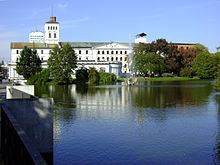 Factory complex, view from the south side | |
| A country |  Poland Poland |
| Location | Одódзь |
| Architectural style | classicism |
| Building | 1835 - 1839 |
| Status | protected by the state |
| Site | |
History
In the first half of the 19th century, Lodz, which was part of the Kingdom of Poland , was a relatively small city. Nevertheless, rapid economic and industrial development began here. The city was open to migrants from countries of Central Europe , as well as other regions of Poland and the Russian Empire. Ludwig Geyer, a German from the Kingdom of Saxony , moved to the city to organize textile production here. The building was built in the years 1835-1839, and then repeatedly reconstructed. Somehow, it still retains its original architectural plan. In the people it became known as the "White Factory" - unlike other later urban buildings, the building was completely plastered. At the end of 1838, Ludwig Geyer installed the first steam engine in Poland with a capacity of 60 hp in the White Factory. Thus, the mechanization of the textile industry began in the city. During the construction of the factory complex, Geyer took the help of the Russian government. He received a soft loan of 400,000 zlotys from the Polish Bank . In addition, he received 175,769 zlotys for a mortgage loan and 24,230 zlotys for a city loan. Together with his own capital, this enabled him to launch in 1839 the most modern textile factory in the entire Kingdom of Poland [2] .
In 1955, the city government decided to place textiles in the building of the Central Museum. In 1958, work began on the reconstruction of the White Factory, which made it possible to adapt the building to the needs of the museum. Finally, in 1960, he began his work. At the same time, the building, namely its eastern wing, was still used as a textile workshop until 1990, when production here was completely discontinued. This wing was transferred to the museum in 2002; Thus, the entire architectural complex was in the hands of the textile museum [1] .
The White Factory is a four-wing building with a courtyard. The oldest wing is the western one, facing Petrkovskaya Street. The north wing was built in 1838, the south - in 1847. The eastern wing, the latest of the four, was erected much later, in 1886. In the courtyard of the building is the Old boiler house. The factory complex also has a high pipe, two towers for dust exhaust and two more water towers. In general, such a complex was a very unusual architectural solution for the first half of the 19th century. Not far south of the building a pond was broken [1] . Next to the White Factory, on the territory that used to also serve as an industrial site, in 2009 the лодódз Forest Architecture Museum was opened in the open [3] .
In 2015, the White Factory was officially declared an object of cultural heritage of Poland [4] .
Notes
- ↑ 1 2 3 Oko. The White Factory (link not available) . Central Museum of Textiles. Date of treatment September 19, 2013. Archived November 17, 2016.
- ↑ Rynkowska A., Ulica Piotrkowska , wyd. I, Łódź: Wydawnictwo Łódzkie, 1970, ISBN 978-83-939822-4-0.
- ↑ The Open Air Museum of Łódź Timber Architecture . Open Air Museums in Poland. Date of treatment October 2, 2013.
- ↑ Zabytki w regionie (Polish) (neopr.) ? . National Heritage Board of Poland. Date of treatment September 18, 2013.