Oyamazumi-jinja ( 大 山 祇 神社 ) is an ancient Shinto shrine ( jinja ) in Japan . The temple is located in the settlement of on Island in the Inland Sea of Japan , about 50 kilometers southeast of Hiroshima . Refers to the city of Imabari in Ehime Prefecture. The Shinto shrine was founded in 594, the temple is dedicated to Ooyamatsumi , the elder brother of the Japanese sun goddess Amaterasu , the god of mountains, seas and wars. The temple was a pilgrimage site for samurai who left weapons and armor as a victim, and is a kind of museum of weapons [1] [2] . The oldest weapons on display date back to the 10th century and account for 80% of the samurai artifacts that have been declared Japan’s national treasures and . The collection contains massive odati , reaching 180 centimeters in length and weighing almost five kilograms, various armor, weapons, helmets and massive bronze mirrors, some of which belonged to famous figures of Japan, including the first shogun Minamoto-no Yoritomo , a Japanese warrior of the 12th century Tomoe Godzen The armor, which is stored in the Oyamazumi temple, is considered to be the armor worn in the battle of Tsuruhime , which, due to claims of divine inspiration in combination with military skills, is compared to Jeanne d'Arc [3] [4] .
| Jinja | |
| Oyamazumi Jinja | |
|---|---|
| Japanese 大 山 祇 神社 | |
 | |
| A country |  Japan Japan |
| Location | , Imabari , Ehime |
| Established | 594 year |
Tsuruhime was born in 1526. She was the daughter of Ohori Yasumoti, rector of Oyamazumi-jinja in Iyo Province . At that time, Ouchi Yoshitaka (1507-1551), who owned the Kyushu and Tyugoku regions, threatened Omishima Island. In 1534, a war broke out between the Ouchi clan and the clan from the Shikoku region, which owned the Oyamazumi Shrine. Tsuruhime's two older brothers died in the war, and when she was 16 years old, her father died of illness, and she inherited the position of rector. Since childhood, Tsuruhime was engaged in martial arts, and when the Ouchi clan attacked Omishima Island for the first time in 1541, she led armed resistance. She proclaimed herself the avatar of Myojin of Mishima ( 三島 明 神 ), the powerful sanctuary kami . At the head of the army, she threw Outi's troops back into the sea [3] [5] [6] .
Oyamazumi-jinja organizes festivals and processions in honor of Tsuruhime. The procession is led by a woman dressed in a Tsuruhime costume. boat races are held. A lot of people come to the holiday [6] [7] .

On the territory of the temple is a natural monument "Group of Kusunoki Oyamazumi-jinja" ( 大 山 祇 神社 の ク ス ノ キ 群 ). Japan’s two hundred oldest kusunoki ( camphor trees ) surround the shrine, including two 2600 years old (Otinomikoto, 乎 千 命 御 手植 の 楠 ) and 3000 years old ( , now dead), adorned with the sacred ropes of Shimenawa from reverence for their age [4] .
Gohonden ( 御 本 殿 ), or the main temple building, was rebuilt in 1378 after a fire caused by the war, is a prime example of architecture ( 流 造 , wave style). Under a roof made of bark of hinoki (stupid cypress ), decorative wood products decorated with flowers adorn the transverse beams of the temple [4] .
The Oyamazumi-jinja sanctuary was highly respected by the imperial court ; during the Nara period (710–794), its branches existed throughout Japan [4] .
Oyamazumi-jinja Maritime Museum ( 大 山 祇 神社 海事 博物館 , Hayama Memorial Hall, 葉 山 記念 館 ) was opened in 1954 for museum storage of the vessel Hayama Maru ( 葉 山 丸 ), (imperial boat), on which emperor Hirohito studied marine biology [4] [8] . A ship with a displacement of 16 tons was built in 1934 at the Imperial Navy of Japan in Yokosuka as a sampling boat. It was equipped with a winch for underwater excavation , played an important role until 1941, when fighting began at the Pacific theater of operations of World War II . During World War II, it was used as a training vessel at the Japanese Academy of the Imperial Navy in Etajima . During the occupation of Japan, the vessel was requisitioned by the Allied forces and served as a patrol vessel in the Japanese Coast Guard . In 1950, the ship was transferred to the in Hayam . The vessel was used to study deep water zones and replenish the collection of various marine organisms. The emperor visited the University of Tokyo in Miura on the ship Hayama Maru [9] .

Torii Oyamazumi Jinja
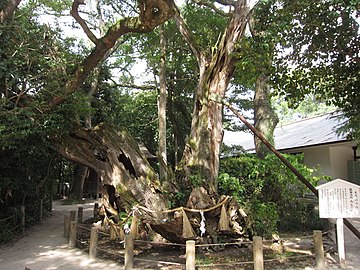
- kusunoki ( camphor tree ) Oyamazumi-jinja 3000 years old

Oyamazumi Jinja Maritime Museum


Notes
- ↑ On foreign museums: [Collection of articles ] / [Comp. and ed. A. S. Korolev and P. I. Galkin]. - M. , 1965. - S. 77. - 169 p. - (Proceedings of the Research Institute of Museology / M-in Culture of the RSFSR; Issue 15).
- ↑ Shustrova, I. Yu. History of World Museums: Textbook / Ministry of Education of the Russian Federation. Yaroslavl State University P. G. Demidova. - Yaroslavl: Yaroslavl State University, 2002. - S. 135. - 174 p. - ISBN 5-8397-0235-8 .
- ↑ 1 2 Turnbull, Stephen. Samurai Women 1184-1877 . - Oxford: Osprey Publishing, 2012 .-- P. 38. - ISBN 978-1780963334 .
- ↑ 1 2 3 4 5 Chordas, Peter. Oyamazumi-jinja Shrine - Japan's Most Extensive Samurai Treasury . The Inland Sea, Setouchi Tourism Authority (2019). Date of treatment July 8, 2019.
- ↑ Haubner, Johannes. Die Macht des Bogens: Japanische Bogenschützen im Spiegel alter Holzschnitte . - Verlag Angelika Hörnig, 2014 .-- S. 130. - ISBN 978-3938921340 .
- ↑ 1 2 Chin, Sarah. Badass Women of History: Tsuruhime Ohori . Tufts Observer (November 3, 2015). Date of treatment July 8, 2019.
- ↑ 大 山 祇 神社 海事 博物館 (葉 山 記念 館) (Japanese) . 今 治 市 役 所. Date of treatment July 9, 2019.
- ↑ Hideo Mohri. His Majesty Emperor Showa (Hirohito) (1901–1989) —The First of Three Generations of Imperial Biologists // Imperial Biologists: The Imperial Family of Japan and Their Contributions to Biological Research. - Springer Nature Singapore Pte Ltd., 2019 .-- P. 1-75. - ISBN 978-981-13-6756-4 .