The 6-inch howitzer of 1915 (the English BL 6-inch 26 cwt howitzer ) is a 152.4-mm British-made artillery gun of the times of the First and Second World Wars.
| 1915 6-inch howitzer | |
|---|---|
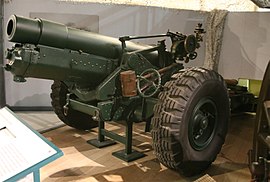 6-inch howitzer of the 1915 model at the Royal Artillery Museum. | |
| Type of | howitzer |
| A country |  Great Britain Great Britain |
| Service history | |
| Years of operation | 1915-1945 |
| Adopted | |
| In service | Great Britain, Canada , South Africa , Australia , New Zealand , Italy , Netherlands , Greece , Russia , Portugal , Estonia |
| Wars and conflicts | World War I The Second World War |
| Production history | |
| Constructor | Vickers |
| Designed by | 1915 |
| Manufacturer | Vickers, Beardmore, Coventry Ordnance Works, Woolwich Ordnance Factory, Midvale Steel Company |
| Total released | 3633 |
| Specifications | |
| Weight, kg | 3693 (barrel - 1295) |
| Length mm | 658 |
| Barrel length, mm | 221 |
| Width mm | 208 |
| Crew (calculation), people | ten |
| Caliber , mm | 152.4 (6 inches) |
| Gate | Uelin piston lock |
| Underride | hydropneumatic |
| Carriage | wheel with sliding beds |
| Elevation angle | 0 ° - 45 ° |
| Angle of rotation | 4 ° left and right |
| starting speed projectile, m / s | 430 m / s |
| Maximum range, m | 8700 (projectile weighing 45.4 kg) 10400 (with a shell weighing 39 kg) [1] |
Description
The 6-inch howitzer was designed to replace the obsolete 6-inch howitzers of the 1896 model ( BL 6-inch 30 cwt howitzer ), which were inferior to German howitzers, such as the 150-mm field howitzer of the 1913 model . Design began in January 1915, the first test batch was released on July 30, 1915, and it entered service at the end of 1915. [2] The combination of firepower, range and mobility (today) made the 6-inch howitzer one of the most important weapons of the British Empire in World War I.
Initially, a 6-inch howitzer was towed by horses , but since 1916 a 3-ton FWD all-wheel drive truck has become a tractor. Wooden wheels with spokes were equipped with “belts” for working in mud or sand to prevent them from getting stuck in moving soil. Towards the end of the war, solid rubber tires were mounted on top of iron tires on the wheel rims, giving the rims a more massive look. On the Western Front, 22.4 million rounds of 6-inch howitzers were fired. [3]
In the interwar period , wooden wheels with knitting needles were replaced with modern steel wheels and pneumatic tires. During World War II, the use of the 6-inch howitzer was limited after 1942 when the 5.5-inch gun came into use. However, it was reintroduced in Burma due to a series of premature detonations in 5.5-inch (140 mm) guns. With the end of the war in 1945, the howitzer was declared obsolete and withdrawn from service.
Captured howitzers captured by the Germans were designated FH-412 (e) .
Ammunition
In World War I, shells weighing 45.4 kg (100 pounds ) were used. After the war, long-range shells weighing 39 kg were fired. [3]
Cordite charge to the howitzer.
45.4 kg Mark XIIA shell
45.4 kg chemical shell Mark VIII
45.4 kg high-explosive fragmentation shell Mark XVI
Gallery
Firing a howitzer battery in PMV Using wheel covers to improve mud patency, Battle of the Somme in September 1916 Near the village of Boesinghe, Battle of Langemarck , August 1917 British battery fires during the Libyan operation , January 23, 1941 The howitzer at the memorial dedicated to the 71st (Transvaal) Siege Battery ( Johnsesburg, 71st (Transvaal) Siege Battery ).
Notes
- ↑ Clarke page 37 quotes 9,500 and 11,400 yd (10 m ); General Farndale page 129-130 quotes 9,500 and 11,400 yd (10,400 m); General Farndale page 129-130 quotes a range of 9,800 yd (9,000 m) for the WWI 2 crh shell, with a range of 12,500 yd (11,400 m) for the later 5/10 crh shell. The longer ranges were obtained with the 86 lb (39 kg) Mk 2D 5/10 crh shell with an augmenting ("Super") charge.
- ↑ Hogg & Thurston 1972, Page 126-127
- ↑ 1 2 Clarke 2005, page 37
Literature
- Dale Clarke, British Artillery 1914-1919. Heavy Artillery. Osprey Publishing, Oxford UK, 2005 ISBN 978-1-84176-788-8
- General Sir Martin Farndale , History of the Royal Regiment of Artillery. Western Front 1914-18. London: Royal Artillery Institution, 1986. ISBN 978-1-870114-00-4
- IV Hogg & LF Thurston, British Artillery Weapons & Ammunition 1914-1918. London: Ian Allan, 1972. ISBN 978-0-7110-0381-1
Links
- Handbook of the BL 6-inch 26-cwt. Mark I howitzer on Mark I traveling carriage, (land service), 1919. Hosted online by State Library of Victoria, Australia
- Gun drill for 6-inch BL 26-cwt howitzer Mark I carriage Mark I 1920 Hosted online by State Library of Victoria, Australia
- Gun drill for BL 6-inch 26 cwt howitzer Mark 1 carriage Mark 1 1926 Hosted online by State Library of Victoria, Australia
- War Office. Chapperton Down Artillery School [film ] . IWM Film . Imperial War Museum (1916). Date of treatment February 11, 2019.
- Video clips on YouTube
- Nigel F Evans, British Artillery in World War 2.6-Inch Howitzer
- WL Ruffell, BL 6-in 26-cwt howitzer
- 6 inch 26 cwt Howitzer at Landships
- Walk around BL 6-inch 26-cwt howitzer WWI exposed to the Sacrario Militare di Redipuglia / Italy