Plabennec ( French Plabennec ) - a commune in the north-west of France , located in the Brittany region, the department of Finister , Brest district, the center of the eponymous canton . Located 20 km north of Brest , 9 km from the national highway N12.
| Commune | |||
| Plabenneck | |||
|---|---|---|---|
| Plabennec | |||
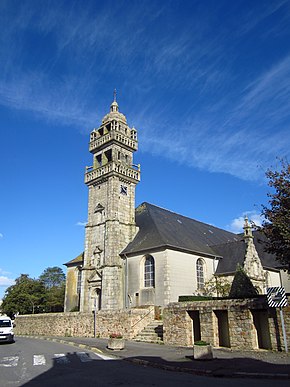 Church of Saint Tenenan | |||
| |||
| A country |  France France | ||
| Region | Brittany | ||
| The Department | Finister | ||
| Canton | Plabenneck | ||
| The mayor | Marie Annik Kreashkadek ( R ) 2014-2020 | ||
| History and Geography | |||
| Square | 50.43 km² | ||
| Center height | 28-102 m | ||
| Timezone | UTC + 1 , in summer UTC + 2 | ||
| Population | |||
| Population | 8 355 people ( 2016 ) | ||
| Density | 166 people / km² | ||
| Digital identifiers | |||
| Postcode | 29860 | ||
| INSEE Code | 29160 | ||
| ville-plabennec.fr (fr.) | |||

Population ( 2016 ) - 8 355 people.
Content
History
Excavations made on the territory of the Plabennek commune showed that people settled in these places from the Iron Age . Mengir Pra-Ledan, discovered in 1835, also dates back to prehistoric times. In the Gallo-Roman period, two Roman roads intersected on the territory of present-day Plabennek. Here were discovered coins of the Roman emperors Postumus and Constantine II , bronze busts of the emperor Gallienus and his wife, fragments of ceramics of the Roman period.
The foundation of modern Plabennek is associated with Saint Tenenan , who arrived in Brittany in the 7th century and built a church in this place. He advised the residents to build a small round tower near their church in order to hide silver and treasures there and protect them from the hands of the barbarians if they wanted to rob this church. Indeed, when the Vikings came to plunder the Plabenneck, they seized the church and besieged the newly built tower, trying to set it on fire, but "the prayers of St. Tenenan were successful," and the Danes retreated. Plabennek belonged to the possessions of the Viscounts of Leon, who built the castle of Lekelen here, from which only the motte was preserved.
Land in the area is particularly suitable for growing crops. Since the 19th century, flax, hemp and wheat have been grown in Plabenneck, then, with the development of agriculture, the land began to be used for growing potatoes.
Attractions
- The parish church of St. Tenenan of the 18th century in the style of classicism , built on the site of the first church of the 7th century
- Church of Lokmaria of the XVI century, restored in 1841 after partial destruction
- Chateau de Loyan of the 80s of the XIX century in the Neo - Gothic style
- Manor Res
Economics
Employment structure:
- agriculture - 9.9%
- industry - 11.1%
- construction - 14.8%
- trade, transport and services - 33.7%
- state and municipal services - 30.5%
The unemployment rate (2015) is 9.5% (France as a whole - 13.5%, the Finister department - 12.7%).
The average annual income per person, euro (2015) - 20,996 (France in general - 20,150, Finister department - 20,481).
Demographics
Population dynamics, people
Administration
Since 2014, Mayor of Plabenneck has been a member of the Republican Party , Marie-Annick Creac'hcadec. In the 2014 municipal elections, her right-wing list won in the 1st round, gaining 52.36% of the vote.
| Period | Surname | The consignment | Notes | |
|---|---|---|---|---|
| 1965 | 1995 | Jean-Francois Goadef | Union in support of the Republic Union for the Popular Movement | deputy of the National Assembly |
| 1995 | 2008 | Louis Cos | Union for the Popular Movement | |
| 2008 | 2014 | Jean-Luc Blenhan | Different left Socialist party | deputy of the National Assembly |
| 2014 | Marie-Annik Kreashkadek | Republicans | ||
Twin Cities
- Waltenhofen , Germany